Questões de Concurso
Comentadas sobre aspectos linguísticos | linguistic aspects em inglês
Foram encontradas 843 questões


The Teacher
Amelia Jane
Remember when we met?
When I was just a kid.
And you said to me,
'It's okay, we're all friends here.'
And treated me like a normal kid?
Well even if you don't,
Thank you, as you now mean the world to me.
Remember when I first cried in front of you?
When times were tough for me.
And you said to me,
'It's okay, I'm here.'
And it all seemed a little better?
Well even if it's slipped your mind,
It made me who I am today.
Remember when you fell apart?
You couldn't cope without your Dad.
And I said to you,
'It's okay, I'm here for you.'
And you put back up your mask?
Because it had slipped that day and I saw,
The real you, scared and hiding.
Remember when I left you?
To move on to my next stage.
And you said to me,
'I'll always be here for you.'
And we hugged and talked for hours?
You wanted me to chase my dreams,
And helped me through my fear.
Remember when I became you?
And you took to the sidelines.
And I said to you,
'I'm here to carry on.'
And you watched like a proud parent,
As I took my first steps?
Now it's me remembering you,
As you lie in the ground.
I'll always remember your calming voice,
And be grateful for what I found.
Available at:
<https://www.familyfriendpoems.com/poem/inspir
ational-thank-you-poem-to-teacher-the-teacher>.
I- It was a dangerous weekend in the water along Auckland's west coast at the weekend; II- Demolition is expected in March; III- A memorial service is to be conducted at eleven o'clock in the morning on Thursday.
Choose the option in which all the underlined prepositions are used correctly.
I- The release of the O-level examination results are something most people in Singapore are familiar with; II- There is a commitment in the Maritimes to adjust minimum wages once a year; III- However, a new study has shown that making up for lost sleep at the weekend might not be such a bad idea.
Choose the option in which the underlined item is correct.
“This group of women _________ its emissaries around the country with a large supply of plastic specula for sale.”
Choose the best option that completes the context above.
Read the fragment below.
“Macron and Theresa May were having a summit, they were discussing how bleak the future was for Britain's financial sector unless we paid into the EU's budget and abided by their rules, and the coverage has skipped over all that to talk about some whizzy idea that has more holes in it than a Hollyoaks.”
In the context above, the underlined phrasal verb can be understood as:
Para responder à questão, considere o texto abaixo.
Bill Introduction Limits. State legislators are faced with two conflicting pressures. On the one hand, lawmakers are asked to sponsor
a great deal of legislation because constituents and interest groups insist “there ought to be a law” for every public problem.  ,
legal provisions specify the length of time that most legislative bodies may remain in session. The ability to consider a
steadily increasing volume of bills is not necessarily compatible with restricted session time. In response, many chambers have
experimented with ways to curb the amount of legislation that enters the process. The most direct approach is to set a numerical limit
on bill introductions.
,
legal provisions specify the length of time that most legislative bodies may remain in session. The ability to consider a
steadily increasing volume of bills is not necessarily compatible with restricted session time. In response, many chambers have
experimented with ways to curb the amount of legislation that enters the process. The most direct approach is to set a numerical limit
on bill introductions.
“When Louise had gone to her own room, I washed, changed into a white frock with a wide blue belt, and did my face and hair very slowly.”
In the sentence above, we can find many modifiers. Mark the alternative that does NOT represent a modifier in this context.
Text for the item.
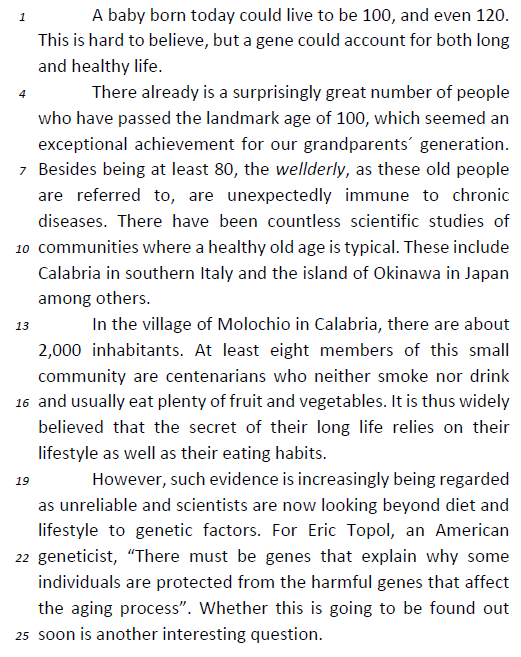
A long and healthy life?
Internet: <www.ngllife.com> (adapted).
Based on the text, judge the following item.
80 years is not a correct alternative for “80” in “at least
80” (line 7).
Text for the question.
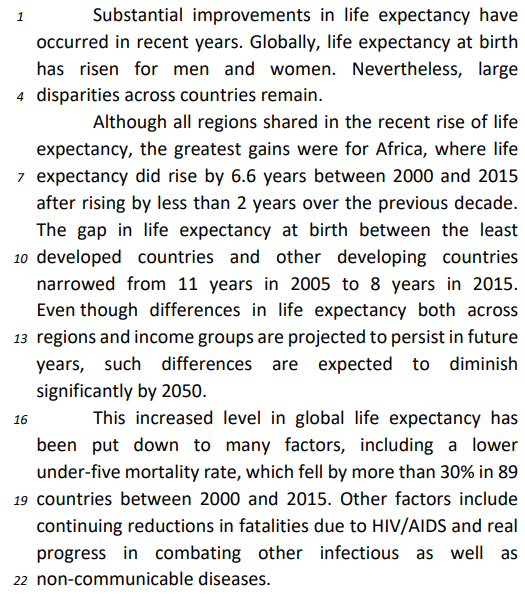
Higher life expectancy worldwide
Text for the question.
Higher life expectancy worldwide
Text for the question.
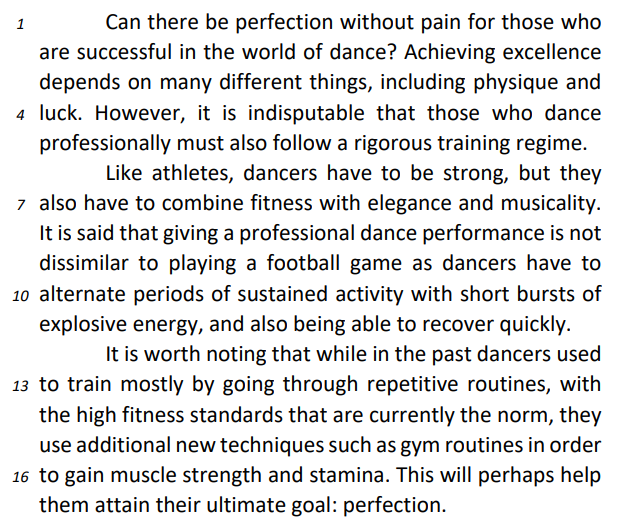
The route to perfection
Text for the question.
The route to perfection
Texto 04
Gottman, John. The Relationship Cure. New York: Three Rivers Press.
Strengthening Relationships at Work
There is a number of things managers can do to strengthen relationships with workers. Strengthening connections with workers can lead to a win-win situation, in that workers may feel respected and valued, and can become much more engaged and productive in their work. And, managers may find that it is much easier to deal with a worker’s negative emotions or psychological health struggles when the foundation of their relationship with the worker is strong.
We can effectively build connections with workers by verbally or nonverbally seeking contact with them (i.e., making what psychologist Dr. John Gottman calls “connection bids”). A connection bid is an attempt to create connections between two people, and is essential for building, maintaining and improving relationships. A connection bid can be anything that we do to seek contact with another person:
- Asking for information: e.g., asking a worker how to solve a work problem. “Would you mind helping me with interpreting this spreadsheet? I’m struggling to get my head around the numbers.”
- Showing interest: e.g., asking workers about their hobbies or recent holidays. “Have you been doing any hiking lately?”
- Expressing affirmation and approval: e.g., complimenting a worker on his latest accomplishment. “Your presentation yesterday was excellent!”
- Expressing caring or support: e.g., demonstrating concern about a worker’s health condition. “Your cough sounds awful. You should think about going home to recover.”
- Offering assistance: e.g., offering support to a worker who is overloaded with tasks. “Would you like me to ask Jocelyn to help you with that project?”
- Making a humorous comment: e.g., lighthearted joking with a worker about a mistake you made. “Sometimes the hurrier I go, the behinder I get!”
- Sending non-verbal signals: e.g., a smile, a wink, a wave, a pat on the back or a thumbs up.
[…]
The way we respond to workers has a sizable impact on the nature of the relationships that result. If we repeatedly turn against or turn away from workers, they may eventually stop reaching out. On the contrary, if we turn toward a person as often as we can, the relationship can be strengthened and become more positive and supportive.
(Disponível em: www.workplacestrategiesformentalhealth.com/mmhm)
Texto 04
Gottman, John. The Relationship Cure. New York: Three Rivers Press.
Strengthening Relationships at Work
There is a number of things managers can do to strengthen relationships with workers. Strengthening connections with workers can lead to a win-win situation, in that workers may feel respected and valued, and can become much more engaged and productive in their work. And, managers may find that it is much easier to deal with a worker’s negative emotions or psychological health struggles when the foundation of their relationship with the worker is strong.
We can effectively build connections with workers by verbally or nonverbally seeking contact with them (i.e., making what psychologist Dr. John Gottman calls “connection bids”). A connection bid is an attempt to create connections between two people, and is essential for building, maintaining and improving relationships. A connection bid can be anything that we do to seek contact with another person:
- Asking for information: e.g., asking a worker how to solve a work problem. “Would you mind helping me with interpreting this spreadsheet? I’m struggling to get my head around the numbers.”
- Showing interest: e.g., asking workers about their hobbies or recent holidays. “Have you been doing any hiking lately?”
- Expressing affirmation and approval: e.g., complimenting a worker on his latest accomplishment. “Your presentation yesterday was excellent!”
- Expressing caring or support: e.g., demonstrating concern about a worker’s health condition. “Your cough sounds awful. You should think about going home to recover.”
- Offering assistance: e.g., offering support to a worker who is overloaded with tasks. “Would you like me to ask Jocelyn to help you with that project?”
- Making a humorous comment: e.g., lighthearted joking with a worker about a mistake you made. “Sometimes the hurrier I go, the behinder I get!”
- Sending non-verbal signals: e.g., a smile, a wink, a wave, a pat on the back or a thumbs up.
[…]
The way we respond to workers has a sizable impact on the nature of the relationships that result. If we repeatedly turn against or turn away from workers, they may eventually stop reaching out. On the contrary, if we turn toward a person as often as we can, the relationship can be strengthened and become more positive and supportive.
(Disponível em: www.workplacestrategiesformentalhealth.com/mmhm)

 Conheça nossos planos