Questões de Concurso
Sobre advérbios e conjunções | adverbs and conjunctions em inglês
Foram encontradas 791 questões


How many adjectives and adverbs are there in the sentence below?
“The cat gracefully leaped onto the tall fence.”
A lawyer used ChatGPT to prepare a court filing. It went horribly awry.
A lawyer who relied on ChatGPT to prepare a court filing on behalf of a man suing an airline is now all too familiar with the artificial intelligence (AI) tool’s shortcomings — including its propensity to invent facts.
Roberto Mata sued Colombian airline Avianca last year, alleging that a metal food and beverage cart injured his knee on a flight to Kennedy International Airport in New York. When Avianca asked a Manhattan judge to dismiss the lawsuit based on the statute of limitations, his lawyer submitted a brief based on research done by ChatGPT.
While ChatGPT can be useful to professionals in numerous industries, including the legal profession, it has proved itself to be both limited and unreliable. In this case, the AI invented court cases that didn’t exist, and asserted that they were real. The fabrications were revealed when Avianca’s lawyers approached the case’s judge, saying they couldn’t locate the cases cited in Mata’s lawyers’ brief in legal databases.
“It seemed clear when we didn’t recognize any of the cases in their opposition brief that something was amiss,” said the airline’s lawyer. And soon they figured it was some sort of chatbot of some kind. On the other hand, the passenger’s lawyer said that it was the first time he’d used ChatGPT for work and, therefore, he was unaware of the possibility that its content could be false.
Internet: <www.cbsnews.com> (adapted).
Based on the preceding text, judge the item that follow.
The sentence “And soon they figured it was some sort of chatbot” can be correctly rephrased as And, before long, they realized
it was some form of chatbot.
O texto IV refere-se à questão.
TEXTO IV
From Rockets to Ball Bearings, Pentagon Struggles to Feed War Machine: The flow of arms to Ukraine has exposed a worrisome lack of production capacity in the United States that has its roots in the end of the Cold War. By Eric Lipton
March 24, 2023,
Disponível em: www.nytimes.com
WASHINGTON — The Navy admiral had a blunt message for the military contractors building precision-guided missiles for his warships, submarines and planes at a moment when the United States is dispatching arms to Ukraine and preparing for the possibility of conflict with China.
“Look at me. I am not forgiving the fact you’re not delivering the ordnance we need. OK?” Adm. Daryl Caudle, who is in charge of delivering weapons to most of the Navy’s East Coast-based fleet, warned contractors during an industry gathering in January. “We’re talking about warfighting, national security, and going against a competitor here and a potential adversary that is like nothing we’ve ever seen. And we can’t dillydally around with these deliveries.”
His open frustration reflects a problem that has become worryingly apparent as the Pentagon dispatches its own stocks of weapons to help Ukraine hold off Russia and Washington warily watches for signs that China might provoke a new conflict by invading Taiwan: The United States lacks the capacity to produce the arms that the nation and its allies need at a time of heightened superpower tensions.
Industry consolidation, depleted manufacturing lines and supply chain issues have combined to constrain the production of basic ammunition like artillery shells while also prompting concern about building adequate reserves of more sophisticated weapons including missiles, air defense systems and counter-artillery radar.
The Pentagon, the White House, Congress and military contractors are all taking steps to address the issues.
Procurement budgets are growing. The military is offering suppliers multiyear contracts to encourage companies to invest more in their manufacturing capacity and is dispatching teams to help solve supply bottlenecks. More generally, the Pentagon is abandoning some of the costcutting changes embraced after the end of the Cold War, including corporate-style just-in-time delivery systems and a drive to shrink the industry.
Dutch government bans phones in schools The Dutch government has announced a ban ______01 mobile phones, tablets, and smartwatches in classrooms starting ______02 January 1, 2024.
The aim is to reduce distractions ______03 lessons and promote better concentration and studying opportunities for students. ______04, devices
_______________05 if they are specifically required for digital skills lessons, for medical reasons, or students with disabilities.
Education Minister Robbert Dijkgraaf ______06 that ______07 mobile phones are a significant part of ______08 lives, they are not suitable for the classroom, and scientific research ______09 this view.
The ban is the result of an agreement between the ministry, schools, and related organizations. Schools have the flexibility to implement the ban in their way, but if the desired outcomes ______10 achieved by the summer of 2024, legal rules ______11 enforced.
Source: https://www.newsinlevels.com/products/dutch government-bans-phones-in-schools-level-3/.
O texto seguinte servirá de base para responder à questão.
New generation of Indigenous activists battle to save the Amazon
Campaigners in Brazil use drones to document work of self-defence teams trying to stop environmental destruction caused by illegal mining
Batista, who belongs to South America's Macuxi people, is part of a new generation of Indigenous journalists helping chronicle an age-old battle against outside aggression. For centuries, non-Indigenous writers and reporters have flocked to the rainforest region to tell their version of that ancestral fight for survival. Now, a growing cohort of Indigenous communicators are telling their own stories, providing first-hand dispatches from some of the Amazon's most inaccessible and under-reported corners.
"It's dangerous work and we suffer a lot when we're out in the field," said Batista, one of about 26,000 inhabitants of Raposa Serra do Sol, Brazil's second most populous Indigenous territory. "But it really gives me strength because I'm showing the reality of our lives to the world."
"It's my job to monitor the territory: to see who's coming in and who is leaving, to find areas being invaded, and to defend the territory because we cannot live without it," said Batista, who was trained by a local Indigenous association, the Conselho Indígena de Roraima, as part of an initiative called Rede Wakywai, which means "our news" in the local Wapichana language.
The Guardian
"Despite his fear of heights, he decided to climb the mountain _____ the breathtaking view from the top.":
TEXT I -
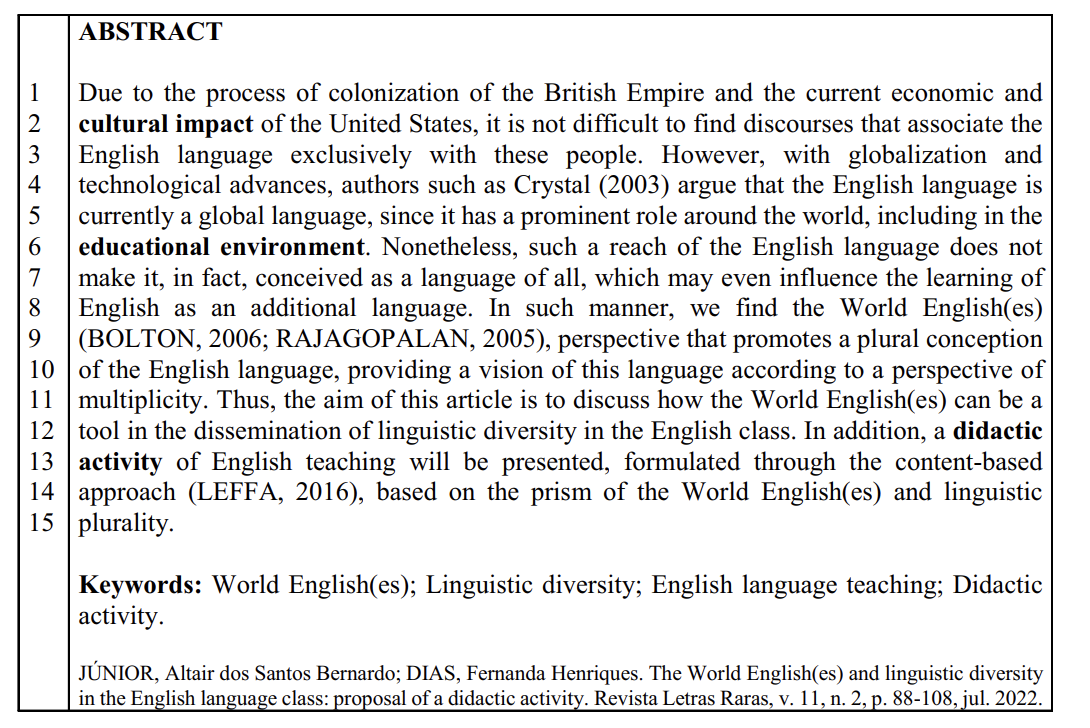
The World English(es) and linguistic diversity in the English language class:
proposal of a didactic activity
Available from: <http://revistas.ufcg.edu.br/ch/index.php/RLR/article/viewFile/2425/1866>. Accessed on: Nov 10 , 2022 th
(__) - The words just, already, always, for, since, yet, still can replace ‘never’, depending the kind of sentence;
(__) - Changing the underlined words into a question, it’s enough put the auxiliary verb before the subject;
(__) - The negative sentences also accepts ‘yet’ and ‘still’;
(__) - ‘for’ and ‘since’ indicates how long the action has been taking.
An archaeologist talks trash
Author, UChicago Asst. Prof. Sarah Newman reframes history of waste in her new book
(1º§) Seeing constant images of floating trash islands and overwhelmed landfills can make it seem as though garbage has been a problem piling up for all of human existence.
(2º§) Book cover for Unmaking Waste by Sarah Newman. Cover has a blue background with grey and white images of trash items. However, UChicago Asst. Prof. Sarah Newman wants to dispose of this simplified version of history. In "Unmaking Waste: New Histories of Old Things," she argues that "waste is neither universal nor self-evident." The anthropological archaeologist claims that waste—what we deem "unwanted"—is a relatively recent idea.
(3º§) According to Newman, Western assumptions about waste begin with an imagined long, dirty stretch of "ancient past" broken up by a few expectations like a gleaming Rome (which Newman says is nastier than we think). In traditional histories of trash, this is followed by a filthy, unwashed Middle Ages leading into a dawning awareness of hygiene, public health and sanitation.
(4º§) Newman moves away from this sanitized narrative and heads to ancient Mesoamerica where the story of waste is far from linear. Using examples and archeological evidence from before and during colonization, Newman shows that people have thought about—and used—"trash" in many different ways.
(5º§) Q: What drew you to study the history of waste?
(6º§) I got interested in the history of waste during graduate school, while I was working at an ancient Maya city called El Zotz, in northern Guatemala. Over a couple of field seasons, archaeologists from our team uncovered unusual, very dense deposits of artifacts in the palace at the city's center.
(7º§) Basically, they were things that seemed to be ancient trash because they were burnt, broken and scattered, but they were also things that didn't seem to be ancient trash because some of the materials were rare or valuable.
(8º§) This made me wonder not only how exactly other archaeologists and I were classifying ancient artifacts as trash or not-trash, but also whether people in the past even had something like the category of "waste" that we have today.
(9º§) Q: In what ways has "trash" defined archaeology and in what ways has our understanding of waste been defined by archaeologists?
(10º§) Archaeology has sometimes been called "the science of rubbish." Although meant to be something of a joke, this also reflects an assumption that archaeologists usually deal with things that people have left behind because they are unwanted or useless. That may be true in some cases, but people also leave things behind that are valuable or serve a specific purpose (such as a burial or an offering).
(11º§) Archaeologists are the ones who decide whether or not what we find is or is not trash, but we don't do that in a vacuum—we can't help but be influenced by the ways the societies that we come from decide what is or is not trash.
(12º§) For example, in the mid-20th century, when the U.S. was celebrating postwar production and consumerism, archaeologists tended to view ancient trash the same way most people viewed modern trash: as evidence of technological progress. With the rise of environmentalism, however, people (including archaeologists) were suddenly more conscious of the trash they themselves were making and we started to view ancient trash and ways of discarding it as reflections of broader social structures.
(13º§) I also think archaeology has had a role (even if an unintentional one) in making trash appear to be an inevitable, even natural fact of life—imagining that our ancestors have been making waste for many thousands of years gives us a convenient excuse for all the trash we make today.
(14º§) Q: You talk about how trash has some mirror-like qualities. What can our trash tell us about ourselves?
(15º§) If you were to imagine someone you know going through the contents of your trash can right now, it would probably make you uncomfortable. Think about all the things someone would learn about you—what you've eaten recently, what newspapers or magazines you've read, what kinds of health or beauty products you use, maybe even some financial details, just to name a few.
(16º§) When I'm teaching about trash, I often use an incredible series of photos by Gregg Segal called "7 Days of Garbage" to illustrate this point. Sometimes I remove the individuals in the portraits and ask my students to describe the missing people just from their trash. It's surprising how much the students can tell about the people—the products and packaging reveal details about family composition, socioeconomic status, ethnicity, gender roles, tastes and hobbies, etc.
(17º§) Q: What are some interesting ways that people have thought about or managed waste in the past?
(18º§) One of the things I write about in the book is the way that the Aztec capital of Tenochtitlán (now Mexico City) had a sophisticated system of waste management in place in the early sixteenth century—a time when many European cities were plagued by garbage-lined streets, clogged gutters, and the indiscriminate dumping of bodily wastes and animal remains.
(19º§) Spaniards described the size and structures of Tenochtitlán with wonder, but they also marveled at the order and cleanliness throughout the city. Several accounts note that an army of laborers were constantly at work sweeping and whitewashing the streets, temples, stairways, courtyards, and houses.
(20º§) One conquistador even describes a system of public latrines, hidden from sight with reeds or grass, from which excrement was collected and reused as agricultural fertilizer. The same account also mentions that canoes full of human waste were sold at the local marketplace, where it was then used in tanning animal hides. Bodily waste could also sometimes be used as a religious offering, especially in acts of penitence.
(21º§) Q: What are some of the common myths we have about trash?
(22º§) The biggest myth about trash is simply that we talk about throwing things "away." There is not, nor has there ever been, an "away" for things to go. As inhabitants of industrialized cities, we often think of landfills as places set apart for things to decay, deteriorate and vanish, but in reality, landfills tend to offer ideal conditions for preservation.
(23º§) Not only do materials refuse to disappear, but the things we think we discard make their way back to us, into our very bodies. Of all the plastic waste ever created—billions of metric tons—about 9% has been recycled. The rest has been found, often reduced to microplastics, everywhere from the Mariana Trench to the top of Mount Everest and from human breast milk to human blood.
(24º§) The title of my book is really about this myth—there is no unmaking our actual waste, but I think we can unmake the idea that it is an inevitable part of human life.
https://news.uchicago.edu/story/archaeologist-talks-trash
Identify the grammatical class of the word "Unmaking" in the book's title "Unmaking Waste: New Histories of Old Things" by Sarah Newman.
Read the text to answer the question.
With the rising complexity of modern information systems and the resulting ever increasing flow of big data, the benefits of Artificial Intelligence (AI) are now widely recognized. Specifically, Machine Learning (ML) methods are already deployed to solve diverse real-world tasks – especially with the advent of deep learning. Fascinating examples of practical achievements of ML are machine translation, travel and vacation recommendations, object detection and tracking, and even various applications in healthcare. Furthermore, ML is rightly considered to be a technology enabler, as it has shown great potential in the context of telecommunication systems or autonomous driving.
Nevertheless, modern society is increasingly relying on Information Technology (IT) systems – including autonomous ones – which are also actively leveraged by malicious entities. Digital threats are, in fact, continuously evolving, and some researchers believe attackers will have sufficient capabilities to harm or kill humans by 2025. To prevent such incidents and mitigate the plethora of risks that can target current and future IT systems, defensive mechanisms require the capability to quickly adapt to the (i) mutating environments and (ii) dynamic threat landscape. Coping with such a twofold requirement via static and human-defined methods is clearly unfeasible, and deployment of Machine Learning in cybersecurity is inescapable.
(https://dl.acm.org. Adaptad)
The word “Nevertheless”, which connects the two paragraphs, indicates
Read the text to answer the question.
With the rising complexity of modern information systems and the resulting ever increasing flow of big data, the benefits of Artificial Intelligence (AI) are now widely recognized. Specifically, Machine Learning (ML) methods are already deployed to solve diverse real-world tasks – especially with the advent of deep learning. Fascinating examples of practical achievements of ML are machine translation, travel and vacation recommendations, object detection and tracking, and even various applications in healthcare. Furthermore, ML is rightly considered to be a technology enabler, as it has shown great potential in the context of telecommunication systems or autonomous driving.
Nevertheless, modern society is increasingly relying on Information Technology (IT) systems – including autonomous ones – which are also actively leveraged by malicious entities. Digital threats are, in fact, continuously evolving, and some researchers believe attackers will have sufficient capabilities to harm or kill humans by 2025. To prevent such incidents and mitigate the plethora of risks that can target current and future IT systems, defensive mechanisms require the capability to quickly adapt to the (i) mutating environments and (ii) dynamic threat landscape. Coping with such a twofold requirement via static and human-defined methods is clearly unfeasible, and deployment of Machine Learning in cybersecurity is inescapable.
(https://dl.acm.org. Adaptad)
In the excerpt from the first paragraph – Furthermore, ML is rightly considered to be a technology enabler –, the word in bold can be replaced, with no change in meaning, by

 Conheça nossos planos