Questões Discursivas

Foram encontradas 20.330 questões

Resolva questões gratuitamente!

Junte-se a mais de 4 milhões de concurseiros!

Q545340 Português
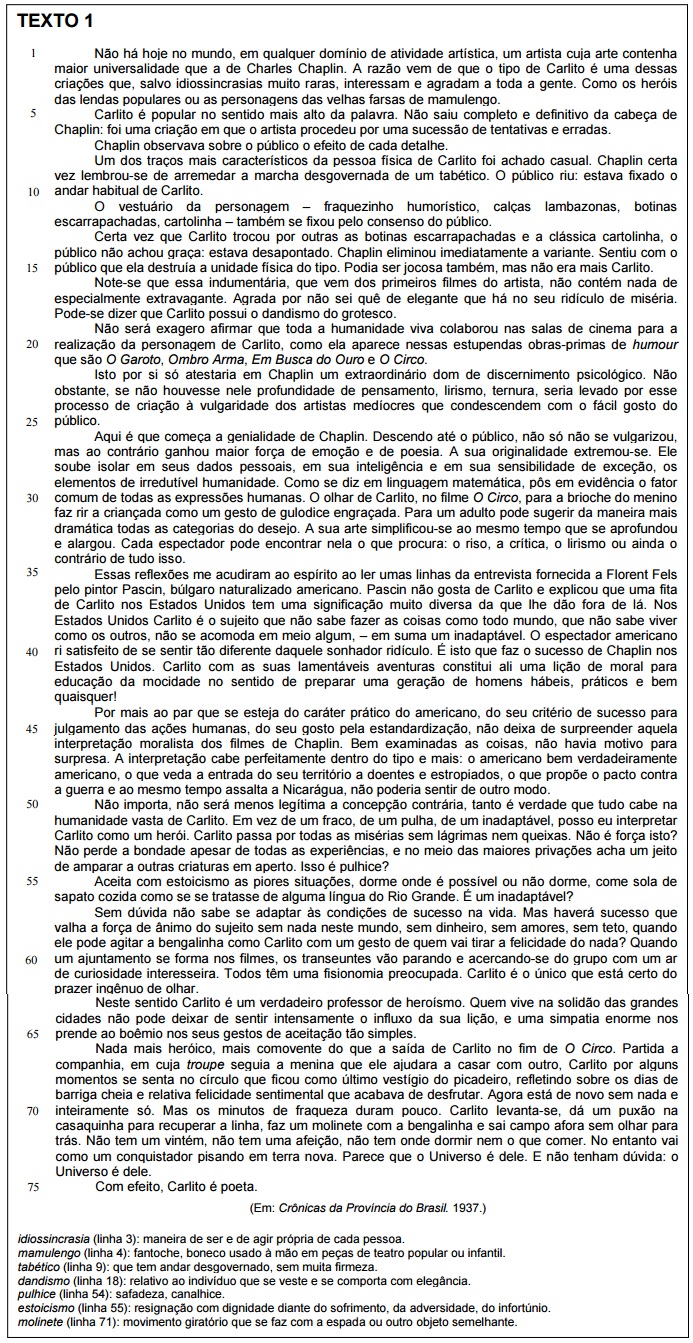
Segundo o texto, herói é aquele que
Alternativas
Q545339 Português
Segundo Bandeira, o comportamento de Carlito é “uma lição de moral para educação da mocidade” (linhas 41 e 42), porque:
Alternativas
Q545338 Português

Considere os enunciados abaixo, atentando para as palavras em negrito.

I. Não há hoje no mundo, em qualquer domínio de atividade artística, um artista cuja arte contenha maior universalidade que a de Charles Chaplin. (linhas 1 e 2)

II. Agrada por não sei quê de elegante que há no seu ridículo de miséria. (linha 17)

III. [...] uma fita de Carlito nos Estados Unidos tem uma significação muito diversa da que lhe dão fora de lá. (linhas 36 e 37)

IV. A interpretação cabe perfeitamente dentro do tipo e mais: o americano bem verdadeiramente americano, o que veda a entrada do seu território a doentes e estropiados, [...] (linhas 47 e 48)


As palavras em negrito têm valor de adjetivo

Alternativas
Q545337 Português
Assinale a opção que retoma a palavra variante no trecho “Chaplin eliminou imediatamente a variante” (linha 14).
Alternativas
Q545336 Português
Sobre Charles Chaplin, o texto nos permite dizer que
Alternativas
Q545335 Português
De acordo com Bandeira,
Alternativas
Q545334 Português
Assinale a opção cujo elemento coesivo em negrito substitui os dois pontos sem alterar o sentido do enunciado.
Alternativas
Q545333 Português

Considere o enunciado “Carlito é popular no sentido mais alto da palavra” (linha 5) e as informações de todo o texto. Na visão de Bandeira, a popularidade pode ser explicada pelo fato de Carlito

I. ser apresentado com indumentária elegante.

II. ser responsável por atrair grande público para os cinemas.

III. retratar o tipo heroico americano, que não quer ser considerado malsucedido.

IV. ter sido ajustado a partir das reações do público.


Está(ão) correta(s):

Alternativas
Q545332 Português
Considerando que o título pode antecipar para o leitor o tema central do texto, assinale a opção que apresenta o título mais adequado.
Alternativas
Q535745 Inglês
FAT IS BEAUTIFUL? 

    Americans are fat, they are getting fatter and as soon as they out eat the South Sea Islanders, they will be the fattest people in the world. This alarming message, from the journalist Greg Critter, has helped promote the provocative bestseller Fat Land. It reveals that six out of every 10 Americans are already overweight and that, if they continue to expand at the current rate, by 2050 all of them will be. So what should they do about it

      There is an obvious and a not-so-obvious answer to this question. Greg Critser provides the conventional solution: they should eat more carefully and do more exercise. He traces the expanding American waistline to Earl Butz, President Nixon’s foul-mouthed Secretary of Agriculture, who drastically brought down food prices in the ‘70s by introducing subsidies for farming. The other great architect of obesity was David Wallerstein, the McDonalds executive who discovered super sizing- offering vast single portions of food so people eat the equivalent of the double helpings that they were too embarrassed to ask for.

     But the issue has another reaction: not “I’m fat, so what can I do about it?” but “I’m fat, so what?” This is the line taken by fat activists and size awareness advocates. They believe that there is nothing wrong with being overweight: negative attitudes towards large people are simply prejudices that need to be fought.

     In part perhaps due to fat liberationists, the USA is changing its views on size. The fashion press, for instance, recently announced that “fat is the new thin.” According to American Vogue the voluptuously curved Kate Winslet, Jennifer Lopez and Kelly Osbourne are much more attractive than the “stick-thin” Hollywood stereotypes. There is also a popular backlash against “self-hating” attitudes of an older generation that was inspired by feminism and sexual liberation to try always be perfect and in control.

     In spite of this, one crucial factor seems destined to keep Americans trying to lose weight. Obesity, as Critser points out, is now - for the first time in the history - the disease of the poor, not the rich. And, in an aspirational society, if the well-off can see their feet, everyone else will want as well. 

Adapted from SPEAKUP n.196, pages 18 to 20. 
The crucial factor that can keep Americans trying to lose weight now is:
Alternativas
Q535744 Inglês
FAT IS BEAUTIFUL? 

    Americans are fat, they are getting fatter and as soon as they out eat the South Sea Islanders, they will be the fattest people in the world. This alarming message, from the journalist Greg Critter, has helped promote the provocative bestseller Fat Land. It reveals that six out of every 10 Americans are already overweight and that, if they continue to expand at the current rate, by 2050 all of them will be. So what should they do about it

      There is an obvious and a not-so-obvious answer to this question. Greg Critser provides the conventional solution: they should eat more carefully and do more exercise. He traces the expanding American waistline to Earl Butz, President Nixon’s foul-mouthed Secretary of Agriculture, who drastically brought down food prices in the ‘70s by introducing subsidies for farming. The other great architect of obesity was David Wallerstein, the McDonalds executive who discovered super sizing- offering vast single portions of food so people eat the equivalent of the double helpings that they were too embarrassed to ask for.

     But the issue has another reaction: not “I’m fat, so what can I do about it?” but “I’m fat, so what?” This is the line taken by fat activists and size awareness advocates. They believe that there is nothing wrong with being overweight: negative attitudes towards large people are simply prejudices that need to be fought.

     In part perhaps due to fat liberationists, the USA is changing its views on size. The fashion press, for instance, recently announced that “fat is the new thin.” According to American Vogue the voluptuously curved Kate Winslet, Jennifer Lopez and Kelly Osbourne are much more attractive than the “stick-thin” Hollywood stereotypes. There is also a popular backlash against “self-hating” attitudes of an older generation that was inspired by feminism and sexual liberation to try always be perfect and in control.

     In spite of this, one crucial factor seems destined to keep Americans trying to lose weight. Obesity, as Critser points out, is now - for the first time in the history - the disease of the poor, not the rich. And, in an aspirational society, if the well-off can see their feet, everyone else will want as well. 

Adapted from SPEAKUP n.196, pages 18 to 20. 
We can say that to Americans who are overweight:
Alternativas
Q535743 Inglês
FAT IS BEAUTIFUL? 

    Americans are fat, they are getting fatter and as soon as they out eat the South Sea Islanders, they will be the fattest people in the world. This alarming message, from the journalist Greg Critter, has helped promote the provocative bestseller Fat Land. It reveals that six out of every 10 Americans are already overweight and that, if they continue to expand at the current rate, by 2050 all of them will be. So what should they do about it

      There is an obvious and a not-so-obvious answer to this question. Greg Critser provides the conventional solution: they should eat more carefully and do more exercise. He traces the expanding American waistline to Earl Butz, President Nixon’s foul-mouthed Secretary of Agriculture, who drastically brought down food prices in the ‘70s by introducing subsidies for farming. The other great architect of obesity was David Wallerstein, the McDonalds executive who discovered super sizing- offering vast single portions of food so people eat the equivalent of the double helpings that they were too embarrassed to ask for.

     But the issue has another reaction: not “I’m fat, so what can I do about it?” but “I’m fat, so what?” This is the line taken by fat activists and size awareness advocates. They believe that there is nothing wrong with being overweight: negative attitudes towards large people are simply prejudices that need to be fought.

     In part perhaps due to fat liberationists, the USA is changing its views on size. The fashion press, for instance, recently announced that “fat is the new thin.” According to American Vogue the voluptuously curved Kate Winslet, Jennifer Lopez and Kelly Osbourne are much more attractive than the “stick-thin” Hollywood stereotypes. There is also a popular backlash against “self-hating” attitudes of an older generation that was inspired by feminism and sexual liberation to try always be perfect and in control.

     In spite of this, one crucial factor seems destined to keep Americans trying to lose weight. Obesity, as Critser points out, is now - for the first time in the history - the disease of the poor, not the rich. And, in an aspirational society, if the well-off can see their feet, everyone else will want as well. 

Adapted from SPEAKUP n.196, pages 18 to 20. 
In the sentence “[…] they were too embarrassed to ask for […]”, to ask for means:
Alternativas
Q535742 Inglês
FAT IS BEAUTIFUL? 

    Americans are fat, they are getting fatter and as soon as they out eat the South Sea Islanders, they will be the fattest people in the world. This alarming message, from the journalist Greg Critter, has helped promote the provocative bestseller Fat Land. It reveals that six out of every 10 Americans are already overweight and that, if they continue to expand at the current rate, by 2050 all of them will be. So what should they do about it

      There is an obvious and a not-so-obvious answer to this question. Greg Critser provides the conventional solution: they should eat more carefully and do more exercise. He traces the expanding American waistline to Earl Butz, President Nixon’s foul-mouthed Secretary of Agriculture, who drastically brought down food prices in the ‘70s by introducing subsidies for farming. The other great architect of obesity was David Wallerstein, the McDonalds executive who discovered super sizing- offering vast single portions of food so people eat the equivalent of the double helpings that they were too embarrassed to ask for.

     But the issue has another reaction: not “I’m fat, so what can I do about it?” but “I’m fat, so what?” This is the line taken by fat activists and size awareness advocates. They believe that there is nothing wrong with being overweight: negative attitudes towards large people are simply prejudices that need to be fought.

     In part perhaps due to fat liberationists, the USA is changing its views on size. The fashion press, for instance, recently announced that “fat is the new thin.” According to American Vogue the voluptuously curved Kate Winslet, Jennifer Lopez and Kelly Osbourne are much more attractive than the “stick-thin” Hollywood stereotypes. There is also a popular backlash against “self-hating” attitudes of an older generation that was inspired by feminism and sexual liberation to try always be perfect and in control.

     In spite of this, one crucial factor seems destined to keep Americans trying to lose weight. Obesity, as Critser points out, is now - for the first time in the history - the disease of the poor, not the rich. And, in an aspirational society, if the well-off can see their feet, everyone else will want as well. 

Adapted from SPEAKUP n.196, pages 18 to 20. 
All the characteristics below prove that U.S.A. is changing its view and size, EXCEPT:
Alternativas
Q535741 Inglês
FAT IS BEAUTIFUL? 

    Americans are fat, they are getting fatter and as soon as they out eat the South Sea Islanders, they will be the fattest people in the world. This alarming message, from the journalist Greg Critter, has helped promote the provocative bestseller Fat Land. It reveals that six out of every 10 Americans are already overweight and that, if they continue to expand at the current rate, by 2050 all of them will be. So what should they do about it

      There is an obvious and a not-so-obvious answer to this question. Greg Critser provides the conventional solution: they should eat more carefully and do more exercise. He traces the expanding American waistline to Earl Butz, President Nixon’s foul-mouthed Secretary of Agriculture, who drastically brought down food prices in the ‘70s by introducing subsidies for farming. The other great architect of obesity was David Wallerstein, the McDonalds executive who discovered super sizing- offering vast single portions of food so people eat the equivalent of the double helpings that they were too embarrassed to ask for.

     But the issue has another reaction: not “I’m fat, so what can I do about it?” but “I’m fat, so what?” This is the line taken by fat activists and size awareness advocates. They believe that there is nothing wrong with being overweight: negative attitudes towards large people are simply prejudices that need to be fought.

     In part perhaps due to fat liberationists, the USA is changing its views on size. The fashion press, for instance, recently announced that “fat is the new thin.” According to American Vogue the voluptuously curved Kate Winslet, Jennifer Lopez and Kelly Osbourne are much more attractive than the “stick-thin” Hollywood stereotypes. There is also a popular backlash against “self-hating” attitudes of an older generation that was inspired by feminism and sexual liberation to try always be perfect and in control.

     In spite of this, one crucial factor seems destined to keep Americans trying to lose weight. Obesity, as Critser points out, is now - for the first time in the history - the disease of the poor, not the rich. And, in an aspirational society, if the well-off can see their feet, everyone else will want as well. 

Adapted from SPEAKUP n.196, pages 18 to 20. 
According to Greg Critser in 2050
Alternativas
Q535705 Literatura

A sequência CORRETA, de cima para baixo, é:

Alternativas
Q535704 Literatura

“Uma das grandes preocupações desses autores era opor-se à burguesia. Criticavam o comportamento abjeto, como o adultério feminino; revelavam também o lado corrupto do clero e a hipocrisia de muitos fieis extremosos, como as beatas. Os escritores, apesar das críticas, mostravam-se impassíveis diante dos fatos narrados, distantes da situação. Apelavam ainda para as impressões sensoriais e, com isso, tornava-se frequente a sexualização do amor.”

O texto acima caracteriza o

Alternativas
Q535703 Literatura
Caracterizam o estilo barroco, EXCETO:
Alternativas
Q535702 Literatura
A relação contexto histórico/estilo de época NÃO está correta em:
Alternativas
Q535701 Literatura
Ilustram corretamente o Modernismo brasileiro, os grandes autores e suas respectivas obras, EXCETO:
Alternativas
Q535700 Português

TELEFONE, UM INIMIGO NECESSÁRIO 

Anna Veronica Mautner

    Na vida nossa de cada dia, muitos tornam o número de telefone acessível, nem sempre com disposição para atender as exigências que disso decorrem. Existe aí uma responsabilidade em relação ao "outro". Se eu dou meu número para alguém, estou anunciando que sou acessível.

    No tempo em que existia lista telefônica, isso poderia ser discutível, pois os números ficavam públicos de certa forma, por lei. Mas, hoje, meu número de celular não está em lista oficial nenhuma, só é acessível se eu der. A partir daí, torno-me responsável por atendê-lo. O processo funciona em mão dupla. Quando ligo para alguém, imagino que vá me atender - senão, por que teria me dado seu número?

    A relação com a telefonia é uma escolha pessoal. Há quem ama falar, há quem é lacônico. Seja como for, tornar-se acessível significa perder graus de liberdade e, ao mesmo tempo, ganhar em acessibilidade. 

    O telefone me torna pública, mas também pode preservar minha privacidade. Para me garantir e me defender, posso usar a secretária eletrônica ou o bina, aliás, inventado e patenteado por um brasileiro. 

    Tudo isso é muito recente. Há cinquenta anos, o telefone era uma raridade reservada para pessoas da classe A. A linha era comprada a preço de ouro. Muitas lojas não tinham mais do que um aparelho - muitas vezes com cadeado; outras, com cadeado só das 13h às 15h, quando ilegalmente recebiam o resultado do jogo do bicho - não disponível para fregueses.

    E, então, um dia, privatizaram a companhia telefônica, e a cidade foi inundada por telefones. Logo depois chegaram os celulares, que invadiram definitivamente nossa vida. 

     Tudo isso transformou as relações interpessoais de maneira avassaladora. Não atender o celular pode ser visto quase como um estelionato. Você está privando o outro do acesso a você - que você prometeu quando deu o número.

    O celular foi uma revolução tão grande quanto a difusão do telefone fixo. Se ligo para o fixo de alguém que não me atende, só sei que a pessoa não está lá. Mas, com o celular, temos que aprender a mentir melhor. Vamos desenvolvendo jeitinhos. Se fulano não me atende, ligo de um número que ele não conhece e descubro se não está lá ou se não quer me atender. Inventamos o bina e depois inventamos jeitinhos para driblá-lo.

     A barreira da invisibilidade ainda não foi vencida. Se é meu amigo ou meu inimigo, não sou capaz de distinguir antes de atender e ouvir a voz. Só depois de atender, o enigma se desfaz. Uma educação para o uso do telefone se faz cada dia mais necessária. 

Folha de São Paulo, 05 fev.2013

VOCABULÁRIO

Lacônico: breve, conciso.

A posição do pronome oblíquo é facultativa em
Alternativas
Respostas
14981: D
14982: E
14983: B
14984: X
14985: A
14986: D
14987: A
14988: C
14989: B
14990: C
14991: C
14992: D
14993: B
14994: A
14995: C
14996: C
14997: B
14998: A
14999: D
15000: C