Questões Militares
Sobre falso cognatos | false cognates em inglês
Foram encontradas 9 questões


Read the text to answer the question.
To begin the dialogue on cultural identity, it is essential to establish a baseline understanding the concept. Culture can be defined by the “totality of that group’s [a community or population] thought, experiences, and patterns of behavior and its concepts, values, and assumptions about life that guide behavior and how those evolve with contact with other cultures.” Cultural identity refers to people who identify themselves with a specific cultural group that has a shared system of symbols and norms for conduct. Recognition of this identity facilitates others’ understanding of the opportunities and challenges faced by individuals within a cultural group. To assist in understanding the basics of cultural identity, symbols and narratives as elements of culture will be examined in this section.
As many of our judgments are based on external observations, it should not be surprising that identities are shaped through use of symbols. According to sociologist Erik Cohen, the use of symbols in defining identity is a universal human trait. Symbols are employed in value systems such as religion, nationalism, social ideologies, and ethnicity. There are times when symbols become so significant to an existing cultural group’s identity that they stand out amongst all other symbols, dominating the narrative of cultural identity of that group. Dominant symbol systems provide “a set of stories, images, landscapes, scenarios, historical events, national symbols, and rituals which represent the shared experiences, sorrows, and triumphs and disasters which give meaning to the nation.” Therefore, understanding how complex symbol systems function and transmit meaning can help with assessing the motivations that underlie a cultural group’s actions. This is key to developing appropriate engagement strategies with cultural groups in urban environments.
Cultural groups use narrativesas a conduit for conveying messages. Narratives can be used as an analytical framework for understanding a wide spectrum of human activities. The stories conveyed through narrative can be viewed as building-blocks of identity in that they enable cultural groups to understand who they are and what they are in relation to others external to their group. In the search to understand cultural identities, knowledge of a cultural group’s narrative is “instructive for understanding how decisions might have come about, the motivations for actions, the causal assumptions drawn, and the arguments put forward, as well as a variety of other actions or variables. ”Therefore, it can be deduced that the future urban environment an Army may find itself operating within will witness a multitude of competing narratives, which may be further exacerbated by competition over limited resources and power.
Source: https://www.armyupress.army.mil/Journals/Military-Review/Online-Exclusive/2015-Online-Exclusive-Articles/Cultural-Identity/ Acess: 03/19/2026.
2024 USHERED IN TWO FIRSTS FOR MILITARY WOMEN. WE’RE ALL CELEBRATING.

PETULA DVORAK Adaptado de washingtonpost.com, 15/01/2024.
Take that, society. (l. 6)
The choice of the underlined expression suggests the following attitude towards society’s expectations:
There are three areas where our behaviour can directly influence our students’ continuing participation: goals and goal setting; learning environment; interesting classes.
(J. Harmer, The practice of English language teaching. 4th ed. Essex: Pearson Longman, 2007. Adaptado)
The task proposed in the last paragraph of the text on ChatGPT illustrates the following motivational behavior on the part of teachers:
Based on the text above, judge the following item.
In the last sentence of the second paragraph, the word
“actual” means present.
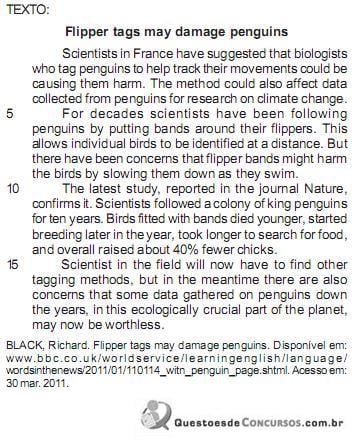
Ainda sobre o texto 1, assinale a alternativa cujas palavras destacadas são, de acordo com o contexto, FALSAS COGNATAS.
I He said, “you realize that there simply is no other option for you out there.” (4º parágrafo).
II. Younger people are less interested in farming, and look for economic opportunities in other, more appealing industries. (7º parágrafo)
III. The trend is extreme in sub-Saharan Africa, where 60 percent of the total population is under the age of 25. And you can find similar figures in other regions. (6º parágrafo)
IV. In his presentation, Mabaya warned against overgeneralizing about the entire African continent. (5º parágrafo)
V. Nevertheless, Mabaya emphasized, there is a lot to be optimistic about. (9º parágrafo)
Estão CORRETAS apenas
The only false cognate is in alternative


 Conheça nossos planos