Questões de Vestibular
Nível médio
Foram encontradas 71.858 questões
Resolva questões gratuitamente!
Junte-se a mais de 4 milhões de concurseiros!


Ano: 2019
Banca:
Cepros
Órgão:
CESMAC
Prova:
Cepros - 2019 - CESMAC - Prova de Medicina-2020.1- 1° DIA |
Q1391690
Geografia
Observe a figura a seguir, na qual estão representados
alguns elementos importantes da dinâmica da
atmosfera terrestre, indicados pelos números 1, 2, 3 e
4.
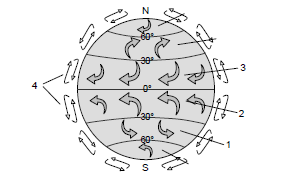
Assinale a alternativa que contém as denominações correspondentes aos números 1, 2, 3 e 4, respectivamente
Assinale a alternativa que contém as denominações correspondentes aos números 1, 2, 3 e 4, respectivamente
Ano: 2019
Banca:
Cepros
Órgão:
CESMAC
Prova:
Cepros - 2019 - CESMAC - Prova de Medicina-2020.1- 1° DIA |
Q1391689
Geografia
A poluição afeta a todos, ricos e pobres, com o efeito
estufa e o buraco na camada de ozônio. Mas a
poluição cotidiana afeta mais duramente os
trabalhadores, que, intoxicados e ensurdecidos nos
seus locais de trabalho, sob o efeito da poluição
térmica das elevadas temperaturas dos altos fornos,
perdem a cada semana parte de sua capacidade
pulmonar por causa dos gases químicos, do pó da
sílica e do asbesto.
(MINC, Carlos. Ecologia e Cidadania. São Paulo, Editora Moderna, 200
Sobre o tema abordado acima, é correto dizer que:
1) o asbesto é um tipo de pó, oriundo da trituração do granito e do gnaisse, muito empregado na construção civil, mas provoca a moléstia asbestose, que consiste numa fibrose hepática, com repercussões nos pulmões daqueles que o aspiram. 2) muitos trabalhadores do setor secundário são expostos a processos intensivos de produção, sobre os quais, muitas vezes, não detêm qualquer controle, e cuja intensidade e duração são determinadas pela maximização dos lucros. 3) com o acúmulo de gases, como o CO2, o óxido nitroso, o metano e o nitrato de prata, maior quantidade de calor é retida na atmosfera, acarretando o aumento da temperatura na baixa troposfera. 4) os efeitos principais da radiação ultravioleta, em face da redução ou destruição do O3 estratosférico, recaem sobre a saúde dos seres humanos, a vida marinha e a vegetação, posto que o ozônio atua como um filtro para essa radiação. 5) numa região intensamente industrializada, a poluição atmosférica aumenta exponencialmente, atingindo a saúde humana, quando sistemas atmosféricos convectivos se instalam sobre ambientes urbanos.
Está(ão) correto(s)
(MINC, Carlos. Ecologia e Cidadania. São Paulo, Editora Moderna, 200
Sobre o tema abordado acima, é correto dizer que:
1) o asbesto é um tipo de pó, oriundo da trituração do granito e do gnaisse, muito empregado na construção civil, mas provoca a moléstia asbestose, que consiste numa fibrose hepática, com repercussões nos pulmões daqueles que o aspiram. 2) muitos trabalhadores do setor secundário são expostos a processos intensivos de produção, sobre os quais, muitas vezes, não detêm qualquer controle, e cuja intensidade e duração são determinadas pela maximização dos lucros. 3) com o acúmulo de gases, como o CO2, o óxido nitroso, o metano e o nitrato de prata, maior quantidade de calor é retida na atmosfera, acarretando o aumento da temperatura na baixa troposfera. 4) os efeitos principais da radiação ultravioleta, em face da redução ou destruição do O3 estratosférico, recaem sobre a saúde dos seres humanos, a vida marinha e a vegetação, posto que o ozônio atua como um filtro para essa radiação. 5) numa região intensamente industrializada, a poluição atmosférica aumenta exponencialmente, atingindo a saúde humana, quando sistemas atmosféricos convectivos se instalam sobre ambientes urbanos.
Está(ão) correto(s)
Ano: 2019
Banca:
Cepros
Órgão:
CESMAC
Prova:
Cepros - 2019 - CESMAC - Prova de Medicina-2020.1- 1° DIA |
Q1391688
História e Geografia de Estados e Municípios
A cultura alagoana perdeu em outubro de 2019 uma
das suas figuras mais emblemáticas, o historiador
Dirceu Accioli Lindoso, que legou a Alagoas uma
extensa obra, de que se destaca 'Utopia armada:
rebeliões de pobres nas matas do Tombo Real', “1832-
1850" (Paz e Terra, 1983). O foco principal desse
estudo volta-se para um movimento social reconhecido
como:
Ano: 2019
Banca:
Cepros
Órgão:
CESMAC
Prova:
Cepros - 2019 - CESMAC - Prova de Medicina-2020.1- 1° DIA |
Q1391687
Conhecimentos Gerais
O romance “Vidas Secas” , 1938, do escritor, jornalista
e político, natural de Alagoas, Graciliano Ramos
(1892-1953), encerra uma severa crítica social,
característica do Movimento Modernista, na sua
segunda fase literária, denominada:
Ano: 2019
Banca:
Cepros
Órgão:
CESMAC
Prova:
Cepros - 2019 - CESMAC - Prova de Medicina-2020.1- 1° DIA |
Q1391686
História
A partir dos anos 1930, a feijoada foi convertida em um
“prato nacional” e, a capoeira, antes reprimida e
criminalizada, passou a ser reconhecida como uma
modalidade esportiva oficial. Essa valorização de
elementos da cultura de matriz africana, contudo,
convergiu com um projeto de poder fortemente
nacionalista e autoritário, que se institucionalizou no
Brasil durante
Ano: 2019
Banca:
Cepros
Órgão:
CESMAC
Prova:
Cepros - 2019 - CESMAC - Prova de Medicina-2020.1- 1° DIA |
Q1391685
História
A quase completa ocupação das terras litorâneas do
Brasil, para o cultivo da cana-de-açúcar, pode ser
considerada como uma das principais motivações para
que a atividade pecuária, no século XVIII, se
expandisse pelas terras mais longínquas dos Sertões.
Dentre os desdobramentos dessa ocupação, é possível salientar:
Dentre os desdobramentos dessa ocupação, é possível salientar:
Ano: 2019
Banca:
Cepros
Órgão:
CESMAC
Prova:
Cepros - 2019 - CESMAC - Prova de Medicina-2020.1- 1° DIA |
Q1391684
Conhecimentos Gerais
Os Tupis designavam Tapuias aos povos indígenas
que não falavam sua língua, ou não compartilhavam
sua cultura, caso dos povos de tronco linguístico
Macro-Jê, também chamados pelos portugueses de
“gente Bárbara”.
Sobre essa percepção dos Tupis acerca dos povos Macro-Jê, pode-se afirmar que:
Sobre essa percepção dos Tupis acerca dos povos Macro-Jê, pode-se afirmar que:
Ano: 2019
Banca:
Cepros
Órgão:
CESMAC
Prova:
Cepros - 2019 - CESMAC - Prova de Medicina-2020.1- 1° DIA |
Q1391683
Conhecimentos Gerais
As políticas econômicas neoliberais aplicadas em
países como Chile, Reino Unido e Estados Unidos,
nas décadas de 1970 e 1980, serviram para a
realização, em 1989, do Consenso de Washington,
que preconizou uma série de medidas a serem
adotadas por países em desenvolvimento, como o
Brasil. Entre as diretrizes, definidas no Consenso é
possível destacar:
Ano: 2019
Banca:
Cepros
Órgão:
CESMAC
Prova:
Cepros - 2019 - CESMAC - Prova de Medicina-2020.1- 1° DIA |
Q1391682
Geografia
Os países industrializados capitalistas, no século XIX,
dominaram territórios e populações na África e na
Ásia, com o objetivo de ampliar os mercados
consumidores e explorar matérias-primas. Este
processo ficou conhecido como Imperialismo. Neste
mesmo período, foi possível verificar o
desenvolvimento de várias áreas da Ciência, uma vez
que
Ano: 2019
Banca:
Cepros
Órgão:
CESMAC
Prova:
Cepros - 2019 - CESMAC - Prova de Medicina-2020.1- 1° DIA |
Q1391681
História
Para a Época Moderna, o conceito de burocracia –
entendido como a estrutura político-administrativa do
Estado – pode ser útil para compreender o
fortalecimento das monarquias europeias. Com a
Dinastia dos Habsburgos, o Estado moderno espanhol
ficou conhecido, entre os historiadores, como “governo
de papel”, e Felipe II, como “rei papeleiro”, pois
Ano: 2019
Banca:
Cepros
Órgão:
CESMAC
Prova:
Cepros - 2019 - CESMAC - Prova de Medicina-2020.1- 1° DIA |
Q1391680
Inglês
Texto associado
Read the text below and answer the following question based on it.
How we learn things shapes our memory
Humans are constantly learning new things. This ability helps us to grow and adapt to new situations daily. But a new study suggests that different learning mechanisms actually shape how the brain stores memories.
As humans, we have not only survived, but thrived throughout time thanks to our ability to learn and adapt to new situations.
Learning itself is a complex process, and there are different types of learning mechanisms through which the brain stores new information and updates old information.
In general terms, there are two ways of learning that humans use to acquire new information in the long term.
One is by association, or through experience. This is when we learn new things incidentally, just because we happened to come across them, or because we are in a new environment that we are learning to navigate little by little.
The other one is learning by reinforcement. This is when we purposefully set out to learn new information — when we take a language course, for example.
A new study conducted by researchers from the Department of Experimental Psychology, the Wellcome Centre for Integrative Neuroimaging, and the Nuffield Department of Clinical Neurosciences — all in Oxford, United Kingdom — indicates that different learning mechanisms have links to memories stored in different parts of the brain.
The researchers add that not only do we store information differently depending on how we acquire it, but that it may be more or less easy for us to lose or change this information for the same reason.
The researchers also explain that the findings indicate that the brain can store information learned through reinforcement for a long time, while other types of information remain more available for updates.
"We also learned that some of this knowledge is very persistent, and the brain does not forget about it even when it becomes irrelevant, while knowledge acquired through an alternative learning mechanism is more flexible and can more easily be changed to new knowledge," notes KleinFlügge.
When it comes to unlearning or forgetting information, the researchers also note that information acquired incidentally through associations is easier to discard than information acquired through goal-oriented learning.
Adaptado de: < https://www.medicalnewstoday.com/articles/326826.php> Acessado em 29 de outubro de 2019.
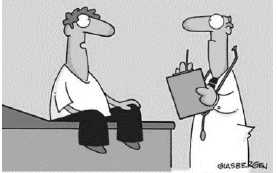
Read the text below and answer the following question
based on it.
Disponivel em: <https://caveviews.blogs.com/cave_news/2010/08/webmdeffect.html>. Acessado em 19 de outubro de 2019.
The patient’s assertion
Disponivel em: <https://caveviews.blogs.com/cave_news/2010/08/webmdeffect.html>. Acessado em 19 de outubro de 2019.
The patient’s assertion
Ano: 2019
Banca:
Cepros
Órgão:
CESMAC
Prova:
Cepros - 2019 - CESMAC - Prova de Medicina-2020.1- 1° DIA |
Q1391679
Inglês
Texto associado
Read the text below and answer the following question based on it.
How we learn things shapes our memory
Humans are constantly learning new things. This ability helps us to grow and adapt to new situations daily. But a new study suggests that different learning mechanisms actually shape how the brain stores memories.
As humans, we have not only survived, but thrived throughout time thanks to our ability to learn and adapt to new situations.
Learning itself is a complex process, and there are different types of learning mechanisms through which the brain stores new information and updates old information.
In general terms, there are two ways of learning that humans use to acquire new information in the long term.
One is by association, or through experience. This is when we learn new things incidentally, just because we happened to come across them, or because we are in a new environment that we are learning to navigate little by little.
The other one is learning by reinforcement. This is when we purposefully set out to learn new information — when we take a language course, for example.
A new study conducted by researchers from the Department of Experimental Psychology, the Wellcome Centre for Integrative Neuroimaging, and the Nuffield Department of Clinical Neurosciences — all in Oxford, United Kingdom — indicates that different learning mechanisms have links to memories stored in different parts of the brain.
The researchers add that not only do we store information differently depending on how we acquire it, but that it may be more or less easy for us to lose or change this information for the same reason.
The researchers also explain that the findings indicate that the brain can store information learned through reinforcement for a long time, while other types of information remain more available for updates.
"We also learned that some of this knowledge is very persistent, and the brain does not forget about it even when it becomes irrelevant, while knowledge acquired through an alternative learning mechanism is more flexible and can more easily be changed to new knowledge," notes KleinFlügge.
When it comes to unlearning or forgetting information, the researchers also note that information acquired incidentally through associations is easier to discard than information acquired through goal-oriented learning.
Adaptado de: < https://www.medicalnewstoday.com/articles/326826.php> Acessado em 29 de outubro de 2019.
When it comes to storing, retrieving and forgetting
information
Ano: 2019
Banca:
Cepros
Órgão:
CESMAC
Prova:
Cepros - 2019 - CESMAC - Prova de Medicina-2020.1- 1° DIA |
Q1391678
Inglês
Texto associado
Read the text below and answer the following question based on it.
How we learn things shapes our memory
Humans are constantly learning new things. This ability helps us to grow and adapt to new situations daily. But a new study suggests that different learning mechanisms actually shape how the brain stores memories.
As humans, we have not only survived, but thrived throughout time thanks to our ability to learn and adapt to new situations.
Learning itself is a complex process, and there are different types of learning mechanisms through which the brain stores new information and updates old information.
In general terms, there are two ways of learning that humans use to acquire new information in the long term.
One is by association, or through experience. This is when we learn new things incidentally, just because we happened to come across them, or because we are in a new environment that we are learning to navigate little by little.
The other one is learning by reinforcement. This is when we purposefully set out to learn new information — when we take a language course, for example.
A new study conducted by researchers from the Department of Experimental Psychology, the Wellcome Centre for Integrative Neuroimaging, and the Nuffield Department of Clinical Neurosciences — all in Oxford, United Kingdom — indicates that different learning mechanisms have links to memories stored in different parts of the brain.
The researchers add that not only do we store information differently depending on how we acquire it, but that it may be more or less easy for us to lose or change this information for the same reason.
The researchers also explain that the findings indicate that the brain can store information learned through reinforcement for a long time, while other types of information remain more available for updates.
"We also learned that some of this knowledge is very persistent, and the brain does not forget about it even when it becomes irrelevant, while knowledge acquired through an alternative learning mechanism is more flexible and can more easily be changed to new knowledge," notes KleinFlügge.
When it comes to unlearning or forgetting information, the researchers also note that information acquired incidentally through associations is easier to discard than information acquired through goal-oriented learning.
Adaptado de: < https://www.medicalnewstoday.com/articles/326826.php> Acessado em 29 de outubro de 2019.
Generally speaking
Ano: 2019
Banca:
Cepros
Órgão:
CESMAC
Prova:
Cepros - 2019 - CESMAC - Prova de Medicina-2020.1- 1° DIA |
Q1391677
Inglês
Texto associado
Read the text below and answer the following question based on it.
How we learn things shapes our memory
Humans are constantly learning new things. This ability helps us to grow and adapt to new situations daily. But a new study suggests that different learning mechanisms actually shape how the brain stores memories.
As humans, we have not only survived, but thrived throughout time thanks to our ability to learn and adapt to new situations.
Learning itself is a complex process, and there are different types of learning mechanisms through which the brain stores new information and updates old information.
In general terms, there are two ways of learning that humans use to acquire new information in the long term.
One is by association, or through experience. This is when we learn new things incidentally, just because we happened to come across them, or because we are in a new environment that we are learning to navigate little by little.
The other one is learning by reinforcement. This is when we purposefully set out to learn new information — when we take a language course, for example.
A new study conducted by researchers from the Department of Experimental Psychology, the Wellcome Centre for Integrative Neuroimaging, and the Nuffield Department of Clinical Neurosciences — all in Oxford, United Kingdom — indicates that different learning mechanisms have links to memories stored in different parts of the brain.
The researchers add that not only do we store information differently depending on how we acquire it, but that it may be more or less easy for us to lose or change this information for the same reason.
The researchers also explain that the findings indicate that the brain can store information learned through reinforcement for a long time, while other types of information remain more available for updates.
"We also learned that some of this knowledge is very persistent, and the brain does not forget about it even when it becomes irrelevant, while knowledge acquired through an alternative learning mechanism is more flexible and can more easily be changed to new knowledge," notes KleinFlügge.
When it comes to unlearning or forgetting information, the researchers also note that information acquired incidentally through associations is easier to discard than information acquired through goal-oriented learning.
Adaptado de: < https://www.medicalnewstoday.com/articles/326826.php> Acessado em 29 de outubro de 2019.
According to the text
Ano: 2019
Banca:
Cepros
Órgão:
CESMAC
Prova:
Cepros - 2019 - CESMAC - Prova de Medicina-2020.1- 1° DIA |
Q1391676
Inglês
Texto associado
In a prospective, randomised, controlled trial to determine
whether comprehensive lifestyle changes affect coronary
atherosclerosis after 1 year, 28 patients were assigned to an
experimental group (low-fat vegetarian diet, stopping
smoking, stress management training, and moderate
exercise) and 20 to a usual-care control group. 195
coronary artery lesions were analysed by quantitative
coronary angiography. The average percentage diameter
stenosis regressed from 40.0 (SD 16.9)% to 37.8 (16.5)% in
the experimental group yet progressed from 42.7 (15.5)% to
46.1 (18.5)% in the control group. When only lesions greater
than 50% stenosed were analysed, the average percentage
diameter stenosis regressed from 61.1 (8.8)% to 55.8
(11.0)% in the experimental group and progressed from
61.7 (9.5)% to 64.4 (16.3)% in the control group. Overall,
82% of experimental-group patients had an average change
towards regression. Comprehensive lifestyle changes may
be able to bring about regression of even severe coronary
atherosclerosis after only 1 year, without use of lipidlowering drugs
Read the text below and answer the following question based on it.
Can lifestyle changes reverse coronary
heart disease? The Lifestyle Heart Trial.
Abstract
Adaptado de:
<https://www.ncbi.nlm.nih.gov/pubmed/1973470> Acessado
em 27 de outubro de 2017.
In “Comprehensive lifestyle changes may be able to
bring about regression…” may expresses:
Ano: 2019
Banca:
Cepros
Órgão:
CESMAC
Prova:
Cepros - 2019 - CESMAC - Prova de Medicina-2020.1- 1° DIA |
Q1391675
Inglês
Texto associado
In a prospective, randomised, controlled trial to determine
whether comprehensive lifestyle changes affect coronary
atherosclerosis after 1 year, 28 patients were assigned to an
experimental group (low-fat vegetarian diet, stopping
smoking, stress management training, and moderate
exercise) and 20 to a usual-care control group. 195
coronary artery lesions were analysed by quantitative
coronary angiography. The average percentage diameter
stenosis regressed from 40.0 (SD 16.9)% to 37.8 (16.5)% in
the experimental group yet progressed from 42.7 (15.5)% to
46.1 (18.5)% in the control group. When only lesions greater
than 50% stenosed were analysed, the average percentage
diameter stenosis regressed from 61.1 (8.8)% to 55.8
(11.0)% in the experimental group and progressed from
61.7 (9.5)% to 64.4 (16.3)% in the control group. Overall,
82% of experimental-group patients had an average change
towards regression. Comprehensive lifestyle changes may
be able to bring about regression of even severe coronary
atherosclerosis after only 1 year, without use of lipidlowering drugs
Read the text below and answer the following question based on it.
Can lifestyle changes reverse coronary
heart disease? The Lifestyle Heart Trial.
Abstract
Adaptado de:
<https://www.ncbi.nlm.nih.gov/pubmed/1973470> Acessado
em 27 de outubro de 2017.
The research conducted showed that
Ano: 2019
Banca:
Cepros
Órgão:
CESMAC
Prova:
Cepros - 2019 - CESMAC - Prova de Medicina-2020.1- 1° DIA |
Q1391674
Inglês
Texto associado
Read the text below and answer the following question based on it

Disponível em: < https://www.wikihow.com/Write-a-Prescription> Acessado em 11 de outubro de 2017
Jane Michelle Smith has been instructed to
Ano: 2019
Banca:
Cepros
Órgão:
CESMAC
Prova:
Cepros - 2019 - CESMAC - Prova de Medicina-2020.1- 1° DIA |
Q1391673
Inglês
Texto associado
Read the text below and answer the following question based on it
Disponível em: < https://www.wikihow.com/Write-a-Prescription> Acessado em 11 de outubro de 2017
Jane has been told to
Ano: 2019
Banca:
Cepros
Órgão:
CESMAC
Prova:
Cepros - 2019 - CESMAC - Prova de Medicina-2020.1- 1° DIA |
Q1391672
Literatura
Leia um trecho de um poema de Olavo Bilac.
Profissão de fé
“Torce, aprimora, alteia, lima A frase; e enfim, No verso de ouro engasta a rima, Como um rubim. Quero que a estrofe cristalina Dobrada ao jeito Do ourives, saia da oficina Sem um defeito”.
Olavo Bilac
Os versos de Olavo Bilac, transcritos acima, representam o ideal literário do:
Profissão de fé
“Torce, aprimora, alteia, lima A frase; e enfim, No verso de ouro engasta a rima, Como um rubim. Quero que a estrofe cristalina Dobrada ao jeito Do ourives, saia da oficina Sem um defeito”.
Olavo Bilac
Os versos de Olavo Bilac, transcritos acima, representam o ideal literário do:
Ano: 2019
Banca:
Cepros
Órgão:
CESMAC
Prova:
Cepros - 2019 - CESMAC - Prova de Medicina-2020.1- 1° DIA |
Q1391671
Literatura
Segundo Afrânio Coutinho, o fragmento “Notas de
Teoria literária”:
“A ficção distingue-se de história e da biografia, por estas serem narrativas de fatos reais. A ficção é produto da imaginação criadora, embora, como toda arte, suas raízes mergulhem na experiência humana. Mas o que a distingue das outras formas de narrativa é que ela é uma transfiguração ou transmutação da realidade, feita pelo espírito do artista, este imprevisível e inesgotável laboratório. A ficção não pretende fornecer um simples retrato da realidade, mas antes criar uma imagem da realidade, uma reinterpretação, uma revisão. É o espetáculo da vida através do olhar interpretativo do artista, a interpretação artística da realidade”.
(Afrânio Coutinho. Notas de Teoria Literária).
O fragmento apresentado acima confirma a concepção de que a narrativa de ficção, embora tenha origem na experiência real, seja uma transfiguração da realidade, a exemplo das seguintes criações do Romance brasileiro:
1) Machado de Assis, em Memórias póstumas de Brás Cubas, que dá voz a um defunto, que narra, logo no primeiro capítulo, os pormenores de sua morte. 2) Graciliano Ramos, em Vidas Secas, que pretendendo manter indícios do Simbolismo, afastou-se dos princípios literários românticos. 3) Guimarães Rosa, em Grande Sertão Veredas, que optou por transfigurar não apenas traços da realidade, mas entrou pela área linguística e a reinterpretou também. 4) Clarice Lispector, em A hora da Estrela, que, fiel à ficção, questiona sua própria habilidade para compor uma narração no gênero ‘romance’.
Estão corretas
“A ficção distingue-se de história e da biografia, por estas serem narrativas de fatos reais. A ficção é produto da imaginação criadora, embora, como toda arte, suas raízes mergulhem na experiência humana. Mas o que a distingue das outras formas de narrativa é que ela é uma transfiguração ou transmutação da realidade, feita pelo espírito do artista, este imprevisível e inesgotável laboratório. A ficção não pretende fornecer um simples retrato da realidade, mas antes criar uma imagem da realidade, uma reinterpretação, uma revisão. É o espetáculo da vida através do olhar interpretativo do artista, a interpretação artística da realidade”.
(Afrânio Coutinho. Notas de Teoria Literária).
O fragmento apresentado acima confirma a concepção de que a narrativa de ficção, embora tenha origem na experiência real, seja uma transfiguração da realidade, a exemplo das seguintes criações do Romance brasileiro:
1) Machado de Assis, em Memórias póstumas de Brás Cubas, que dá voz a um defunto, que narra, logo no primeiro capítulo, os pormenores de sua morte. 2) Graciliano Ramos, em Vidas Secas, que pretendendo manter indícios do Simbolismo, afastou-se dos princípios literários românticos. 3) Guimarães Rosa, em Grande Sertão Veredas, que optou por transfigurar não apenas traços da realidade, mas entrou pela área linguística e a reinterpretou também. 4) Clarice Lispector, em A hora da Estrela, que, fiel à ficção, questiona sua própria habilidade para compor uma narração no gênero ‘romance’.
Estão corretas
 Conheça nossos planos