Foram encontradas 75.429 questões
Resolva questões gratuitamente!
Junte-se a mais de 4 milhões de concurseiros!


 Source: SCHULZ, Charles M. Comic strip Peanuts - Snoopy. Available in: https:// weheartit.com/entry/119469395 Access: July, 22 2020.
Which of the following best expresses the information presented in the cartoon above?
By Philip K. Wilson
Arthur Conan Doyle, in full Sir Arthur Ignatius Conan Doyle, (born May 22, 1859, Edinburgh, Scotland—died July 7, 1930, Crowborough, Sussex, England), Scottish writer best known for his creation of the detective Sherlock Holmes — one of the most vivid and enduring characters in English fiction.
Conan Doyle began seven years of Jesuit education in Lancashire, England, in 1868. After an additional year of schooling in Feldkirch, Austria, Conan Doyle returned to Edinburgh. Through the influence of Dr. Bryan Charles Waller, his mother’s lodger, he prepared for entry into the University of Edinburgh’s Medical School. He received Bachelor of Medicine and Master of Surgery qualifications from Edinburgh in 1881 and an M.D. in 1885 upon completing his thesis, “An Essay upon the Vasomotor Changes in Tabes Dorsalis.” While a medical student, Conan Doyle was deeply impressed by the skill of his professor, Dr. Joseph Bell, in observing the most minute detail regarding a patient’s condition. (01)___. Other aspects of Conan Doyle’s medical education and experiences appear in his semiautobiographical novels, The Firm of Girdlestone (1890) and The Stark Munro Letters (1895), and in the collection of medical short stories Round the Red Lamp (1894). (See also Sherlock Holmes: Pioneer in Forensic Science.)
WILSON, Philip K. Arthur Conan Doyle - British author. Published in July 3, 2020. Encyclopaedia Britannica. Available in: Access in: July, 23 2020 (Adapted).
One sentence is missing in the text. According to the context, choose the alternative which correctly completes the idea of the text in the gap [showed in bold and numbered as 01 in the text].
By Sipur Joseph
In recent years, ethical issues regarding our energy use and systems have (1)___ been at the forefront of the global conscious. Growing awareness of climate change has led us to question how we’re producing and using energy, and how sustainable these practices are.
These ethical (2)___ are more important now than ever. The IPCC has predicted that global temperatures will rise by up to 10 degrees over the next century, and this is largely due to emissions from energy production. In fact, 90% of all carbon emissions caused by human activity come from fossil fuels.
(3)___, this shows no signs of reducing, with the International Energy Agency predicting that Chinese emissions will double by 2035.
To keep global temperature increases within manageable levels, we need to leave 80% of our current fossil fuel reserves underground. As such, the need for ethical alternatives to fossil fuels is greater now than ever. Here are 3 of the most promising alternative fuel sources that could (4)___ us to turn things around: solar power, wave energy and wind energy.
JOSEPH, Sipur. 3 of the Best Ethical Alternatives to Fossil Fuels. Energy Central Pulse. The Energy Collective Group. Published in: 01 August 2019. Available in: https://energycentral.com/c/ee/3-best-ethical-alternatives-fossil- fuels Access in: July, 20 2020 (Adapted).
Quatro termos foram omitidos no texto. Escolha a alternativa que apresenta as palavras que completam, correta e respectivamente, as lacunas no texto.
When most of us think back to our childhood school days, we can also remember at least a handful of kids who thought history class was a drag. To (1) them, history just seemed like a jumble of names and dates attached to events long over with and people long dead. What was the point of learning (2) it at all?
They didn’t know then that history was one of the most important subjects they’d ever study. Here we’ll take a closer look at why history is important and explore why everyone should make it a point to study it in depth.
History helps us understand ourselves.
To understand who you are, you need to develop a sense of self. A large part of that is learning where you fit into the story of your country or the global community in the grand scheme of things. History tells you the story of how your nation, city, or community came to be everything that it is. It tells you where your ancestors came from and tells you who (3) they were. Most importantly of all, it gives you the ability to spot (and appreciate) the legacies you may have inherited from (4) them.
Arcadia Publishing. Why it's important that we study History. Available in:https://www.arcadiapublishing.com/Navigation/Community/Arcadia-andTHP-Blog/June-2016/Why-It%E2%80%99s-Important-That-We-Study-History. Access in: July, 22 2020 (Adapted).
Escolha a alternativa cujas expressões se referem, correta e respectivamente, às quatro palavras destacadas e numeradas no texto.
MUSIC AND HEALTH
Music is a fundamental attribute of the human species. Virtually all cultures, from the most primitive to the most advanced, make music. It's been true through history, and it's true throughout an individual's lifespan. In tune or not, we humans sing and hum; in time or not, we clap and sway; in step or not, we dance and bounce.
The human brain and nervous system are hard-wired to distinguish music from noise and to respond to rhythm and repetition, tones and tunes. Is this a biologic accident, or does it serve a purpose? It's not possible to say. Still, a varied group of studies suggests that music may enhance human health and performance.
Music and the mind
The most highly publicized mental influence of music is the "Mozart effect." Struck by the observation that many musicians have unusual mathematical ability, researchers at the University of California, Irvine, investigated how listening to music affects cognitive function in general, and spatialtemporal reasoning in particular. In their first study, they administered standard IQ test questions to three groups of college students, comparing those who had spent 10 minutes listening to a Mozart piano sonata with a group that had been listening to a relaxation tape and one that had been waiting in silence. Mozart was the winner, consistently boosting test scores. Next, the investigators checked to see if the effect was specific to classical music or if any form of music would enhance mental performance. They compared Mozart's music with repetitive music by Philip Glass; again, Mozart seemed to help, improving spatial reasoning as measured by complex paper cutting and folding tasks and short-term memory as measured by a 16-item test.
Harvard Health Publishing/Harvard Medical School. Music and health. Published: July 2011. Available in: https://www.health.harvard.edu/staying- healthy/music-and-health Access: july, 18, 2020 (Adapted).
The article discusses the relation between music and health. For that, it shows an example on the effects of music to our minds. What is the best statement about the example given in the text?
Soneto da Família Nobre. Autor desconhecido. http://www.quimica.ufc.br/?q=node/126.
Neste trecho de Soneto da Família Nobre, é possível ser identificada uma propriedade do elemento químico carbono. Trata-se de
https://www.todini.com/br/produtos-quimicos/outros/acido-malonico
Substituindo cada um dos grupos carboxílicos, no exemplo dado acima, por um grupo hidroxila, obtém-se um novo composto, conhecido como
O ponto de ebulição representa a temperatura em que uma substância atinge e muda do estado líquido para o estado gasoso. Variáveis, tais como pressão atmosférica, altitude, composição e massa da substância influenciam no processo de mudança de estado físico.
Para responder à questão, você deve considerar as variáveis destacadas no texto I e o fato de uma pessoa preparar seu café, somente, quando a água atinge a temperatura de ebulição.
TEXTO II
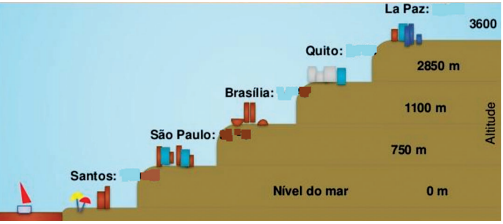
Considerando os textos I e II, analise a seguinte situação.
Uma pessoa que mora em Santos mudou-se recentemente para a cidade de La Paz – Peru. Ela decidiu medir o tempo que gasta para passar a mesma quantidade de café quando morava em Santos, usando a mesma quantidade de calor.
Nessa situação, o tempo gasto para passar o café será
A variedade alotrópica do S ocorre quando são apresentadas substâncias de
Analise o ciclo a seguir.
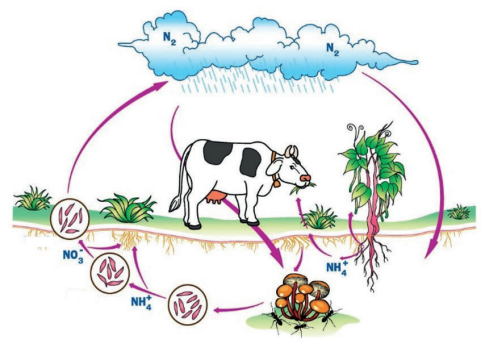 LINHARES, Sérgio; GEWANDSZNAJDER, Fernando. Biologia. V. 3. São Paulo: Ática, 2014.
 Durante as etapas do ciclo do nitrogênio ocorre
LOPES, Sônia; ROSSO, Sérgio. BIO: volume único. 2.ed. São Paulo: Saraiva, 2013.
Pode-se afirmar que os insetos têm desenvolvimento
I. ametábolo, direto, sem metamorfose. Do ovo eclode um indivíduo jovem semelhante ao adulto. Exemplo: traça-dos-livros. II. hemimetábulo, indireto, com metamorfose incompleta. Do ovo eclode uma ninfa semelhante ao adulto, mas não tem asas desenvolvidas. A ninfa origina o adulto. Exemplo: percevejo. III. holometábulo, indireto, com metamorfose completa. Do ovo eclode uma larva distinta do adulto, passa por uma fase de pupa, podendo formar casulo. Daí ocorre a metamorfose onde a larva se transforma no jovem que emerge completamente formado e origina o adulto. Exemplo: moscas.
Estão corretas as seguintes afirmativas:
A proteção vacinal da poliomielite, no Brasil, está sofrendo queda brusca. De janeiro a julho de 2020, a cobertura atingiu 60% do público-alvo, muito abaixo dos 95% preconizados pela Organização Mundial da Saúde (OMS). O distanciamento social e o medo causado pela pandemia da Covid-19 são listados como as causas do declínio. Os números preocupam médicos que temem um novo surto da doença já erradicada no país. A integrante do Departamento de Infectologia da Sociedade Brasileira de Pediatria afirma que, atualmente, há mais de 1 milhão de crianças inadequadamente vacinadas. A poliomielite é uma doença grave que pode causar paralisia e atrofia dos membros e sua evolução pode levar à morte. Apesar de ser predominante entre as crianças com até 5 anos de idade, ela também pode afetar adultos.
https://www.metropoles.com/saude/poliomielite-volta-a-preocupar-em-cenario-de-queda-na-vacinacao
Em relação à poliomielite, é correto afirmar que se trata de uma patologia
Analise os esquemas que representam diferentes fases da divisão celular por meiose.
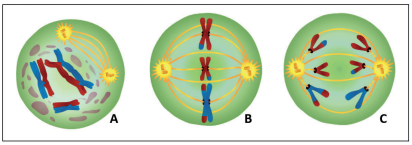
https://www.infoescola.com/citologia/meiose
Os esquemas A, B e C correspondem, respectivamente, às fases de
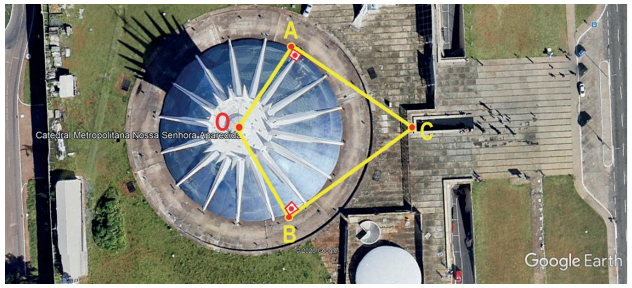
Um turista localizado no ponto C observa dois trabalhadores nos pontos A e B numa trajetória retilínea a x metros de distância de cada um. Sabendo que o arco AB é de 3 π/4 metros, nessas condições, o valor de x, em metros, é
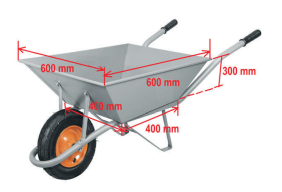
Quantos volumes desse carrinho de mão, completamente cheios de terra, serão necessários para transportar 1,90 m³ de areia?
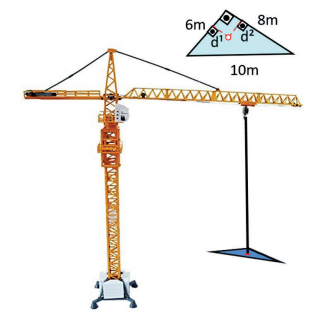
As distâncias d¹ e d², em metros, do ponto de içamento em relação aos menores lados desse triângulo para que a peça seja içada exatamente pelo ponto de encontro das três medianas são iguais a
A probabilidade de que seja homem um apoiador do candidato A, selecionado ao acaso, é
A alta dose de radiação tem a função de promover várias mutações no DNA e/ou RNA dos vírus, levando-o à morte ou impedindo que ele se reproduza. A luz UV é eficaz para inativar bactérias e vírus nas faixas de UV-B e UV-C com onda de comprimento entre 200 a 310 nm (nanômetros).
https://www.uol.com.br/tilt/noticias/redacao/2020/08/07/para-anvisa-nao-ha-certeza-de-que-raios-ultravioleta-destroem-coronavirus.htm (Adaptada)
Sabe-se que a radiação eletromagnética (ou simplesmente, a luz) é quantizada, segundo Einstein, e a quantidade elementar de luz, hoje, recebe o nome de fóton. Por isso, para eliminar o vírus sobre a superfície, uma rede de supermercado instalou cabines UV para descontaminar os carrinhos de compras. A cabine contém luz ultravioleta com comprimento de onda de 300 nm.
Qual a energia desse fóton em elétrons-volts?
Adote a constante de Planck = 4,14.10-15 eV.s e a velocidade da luz de 3,0.108 m/s
Para um exame do tórax, o campo magnético necessário é 1,5 T produzido por uma corrente elétrica de 20 A. Qual é o número de espira, por centímetro, nesse tubo para a realização desse exame? Considere µ = 1,25.10 -6 T.m/A
Ela foi construída em 1889, em Paris, como parte das comemorações do centenário da Revolução Francesa. Inaugurada, em março de 1889, a torre Eiffel, ou “Dama de Ferro”, como ficou conhecida na época, comparada às pirâmides do Egito por seu idealizador, possui 7 mil toneladas de ferro e 3 mil toneladas de materiais variados, e levou só dois anos para ficar pronta. A construção foi um enorme desafio para a engenharia da época porque possui 300 m de altura e fica 15 cm mais alta no verão, devido à dilatação térmica do ferro. No seu topo, tem várias antenas de rádio cuja esfera de aço de cada antena tem raio de 10 m para garantir estabilidade contra ventos fortes. No verão parisiense, essas esferas sofrem uma variação de 5,04 m3 quando a temperatura chega a 30°C.
https://super.abril.com.br/mundo-estranho/como-foi-construida-a-torre-eiffel/(Adaptada)
Uma das esferas da antena de transmissão no topo da torre precisa ser substituída por outra, de mesmo material, cujo volume é 250 m³ a 2 °C. Qual a variação de volume, em m³, dessa esfera quando a temperatura chegar a 42 °C? Considere π=3

 Conheça nossos planos