Questões de Vestibular
Comentadas
Foram encontradas 36.804 questões
Resolva questões gratuitamente!
Junte-se a mais de 4 milhões de concurseiros!


Assinale a alternativa correta.

Do ponto de vista da norma culta, é correto afirmar que
“coisarˮ é
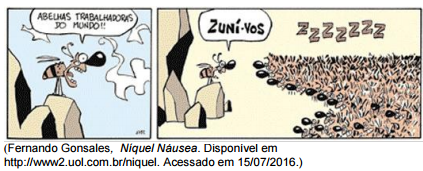
Na tira acima, o autor retoma um célebre lema retirado do Manifesto Comunista (1848), de Karl Marx e Friedrich Engels: “Operários do mundo, uni-vos!”.
Considerando os sentidos produzidos pela tirinha, é correto
afirmar que nela se lê
Lá na varanda Dom Quixote conversava com Dona Benta sobre as aventuras, e muito admirado ficou de saber que sua história andava a correr mundo; escrita por um tal de Cervantes. Nem quis acreditar; foi preciso que Narizinho lhe trouxesse a edição de luxo ilustrada por Gustavo Doré. O fidalgo folheou o livro muito atento às gravuras, que achou ótimas, porém falsas. - Isso não passa duma mistificação! - protestou ele. – Esta cena aqui, por exemplo. Está errada. Eu não espetei este frade, como o desenhista pintou - espetei aquele lá. - Isto é inevitável - disse Dona Benta. – Os historiadores costumam arranjar os fatos do modo mais cômodo para eles; por isto a História não passa de histórias. (Adaptado de Monteiro Lobato, O Picapau Amarelo. São Paulo: Brasiliense, 2004, p. 18.)
Na cena narrada
TEXT
Nearly 250 million young children across the world – 43% of under-fives – are unlikely to fulfil their potential as adults because of stunting and extreme poverty, new figures show.
The first three years of life are crucial to a child’s development, according to a series of research papers published in the Lancet medical journal, which says there are also economic costs to the failure to help them grow. Those who do not get the nutrition, care and stimulation they need will earn about 26% less than others as adults.
“The costs of not acting immediately to expand services to improve early childhood development are high for individuals and their families, as well as for societies,” say the researchers. The cost to some countries in GDP (gross domestic product), they estimate, is as much as twice their spending on healthcare.
The figures come as the World Bank prepares for a summit meeting with finance ministers around the globe to discuss how nurturing children in their early years will help their countries’ economic development. The World Bank president, Jim Yong Kim, has told the Guardian that he intends to use the World Economic Forum in Davos each year to name and shame countries that do not reduce their high stunting rates.
The Lancet series says the first 24 months of life are the critical time for avoiding stunting. Undernourished children living in extreme poverty end up small and their brain development is affected, so that they find it hard to learn. “Some catch-up is possible in height-for-age after 24 months, with uncertain cognitive gains,” says one of the papers.
In sub-Saharan Africa, 66% of children are estimated to be at risk of poor development because of stunting and poverty. In south Asia, the figure is 65%, and 18% in the Caribbean and South America.
Mothers need to be well nourished to give their babies a good start in life and be able to breastfeed. Families need help to give children the nutrition and nurturing they need, say researchers. That includes breastfeeding, free pre-school education – which is available in only two-thirds of high-income countries – paid leave for parents and a minimum wage to pull more families out of poverty.
There are children at risk in all countries, rich and poor. The series points to early childhood programs that have been effective, including Sure Start in the UK, Early Head Start in the US, Chile’s Crece Contigo and Grade R in South Africa
In a Comment piece in the journal, Dr Margaret Chan, director general of the World Health Organization, Anthony Lake, executive director of the United Nations Children’s Fund, and Keith Hansen, vice-president for human development at the World Bank, write: “The early childhood agenda is truly global, because the need is not limited to low-income countries. Children living in disadvantaged households in middle-income and wealthy countries are also at risk.
“In targeting our investments, we should give priority to populations in the greatest need, such as families and children in extreme poverty and those who require humanitarian assistance. In addition, we have to build more resilient systems in vulnerable communities to mitigate the disruptive influence of natural disasters, fragility, conflict, and violence.”
Wanda Wyporska, executive director of the Equality Trust, said: “It’s no surprise that the richer you are, the better your health is likely to be”. But the chasm of health inequality between rich and poor has widened in recent years.
“Being born into a poor family shouldn’t mean decades of poorer health and even premature death, but that’s the shameful reality of the UK’s health gap. If you rank neighborhoods in the UK from the richest to the poorest, you have almost perfectly ranked health from the best to the worst.”
https://www.theguardian.com/global-development/2016/oct/04
TEXT
Nearly 250 million young children across the world – 43% of under-fives – are unlikely to fulfil their potential as adults because of stunting and extreme poverty, new figures show.
The first three years of life are crucial to a child’s development, according to a series of research papers published in the Lancet medical journal, which says there are also economic costs to the failure to help them grow. Those who do not get the nutrition, care and stimulation they need will earn about 26% less than others as adults.
“The costs of not acting immediately to expand services to improve early childhood development are high for individuals and their families, as well as for societies,” say the researchers. The cost to some countries in GDP (gross domestic product), they estimate, is as much as twice their spending on healthcare.
The figures come as the World Bank prepares for a summit meeting with finance ministers around the globe to discuss how nurturing children in their early years will help their countries’ economic development. The World Bank president, Jim Yong Kim, has told the Guardian that he intends to use the World Economic Forum in Davos each year to name and shame countries that do not reduce their high stunting rates.
The Lancet series says the first 24 months of life are the critical time for avoiding stunting. Undernourished children living in extreme poverty end up small and their brain development is affected, so that they find it hard to learn. “Some catch-up is possible in height-for-age after 24 months, with uncertain cognitive gains,” says one of the papers.
In sub-Saharan Africa, 66% of children are estimated to be at risk of poor development because of stunting and poverty. In south Asia, the figure is 65%, and 18% in the Caribbean and South America.
Mothers need to be well nourished to give their babies a good start in life and be able to breastfeed. Families need help to give children the nutrition and nurturing they need, say researchers. That includes breastfeeding, free pre-school education – which is available in only two-thirds of high-income countries – paid leave for parents and a minimum wage to pull more families out of poverty.
There are children at risk in all countries, rich and poor. The series points to early childhood programs that have been effective, including Sure Start in the UK, Early Head Start in the US, Chile’s Crece Contigo and Grade R in South Africa
In a Comment piece in the journal, Dr Margaret Chan, director general of the World Health Organization, Anthony Lake, executive director of the United Nations Children’s Fund, and Keith Hansen, vice-president for human development at the World Bank, write: “The early childhood agenda is truly global, because the need is not limited to low-income countries. Children living in disadvantaged households in middle-income and wealthy countries are also at risk.
“In targeting our investments, we should give priority to populations in the greatest need, such as families and children in extreme poverty and those who require humanitarian assistance. In addition, we have to build more resilient systems in vulnerable communities to mitigate the disruptive influence of natural disasters, fragility, conflict, and violence.”
Wanda Wyporska, executive director of the Equality Trust, said: “It’s no surprise that the richer you are, the better your health is likely to be”. But the chasm of health inequality between rich and poor has widened in recent years.
“Being born into a poor family shouldn’t mean decades of poorer health and even premature death, but that’s the shameful reality of the UK’s health gap. If you rank neighborhoods in the UK from the richest to the poorest, you have almost perfectly ranked health from the best to the worst.”
https://www.theguardian.com/global-development/2016/oct/04
TEXT
Nearly 250 million young children across the world – 43% of under-fives – are unlikely to fulfil their potential as adults because of stunting and extreme poverty, new figures show.
The first three years of life are crucial to a child’s development, according to a series of research papers published in the Lancet medical journal, which says there are also economic costs to the failure to help them grow. Those who do not get the nutrition, care and stimulation they need will earn about 26% less than others as adults.
“The costs of not acting immediately to expand services to improve early childhood development are high for individuals and their families, as well as for societies,” say the researchers. The cost to some countries in GDP (gross domestic product), they estimate, is as much as twice their spending on healthcare.
The figures come as the World Bank prepares for a summit meeting with finance ministers around the globe to discuss how nurturing children in their early years will help their countries’ economic development. The World Bank president, Jim Yong Kim, has told the Guardian that he intends to use the World Economic Forum in Davos each year to name and shame countries that do not reduce their high stunting rates.
The Lancet series says the first 24 months of life are the critical time for avoiding stunting. Undernourished children living in extreme poverty end up small and their brain development is affected, so that they find it hard to learn. “Some catch-up is possible in height-for-age after 24 months, with uncertain cognitive gains,” says one of the papers.
In sub-Saharan Africa, 66% of children are estimated to be at risk of poor development because of stunting and poverty. In south Asia, the figure is 65%, and 18% in the Caribbean and South America.
Mothers need to be well nourished to give their babies a good start in life and be able to breastfeed. Families need help to give children the nutrition and nurturing they need, say researchers. That includes breastfeeding, free pre-school education – which is available in only two-thirds of high-income countries – paid leave for parents and a minimum wage to pull more families out of poverty.
There are children at risk in all countries, rich and poor. The series points to early childhood programs that have been effective, including Sure Start in the UK, Early Head Start in the US, Chile’s Crece Contigo and Grade R in South Africa
In a Comment piece in the journal, Dr Margaret Chan, director general of the World Health Organization, Anthony Lake, executive director of the United Nations Children’s Fund, and Keith Hansen, vice-president for human development at the World Bank, write: “The early childhood agenda is truly global, because the need is not limited to low-income countries. Children living in disadvantaged households in middle-income and wealthy countries are also at risk.
“In targeting our investments, we should give priority to populations in the greatest need, such as families and children in extreme poverty and those who require humanitarian assistance. In addition, we have to build more resilient systems in vulnerable communities to mitigate the disruptive influence of natural disasters, fragility, conflict, and violence.”
Wanda Wyporska, executive director of the Equality Trust, said: “It’s no surprise that the richer you are, the better your health is likely to be”. But the chasm of health inequality between rich and poor has widened in recent years.
“Being born into a poor family shouldn’t mean decades of poorer health and even premature death, but that’s the shameful reality of the UK’s health gap. If you rank neighborhoods in the UK from the richest to the poorest, you have almost perfectly ranked health from the best to the worst.”
https://www.theguardian.com/global-development/2016/oct/04
TEXT
Nearly 250 million young children across the world – 43% of under-fives – are unlikely to fulfil their potential as adults because of stunting and extreme poverty, new figures show.
The first three years of life are crucial to a child’s development, according to a series of research papers published in the Lancet medical journal, which says there are also economic costs to the failure to help them grow. Those who do not get the nutrition, care and stimulation they need will earn about 26% less than others as adults.
“The costs of not acting immediately to expand services to improve early childhood development are high for individuals and their families, as well as for societies,” say the researchers. The cost to some countries in GDP (gross domestic product), they estimate, is as much as twice their spending on healthcare.
The figures come as the World Bank prepares for a summit meeting with finance ministers around the globe to discuss how nurturing children in their early years will help their countries’ economic development. The World Bank president, Jim Yong Kim, has told the Guardian that he intends to use the World Economic Forum in Davos each year to name and shame countries that do not reduce their high stunting rates.
The Lancet series says the first 24 months of life are the critical time for avoiding stunting. Undernourished children living in extreme poverty end up small and their brain development is affected, so that they find it hard to learn. “Some catch-up is possible in height-for-age after 24 months, with uncertain cognitive gains,” says one of the papers.
In sub-Saharan Africa, 66% of children are estimated to be at risk of poor development because of stunting and poverty. In south Asia, the figure is 65%, and 18% in the Caribbean and South America.
Mothers need to be well nourished to give their babies a good start in life and be able to breastfeed. Families need help to give children the nutrition and nurturing they need, say researchers. That includes breastfeeding, free pre-school education – which is available in only two-thirds of high-income countries – paid leave for parents and a minimum wage to pull more families out of poverty.
There are children at risk in all countries, rich and poor. The series points to early childhood programs that have been effective, including Sure Start in the UK, Early Head Start in the US, Chile’s Crece Contigo and Grade R in South Africa
In a Comment piece in the journal, Dr Margaret Chan, director general of the World Health Organization, Anthony Lake, executive director of the United Nations Children’s Fund, and Keith Hansen, vice-president for human development at the World Bank, write: “The early childhood agenda is truly global, because the need is not limited to low-income countries. Children living in disadvantaged households in middle-income and wealthy countries are also at risk.
“In targeting our investments, we should give priority to populations in the greatest need, such as families and children in extreme poverty and those who require humanitarian assistance. In addition, we have to build more resilient systems in vulnerable communities to mitigate the disruptive influence of natural disasters, fragility, conflict, and violence.”
Wanda Wyporska, executive director of the Equality Trust, said: “It’s no surprise that the richer you are, the better your health is likely to be”. But the chasm of health inequality between rich and poor has widened in recent years.
“Being born into a poor family shouldn’t mean decades of poorer health and even premature death, but that’s the shameful reality of the UK’s health gap. If you rank neighborhoods in the UK from the richest to the poorest, you have almost perfectly ranked health from the best to the worst.”
https://www.theguardian.com/global-development/2016/oct/04
TEXT
Nearly 250 million young children across the world – 43% of under-fives – are unlikely to fulfil their potential as adults because of stunting and extreme poverty, new figures show.
The first three years of life are crucial to a child’s development, according to a series of research papers published in the Lancet medical journal, which says there are also economic costs to the failure to help them grow. Those who do not get the nutrition, care and stimulation they need will earn about 26% less than others as adults.
“The costs of not acting immediately to expand services to improve early childhood development are high for individuals and their families, as well as for societies,” say the researchers. The cost to some countries in GDP (gross domestic product), they estimate, is as much as twice their spending on healthcare.
The figures come as the World Bank prepares for a summit meeting with finance ministers around the globe to discuss how nurturing children in their early years will help their countries’ economic development. The World Bank president, Jim Yong Kim, has told the Guardian that he intends to use the World Economic Forum in Davos each year to name and shame countries that do not reduce their high stunting rates.
The Lancet series says the first 24 months of life are the critical time for avoiding stunting. Undernourished children living in extreme poverty end up small and their brain development is affected, so that they find it hard to learn. “Some catch-up is possible in height-for-age after 24 months, with uncertain cognitive gains,” says one of the papers.
In sub-Saharan Africa, 66% of children are estimated to be at risk of poor development because of stunting and poverty. In south Asia, the figure is 65%, and 18% in the Caribbean and South America.
Mothers need to be well nourished to give their babies a good start in life and be able to breastfeed. Families need help to give children the nutrition and nurturing they need, say researchers. That includes breastfeeding, free pre-school education – which is available in only two-thirds of high-income countries – paid leave for parents and a minimum wage to pull more families out of poverty.
There are children at risk in all countries, rich and poor. The series points to early childhood programs that have been effective, including Sure Start in the UK, Early Head Start in the US, Chile’s Crece Contigo and Grade R in South Africa
In a Comment piece in the journal, Dr Margaret Chan, director general of the World Health Organization, Anthony Lake, executive director of the United Nations Children’s Fund, and Keith Hansen, vice-president for human development at the World Bank, write: “The early childhood agenda is truly global, because the need is not limited to low-income countries. Children living in disadvantaged households in middle-income and wealthy countries are also at risk.
“In targeting our investments, we should give priority to populations in the greatest need, such as families and children in extreme poverty and those who require humanitarian assistance. In addition, we have to build more resilient systems in vulnerable communities to mitigate the disruptive influence of natural disasters, fragility, conflict, and violence.”
Wanda Wyporska, executive director of the Equality Trust, said: “It’s no surprise that the richer you are, the better your health is likely to be”. But the chasm of health inequality between rich and poor has widened in recent years.
“Being born into a poor family shouldn’t mean decades of poorer health and even premature death, but that’s the shameful reality of the UK’s health gap. If you rank neighborhoods in the UK from the richest to the poorest, you have almost perfectly ranked health from the best to the worst.”
https://www.theguardian.com/global-development/2016/oct/04
TEXT
Nearly 250 million young children across the world – 43% of under-fives – are unlikely to fulfil their potential as adults because of stunting and extreme poverty, new figures show.
The first three years of life are crucial to a child’s development, according to a series of research papers published in the Lancet medical journal, which says there are also economic costs to the failure to help them grow. Those who do not get the nutrition, care and stimulation they need will earn about 26% less than others as adults.
“The costs of not acting immediately to expand services to improve early childhood development are high for individuals and their families, as well as for societies,” say the researchers. The cost to some countries in GDP (gross domestic product), they estimate, is as much as twice their spending on healthcare.
The figures come as the World Bank prepares for a summit meeting with finance ministers around the globe to discuss how nurturing children in their early years will help their countries’ economic development. The World Bank president, Jim Yong Kim, has told the Guardian that he intends to use the World Economic Forum in Davos each year to name and shame countries that do not reduce their high stunting rates.
The Lancet series says the first 24 months of life are the critical time for avoiding stunting. Undernourished children living in extreme poverty end up small and their brain development is affected, so that they find it hard to learn. “Some catch-up is possible in height-for-age after 24 months, with uncertain cognitive gains,” says one of the papers.
In sub-Saharan Africa, 66% of children are estimated to be at risk of poor development because of stunting and poverty. In south Asia, the figure is 65%, and 18% in the Caribbean and South America.
Mothers need to be well nourished to give their babies a good start in life and be able to breastfeed. Families need help to give children the nutrition and nurturing they need, say researchers. That includes breastfeeding, free pre-school education – which is available in only two-thirds of high-income countries – paid leave for parents and a minimum wage to pull more families out of poverty.
There are children at risk in all countries, rich and poor. The series points to early childhood programs that have been effective, including Sure Start in the UK, Early Head Start in the US, Chile’s Crece Contigo and Grade R in South Africa
In a Comment piece in the journal, Dr Margaret Chan, director general of the World Health Organization, Anthony Lake, executive director of the United Nations Children’s Fund, and Keith Hansen, vice-president for human development at the World Bank, write: “The early childhood agenda is truly global, because the need is not limited to low-income countries. Children living in disadvantaged households in middle-income and wealthy countries are also at risk.
“In targeting our investments, we should give priority to populations in the greatest need, such as families and children in extreme poverty and those who require humanitarian assistance. In addition, we have to build more resilient systems in vulnerable communities to mitigate the disruptive influence of natural disasters, fragility, conflict, and violence.”
Wanda Wyporska, executive director of the Equality Trust, said: “It’s no surprise that the richer you are, the better your health is likely to be”. But the chasm of health inequality between rich and poor has widened in recent years.
“Being born into a poor family shouldn’t mean decades of poorer health and even premature death, but that’s the shameful reality of the UK’s health gap. If you rank neighborhoods in the UK from the richest to the poorest, you have almost perfectly ranked health from the best to the worst.”
https://www.theguardian.com/global-development/2016/oct/04
TEXT
Nearly 250 million young children across the world – 43% of under-fives – are unlikely to fulfil their potential as adults because of stunting and extreme poverty, new figures show.
The first three years of life are crucial to a child’s development, according to a series of research papers published in the Lancet medical journal, which says there are also economic costs to the failure to help them grow. Those who do not get the nutrition, care and stimulation they need will earn about 26% less than others as adults.
“The costs of not acting immediately to expand services to improve early childhood development are high for individuals and their families, as well as for societies,” say the researchers. The cost to some countries in GDP (gross domestic product), they estimate, is as much as twice their spending on healthcare.
The figures come as the World Bank prepares for a summit meeting with finance ministers around the globe to discuss how nurturing children in their early years will help their countries’ economic development. The World Bank president, Jim Yong Kim, has told the Guardian that he intends to use the World Economic Forum in Davos each year to name and shame countries that do not reduce their high stunting rates.
The Lancet series says the first 24 months of life are the critical time for avoiding stunting. Undernourished children living in extreme poverty end up small and their brain development is affected, so that they find it hard to learn. “Some catch-up is possible in height-for-age after 24 months, with uncertain cognitive gains,” says one of the papers.
In sub-Saharan Africa, 66% of children are estimated to be at risk of poor development because of stunting and poverty. In south Asia, the figure is 65%, and 18% in the Caribbean and South America.
Mothers need to be well nourished to give their babies a good start in life and be able to breastfeed. Families need help to give children the nutrition and nurturing they need, say researchers. That includes breastfeeding, free pre-school education – which is available in only two-thirds of high-income countries – paid leave for parents and a minimum wage to pull more families out of poverty.
There are children at risk in all countries, rich and poor. The series points to early childhood programs that have been effective, including Sure Start in the UK, Early Head Start in the US, Chile’s Crece Contigo and Grade R in South Africa
In a Comment piece in the journal, Dr Margaret Chan, director general of the World Health Organization, Anthony Lake, executive director of the United Nations Children’s Fund, and Keith Hansen, vice-president for human development at the World Bank, write: “The early childhood agenda is truly global, because the need is not limited to low-income countries. Children living in disadvantaged households in middle-income and wealthy countries are also at risk.
“In targeting our investments, we should give priority to populations in the greatest need, such as families and children in extreme poverty and those who require humanitarian assistance. In addition, we have to build more resilient systems in vulnerable communities to mitigate the disruptive influence of natural disasters, fragility, conflict, and violence.”
Wanda Wyporska, executive director of the Equality Trust, said: “It’s no surprise that the richer you are, the better your health is likely to be”. But the chasm of health inequality between rich and poor has widened in recent years.
“Being born into a poor family shouldn’t mean decades of poorer health and even premature death, but that’s the shameful reality of the UK’s health gap. If you rank neighborhoods in the UK from the richest to the poorest, you have almost perfectly ranked health from the best to the worst.”
https://www.theguardian.com/global-development/2016/oct/04
TEXT
Nearly 250 million young children across the world – 43% of under-fives – are unlikely to fulfil their potential as adults because of stunting and extreme poverty, new figures show.
The first three years of life are crucial to a child’s development, according to a series of research papers published in the Lancet medical journal, which says there are also economic costs to the failure to help them grow. Those who do not get the nutrition, care and stimulation they need will earn about 26% less than others as adults.
“The costs of not acting immediately to expand services to improve early childhood development are high for individuals and their families, as well as for societies,” say the researchers. The cost to some countries in GDP (gross domestic product), they estimate, is as much as twice their spending on healthcare.
The figures come as the World Bank prepares for a summit meeting with finance ministers around the globe to discuss how nurturing children in their early years will help their countries’ economic development. The World Bank president, Jim Yong Kim, has told the Guardian that he intends to use the World Economic Forum in Davos each year to name and shame countries that do not reduce their high stunting rates.
The Lancet series says the first 24 months of life are the critical time for avoiding stunting. Undernourished children living in extreme poverty end up small and their brain development is affected, so that they find it hard to learn. “Some catch-up is possible in height-for-age after 24 months, with uncertain cognitive gains,” says one of the papers.
In sub-Saharan Africa, 66% of children are estimated to be at risk of poor development because of stunting and poverty. In south Asia, the figure is 65%, and 18% in the Caribbean and South America.
Mothers need to be well nourished to give their babies a good start in life and be able to breastfeed. Families need help to give children the nutrition and nurturing they need, say researchers. That includes breastfeeding, free pre-school education – which is available in only two-thirds of high-income countries – paid leave for parents and a minimum wage to pull more families out of poverty.
There are children at risk in all countries, rich and poor. The series points to early childhood programs that have been effective, including Sure Start in the UK, Early Head Start in the US, Chile’s Crece Contigo and Grade R in South Africa
In a Comment piece in the journal, Dr Margaret Chan, director general of the World Health Organization, Anthony Lake, executive director of the United Nations Children’s Fund, and Keith Hansen, vice-president for human development at the World Bank, write: “The early childhood agenda is truly global, because the need is not limited to low-income countries. Children living in disadvantaged households in middle-income and wealthy countries are also at risk.
“In targeting our investments, we should give priority to populations in the greatest need, such as families and children in extreme poverty and those who require humanitarian assistance. In addition, we have to build more resilient systems in vulnerable communities to mitigate the disruptive influence of natural disasters, fragility, conflict, and violence.”
Wanda Wyporska, executive director of the Equality Trust, said: “It’s no surprise that the richer you are, the better your health is likely to be”. But the chasm of health inequality between rich and poor has widened in recent years.
“Being born into a poor family shouldn’t mean decades of poorer health and even premature death, but that’s the shameful reality of the UK’s health gap. If you rank neighborhoods in the UK from the richest to the poorest, you have almost perfectly ranked health from the best to the worst.”
https://www.theguardian.com/global-development/2016/oct/04
Os anabolizantes esteroides são drogas derivadas do hormônio testosterona. De acordo com a Sociedade Brasileira de Endocrinologia e Metabologia, um em cada dezesseis estudantes já usou anabolizantes esteroides, sem prescrição médica, ignorando seus efeitos colaterais perigosos, tanto físicos como psicológicos.
Fonte: http://www.endocrino.org.br/anabolizantes-
esteroides-e-os-jovens/
No que diz respeito aos hormônios humanos, é correto afirmar que
Em setembro de 2016, a revista New Scientist divulgou o nascimento do primeiro bebê gerado a partir do DNA de três pessoas. Os óvulos, com DNA nuclear da mãe e DNA mitocondrial da doadora, foram fertilizados com espermatozoides do pai e um dos cinco embriões resultantes foi injetado dentro do útero da mãe.
Fonte: https://www.newscientist.com/article/2107219-
exclusive-worlds-first-baby-born-with-new-3-parenttechnique/
Em relação à reprodução humana, é correto afirmar que
 Conheça nossos planos