Questões de Vestibular
Comentadas
Foram encontradas 36.784 questões
Resolva questões gratuitamente!
Junte-se a mais de 4 milhões de concurseiros!


Leia o trecho do conto “Pai contra mãe”, de Machado de Assis (1839-1908), para responder à questão.
A escravidão levou consigo ofícios e aparelhos, como terá sucedido a outras instituições sociais. Não cito alguns aparelhos senão por se ligarem a certo ofício. Um deles era o ferro ao pescoço, outro o ferro ao pé; havia também a máscara de folha de flandres. A máscara fazia perder o vício da embriaguez aos escravos, por lhes tapar a boca. Tinha só três buracos, dois para ver, um para respirar, e era fechada atrás da cabeça por um cadeado. Com o vício de beber, perdiam a tentação de furtar, porque geralmente era dos vinténs do senhor que eles tiravam com que matar a sede, e aí ficavam dois pecados extintos, e a sobriedade e a honestidade certas. Era grotesca tal máscara, mas a ordem social e humana nem sempre se alcança sem o grotesco, e alguma vez o cruel. Os funileiros as tinham penduradas, à venda, na porta das lojas. Mas não cuidemos de máscaras.
O ferro ao pescoço era aplicado aos escravos fujões. Imaginai uma coleira grossa, com a haste grossa também, à direita ou à esquerda, até ao alto da cabeça e fechada atrás com chave. Pesava, naturalmente, mas era menos castigo que sinal. Escravo que fugia assim, onde quer que andasse, mostrava um reincidente, e com pouco era pegado.
Há meio século, os escravos fugiam com frequência. Eram muitos, e nem todos gostavam da escravidão. Sucedia ocasionalmente apanharem pancada, e nem todos gostavam de apanhar pancada. Grande parte era apenas repreendida; havia alguém de casa que servia de padrinho, e o mesmo dono não era mau; além disso, o sentimento da propriedade moderava a ação, porque dinheiro também dói. A fuga repetia-se, entretanto. Casos houve, ainda que raros, em que o escravo de contrabando, apenas comprado no Valongo, deitava a correr, sem conhecer as ruas da cidade. Dos que seguiam para casa, não raro, apenas ladinos, pediam ao senhor que lhes marcasse aluguel, e iam ganhá-lo fora, quitandando.
Quem perdia um escravo por fuga dava algum dinheiro a quem lho levasse. Punha anúncios nas folhas públicas, com os sinais do fugido, o nome, a roupa, o defeito físico, se o tinha, o bairro por onde andava e a quantia de gratificação. Quando não vinha a quantia, vinha promessa: “gratificar-se-á generosamente” – ou “receberá uma boa gratificação”. Muita vez o anúncio trazia em cima ou ao lado uma vinheta, figura de preto, descalço, correndo, vara ao ombro, e na ponta uma trouxa. Protestava-se com todo o rigor da lei contra quem o acoitasse.
Ora, pegar escravos fugidios era um ofício do tempo. Não seria nobre, mas por ser instrumento da força com que se mantêm a lei e a propriedade, trazia esta outra nobreza implícita das ações reivindicadoras. Ninguém se metia em tal ofício por desfastio ou estudo; a pobreza, a necessidade de uma achega, a inaptidão para outros trabalhos, o acaso, e alguma vez o gosto de servir também, ainda que por outra via, davam o impulso ao homem que se sentia bastante rijo para pôr ordem à desordem.
(Contos: uma antologia, 1998.)
Leia o trecho do conto “Pai contra mãe”, de Machado de Assis (1839-1908), para responder à questão.
A escravidão levou consigo ofícios e aparelhos, como terá sucedido a outras instituições sociais. Não cito alguns aparelhos senão por se ligarem a certo ofício. Um deles era o ferro ao pescoço, outro o ferro ao pé; havia também a máscara de folha de flandres. A máscara fazia perder o vício da embriaguez aos escravos, por lhes tapar a boca. Tinha só três buracos, dois para ver, um para respirar, e era fechada atrás da cabeça por um cadeado. Com o vício de beber, perdiam a tentação de furtar, porque geralmente era dos vinténs do senhor que eles tiravam com que matar a sede, e aí ficavam dois pecados extintos, e a sobriedade e a honestidade certas. Era grotesca tal máscara, mas a ordem social e humana nem sempre se alcança sem o grotesco, e alguma vez o cruel. Os funileiros as tinham penduradas, à venda, na porta das lojas. Mas não cuidemos de máscaras.
O ferro ao pescoço era aplicado aos escravos fujões. Imaginai uma coleira grossa, com a haste grossa também, à direita ou à esquerda, até ao alto da cabeça e fechada atrás com chave. Pesava, naturalmente, mas era menos castigo que sinal. Escravo que fugia assim, onde quer que andasse, mostrava um reincidente, e com pouco era pegado.
Há meio século, os escravos fugiam com frequência. Eram muitos, e nem todos gostavam da escravidão. Sucedia ocasionalmente apanharem pancada, e nem todos gostavam de apanhar pancada. Grande parte era apenas repreendida; havia alguém de casa que servia de padrinho, e o mesmo dono não era mau; além disso, o sentimento da propriedade moderava a ação, porque dinheiro também dói. A fuga repetia-se, entretanto. Casos houve, ainda que raros, em que o escravo de contrabando, apenas comprado no Valongo, deitava a correr, sem conhecer as ruas da cidade. Dos que seguiam para casa, não raro, apenas ladinos, pediam ao senhor que lhes marcasse aluguel, e iam ganhá-lo fora, quitandando.
Quem perdia um escravo por fuga dava algum dinheiro a quem lho levasse. Punha anúncios nas folhas públicas, com os sinais do fugido, o nome, a roupa, o defeito físico, se o tinha, o bairro por onde andava e a quantia de gratificação. Quando não vinha a quantia, vinha promessa: “gratificar-se-á generosamente” – ou “receberá uma boa gratificação”. Muita vez o anúncio trazia em cima ou ao lado uma vinheta, figura de preto, descalço, correndo, vara ao ombro, e na ponta uma trouxa. Protestava-se com todo o rigor da lei contra quem o acoitasse.
Ora, pegar escravos fugidios era um ofício do tempo. Não seria nobre, mas por ser instrumento da força com que se mantêm a lei e a propriedade, trazia esta outra nobreza implícita das ações reivindicadoras. Ninguém se metia em tal ofício por desfastio ou estudo; a pobreza, a necessidade de uma achega, a inaptidão para outros trabalhos, o acaso, e alguma vez o gosto de servir também, ainda que por outra via, davam o impulso ao homem que se sentia bastante rijo para pôr ordem à desordem.
(Contos: uma antologia, 1998.)
A poesia dos antigos era a da posse, a dos novos é a da saudade (e anseio); aquela se ergue, firme, no chão do presente; esta oscila entre recordação e pressentimento. O ideal grego era a concórdia e o equilíbrio perfeitos de todas as forças; a harmonia natural. Os novos, porém, adquiriram a consciência da fragmentação interna que torna impossível este ideal; por isso, a sua poesia aspira a reconciliar os dois mundos em que se sentem divididos, o espiritual e o sensível, fundindo-os de um modo indissolúvel. Os antigos solucionam a sua tarefa, chegando à perfeição; os novos só pela aproximação podem satisfazer o seu anseio do infinito.
(August Schlegel apud Anatol Rosenfeld. Texto/Contexto I, 1996. Adaptado.)
Os “novos” a que se refere o escritor alemão August Schlegel são os poetas
Leia o excerto do “Sermão do bom ladrão”, de Antônio Vieira (1608-1697), para responder à questão..
Navegava Alexandre [Magno] em uma poderosa armada pelo Mar Eritreu a conquistar a Índia; e como fosse trazido à sua presença um pirata, que por ali andava roubando os pescadores, repreendeu-o muito Alexandre de andar em tão mau ofício; porém ele, que não era medroso nem lerdo, respondeu assim: “Basta, Senhor, que eu, porque roubo em uma barca, sou ladrão, e vós, porque roubais em uma armada, sois imperador?”. Assim é. O roubar pouco é culpa, o roubar muito é grandeza: o roubar com pouco poder faz os piratas, o roubar com muito, os Alexandres. Mas Sêneca, que sabia bem distinguir as qualidades, e interpretar as significações, a uns e outros, definiu com o mesmo nome: [...] Se o rei de Macedônia, ou qualquer outro, fizer o que faz o ladrão e o pirata; o ladrão, o pirata e o rei, todos têm o mesmo lugar, e merecem o mesmo nome.
Quando li isto em Sêneca, não me admirei tanto de que um filósofo estoico se atrevesse a escrever uma tal sentença em Roma, reinando nela Nero; o que mais me admirou, e quase envergonhou, foi que os nossos oradores evangélicos em tempo de príncipes católicos, ou para a emenda, ou para a cautela, não preguem a mesma doutrina. Saibam estes eloquentes mudos que mais ofendem os reis com o que calam que com o que disserem; porque a confiança com que isto se diz é sinal que lhes não toca, e que se não podem ofender; e a cautela com que se cala é argumento de que se ofenderão, porque lhes pode tocar. [...]
Suponho, finalmente, que os ladrões de que falo não são aqueles miseráveis, a quem a pobreza e vileza de sua fortuna condenou a este gênero de vida, porque a mesma sua miséria ou escusa ou alivia o seu pecado [...]. O ladrão que furta para comer não vai nem leva ao Inferno: os que não só vão, mas levam, de que eu trato, são os ladrões de maior calibre e de mais alta esfera [...]. Não são só ladrões, diz o santo [São Basílio Magno], os que cortam bolsas, ou espreitam os que se vão banhar, para lhes colher a roupa; os ladrões que mais própria e dignamente merecem este título são aqueles a quem os reis encomendam os exércitos e legiões, ou o governo das províncias, ou a administração das cidades, os quais já com manha, já com força, roubam e despojam os povos. Os outros ladrões roubam um homem, estes roubam cidades e reinos: os outros furtam debaixo do seu risco, estes sem temor, nem perigo: os outros, se furtam, são enforcados: estes furtam e enforcam.
(Essencial, 2011.)
“[...] os ladrões de que falo não são aqueles miseráveis, a quem a pobreza e vileza de sua fortuna condenou a este gênero de vida [...].” (3° parágrafo)
Os termos destacados constituem, respectivamente,
Leia o excerto do “Sermão do bom ladrão”, de Antônio Vieira (1608-1697), para responder à questão..
Navegava Alexandre [Magno] em uma poderosa armada pelo Mar Eritreu a conquistar a Índia; e como fosse trazido à sua presença um pirata, que por ali andava roubando os pescadores, repreendeu-o muito Alexandre de andar em tão mau ofício; porém ele, que não era medroso nem lerdo, respondeu assim: “Basta, Senhor, que eu, porque roubo em uma barca, sou ladrão, e vós, porque roubais em uma armada, sois imperador?”. Assim é. O roubar pouco é culpa, o roubar muito é grandeza: o roubar com pouco poder faz os piratas, o roubar com muito, os Alexandres. Mas Sêneca, que sabia bem distinguir as qualidades, e interpretar as significações, a uns e outros, definiu com o mesmo nome: [...] Se o rei de Macedônia, ou qualquer outro, fizer o que faz o ladrão e o pirata; o ladrão, o pirata e o rei, todos têm o mesmo lugar, e merecem o mesmo nome.
Quando li isto em Sêneca, não me admirei tanto de que um filósofo estoico se atrevesse a escrever uma tal sentença em Roma, reinando nela Nero; o que mais me admirou, e quase envergonhou, foi que os nossos oradores evangélicos em tempo de príncipes católicos, ou para a emenda, ou para a cautela, não preguem a mesma doutrina. Saibam estes eloquentes mudos que mais ofendem os reis com o que calam que com o que disserem; porque a confiança com que isto se diz é sinal que lhes não toca, e que se não podem ofender; e a cautela com que se cala é argumento de que se ofenderão, porque lhes pode tocar. [...]
Suponho, finalmente, que os ladrões de que falo não são aqueles miseráveis, a quem a pobreza e vileza de sua fortuna condenou a este gênero de vida, porque a mesma sua miséria ou escusa ou alivia o seu pecado [...]. O ladrão que furta para comer não vai nem leva ao Inferno: os que não só vão, mas levam, de que eu trato, são os ladrões de maior calibre e de mais alta esfera [...]. Não são só ladrões, diz o santo [São Basílio Magno], os que cortam bolsas, ou espreitam os que se vão banhar, para lhes colher a roupa; os ladrões que mais própria e dignamente merecem este título são aqueles a quem os reis encomendam os exércitos e legiões, ou o governo das províncias, ou a administração das cidades, os quais já com manha, já com força, roubam e despojam os povos. Os outros ladrões roubam um homem, estes roubam cidades e reinos: os outros furtam debaixo do seu risco, estes sem temor, nem perigo: os outros, se furtam, são enforcados: estes furtam e enforcam.
(Essencial, 2011.)
Leia o excerto do “Sermão do bom ladrão”, de Antônio Vieira (1608-1697), para responder à questão..
Navegava Alexandre [Magno] em uma poderosa armada pelo Mar Eritreu a conquistar a Índia; e como fosse trazido à sua presença um pirata, que por ali andava roubando os pescadores, repreendeu-o muito Alexandre de andar em tão mau ofício; porém ele, que não era medroso nem lerdo, respondeu assim: “Basta, Senhor, que eu, porque roubo em uma barca, sou ladrão, e vós, porque roubais em uma armada, sois imperador?”. Assim é. O roubar pouco é culpa, o roubar muito é grandeza: o roubar com pouco poder faz os piratas, o roubar com muito, os Alexandres. Mas Sêneca, que sabia bem distinguir as qualidades, e interpretar as significações, a uns e outros, definiu com o mesmo nome: [...] Se o rei de Macedônia, ou qualquer outro, fizer o que faz o ladrão e o pirata; o ladrão, o pirata e o rei, todos têm o mesmo lugar, e merecem o mesmo nome.
Quando li isto em Sêneca, não me admirei tanto de que um filósofo estoico se atrevesse a escrever uma tal sentença em Roma, reinando nela Nero; o que mais me admirou, e quase envergonhou, foi que os nossos oradores evangélicos em tempo de príncipes católicos, ou para a emenda, ou para a cautela, não preguem a mesma doutrina. Saibam estes eloquentes mudos que mais ofendem os reis com o que calam que com o que disserem; porque a confiança com que isto se diz é sinal que lhes não toca, e que se não podem ofender; e a cautela com que se cala é argumento de que se ofenderão, porque lhes pode tocar. [...]
Suponho, finalmente, que os ladrões de que falo não são aqueles miseráveis, a quem a pobreza e vileza de sua fortuna condenou a este gênero de vida, porque a mesma sua miséria ou escusa ou alivia o seu pecado [...]. O ladrão que furta para comer não vai nem leva ao Inferno: os que não só vão, mas levam, de que eu trato, são os ladrões de maior calibre e de mais alta esfera [...]. Não são só ladrões, diz o santo [São Basílio Magno], os que cortam bolsas, ou espreitam os que se vão banhar, para lhes colher a roupa; os ladrões que mais própria e dignamente merecem este título são aqueles a quem os reis encomendam os exércitos e legiões, ou o governo das províncias, ou a administração das cidades, os quais já com manha, já com força, roubam e despojam os povos. Os outros ladrões roubam um homem, estes roubam cidades e reinos: os outros furtam debaixo do seu risco, estes sem temor, nem perigo: os outros, se furtam, são enforcados: estes furtam e enforcam.
(Essencial, 2011.)
Em um trecho do “Sermão da Sexagésima”, Antônio Vieira critica o chamado estilo cultista de alguns oradores sacros de sua época nos seguintes termos: “Basta que não havemos de ver num sermão duas palavras em paz? Todas hão de estar sempre em fronteira com o seu contrário?”
Palavras “em fronteira com o seu contrário”, contudo, também foram empregadas por Vieira, conforme se verifica na expressão destacada em:
Leia o excerto do “Sermão do bom ladrão”, de Antônio Vieira (1608-1697), para responder à questão..
Navegava Alexandre [Magno] em uma poderosa armada pelo Mar Eritreu a conquistar a Índia; e como fosse trazido à sua presença um pirata, que por ali andava roubando os pescadores, repreendeu-o muito Alexandre de andar em tão mau ofício; porém ele, que não era medroso nem lerdo, respondeu assim: “Basta, Senhor, que eu, porque roubo em uma barca, sou ladrão, e vós, porque roubais em uma armada, sois imperador?”. Assim é. O roubar pouco é culpa, o roubar muito é grandeza: o roubar com pouco poder faz os piratas, o roubar com muito, os Alexandres. Mas Sêneca, que sabia bem distinguir as qualidades, e interpretar as significações, a uns e outros, definiu com o mesmo nome: [...] Se o rei de Macedônia, ou qualquer outro, fizer o que faz o ladrão e o pirata; o ladrão, o pirata e o rei, todos têm o mesmo lugar, e merecem o mesmo nome.
Quando li isto em Sêneca, não me admirei tanto de que um filósofo estoico se atrevesse a escrever uma tal sentença em Roma, reinando nela Nero; o que mais me admirou, e quase envergonhou, foi que os nossos oradores evangélicos em tempo de príncipes católicos, ou para a emenda, ou para a cautela, não preguem a mesma doutrina. Saibam estes eloquentes mudos que mais ofendem os reis com o que calam que com o que disserem; porque a confiança com que isto se diz é sinal que lhes não toca, e que se não podem ofender; e a cautela com que se cala é argumento de que se ofenderão, porque lhes pode tocar. [...]
Suponho, finalmente, que os ladrões de que falo não são aqueles miseráveis, a quem a pobreza e vileza de sua fortuna condenou a este gênero de vida, porque a mesma sua miséria ou escusa ou alivia o seu pecado [...]. O ladrão que furta para comer não vai nem leva ao Inferno: os que não só vão, mas levam, de que eu trato, são os ladrões de maior calibre e de mais alta esfera [...]. Não são só ladrões, diz o santo [São Basílio Magno], os que cortam bolsas, ou espreitam os que se vão banhar, para lhes colher a roupa; os ladrões que mais própria e dignamente merecem este título são aqueles a quem os reis encomendam os exércitos e legiões, ou o governo das províncias, ou a administração das cidades, os quais já com manha, já com força, roubam e despojam os povos. Os outros ladrões roubam um homem, estes roubam cidades e reinos: os outros furtam debaixo do seu risco, estes sem temor, nem perigo: os outros, se furtam, são enforcados: estes furtam e enforcam.
(Essencial, 2011.)
Leia o excerto do “Sermão do bom ladrão”, de Antônio Vieira (1608-1697), para responder à questão..
Navegava Alexandre [Magno] em uma poderosa armada pelo Mar Eritreu a conquistar a Índia; e como fosse trazido à sua presença um pirata, que por ali andava roubando os pescadores, repreendeu-o muito Alexandre de andar em tão mau ofício; porém ele, que não era medroso nem lerdo, respondeu assim: “Basta, Senhor, que eu, porque roubo em uma barca, sou ladrão, e vós, porque roubais em uma armada, sois imperador?”. Assim é. O roubar pouco é culpa, o roubar muito é grandeza: o roubar com pouco poder faz os piratas, o roubar com muito, os Alexandres. Mas Sêneca, que sabia bem distinguir as qualidades, e interpretar as significações, a uns e outros, definiu com o mesmo nome: [...] Se o rei de Macedônia, ou qualquer outro, fizer o que faz o ladrão e o pirata; o ladrão, o pirata e o rei, todos têm o mesmo lugar, e merecem o mesmo nome.
Quando li isto em Sêneca, não me admirei tanto de que um filósofo estoico se atrevesse a escrever uma tal sentença em Roma, reinando nela Nero; o que mais me admirou, e quase envergonhou, foi que os nossos oradores evangélicos em tempo de príncipes católicos, ou para a emenda, ou para a cautela, não preguem a mesma doutrina. Saibam estes eloquentes mudos que mais ofendem os reis com o que calam que com o que disserem; porque a confiança com que isto se diz é sinal que lhes não toca, e que se não podem ofender; e a cautela com que se cala é argumento de que se ofenderão, porque lhes pode tocar. [...]
Suponho, finalmente, que os ladrões de que falo não são aqueles miseráveis, a quem a pobreza e vileza de sua fortuna condenou a este gênero de vida, porque a mesma sua miséria ou escusa ou alivia o seu pecado [...]. O ladrão que furta para comer não vai nem leva ao Inferno: os que não só vão, mas levam, de que eu trato, são os ladrões de maior calibre e de mais alta esfera [...]. Não são só ladrões, diz o santo [São Basílio Magno], os que cortam bolsas, ou espreitam os que se vão banhar, para lhes colher a roupa; os ladrões que mais própria e dignamente merecem este título são aqueles a quem os reis encomendam os exércitos e legiões, ou o governo das províncias, ou a administração das cidades, os quais já com manha, já com força, roubam e despojam os povos. Os outros ladrões roubam um homem, estes roubam cidades e reinos: os outros furtam debaixo do seu risco, estes sem temor, nem perigo: os outros, se furtam, são enforcados: estes furtam e enforcam.
(Essencial, 2011.)
Leia o excerto do “Sermão do bom ladrão”, de Antônio Vieira (1608-1697), para responder à questão..
Navegava Alexandre [Magno] em uma poderosa armada pelo Mar Eritreu a conquistar a Índia; e como fosse trazido à sua presença um pirata, que por ali andava roubando os pescadores, repreendeu-o muito Alexandre de andar em tão mau ofício; porém ele, que não era medroso nem lerdo, respondeu assim: “Basta, Senhor, que eu, porque roubo em uma barca, sou ladrão, e vós, porque roubais em uma armada, sois imperador?”. Assim é. O roubar pouco é culpa, o roubar muito é grandeza: o roubar com pouco poder faz os piratas, o roubar com muito, os Alexandres. Mas Sêneca, que sabia bem distinguir as qualidades, e interpretar as significações, a uns e outros, definiu com o mesmo nome: [...] Se o rei de Macedônia, ou qualquer outro, fizer o que faz o ladrão e o pirata; o ladrão, o pirata e o rei, todos têm o mesmo lugar, e merecem o mesmo nome.
Quando li isto em Sêneca, não me admirei tanto de que um filósofo estoico se atrevesse a escrever uma tal sentença em Roma, reinando nela Nero; o que mais me admirou, e quase envergonhou, foi que os nossos oradores evangélicos em tempo de príncipes católicos, ou para a emenda, ou para a cautela, não preguem a mesma doutrina. Saibam estes eloquentes mudos que mais ofendem os reis com o que calam que com o que disserem; porque a confiança com que isto se diz é sinal que lhes não toca, e que se não podem ofender; e a cautela com que se cala é argumento de que se ofenderão, porque lhes pode tocar. [...]
Suponho, finalmente, que os ladrões de que falo não são aqueles miseráveis, a quem a pobreza e vileza de sua fortuna condenou a este gênero de vida, porque a mesma sua miséria ou escusa ou alivia o seu pecado [...]. O ladrão que furta para comer não vai nem leva ao Inferno: os que não só vão, mas levam, de que eu trato, são os ladrões de maior calibre e de mais alta esfera [...]. Não são só ladrões, diz o santo [São Basílio Magno], os que cortam bolsas, ou espreitam os que se vão banhar, para lhes colher a roupa; os ladrões que mais própria e dignamente merecem este título são aqueles a quem os reis encomendam os exércitos e legiões, ou o governo das províncias, ou a administração das cidades, os quais já com manha, já com força, roubam e despojam os povos. Os outros ladrões roubam um homem, estes roubam cidades e reinos: os outros furtam debaixo do seu risco, estes sem temor, nem perigo: os outros, se furtam, são enforcados: estes furtam e enforcam.
(Essencial, 2011.)
“Se o rei de Macedônia, ou qualquer outro, fizer o que faz o ladrão e o pirata; o ladrão, o pirata e o rei, todos têm o mesmo lugar, e merecem o mesmo nome.” (1° parágrafo)
Em relação ao trecho que o sucede, o trecho destacado tem sentido de
Leia o excerto do “Sermão do bom ladrão”, de Antônio Vieira (1608-1697), para responder à questão..
Navegava Alexandre [Magno] em uma poderosa armada pelo Mar Eritreu a conquistar a Índia; e como fosse trazido à sua presença um pirata, que por ali andava roubando os pescadores, repreendeu-o muito Alexandre de andar em tão mau ofício; porém ele, que não era medroso nem lerdo, respondeu assim: “Basta, Senhor, que eu, porque roubo em uma barca, sou ladrão, e vós, porque roubais em uma armada, sois imperador?”. Assim é. O roubar pouco é culpa, o roubar muito é grandeza: o roubar com pouco poder faz os piratas, o roubar com muito, os Alexandres. Mas Sêneca, que sabia bem distinguir as qualidades, e interpretar as significações, a uns e outros, definiu com o mesmo nome: [...] Se o rei de Macedônia, ou qualquer outro, fizer o que faz o ladrão e o pirata; o ladrão, o pirata e o rei, todos têm o mesmo lugar, e merecem o mesmo nome.
Quando li isto em Sêneca, não me admirei tanto de que um filósofo estoico se atrevesse a escrever uma tal sentença em Roma, reinando nela Nero; o que mais me admirou, e quase envergonhou, foi que os nossos oradores evangélicos em tempo de príncipes católicos, ou para a emenda, ou para a cautela, não preguem a mesma doutrina. Saibam estes eloquentes mudos que mais ofendem os reis com o que calam que com o que disserem; porque a confiança com que isto se diz é sinal que lhes não toca, e que se não podem ofender; e a cautela com que se cala é argumento de que se ofenderão, porque lhes pode tocar. [...]
Suponho, finalmente, que os ladrões de que falo não são aqueles miseráveis, a quem a pobreza e vileza de sua fortuna condenou a este gênero de vida, porque a mesma sua miséria ou escusa ou alivia o seu pecado [...]. O ladrão que furta para comer não vai nem leva ao Inferno: os que não só vão, mas levam, de que eu trato, são os ladrões de maior calibre e de mais alta esfera [...]. Não são só ladrões, diz o santo [São Basílio Magno], os que cortam bolsas, ou espreitam os que se vão banhar, para lhes colher a roupa; os ladrões que mais própria e dignamente merecem este título são aqueles a quem os reis encomendam os exércitos e legiões, ou o governo das províncias, ou a administração das cidades, os quais já com manha, já com força, roubam e despojam os povos. Os outros ladrões roubam um homem, estes roubam cidades e reinos: os outros furtam debaixo do seu risco, estes sem temor, nem perigo: os outros, se furtam, são enforcados: estes furtam e enforcam.
(Essencial, 2011.)
Examine a tira Hagar, o Horrível do cartunista americano Dik Browne (1917-1989).
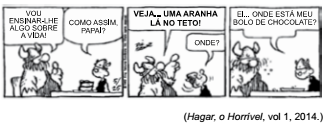
O ensinamento ministrado por Hagar a seu filho poderia
ser expresso do seguinte modo:
T E X T
As growth slows in wealthy countries, Western food companies are aggressively expanding in developing nations, contributing to obesity and health problems.
FORTALEZA, Brazil — Children’s squeals rang through the muggy morning air as a woman pushed a gleaming white cart along pitted, trash-strewn streets. She was making deliveries to some of the poorest households in this seaside city, bringing pudding, cookies and other packaged foods to the customers on her sales route.
Celene da Silva, 29, is one of thousands of door-to-door vendors for Nestlé, helping the world’s largest packaged food conglomerate expand its reach into a quarter-million households in Brazil’s farthestflung corners.
As she dropped off variety packs of Chandelle pudding, Kit-Kats and Mucilon infant cereal, there was something striking about her customers: Many were visibly overweight, even small children.
She gestured to a home along her route and shook her head, recalling how its patriarch, a morbidly obese man, died the previous week. “He ate a piece of cake and died in his sleep,” she said.
Mrs. da Silva, who herself weighs more than 200 pounds, recently discovered that she had high blood pressure, a condition she acknowledges is probably tied to her weakness for fried chicken and the Coca-Cola she drinks with every meal, breakfast included.
Nestlé’s direct-sales army in Brazil is part of a broader transformation of the food system that is delivering Western-style processed food and sugary drinks to the most isolated pockets of Latin America, Africa and Asia. As their growth slows in the wealthiest countries, multinational food companies like Nestlé, PepsiCo and General Mills have been aggressively expanding their presence in developing nations, unleashing a marketing juggernaut that is upending traditional diets from Brazil to Ghana to India.
A New York Times examination of corporate records, epidemiological studies and government reports — as well as interviews with scores of nutritionists and health experts around the world — reveals a sea change in the way food is produced, distributed and advertised across much of the globe. The shift, many public health experts say, is contributing to a new epidemic of diabetes and heart disease, chronic illnesses that are fed by soaring rates of obesity in places that struggled with hunger and malnutrition just a generation ago.
The new reality is captured by a single, stark fact: Across the world, more people are now obese than underweight. At the same time, scientists say, the growing availability of high-calorie, nutrient-poor foods is generating a new type of malnutrition, one in which a growing number of people are both overweight and undernourished.
“The prevailing story is that this is the best of all possible worlds — cheap food, widely available. If you don’t think about it too hard, it makes sense,” said Anthony Winson, who studies the political economics of nutrition at the University of Guelph in Ontario. A closer look, however, reveals a much different story, he said. “To put it in stark terms: The diet is killing us.”
Even critics of processed food acknowledge that there are multiple factors in the rise of obesity, including genetics, urbanization, growing incomes and more sedentary lives. Nestlé executives say their products have helped alleviate hunger, provided crucial nutrients, and that the company has squeezed salt, fat and sugar from thousands of items to make them healthier. But Sean Westcott, head of food research and development at Nestlé, conceded obesity has been an unexpected side effect of making inexpensive processed food more widely available.
“We didn’t expect what the impact would be,” he said.
Part of the problem, he added, is a natural tendency for people to overeat as they can afford more food. Nestlé, he said, strives to educate consumers about proper portion size and to make and market foods that balance “pleasure and nutrition.”
There are now more than 700 million obese people worldwide, 108 million of them children, according to research published recently in The New England Journal of Medicine. The prevalence of obesity has doubled in 73 countries since 1980, contributing to four million premature deaths, the study found.
By ANDREW JACOBS and MATT RICHTEL
The New York Times SEPT. 16, 2017
https://www.nytimes.com
T E X T
As growth slows in wealthy countries, Western food companies are aggressively expanding in developing nations, contributing to obesity and health problems.
FORTALEZA, Brazil — Children’s squeals rang through the muggy morning air as a woman pushed a gleaming white cart along pitted, trash-strewn streets. She was making deliveries to some of the poorest households in this seaside city, bringing pudding, cookies and other packaged foods to the customers on her sales route.
Celene da Silva, 29, is one of thousands of door-to-door vendors for Nestlé, helping the world’s largest packaged food conglomerate expand its reach into a quarter-million households in Brazil’s farthestflung corners.
As she dropped off variety packs of Chandelle pudding, Kit-Kats and Mucilon infant cereal, there was something striking about her customers: Many were visibly overweight, even small children.
She gestured to a home along her route and shook her head, recalling how its patriarch, a morbidly obese man, died the previous week. “He ate a piece of cake and died in his sleep,” she said.
Mrs. da Silva, who herself weighs more than 200 pounds, recently discovered that she had high blood pressure, a condition she acknowledges is probably tied to her weakness for fried chicken and the Coca-Cola she drinks with every meal, breakfast included.
Nestlé’s direct-sales army in Brazil is part of a broader transformation of the food system that is delivering Western-style processed food and sugary drinks to the most isolated pockets of Latin America, Africa and Asia. As their growth slows in the wealthiest countries, multinational food companies like Nestlé, PepsiCo and General Mills have been aggressively expanding their presence in developing nations, unleashing a marketing juggernaut that is upending traditional diets from Brazil to Ghana to India.
A New York Times examination of corporate records, epidemiological studies and government reports — as well as interviews with scores of nutritionists and health experts around the world — reveals a sea change in the way food is produced, distributed and advertised across much of the globe. The shift, many public health experts say, is contributing to a new epidemic of diabetes and heart disease, chronic illnesses that are fed by soaring rates of obesity in places that struggled with hunger and malnutrition just a generation ago.
The new reality is captured by a single, stark fact: Across the world, more people are now obese than underweight. At the same time, scientists say, the growing availability of high-calorie, nutrient-poor foods is generating a new type of malnutrition, one in which a growing number of people are both overweight and undernourished.
“The prevailing story is that this is the best of all possible worlds — cheap food, widely available. If you don’t think about it too hard, it makes sense,” said Anthony Winson, who studies the political economics of nutrition at the University of Guelph in Ontario. A closer look, however, reveals a much different story, he said. “To put it in stark terms: The diet is killing us.”
Even critics of processed food acknowledge that there are multiple factors in the rise of obesity, including genetics, urbanization, growing incomes and more sedentary lives. Nestlé executives say their products have helped alleviate hunger, provided crucial nutrients, and that the company has squeezed salt, fat and sugar from thousands of items to make them healthier. But Sean Westcott, head of food research and development at Nestlé, conceded obesity has been an unexpected side effect of making inexpensive processed food more widely available.
“We didn’t expect what the impact would be,” he said.
Part of the problem, he added, is a natural tendency for people to overeat as they can afford more food. Nestlé, he said, strives to educate consumers about proper portion size and to make and market foods that balance “pleasure and nutrition.”
There are now more than 700 million obese people worldwide, 108 million of them children, according to research published recently in The New England Journal of Medicine. The prevalence of obesity has doubled in 73 countries since 1980, contributing to four million premature deaths, the study found.
By ANDREW JACOBS and MATT RICHTEL
The New York Times SEPT. 16, 2017
https://www.nytimes.com
T E X T
As growth slows in wealthy countries, Western food companies are aggressively expanding in developing nations, contributing to obesity and health problems.
FORTALEZA, Brazil — Children’s squeals rang through the muggy morning air as a woman pushed a gleaming white cart along pitted, trash-strewn streets. She was making deliveries to some of the poorest households in this seaside city, bringing pudding, cookies and other packaged foods to the customers on her sales route.
Celene da Silva, 29, is one of thousands of door-to-door vendors for Nestlé, helping the world’s largest packaged food conglomerate expand its reach into a quarter-million households in Brazil’s farthestflung corners.
As she dropped off variety packs of Chandelle pudding, Kit-Kats and Mucilon infant cereal, there was something striking about her customers: Many were visibly overweight, even small children.
She gestured to a home along her route and shook her head, recalling how its patriarch, a morbidly obese man, died the previous week. “He ate a piece of cake and died in his sleep,” she said.
Mrs. da Silva, who herself weighs more than 200 pounds, recently discovered that she had high blood pressure, a condition she acknowledges is probably tied to her weakness for fried chicken and the Coca-Cola she drinks with every meal, breakfast included.
Nestlé’s direct-sales army in Brazil is part of a broader transformation of the food system that is delivering Western-style processed food and sugary drinks to the most isolated pockets of Latin America, Africa and Asia. As their growth slows in the wealthiest countries, multinational food companies like Nestlé, PepsiCo and General Mills have been aggressively expanding their presence in developing nations, unleashing a marketing juggernaut that is upending traditional diets from Brazil to Ghana to India.
A New York Times examination of corporate records, epidemiological studies and government reports — as well as interviews with scores of nutritionists and health experts around the world — reveals a sea change in the way food is produced, distributed and advertised across much of the globe. The shift, many public health experts say, is contributing to a new epidemic of diabetes and heart disease, chronic illnesses that are fed by soaring rates of obesity in places that struggled with hunger and malnutrition just a generation ago.
The new reality is captured by a single, stark fact: Across the world, more people are now obese than underweight. At the same time, scientists say, the growing availability of high-calorie, nutrient-poor foods is generating a new type of malnutrition, one in which a growing number of people are both overweight and undernourished.
“The prevailing story is that this is the best of all possible worlds — cheap food, widely available. If you don’t think about it too hard, it makes sense,” said Anthony Winson, who studies the political economics of nutrition at the University of Guelph in Ontario. A closer look, however, reveals a much different story, he said. “To put it in stark terms: The diet is killing us.”
Even critics of processed food acknowledge that there are multiple factors in the rise of obesity, including genetics, urbanization, growing incomes and more sedentary lives. Nestlé executives say their products have helped alleviate hunger, provided crucial nutrients, and that the company has squeezed salt, fat and sugar from thousands of items to make them healthier. But Sean Westcott, head of food research and development at Nestlé, conceded obesity has been an unexpected side effect of making inexpensive processed food more widely available.
“We didn’t expect what the impact would be,” he said.
Part of the problem, he added, is a natural tendency for people to overeat as they can afford more food. Nestlé, he said, strives to educate consumers about proper portion size and to make and market foods that balance “pleasure and nutrition.”
There are now more than 700 million obese people worldwide, 108 million of them children, according to research published recently in The New England Journal of Medicine. The prevalence of obesity has doubled in 73 countries since 1980, contributing to four million premature deaths, the study found.
By ANDREW JACOBS and MATT RICHTEL
The New York Times SEPT. 16, 2017
https://www.nytimes.com
T E X T
As growth slows in wealthy countries, Western food companies are aggressively expanding in developing nations, contributing to obesity and health problems.
FORTALEZA, Brazil — Children’s squeals rang through the muggy morning air as a woman pushed a gleaming white cart along pitted, trash-strewn streets. She was making deliveries to some of the poorest households in this seaside city, bringing pudding, cookies and other packaged foods to the customers on her sales route.
Celene da Silva, 29, is one of thousands of door-to-door vendors for Nestlé, helping the world’s largest packaged food conglomerate expand its reach into a quarter-million households in Brazil’s farthestflung corners.
As she dropped off variety packs of Chandelle pudding, Kit-Kats and Mucilon infant cereal, there was something striking about her customers: Many were visibly overweight, even small children.
She gestured to a home along her route and shook her head, recalling how its patriarch, a morbidly obese man, died the previous week. “He ate a piece of cake and died in his sleep,” she said.
Mrs. da Silva, who herself weighs more than 200 pounds, recently discovered that she had high blood pressure, a condition she acknowledges is probably tied to her weakness for fried chicken and the Coca-Cola she drinks with every meal, breakfast included.
Nestlé’s direct-sales army in Brazil is part of a broader transformation of the food system that is delivering Western-style processed food and sugary drinks to the most isolated pockets of Latin America, Africa and Asia. As their growth slows in the wealthiest countries, multinational food companies like Nestlé, PepsiCo and General Mills have been aggressively expanding their presence in developing nations, unleashing a marketing juggernaut that is upending traditional diets from Brazil to Ghana to India.
A New York Times examination of corporate records, epidemiological studies and government reports — as well as interviews with scores of nutritionists and health experts around the world — reveals a sea change in the way food is produced, distributed and advertised across much of the globe. The shift, many public health experts say, is contributing to a new epidemic of diabetes and heart disease, chronic illnesses that are fed by soaring rates of obesity in places that struggled with hunger and malnutrition just a generation ago.
The new reality is captured by a single, stark fact: Across the world, more people are now obese than underweight. At the same time, scientists say, the growing availability of high-calorie, nutrient-poor foods is generating a new type of malnutrition, one in which a growing number of people are both overweight and undernourished.
“The prevailing story is that this is the best of all possible worlds — cheap food, widely available. If you don’t think about it too hard, it makes sense,” said Anthony Winson, who studies the political economics of nutrition at the University of Guelph in Ontario. A closer look, however, reveals a much different story, he said. “To put it in stark terms: The diet is killing us.”
Even critics of processed food acknowledge that there are multiple factors in the rise of obesity, including genetics, urbanization, growing incomes and more sedentary lives. Nestlé executives say their products have helped alleviate hunger, provided crucial nutrients, and that the company has squeezed salt, fat and sugar from thousands of items to make them healthier. But Sean Westcott, head of food research and development at Nestlé, conceded obesity has been an unexpected side effect of making inexpensive processed food more widely available.
“We didn’t expect what the impact would be,” he said.
Part of the problem, he added, is a natural tendency for people to overeat as they can afford more food. Nestlé, he said, strives to educate consumers about proper portion size and to make and market foods that balance “pleasure and nutrition.”
There are now more than 700 million obese people worldwide, 108 million of them children, according to research published recently in The New England Journal of Medicine. The prevalence of obesity has doubled in 73 countries since 1980, contributing to four million premature deaths, the study found.
By ANDREW JACOBS and MATT RICHTEL
The New York Times SEPT. 16, 2017
https://www.nytimes.com
T E X T
As growth slows in wealthy countries, Western food companies are aggressively expanding in developing nations, contributing to obesity and health problems.
FORTALEZA, Brazil — Children’s squeals rang through the muggy morning air as a woman pushed a gleaming white cart along pitted, trash-strewn streets. She was making deliveries to some of the poorest households in this seaside city, bringing pudding, cookies and other packaged foods to the customers on her sales route.
Celene da Silva, 29, is one of thousands of door-to-door vendors for Nestlé, helping the world’s largest packaged food conglomerate expand its reach into a quarter-million households in Brazil’s farthestflung corners.
As she dropped off variety packs of Chandelle pudding, Kit-Kats and Mucilon infant cereal, there was something striking about her customers: Many were visibly overweight, even small children.
She gestured to a home along her route and shook her head, recalling how its patriarch, a morbidly obese man, died the previous week. “He ate a piece of cake and died in his sleep,” she said.
Mrs. da Silva, who herself weighs more than 200 pounds, recently discovered that she had high blood pressure, a condition she acknowledges is probably tied to her weakness for fried chicken and the Coca-Cola she drinks with every meal, breakfast included.
Nestlé’s direct-sales army in Brazil is part of a broader transformation of the food system that is delivering Western-style processed food and sugary drinks to the most isolated pockets of Latin America, Africa and Asia. As their growth slows in the wealthiest countries, multinational food companies like Nestlé, PepsiCo and General Mills have been aggressively expanding their presence in developing nations, unleashing a marketing juggernaut that is upending traditional diets from Brazil to Ghana to India.
A New York Times examination of corporate records, epidemiological studies and government reports — as well as interviews with scores of nutritionists and health experts around the world — reveals a sea change in the way food is produced, distributed and advertised across much of the globe. The shift, many public health experts say, is contributing to a new epidemic of diabetes and heart disease, chronic illnesses that are fed by soaring rates of obesity in places that struggled with hunger and malnutrition just a generation ago.
The new reality is captured by a single, stark fact: Across the world, more people are now obese than underweight. At the same time, scientists say, the growing availability of high-calorie, nutrient-poor foods is generating a new type of malnutrition, one in which a growing number of people are both overweight and undernourished.
“The prevailing story is that this is the best of all possible worlds — cheap food, widely available. If you don’t think about it too hard, it makes sense,” said Anthony Winson, who studies the political economics of nutrition at the University of Guelph in Ontario. A closer look, however, reveals a much different story, he said. “To put it in stark terms: The diet is killing us.”
Even critics of processed food acknowledge that there are multiple factors in the rise of obesity, including genetics, urbanization, growing incomes and more sedentary lives. Nestlé executives say their products have helped alleviate hunger, provided crucial nutrients, and that the company has squeezed salt, fat and sugar from thousands of items to make them healthier. But Sean Westcott, head of food research and development at Nestlé, conceded obesity has been an unexpected side effect of making inexpensive processed food more widely available.
“We didn’t expect what the impact would be,” he said.
Part of the problem, he added, is a natural tendency for people to overeat as they can afford more food. Nestlé, he said, strives to educate consumers about proper portion size and to make and market foods that balance “pleasure and nutrition.”
There are now more than 700 million obese people worldwide, 108 million of them children, according to research published recently in The New England Journal of Medicine. The prevalence of obesity has doubled in 73 countries since 1980, contributing to four million premature deaths, the study found.
By ANDREW JACOBS and MATT RICHTEL
The New York Times SEPT. 16, 2017
https://www.nytimes.com
T E X T
As growth slows in wealthy countries, Western food companies are aggressively expanding in developing nations, contributing to obesity and health problems.
FORTALEZA, Brazil — Children’s squeals rang through the muggy morning air as a woman pushed a gleaming white cart along pitted, trash-strewn streets. She was making deliveries to some of the poorest households in this seaside city, bringing pudding, cookies and other packaged foods to the customers on her sales route.
Celene da Silva, 29, is one of thousands of door-to-door vendors for Nestlé, helping the world’s largest packaged food conglomerate expand its reach into a quarter-million households in Brazil’s farthestflung corners.
As she dropped off variety packs of Chandelle pudding, Kit-Kats and Mucilon infant cereal, there was something striking about her customers: Many were visibly overweight, even small children.
She gestured to a home along her route and shook her head, recalling how its patriarch, a morbidly obese man, died the previous week. “He ate a piece of cake and died in his sleep,” she said.
Mrs. da Silva, who herself weighs more than 200 pounds, recently discovered that she had high blood pressure, a condition she acknowledges is probably tied to her weakness for fried chicken and the Coca-Cola she drinks with every meal, breakfast included.
Nestlé’s direct-sales army in Brazil is part of a broader transformation of the food system that is delivering Western-style processed food and sugary drinks to the most isolated pockets of Latin America, Africa and Asia. As their growth slows in the wealthiest countries, multinational food companies like Nestlé, PepsiCo and General Mills have been aggressively expanding their presence in developing nations, unleashing a marketing juggernaut that is upending traditional diets from Brazil to Ghana to India.
A New York Times examination of corporate records, epidemiological studies and government reports — as well as interviews with scores of nutritionists and health experts around the world — reveals a sea change in the way food is produced, distributed and advertised across much of the globe. The shift, many public health experts say, is contributing to a new epidemic of diabetes and heart disease, chronic illnesses that are fed by soaring rates of obesity in places that struggled with hunger and malnutrition just a generation ago.
The new reality is captured by a single, stark fact: Across the world, more people are now obese than underweight. At the same time, scientists say, the growing availability of high-calorie, nutrient-poor foods is generating a new type of malnutrition, one in which a growing number of people are both overweight and undernourished.
“The prevailing story is that this is the best of all possible worlds — cheap food, widely available. If you don’t think about it too hard, it makes sense,” said Anthony Winson, who studies the political economics of nutrition at the University of Guelph in Ontario. A closer look, however, reveals a much different story, he said. “To put it in stark terms: The diet is killing us.”
Even critics of processed food acknowledge that there are multiple factors in the rise of obesity, including genetics, urbanization, growing incomes and more sedentary lives. Nestlé executives say their products have helped alleviate hunger, provided crucial nutrients, and that the company has squeezed salt, fat and sugar from thousands of items to make them healthier. But Sean Westcott, head of food research and development at Nestlé, conceded obesity has been an unexpected side effect of making inexpensive processed food more widely available.
“We didn’t expect what the impact would be,” he said.
Part of the problem, he added, is a natural tendency for people to overeat as they can afford more food. Nestlé, he said, strives to educate consumers about proper portion size and to make and market foods that balance “pleasure and nutrition.”
There are now more than 700 million obese people worldwide, 108 million of them children, according to research published recently in The New England Journal of Medicine. The prevalence of obesity has doubled in 73 countries since 1980, contributing to four million premature deaths, the study found.
By ANDREW JACOBS and MATT RICHTEL
The New York Times SEPT. 16, 2017
https://www.nytimes.com
T E X T
As growth slows in wealthy countries, Western food companies are aggressively expanding in developing nations, contributing to obesity and health problems.
FORTALEZA, Brazil — Children’s squeals rang through the muggy morning air as a woman pushed a gleaming white cart along pitted, trash-strewn streets. She was making deliveries to some of the poorest households in this seaside city, bringing pudding, cookies and other packaged foods to the customers on her sales route.
Celene da Silva, 29, is one of thousands of door-to-door vendors for Nestlé, helping the world’s largest packaged food conglomerate expand its reach into a quarter-million households in Brazil’s farthestflung corners.
As she dropped off variety packs of Chandelle pudding, Kit-Kats and Mucilon infant cereal, there was something striking about her customers: Many were visibly overweight, even small children.
She gestured to a home along her route and shook her head, recalling how its patriarch, a morbidly obese man, died the previous week. “He ate a piece of cake and died in his sleep,” she said.
Mrs. da Silva, who herself weighs more than 200 pounds, recently discovered that she had high blood pressure, a condition she acknowledges is probably tied to her weakness for fried chicken and the Coca-Cola she drinks with every meal, breakfast included.
Nestlé’s direct-sales army in Brazil is part of a broader transformation of the food system that is delivering Western-style processed food and sugary drinks to the most isolated pockets of Latin America, Africa and Asia. As their growth slows in the wealthiest countries, multinational food companies like Nestlé, PepsiCo and General Mills have been aggressively expanding their presence in developing nations, unleashing a marketing juggernaut that is upending traditional diets from Brazil to Ghana to India.
A New York Times examination of corporate records, epidemiological studies and government reports — as well as interviews with scores of nutritionists and health experts around the world — reveals a sea change in the way food is produced, distributed and advertised across much of the globe. The shift, many public health experts say, is contributing to a new epidemic of diabetes and heart disease, chronic illnesses that are fed by soaring rates of obesity in places that struggled with hunger and malnutrition just a generation ago.
The new reality is captured by a single, stark fact: Across the world, more people are now obese than underweight. At the same time, scientists say, the growing availability of high-calorie, nutrient-poor foods is generating a new type of malnutrition, one in which a growing number of people are both overweight and undernourished.
“The prevailing story is that this is the best of all possible worlds — cheap food, widely available. If you don’t think about it too hard, it makes sense,” said Anthony Winson, who studies the political economics of nutrition at the University of Guelph in Ontario. A closer look, however, reveals a much different story, he said. “To put it in stark terms: The diet is killing us.”
Even critics of processed food acknowledge that there are multiple factors in the rise of obesity, including genetics, urbanization, growing incomes and more sedentary lives. Nestlé executives say their products have helped alleviate hunger, provided crucial nutrients, and that the company has squeezed salt, fat and sugar from thousands of items to make them healthier. But Sean Westcott, head of food research and development at Nestlé, conceded obesity has been an unexpected side effect of making inexpensive processed food more widely available.
“We didn’t expect what the impact would be,” he said.
Part of the problem, he added, is a natural tendency for people to overeat as they can afford more food. Nestlé, he said, strives to educate consumers about proper portion size and to make and market foods that balance “pleasure and nutrition.”
There are now more than 700 million obese people worldwide, 108 million of them children, according to research published recently in The New England Journal of Medicine. The prevalence of obesity has doubled in 73 countries since 1980, contributing to four million premature deaths, the study found.
By ANDREW JACOBS and MATT RICHTEL
The New York Times SEPT. 16, 2017
https://www.nytimes.com
T E X T
As growth slows in wealthy countries, Western food companies are aggressively expanding in developing nations, contributing to obesity and health problems.
FORTALEZA, Brazil — Children’s squeals rang through the muggy morning air as a woman pushed a gleaming white cart along pitted, trash-strewn streets. She was making deliveries to some of the poorest households in this seaside city, bringing pudding, cookies and other packaged foods to the customers on her sales route.
Celene da Silva, 29, is one of thousands of door-to-door vendors for Nestlé, helping the world’s largest packaged food conglomerate expand its reach into a quarter-million households in Brazil’s farthestflung corners.
As she dropped off variety packs of Chandelle pudding, Kit-Kats and Mucilon infant cereal, there was something striking about her customers: Many were visibly overweight, even small children.
She gestured to a home along her route and shook her head, recalling how its patriarch, a morbidly obese man, died the previous week. “He ate a piece of cake and died in his sleep,” she said.
Mrs. da Silva, who herself weighs more than 200 pounds, recently discovered that she had high blood pressure, a condition she acknowledges is probably tied to her weakness for fried chicken and the Coca-Cola she drinks with every meal, breakfast included.
Nestlé’s direct-sales army in Brazil is part of a broader transformation of the food system that is delivering Western-style processed food and sugary drinks to the most isolated pockets of Latin America, Africa and Asia. As their growth slows in the wealthiest countries, multinational food companies like Nestlé, PepsiCo and General Mills have been aggressively expanding their presence in developing nations, unleashing a marketing juggernaut that is upending traditional diets from Brazil to Ghana to India.
A New York Times examination of corporate records, epidemiological studies and government reports — as well as interviews with scores of nutritionists and health experts around the world — reveals a sea change in the way food is produced, distributed and advertised across much of the globe. The shift, many public health experts say, is contributing to a new epidemic of diabetes and heart disease, chronic illnesses that are fed by soaring rates of obesity in places that struggled with hunger and malnutrition just a generation ago.
The new reality is captured by a single, stark fact: Across the world, more people are now obese than underweight. At the same time, scientists say, the growing availability of high-calorie, nutrient-poor foods is generating a new type of malnutrition, one in which a growing number of people are both overweight and undernourished.
“The prevailing story is that this is the best of all possible worlds — cheap food, widely available. If you don’t think about it too hard, it makes sense,” said Anthony Winson, who studies the political economics of nutrition at the University of Guelph in Ontario. A closer look, however, reveals a much different story, he said. “To put it in stark terms: The diet is killing us.”
Even critics of processed food acknowledge that there are multiple factors in the rise of obesity, including genetics, urbanization, growing incomes and more sedentary lives. Nestlé executives say their products have helped alleviate hunger, provided crucial nutrients, and that the company has squeezed salt, fat and sugar from thousands of items to make them healthier. But Sean Westcott, head of food research and development at Nestlé, conceded obesity has been an unexpected side effect of making inexpensive processed food more widely available.
“We didn’t expect what the impact would be,” he said.
Part of the problem, he added, is a natural tendency for people to overeat as they can afford more food. Nestlé, he said, strives to educate consumers about proper portion size and to make and market foods that balance “pleasure and nutrition.”
There are now more than 700 million obese people worldwide, 108 million of them children, according to research published recently in The New England Journal of Medicine. The prevalence of obesity has doubled in 73 countries since 1980, contributing to four million premature deaths, the study found.
By ANDREW JACOBS and MATT RICHTEL
The New York Times SEPT. 16, 2017
https://www.nytimes.com
Hormônios são substâncias produzidas e liberadas por determinadas células para atuarem sobre células-alvo modificando seu funcionamento. Relacione corretamente os hormônios às descrições apresentadas a seguir, numerando a coluna II de acordo com a coluna I.
Coluna I
1. Insulina
2. Adrenalina
3. Prolactina
4. Glicocorticoide
Coluna II
( ) Aumenta a taxa cardíaca, a pressão sanguínea e desvia o fluxo sanguíneo do intestino para os músculos esqueléticos.
( ) Estimula a síntese de proteínas e o armazenamento de glicose pelas células, reduzindo a concentração de glicose no sangue.
( ) Influencia a concentração de glicose no sangue e outros aspectos do metabolismo de gorduras, proteínas e carboidratos.
( ) Estimula o desenvolvimento das mamas e a produção e secreção de leite nas fêmeas de mamíferos.
A sequência correta, de cima para baixo, é:
 Conheça nossos planos