Questões de Vestibular
Comentadas
Foram encontradas 36.753 questões
Resolva questões gratuitamente!
Junte-se a mais de 4 milhões de concurseiros!


A história da afro-brasileira Maria Felipa remonta à formação socioeconômica do Brasil colonial e ao processo de independência do Brasil.
Nesse contexto, é correto afirmar que a
A origem da riqueza das nações sempre foi motivo de debate e divergência entre pesquisadores, cientistas e políticos, sendo que o pensamento econômico retratado no texto se relaciona ao
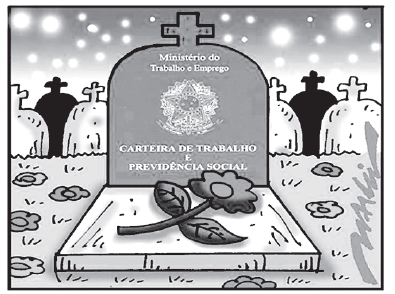
A charge é uma forma satírica de se retratar determinada situação vigente na sociedade, sendo que a charge apresentada critica,
no Brasil,
O positivismo influenciou diversos eventos históricos, tanto na Europa do século XIX quanto no Brasil, como se pode inferir
As obras de ficção, muitas vezes, se inspiram nos acontecimentos históricos, para recriá-los em sua narrativa.
Dessa forma, o trecho do romance de Timur Vermes caracteriza o pensamento
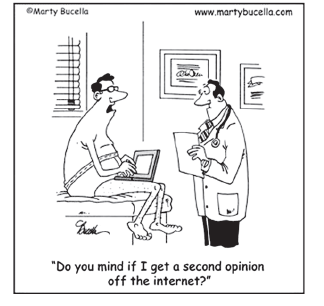
Disponível em: <www.google.com.br/search?q=Marty+Bucella%27+cartoon&rlz> . Acesso em: 12 out. 2017.
The patient in this cartoon
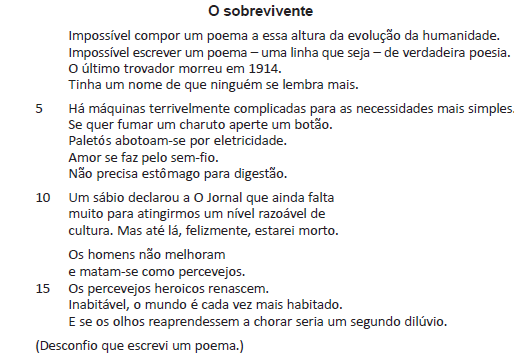
DRUMMOND DE ANDRADE, Carlos. Alguma poesia [1930]. Poesia Completa. Rio de Janeiro: Editora Nova Aguilar, 2002. p. 26.
Marque com V ou com F, conforme sejam, respectivamente, verdadeiras ou falsas as afirmativas sobre o texto.
( ) Uma comparação entre o início do poema (v. 1-2) e seu final (v. 18) permite inferir que o poeta, frente à trágica configuração do mundo, desiste de procurar entende-lo através de sua poesia.
( ) Na segunda estrofe (v. 5-9), as constatações do poeta se voltam para a difusão generalizada da tecnologia que retira a naturalidade das ações humanas, sufocando até mesmo o lirismo do amor.
( ) Em relação à possibilidade de melhoria do ser humano e de progresso do mundo, o poeta expressa pessimismo, nos versos de 10 a 12, revelando seu senso crítico e sua ironia.
( ) A comparação entre homens e percevejos (v. 13-14) destaca a irracionalidade da destruição da humanidade provocada pelas guerras e, ao mesmo tempo, a insistência heroica na preservação da espécie humana.
( ) O título do poema é uma alusão à esperança do poeta de que ele e sua poesia possam atravessar incólumes as grandes adversidades anunciadas para o século XX.
A alternativa que contém a sequência correta, de cima para baixo, é a
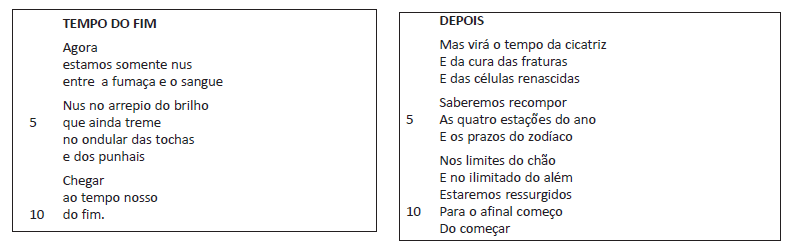
CUNHA, Helena Parente. Inéditos (Em tempo de Fim de Mundo). Além de estar: antologia poética. Rio de Janeiro: Imago; Salvador: fundação Cultural do Estado da Bahia, 2000. p. 192-193.
Há uma afirmação verdadeira sobre os poemas de Helena Parente Cunha em
I. . “brilho” (v. 4) e “tochas” (v. 6), no poema Tempo do fim, sugerem conclusão vitoriosa de um processo longo e penoso.
II. “quatro estações” (v. 5) e “prazos do zodíaco” (v. 6) no poema Depois, se referem às limitações que o tempo impõe à possibilidade de superar situações adversas.
III. “a fumaça e o sangue” (v. 3), no poema Tempo do fim, sugerem sofrimento e morte; “cicatriz” (v. 1) e “células renascidas” (v. 3), no poema Depois sugerem cura e superação.
IV. Em Tempo do fim, há uma constatação negativa, sobre a violência; em Depois, a autora acena com uma perspectiva positiva, de recuperação do equilíbrio.
V. Ao usar a primeira pessoa do plural nos dois poemas, a autora se inclui como integrante da humanidade, a respeito da qual faz constatações e previsões.
A alternativa em que todas as afirmativas indicadas estão corretas é a
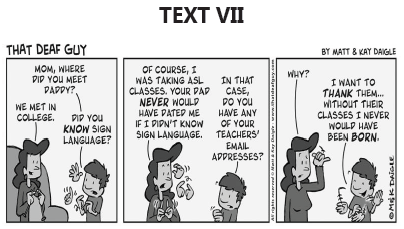 Taken from <http://www.thatdeafguy.com/?p=697> . Accessed on August
21st, 2017
Taken from <http://www.thatdeafguy.com/?p=697> . Accessed on August
21st, 2017In the exerpt "In that case, do you have any of your teachers e-mail addresses?", taken from TEXT VII, the corresponding reported speech for the sentence would be:
Taken from <http://www.thatdeafguy.com/?p=697> . Accessed on August 21st, 2017
That Deaf Guy is a website that reproduces situations about a family in which the father is deaf. From this comic stripe one can infer that:
TEXT V
They call it ‘tourism-phobia’ but that’s not what’s happening in Barcelona
Jordi Rabassa, Barcelona en Comú District Councilor for the
Old City in Barcelona
There‘s a new word that‘s taken over the local political debate in Barcelona: tourism-phobia. For months now, political and media personalities have been using accusations of tourism-phobia to attack the social movements and political parties that are questioning the so-called ‗tourism industry‘ and its repercussions on the right to the city.
The use of ―tourism-phobia‖ seeks to criminalize this criticism, painting it as a form of racism against people who visit the city in the popular imagination. But this attempt to compare, even at a subconscious level, ―tourism-phobia‖ and racism is not just irresponsible, it‘s a sign of defeat by those who have invented the word. Because these are the same people who warned us that regulating tourism would paralyze economic activity and employment in the city. This argument, based on the supposedly unquestionable logic of the productive economy, hasn‘t gone anywhere; it‘s the same old neoliberal discourse that tourism is a harmless and friendly activity. They‘ve just pushed it aside temporarily to make room for the related idea of tourism-phobia, which aims to appeal to people‘s emotions.
They call it tourism-phobia but they probably don‘t know what they really want to say. They use the concept of tourism-phobia to camouflage their support for business interests that are putting the right to the city of the people of Barcelona at risk. They call it tourism-phobia to weaken the city government, to criminalize the most active and radical social movements, and to patronize unorganized citizens. They call it tourism-phobia to inject a meme that can be launched on social media and vomited up on TV and the radio.
Those of us in Barcelona who criticize, problematize or reject an economic model based on the liberalization of the tourism industry are not filled with hate. We‘re defending human rights, principally the right to housing and the right to the city.
Those who criticize the hegemony of tourism as an economic model are calling for a fair and inclusive city, a city with neighborhoods where people can live. We‘re demanding rent caps and denouncing speculation with commercial premises and licenses. We‘re condemning the black market of tourist apartments that is pushing low-income families out of their homes. We‘re saying, loud and clear, that we want public, affordable housing. We‘re working to make sure that our streets and squares aren‘t overwhelmed by visitors. We‘re grieving for the men and women who‘ve been expelled from our neighborhoods.
They call it tourism-phobia but that‘s not what it is: it‘s a conscious demand for the right to the city.
Translation of an article published in eldiario.es on 27/06/2017
Disponível em: https://medium.com/@BComuGlobal/they-call-ittourism-phobia-but-that-s-not-what-s-happening-in-barcelonacb56b02da97b Acesso em: 07 ago. 2017.
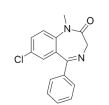
A respeito da molécula do diazepam, é correto afirmar que possui:
(Carone, E. A Primeira República – 1889-1930. Rio de Janeiro, Difel. 1976, p. 103)
O fragmento acima descreve uma das características mais marcantes da Primeira República, que é
(Disponível em <http://congressoemfoco.uol.com.br/noticias/mercosulsuspende-novamente-venezuela-por-ruptura-da-ordem-democratica/>.
Sobre o processo de formação do Mercosul, é CORRETO afirmar que:
(fonte: Folha de S. Paulo, 26/06/2017, disponível em <http://www1.folha.uol.com.br/mundo/2017/06/1896114-para-russosstalin-e-a-figura-mais-notavel-da-historia-mundial.shtml>. Acesso em 08/08/2017)
Figura emblemática do século XX, Stálin tornou-se importante historicamente em função de sua atuação:
Leia o trecho da reportagem abaixo e assinale a alternativa CORRETA:
"O senador Romero Jucá disse, em vídeo publicado em suas redes sociais, que marcou posição pela expulsão da Venezuela do Mercosul e fechamento da fronteira: ‗Semana que vem, vou com a prefeita Teresa Surita na Casa Civil falar sobre nossa posição‘. A Folha procurou a assessoria de Jucá, que informou que o senador fará, nesta quinta-feira, 17, um pronunciamento em seus perfis das redes sociais esclarecendo os pontos dessa proposta."
FOLHAWEB. Telmário é contra proposta de Jucá de fechamento da fronteira”. 17/08/2017. Disponível em <
http://www.folhabv.com.br/noticia/Telmario-e-contra-proposta-de-Jucade-fechamento-da-fronteira/31376>
 Conheça nossos planos