Foram encontradas 36.754 questões
Resolva questões gratuitamente!
Junte-se a mais de 4 milhões de concurseiros!


Texto 2
O CACTO
Aquele cacto lembrava os gestos desesperados da estatuária:
Laocoonte constrangido pelas serpentes,
Ugolino e os filhos esfaimados.
Evocava também o seco nordeste, carnaubais, caatingas...
Era enorme, mesmo para esta terra de feracidades excepcionais.
Um dia um tufão furibundo abateu-o pela raiz.
O cacto tombou atravessando a rua,
Quebrou os beirais do casario fronteiro,
Impediu o trânsito de bonde, automóveis, carroças,
Arrebentou os cabos elétricos e durante vinte e quatro horas privou a cidade de iluminação e
energia:
— Era belo, áspero, intratável.
(BANDEIRA, Manuel. Poesia completa e prosa. Rio de Janeiro: Aguillar, 1974. p. 205.)
Texto 3
A ÁRVORE DA SERRA
— As árvores, meu filho, não têm alma!
E esta árvore me serve de empecilho...
É preciso cortá-la, pois, meu filho,
Para que eu tenha uma velhice calma!
— Meu pai, por que sua ira não se acalma?!
Não vê que em tudo existe o mesmo brilho?!
Deus pôs almas nos cedros... no junquilho...
Esta árvore, meu pai, possui minha‘alma!...
— Disse — e ajoelhou-se, numa rogativa:
―Não mate a árvore, pai, para que eu viva!‖
E quando a árvore, olhando a pátria serra,
Caiu aos golpes do machado bronco,
O moço triste se abraçou com o tronco
E nunca mais se levantou da terra!
(ANJOS, Augusto. Eu e outras poesias. São Paulo: Martins Fontes, 1994. p. 90.)
Exam ine the follow ing cartoon to answ er question.
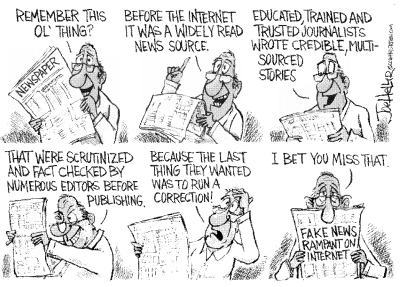
Sobre o cartoon, qual das afirmações a seguir é FALSA?
Tell Us What to Call the Generation After Millennials {Please)
Millennials are getting older. Not that much older, of course. We're a roughly defined generational cohort, but arguably the oldest members of our demographic set are just beginning to reach the age of 40.
Meanwhile, the American generation behind millennials has started to move intothe workplace. And while some have proposed names for this group born in 1995 and after — Generation Z, PostMillennials, The Homeland Generation, iGeneration — all of these names are bad. The first two don't even strive for originality! Come on. Then again, it's hard to know what makes a generational name stick.
"Millennial" was coined in the late 1980s by the consultants Neil Howe and William Strauss, both baby boomers, before the term Generation X was even popularized. (They wanted to call them "13th Gen," but that didn't stick, and neither did "slackers."
But their term "millennial" did not become the dominant name for the huge generation after those two until much later. "In retrospect, it's easy to see that names that people gravitate to say something," Mr. Howe said in a recent interview. "Either the name itself or the way in which it was adapted."
But Malcolm Harris, the millennial author of "Kids These Days: Human Capital and the Making of Millennials," argues that those most interested in naming generations are those trying to sell things to that cohort.
"Generations are really only understood in retrospect," Mr. Harris said. "Some people have a financial interest in naming them as soon as possible, people trying to sell stuff. That's the first perspective we get on any cohort, and I don't think it's necessarily a very good one."
One stumbling block is a lack of agreement about the birth years for each generation. People on the fringes can feel as if they've got almost nothing in common with the rest of the group. A few years' difference can determine if you could have been drafted for Vietnam, watched the first MTV videos, or were born into a world of instant messaging.
In 2015, the Census Bureau said that there were 83.1 million American millennials (born between 1982 and 2000), exceeding the 75.4 million baby boomers (between 1946 and 1964), and the 65 million that Pew Research said belong in Generation X (between 1965 and 1980). But the generation after millennials is still so ill-defined (probably because of the whole name issue) that an accurate count has not yet been established.
And a good name? Nope.
Fonte: New York Times. Publicado em 23/01/2018. Disponível em: https://www.nytimes.
com/2018/01/23/style/generation-names.html
Tell Us What to Call the Generation After Millennials {Please)
Millennials are getting older. Not that much older, of course. We're a roughly defined generational cohort, but arguably the oldest members of our demographic set are just beginning to reach the age of 40.
Meanwhile, the American generation behind millennials has started to move intothe workplace. And while some have proposed names for this group born in 1995 and after — Generation Z, PostMillennials, The Homeland Generation, iGeneration — all of these names are bad. The first two don't even strive for originality! Come on. Then again, it's hard to know what makes a generational name stick.
"Millennial" was coined in the late 1980s by the consultants Neil Howe and William Strauss, both baby boomers, before the term Generation X was even popularized. (They wanted to call them "13th Gen," but that didn't stick, and neither did "slackers."
But their term "millennial" did not become the dominant name for the huge generation after those two until much later. "In retrospect, it's easy to see that names that people gravitate to say something," Mr. Howe said in a recent interview. "Either the name itself or the way in which it was adapted."
But Malcolm Harris, the millennial author of "Kids These Days: Human Capital and the Making of Millennials," argues that those most interested in naming generations are those trying to sell things to that cohort.
"Generations are really only understood in retrospect," Mr. Harris said. "Some people have a financial interest in naming them as soon as possible, people trying to sell stuff. That's the first perspective we get on any cohort, and I don't think it's necessarily a very good one."
One stumbling block is a lack of agreement about the birth years for each generation. People on the fringes can feel as if they've got almost nothing in common with the rest of the group. A few years' difference can determine if you could have been drafted for Vietnam, watched the first MTV videos, or were born into a world of instant messaging.
In 2015, the Census Bureau said that there were 83.1 million American millennials (born between 1982 and 2000), exceeding the 75.4 million baby boomers (between 1946 and 1964), and the 65 million that Pew Research said belong in Generation X (between 1965 and 1980). But the generation after millennials is still so ill-defined (probably because of the whole name issue) that an accurate count has not yet been established.
And a good name? Nope.
Fonte: New York Times. Publicado em 23/01/2018. Disponível em: https://www.nytimes.
com/2018/01/23/style/generation-names.html
Tell Us What to Call the Generation After Millennials {Please)
Millennials are getting older. Not that much older, of course. We're a roughly defined generational cohort, but arguably the oldest members of our demographic set are just beginning to reach the age of 40.
Meanwhile, the American generation behind millennials has started to move intothe workplace. And while some have proposed names for this group born in 1995 and after — Generation Z, PostMillennials, The Homeland Generation, iGeneration — all of these names are bad. The first two don't even strive for originality! Come on. Then again, it's hard to know what makes a generational name stick.
"Millennial" was coined in the late 1980s by the consultants Neil Howe and William Strauss, both baby boomers, before the term Generation X was even popularized. (They wanted to call them "13th Gen," but that didn't stick, and neither did "slackers."
But their term "millennial" did not become the dominant name for the huge generation after those two until much later. "In retrospect, it's easy to see that names that people gravitate to say something," Mr. Howe said in a recent interview. "Either the name itself or the way in which it was adapted."
But Malcolm Harris, the millennial author of "Kids These Days: Human Capital and the Making of Millennials," argues that those most interested in naming generations are those trying to sell things to that cohort.
"Generations are really only understood in retrospect," Mr. Harris said. "Some people have a financial interest in naming them as soon as possible, people trying to sell stuff. That's the first perspective we get on any cohort, and I don't think it's necessarily a very good one."
One stumbling block is a lack of agreement about the birth years for each generation. People on the fringes can feel as if they've got almost nothing in common with the rest of the group. A few years' difference can determine if you could have been drafted for Vietnam, watched the first MTV videos, or were born into a world of instant messaging.
In 2015, the Census Bureau said that there were 83.1 million American millennials (born between 1982 and 2000), exceeding the 75.4 million baby boomers (between 1946 and 1964), and the 65 million that Pew Research said belong in Generation X (between 1965 and 1980). But the generation after millennials is still so ill-defined (probably because of the whole name issue) that an accurate count has not yet been established.
And a good name? Nope.
Fonte: New York Times. Publicado em 23/01/2018. Disponível em: https://www.nytimes.
com/2018/01/23/style/generation-names.html
Tell Us What to Call the Generation After Millennials {Please)
Millennials are getting older. Not that much older, of course. We're a roughly defined generational cohort, but arguably the oldest members of our demographic set are just beginning to reach the age of 40.
Meanwhile, the American generation behind millennials has started to move intothe workplace. And while some have proposed names for this group born in 1995 and after — Generation Z, PostMillennials, The Homeland Generation, iGeneration — all of these names are bad. The first two don't even strive for originality! Come on. Then again, it's hard to know what makes a generational name stick.
"Millennial" was coined in the late 1980s by the consultants Neil Howe and William Strauss, both baby boomers, before the term Generation X was even popularized. (They wanted to call them "13th Gen," but that didn't stick, and neither did "slackers."
But their term "millennial" did not become the dominant name for the huge generation after those two until much later. "In retrospect, it's easy to see that names that people gravitate to say something," Mr. Howe said in a recent interview. "Either the name itself or the way in which it was adapted."
But Malcolm Harris, the millennial author of "Kids These Days: Human Capital and the Making of Millennials," argues that those most interested in naming generations are those trying to sell things to that cohort.
"Generations are really only understood in retrospect," Mr. Harris said. "Some people have a financial interest in naming them as soon as possible, people trying to sell stuff. That's the first perspective we get on any cohort, and I don't think it's necessarily a very good one."
One stumbling block is a lack of agreement about the birth years for each generation. People on the fringes can feel as if they've got almost nothing in common with the rest of the group. A few years' difference can determine if you could have been drafted for Vietnam, watched the first MTV videos, or were born into a world of instant messaging.
In 2015, the Census Bureau said that there were 83.1 million American millennials (born between 1982 and 2000), exceeding the 75.4 million baby boomers (between 1946 and 1964), and the 65 million that Pew Research said belong in Generation X (between 1965 and 1980). But the generation after millennials is still so ill-defined (probably because of the whole name issue) that an accurate count has not yet been established.
And a good name? Nope.
Fonte: New York Times. Publicado em 23/01/2018. Disponível em: https://www.nytimes.
com/2018/01/23/style/generation-names.html
Quanto a esse fluxo migratório recente ao Brasil, é correto afirmar que:
Entre as escolas de samba do carnaval carioca de 2018, as campeãs se destacaram, também, por apresentar conteúdos de crítica social O samba-enredo Meu Deus, meu Deus, está extinta a escravidão?, da vice-campeã, Paraíso do Tuiuti, fazia referência ao fato de o Brasil ter sido o último país das Américas a abolir a escravidão e, 130 anos depois, o País estava na iminência de aprovar uma legislação que reduz benefícios e facilita a contratação de empregados terceirizados e temporários. Ao relacionar o lento processo de abolição da escravatura com a reforma da lei trabalhista, é correto afirmar que a Escola criticou a maneira como o País, historicamente, lida com:

Em 02 de setembro de 2018, um incêndio consumiu a maior parte do acervo do Mluseu Nacional, no Rio de Janeiro. Esse fato foi amplamente noticiado e comentado pela mídia nos dias subsequentes.
Sobre a tragédia envolvendo o Museu Nacional, assinale a alternativa correta:
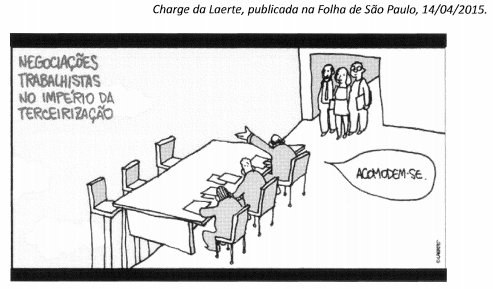
A charge da cartunista Laerte remete à nova situação das relações trabalhistas criada
recentemente no Brasil, e alude:
A charge de Henfil, ao lado, transmite parte dos sentimentos surgidos no processo de redemocratização do governo brasileiro, especialmente entre os anos 1987 e 1988, quando teve lugar a última constituinte. Seguindo o otimismo de Henfil, podemos afirmar que a constituição de 1988 foi:

 Conheça nossos planos