Foram encontradas 36.751 questões

Resolva questões gratuitamente!

Junte-se a mais de 4 milhões de concurseiros!

Ano: 2019 Banca: UEG Órgão: UEG Prova: UEG - 2019 - UEG - Vestibular - Medicina - Inglês |
Q1300923 Geografia
Nas semifinais da copa do mundo de futebol, realizadas no Brasil em 2014, a seleção brasileira jogou contra a Alemanha, no estádio do Mineirão em Belo Horizonte – MG, em partida que teve início às 17 horas do dia 8 de julho de 2014. Considerando os fusos horários de Brasil (-3UTC) e Alemanha (+1UTC, desconsiderando o horário de verão), os brasileiros que estavam na Alemanha assistiram ao jogo a partir das
Alternativas
Ano: 2019 Banca: UEG Órgão: UEG Prova: UEG - 2019 - UEG - Vestibular - Medicina - Inglês |
Q1300922 História e Geografia de Estados e Municípios
Leia o texto a seguir.
A comparação dos números admitidos por Cunha Mattos com o dos anos de 1804 e 1809 mostraria que os progressos da população se fizeram muito menos sentir entre os brancos do que entre os negros e mulatos livres, o que provaria, como tudo o que me leva a crer, que o clima da América Tropical convém mais aos homens de cor do que à raça caucásica.
SAINT-HILAIRE, Auguste de. Viagem às nascentes do rio São Francisco e pela Província de Goiás. São Paulo: Companhia Editora Nacional, 1937. p. 300.
Em 2019, completaram-se 200 anos da passagem do viajante francês Auguste de Saint-Hilaire por Goiás. No texto citado, ao analisar os dados demográficos sobre a população goiana, o francês corrobora a tese
Alternativas
Ano: 2019 Banca: UEG Órgão: UEG Prova: UEG - 2019 - UEG - Vestibular - Medicina - Inglês |
Q1300921 Conhecimentos Gerais
Leia o texto a seguir.
A eleição do presidente da república por via direta, a primeira em vinte e nove anos, com um eleitorado descontente, poderia levar a um resultado desfavorável aos interesses da elite. Inscreveram-se 24 candidatos cujas campanhas realizaram grandes comícios, ocuparam horários políticos gratuitos na televisão e no rádio, influenciando decisivamente na formação da opinião dos eleitores.
FIUSA, L. P. L.; DOMINGUES, J. E. História: o Brasil em foco. São Paulo: FTD, 1996. p. 391.
As eleições de 1989 confirmaram uma tendência verificada nos pleitos para o executivo municipal do ano 1988, cujas eleições foram marcadas
Alternativas
Ano: 2019 Banca: UEG Órgão: UEG Prova: UEG - 2019 - UEG - Vestibular - Medicina - Inglês |
Q1300920 Conhecimentos Gerais
Leia o texto a seguir.
Ao longo de 15 anos (1498 a 1513), Leonardo desenhou órgãos e elementos dos sistemas anatomofuncionais do corpo humano em um estudo que começou pela leitura das obras de autores da medicina pré-renascentista [...]. Ele também participou de dissecações do corpo humano e de diversos animais. Porém, jamais terminou e publicou a obra que, segundo pesquisadores, poderia ter revolucionado a medicina.
Disponível em: www.unicamp.br/unicamp/jr/568/leonardo-da-vinci-o-desbravador-do-corpo-humano. Acesso em: 6 maio 2019.
Em 2019 completam 500 anos da morte do pintor e inventor italiano Leonardo Da Vinci. A não publicação de suas pesquisas sobre corpos humanos e de animais impediu que ele somasse à sua fama de gênio universal também o título de “pai da anatomia” moderna. Esse reconhecimento ficou com
Alternativas
Ano: 2019 Banca: UEG Órgão: UEG Prova: UEG - 2019 - UEG - Vestibular - Medicina - Inglês |
Q1300919 História

Leia o texto a seguir.

A Grande Depressão confirmou a crença de intelectuais, ativistas e cidadãos comuns de que havia alguma coisa fundamentalmente errada no mundo em que viviam. Quem sabia o que se podia fazer a respeito? Certamente poucos dos que ocupavam cargos de autoridade em seus países e com certeza não aqueles que tentavam traçar um curso com os instrumentos de navegação tradicionais do liberalismo secular ou da fé tradicional, e com cartas dos mares do século XIX, nas quais era claro que não se devia mais confiar.  

HOBSBAWM, Eric. A Era dos Extremos. São Paulo: Companhia das Letras, 1995, p. 86.


O texto citado revela que as mais bem-sucedidas medidas econômicas utilizadas para combater os efeitos da Crise de 1929 advieram de novas posturas em relação às teorias econômicas vigentes, como aquelas colocadas em prática pelo presidente norte-americano Franklin Roosevelt. Essas medidas consistiram basicamente 

Alternativas
Ano: 2019 Banca: UEG Órgão: UEG Prova: UEG - 2019 - UEG - Vestibular - Medicina - Inglês |
Q1300918 História
Leia o texto a seguir.
Assim como sucedeu nas artes plásticas, sobretudo na arquitetura, os romanos dedicaram mais atenção à acumulação de experiências práticas, no campo das ciências [...]. Foram apoiados pelos imperadores os estudos de Medicina, inclusive construindo-se hospitais públicos e até uma escola de medicina, onde se realizavam intervenções cirúrgicas.
AQUINO; DENIZE; OSCAR. História das Sociedades. Rio de Janeiro: Ao livro técnico, 1980. p. 268-269.
Os saberes médicos romanos podem ser exemplificados a partir da atuação de
Alternativas
Ano: 2019 Banca: UEG Órgão: UEG Prova: UEG - 2019 - UEG - Vestibular - Medicina - Inglês |
Q1300915 Física
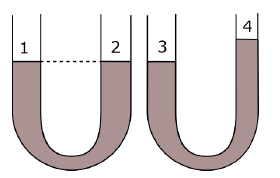
A figura a seguir apresenta dois vasos que estão em equilíbrio hidrostático, devido às pressões exercidas na superfície dos líquidos 1, 2, 3 e 4.
Imagem associada para resolução da questão

Os vasos são preenchidos com líquido de mesma densidade, logo, na superfície desses líquidos a pressão

Alternativas
Ano: 2019 Banca: UEG Órgão: UEG Prova: UEG - 2019 - UEG - Vestibular - Medicina - Inglês |
Q1300895 Português
Observe os quadrinhos a seguir.
Imagem associada para resolução da questão
Disponível em: http://psicologia-e-familia.blogspot.com/2012/04/charges-tirinhas-e-cartoons.html. Acesso em: 31 out. 2019.
O sentido dos quadrinhos, e seu consequente efeito cômico, são obtidos a partir do uso
Alternativas
Ano: 2019 Banca: UEG Órgão: UEG Prova: UEG - 2019 - UEG - Vestibular - Medicina - Inglês |
Q1300892 Inglês

Leia o texto a seguir para responder à questão. 

Artificial intelligence and the future of medicine

Washington University researchers are working to develop artificial intelligence (AI) systems for health care, which have the potential to transform the diagnosis and treatment of diseases, helping to ensure that patients get the right treatment at the right time.
In health care, artificial intelligence relies on the power of computers to sift through and make sense of reams of electronic data about patients—such as their ages, medical histories, health status, test results, medical images, DNA sequences, and many other sources of health information. AI excels at the complex identification of patterns in these reams of data, and it can do this at a scale and speed beyond human capacity. The hope is that this technology can be harnessed to help doctors and patients make better health-care decisions.


Where are the first places we will start to see AI entering medical practice?

One of the first applications of AI in patient care that we currently see is in imaging, to help improve the diagnosis of cancer or heart problems, for example. There are many types of imaging tests —X-rays, CT scans, MRIs and echocardiograms. But the underlying commonality in all those imaging methods is huge amounts of high-quality data. For AI to work well, it's best to have very complete data sets—no missing numbers, so to speak—and digital images provide that. Plus, the human eye is often blind to some of the patterns that could be present in these images—subtle changes in breast tissue over several years of mammograms, for example. There has been some interesting work done in recognizing early patterns of cancer or early patterns of heart failure that even a highly trained physician would not see.
In many ways, we already have very simple forms of AI in the clinic now. We've had tools for a long time that identify abnormal rhythms in an EKG, for example. An abnormal heartbeat pattern triggers an alert to draw a clinician's attention. This is a computer trying to replicate a human being understanding that data and saying, "This doesn't look normal, you may need to address this problem." Now, we have the capacity to analyze much larger and more complex sources of data, such as the entire electronic health record and perhaps even data pulled from daily life, as more people track their sleep patterns or pulse rates with wearable devices, for example.


What effect will this have on how doctors practice medicine?

It's important to emphasize that these tools are never going to replace clinicians. These technologies will provide assistance, helping care providers see important signals in massive amounts of data that would otherwise remain hidden. But at the same time, there are levels of understanding that computers still can't and may never replicate. To take a treatment recommendation from an AI, even an excellent recommendation, and decide if it's right for the patient is inherently a human decision-making process. What are the patient's preferences? What are the patient's values? What does this mean for the patient's life and for his or her family? That's never going to be an AI function. As these AI systems slowly emerge, we may start to see the roles of physicians changing—in my opinion, in better ways. Doctors' roles may shift from being data collectors and analyzers to being interpreters and councilors for patients as they try to navigate their health. 
Right now, the challenges we need to address as we try to bring AI into medical practice include improving the quality of the data that we feed into AI systems, developing ways to evaluate whether an AI system is actually better than standard of care, ensuring patient privacy and making sure not only that AI doesn't disrupt clinical work flow but in fact improves it. But if doctors do their jobs right and build these systems well, much of what we have described will become so ingrained in the system, people won't even refer to it separately as informatics or AI. It will just be medicine. 

Disponível em: https://medicalxpress.com/news/2018-12-artificial-intelligence-future-medicine.html. Acesso em: 02 maio 2019.
De acordo com o texto, em termos de sentido, verifica-se que o trecho
Alternativas
Ano: 2019 Banca: UEG Órgão: UEG Prova: UEG - 2019 - UEG - Vestibular - Medicina - Inglês |
Q1300891 Inglês

Leia o texto a seguir para responder à questão. 

Artificial intelligence and the future of medicine

Washington University researchers are working to develop artificial intelligence (AI) systems for health care, which have the potential to transform the diagnosis and treatment of diseases, helping to ensure that patients get the right treatment at the right time.
In health care, artificial intelligence relies on the power of computers to sift through and make sense of reams of electronic data about patients—such as their ages, medical histories, health status, test results, medical images, DNA sequences, and many other sources of health information. AI excels at the complex identification of patterns in these reams of data, and it can do this at a scale and speed beyond human capacity. The hope is that this technology can be harnessed to help doctors and patients make better health-care decisions.


Where are the first places we will start to see AI entering medical practice?

One of the first applications of AI in patient care that we currently see is in imaging, to help improve the diagnosis of cancer or heart problems, for example. There are many types of imaging tests —X-rays, CT scans, MRIs and echocardiograms. But the underlying commonality in all those imaging methods is huge amounts of high-quality data. For AI to work well, it's best to have very complete data sets—no missing numbers, so to speak—and digital images provide that. Plus, the human eye is often blind to some of the patterns that could be present in these images—subtle changes in breast tissue over several years of mammograms, for example. There has been some interesting work done in recognizing early patterns of cancer or early patterns of heart failure that even a highly trained physician would not see.
In many ways, we already have very simple forms of AI in the clinic now. We've had tools for a long time that identify abnormal rhythms in an EKG, for example. An abnormal heartbeat pattern triggers an alert to draw a clinician's attention. This is a computer trying to replicate a human being understanding that data and saying, "This doesn't look normal, you may need to address this problem." Now, we have the capacity to analyze much larger and more complex sources of data, such as the entire electronic health record and perhaps even data pulled from daily life, as more people track their sleep patterns or pulse rates with wearable devices, for example.


What effect will this have on how doctors practice medicine?

It's important to emphasize that these tools are never going to replace clinicians. These technologies will provide assistance, helping care providers see important signals in massive amounts of data that would otherwise remain hidden. But at the same time, there are levels of understanding that computers still can't and may never replicate. To take a treatment recommendation from an AI, even an excellent recommendation, and decide if it's right for the patient is inherently a human decision-making process. What are the patient's preferences? What are the patient's values? What does this mean for the patient's life and for his or her family? That's never going to be an AI function. As these AI systems slowly emerge, we may start to see the roles of physicians changing—in my opinion, in better ways. Doctors' roles may shift from being data collectors and analyzers to being interpreters and councilors for patients as they try to navigate their health. 
Right now, the challenges we need to address as we try to bring AI into medical practice include improving the quality of the data that we feed into AI systems, developing ways to evaluate whether an AI system is actually better than standard of care, ensuring patient privacy and making sure not only that AI doesn't disrupt clinical work flow but in fact improves it. But if doctors do their jobs right and build these systems well, much of what we have described will become so ingrained in the system, people won't even refer to it separately as informatics or AI. It will just be medicine. 

Disponível em: https://medicalxpress.com/news/2018-12-artificial-intelligence-future-medicine.html. Acesso em: 02 maio 2019.
Analisando-se os aspectos linguísticos e estruturais do texto, constata-se que
Alternativas
Ano: 2019 Banca: UEG Órgão: UEG Prova: UEG - 2019 - UEG - Vestibular - Medicina - Inglês |
Q1300890 Inglês

Leia o texto a seguir para responder à questão. 

Artificial intelligence and the future of medicine

Washington University researchers are working to develop artificial intelligence (AI) systems for health care, which have the potential to transform the diagnosis and treatment of diseases, helping to ensure that patients get the right treatment at the right time.
In health care, artificial intelligence relies on the power of computers to sift through and make sense of reams of electronic data about patients—such as their ages, medical histories, health status, test results, medical images, DNA sequences, and many other sources of health information. AI excels at the complex identification of patterns in these reams of data, and it can do this at a scale and speed beyond human capacity. The hope is that this technology can be harnessed to help doctors and patients make better health-care decisions.


Where are the first places we will start to see AI entering medical practice?

One of the first applications of AI in patient care that we currently see is in imaging, to help improve the diagnosis of cancer or heart problems, for example. There are many types of imaging tests —X-rays, CT scans, MRIs and echocardiograms. But the underlying commonality in all those imaging methods is huge amounts of high-quality data. For AI to work well, it's best to have very complete data sets—no missing numbers, so to speak—and digital images provide that. Plus, the human eye is often blind to some of the patterns that could be present in these images—subtle changes in breast tissue over several years of mammograms, for example. There has been some interesting work done in recognizing early patterns of cancer or early patterns of heart failure that even a highly trained physician would not see.
In many ways, we already have very simple forms of AI in the clinic now. We've had tools for a long time that identify abnormal rhythms in an EKG, for example. An abnormal heartbeat pattern triggers an alert to draw a clinician's attention. This is a computer trying to replicate a human being understanding that data and saying, "This doesn't look normal, you may need to address this problem." Now, we have the capacity to analyze much larger and more complex sources of data, such as the entire electronic health record and perhaps even data pulled from daily life, as more people track their sleep patterns or pulse rates with wearable devices, for example.


What effect will this have on how doctors practice medicine?

It's important to emphasize that these tools are never going to replace clinicians. These technologies will provide assistance, helping care providers see important signals in massive amounts of data that would otherwise remain hidden. But at the same time, there are levels of understanding that computers still can't and may never replicate. To take a treatment recommendation from an AI, even an excellent recommendation, and decide if it's right for the patient is inherently a human decision-making process. What are the patient's preferences? What are the patient's values? What does this mean for the patient's life and for his or her family? That's never going to be an AI function. As these AI systems slowly emerge, we may start to see the roles of physicians changing—in my opinion, in better ways. Doctors' roles may shift from being data collectors and analyzers to being interpreters and councilors for patients as they try to navigate their health. 
Right now, the challenges we need to address as we try to bring AI into medical practice include improving the quality of the data that we feed into AI systems, developing ways to evaluate whether an AI system is actually better than standard of care, ensuring patient privacy and making sure not only that AI doesn't disrupt clinical work flow but in fact improves it. But if doctors do their jobs right and build these systems well, much of what we have described will become so ingrained in the system, people won't even refer to it separately as informatics or AI. It will just be medicine. 

Disponível em: https://medicalxpress.com/news/2018-12-artificial-intelligence-future-medicine.html. Acesso em: 02 maio 2019.
Considering the ideas expressed in the text, artificial intelligence (AI) systems
Alternativas
Ano: 2019 Banca: UEG Órgão: UEG Prova: UEG - 2019 - UEG - Vestibular - Língua Inglesa |
Q1300849 Sociologia
A sociologia nasce no contexto da consolidação da ciência enquanto forma de pensamento dominante. Com o desenvolvimento do capitalismo e a progressiva urbanização, alguns pensadores começaram a refletir sobre os problemas da sociedade em transformação, como a fome, o saneamento básico, as longas e fatigantes jornadas de trabalho etc. A partir desse momento, emerge a sociologia, como uma ciência com objeto e método específicos, e surgem os primeiros sociólogos. Um destes sociólogos foi Auguste Comte, que fundamentou a sociologia a partir do método positivista. O positivismo de Comte defende
Alternativas
Ano: 2019 Banca: UEG Órgão: UEG Prova: UEG - 2019 - UEG - Vestibular - Língua Inglesa |
Q1300848 Filosofia
Karl Marx é considerado um dos grandes filósofos da época moderna. Em sua trajetória intelectual, ele teve grande influência de outro grande filósofo, Hegel. Existe uma polêmica sobre a posição de Marx em relação a Hegel a partir do momento em que ele fundou sua concepção materialista da história. A esse respeito, verifica-se que Marx:
Alternativas
Ano: 2019 Banca: UEG Órgão: UEG Prova: UEG - 2019 - UEG - Vestibular - Língua Inglesa |
Q1300847 Sociologia
Ideologia

Cazuza
Meu partido
É um coração partido
E as ilusões
Estão todas perdidas
Os meus sonhos
Foram todos vendidos
Tão barato que eu nem acredito
Ah! Eu nem acredito

Que aquele garoto
Que ia mudar o mundo
Mudar o mundo
Frequenta agora
As festas do Grand Monde

Meus heróis
Morreram de overdose
Meus inimigos
Estão no poder
Ideologia!
Eu quero uma pra viver
Ideologia!
Eu quero uma pra viver

O meu prazer
Agora é risco de vida
Meu sex and drugs
Não tem nenhum rock 'n' roll
Eu vou pagar
A conta do analista
Pra nunca mais
Ter que saber
Quem eu sou
Ah! Saber quem eu sou

Pois aquele garoto
Que ia mudar o mundo
Mudar o mundo
Agora assiste a tudo
Em cima do muro
Em cima do muro!

Meus heróis
Morreram de overdose
Meus inimigos
Estão no poder
Ideologia!
Eu quero uma pra viver
Ideologia!
Pra viver

Pois aquele garoto
Que ia mudar o mundo
Mudar o mundo
Agora assiste a tudo
Em cima do muro
Em cima do muro

Meus heróis
Morreram de overdose
Meus inimigos
Estão no poder
Ideologia!
Eu quero uma pra viver
Ideologia!
Eu quero uma pra viver
Ideologia!
Pra viver
Ideologia!
Eu quero uma pra viver

Disponível em: https://www.letras.mus.br/cazuza/43860/. Acesso em: 09 out. 2019.
O termo “ideologia” é um dos mais abordados na história da filosofia e da sociologia. Desde o surgimento da palavra e seu primeiro significado, com Destutt de Tracy, ela recebeu várias interpretações, entre as quais as de Marx e posteriormente Mannheim, até chegar a Ricouer e outros. A ideologia já foi concebida como falsa consciência, sistema de pensamento ilusório, pensamento valorativo, concepção metafísica pré-científica, visão de mundo, etc. A letra da música “ideologia” tematiza esse termo. A partir das concepções existentes sobre esse termo, podemos dizer que a ideologia, de acordo com a letra da música, se aproxima mais da concepção:
Alternativas
Ano: 2019 Banca: UEG Órgão: UEG Prova: UEG - 2019 - UEG - Vestibular - Língua Inglesa |
Q1300846 Sociologia
No final dos anos 1960, uma crise na sociedade foi fortalecida por movimentos de contestação social. Entre estes movimentos destaca-se a rebelião de Maio de 1968 na França, em que estudantes se aliaram aos operários na contestação de diversos elementos da sociabilidade e das relações sociais existentes. Esta rebelião se constituiu em um marco para a organização política dos movimentos sociais, pois apresentava tendências
Alternativas
Ano: 2019 Banca: UEG Órgão: UEG Prova: UEG - 2019 - UEG - Vestibular - Língua Inglesa |
Q1300845 Geografia

“Inferno na floresta: o que sabemos sobre os incêndios na Amazônia

A Amazônia sempre sofreu com queimadas ligadas à exploração de terra.

Mas como isso chegou tão longe?

São Paulo – Os olhos do Brasil e do mundo se voltam para a maior floresta tropical e maior reserva de biodiversidade da Terra. Milhares de mensagens de alerta em diferentes línguas circulam nas redes sociais com a hashtag #PrayForAmazonia. A razão não poderia ser pior: a Amazônia arde em chamas”.

Disponível em: https://exame.abril.com.br/brasil/inferno-na-floresta-o-que-sabemos-sobre-os-incendios-na-amazonia/. Acesso em: 20 set. 2019.

O texto alerta para o problema ambiental das queimadas na região da Amazônia brasileira, que no ano de 2019 tornou-se assunto frequente nas mídias internacionais. Sobre as causas desses focos de queimadas/incêndios, tem se que:
Alternativas
Ano: 2019 Banca: UEG Órgão: UEG Prova: UEG - 2019 - UEG - Vestibular - Língua Inglesa |
Q1300844 Geografia
Considerando que em Brasília, localizada no fuso horário UTC -3, sejam exatamente 16 horas, na cidade de Los Angeles, nos Estados Unidos da América, localizada no fuso horário UTC -8, serão, nesse mesmo dia, exatamente:
Alternativas
Ano: 2019 Banca: UEG Órgão: UEG Prova: UEG - 2019 - UEG - Vestibular - Língua Inglesa |
Q1300843 Geografia
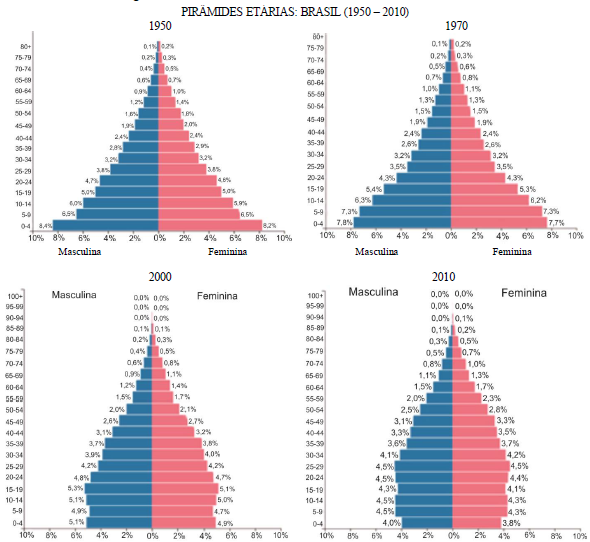
A população de um país pode ser caracterizada com base em vários parâmetros, dentre eles: idade e gênero, conforme se verifica a seguir. Imagem associada para resolução da questão Com base nas pirâmides etárias apresentadas, constata-se o seguinte:
Alternativas
Ano: 2019 Banca: UEG Órgão: UEG Prova: UEG - 2019 - UEG - Vestibular - Língua Inglesa |
Q1300842 História e Geografia de Estados e Municípios

Dentre as fontes de arrecadação de impostos no estado de Goiás, o maior percentual provém do Imposto Sobre Circulação de Mercadorias (ICMS):
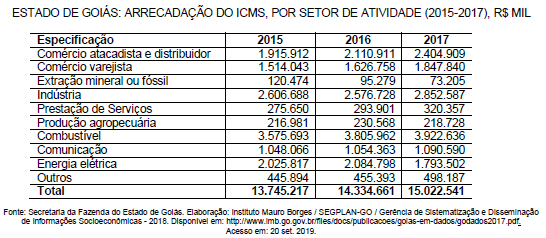
Imagem associada para resolução da questão

Com base nos dados da tabela apresentada, verifica-se que

Alternativas
Ano: 2019 Banca: UEG Órgão: UEG Prova: UEG - 2019 - UEG - Vestibular - Língua Inglesa |
Q1300841 História

Leia o texto a seguir.

A construção dos Estados Nacionais significou um longo processo de lutas sociais e políticas, em que se confrontaram adversários poderosos, muitas vezes acompanhados de longas guerras civis, envolvendo grande parte da sociedade, de abastados fazendeiros a pobres peões.

PRADO, M.L.C. América Latina no século XIX: tramas, telas e textos. São Paulo: Edusp, 2004. p. 75.

O texto citado refere-se ao contexto de emancipação política dos países latino-americanos. Um caso singular de libertação na qual o país emancipou-se lutando contra outra nação americana foi o

Alternativas
Respostas
9481: A
9482: C
9483: A
9484: D
9485: B
9486: B
9487: E
9488: E
9489: D
9490: A
9491: D
9492: C
9493: E
9494: C
9495: A
9496: D
9497: D
9498: E
9499: B
9500: A