Foram encontradas 36.667 questões
Resolva questões gratuitamente!
Junte-se a mais de 4 milhões de concurseiros!


A criação do Banco da Amazônia e da Superintendência do Desenvolvimento da Amazônia (SUDAM) preconizou uma política de concessão de incentivos fiscais aos empresários, especialmente das regiões mais ricas do país, para que deixassem de pagar 50% do imposto de renda, desde que o dinheiro fosse depositado naquele banco para financiar projetos de desenvolvimento no estado do Amazonas. Os investimentos orientaram-se de preferência para a agropecuária, de modo que um grande número de empresários e de empresas, especialmente do Sudeste do Brasil sem tradição no ramo; tornaram-se proprietários de terras e empresários rurais. Em princípio a aquisição de terras pelos grandes capitalistas do Sudeste animou o mercado imobiliário.
José de Sousa Martins. O Poder do Atraso. Adaptado.
Assinale a alternativa que apresenta a combinação correta entre o período a que se refere o texto e as implicações, territoriais e sociais, observadas nas áreas onde a política de incentivos fiscais entrou em operação.
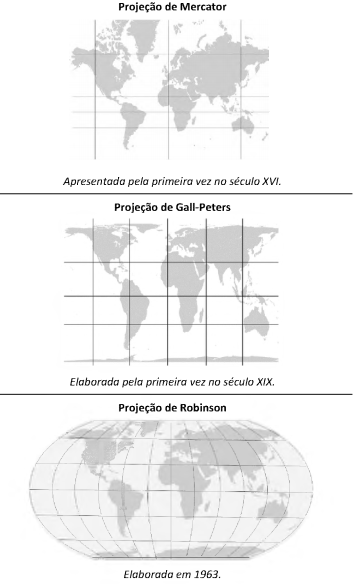
Sobre as projeções cartográficas apresentadas, suas formas e
dimensões, é correto afirmar:
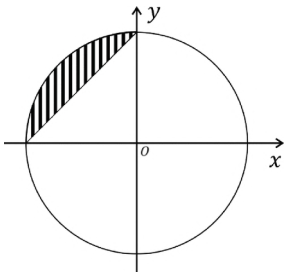
A região hachurada do plano cartesiano xOy contida no círculo de centro na origem O e raio 1, mostrada na figura, pode ser descrita por
Note e adote:
círculo de centro O e raio 1 é o conjunto de todos os pontos do plano que
estão a uma distância de O menor do que ou igual a 1.
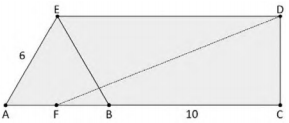
Na figura, os segmentos AC e DE são paralelos entre si e
perpendiculares ao segmento CD; o ponto B pertence ao
segmento AC; F é o ponto médio do segmento AB; e ABE é um
triângulo equilátero. Além disso, o segmento BC mede 10
unidades de comprimento e o segmento AE mede 6 unidades
de comprimento. A medida do segmento DF, em unidades de
comprimento, é igual a
Um aplicativo de videoconferências estabelece, para cada reunião, um código de 10 letras, usando um alfabeto completo de 26 letras. A quantidade de códigos distintos possíveis está entre
Note e adote:
log10 13 ≅ 1,114
1 bilhão = 109
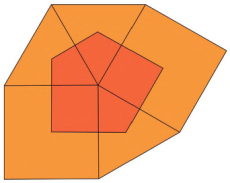
Três triângulos equiláteros e dois quadrados formam uma
figura plana, como ilustrado. Seus centros são os vértices de um
pentágono irregular, que está destacado na figura. Se T é a área
de cada um dos triângulos e Q a área de cada um dos
quadrados, a área desse pentágono é

O quadrinho aborda o tema de números primos, sobre os quais
é correto afirmar:
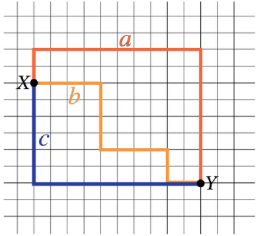
A figura ilustra graficamente uma região de um bairro, com ruas
ortogonais entre si. O ponto X indica um condomínio
residencial, e o ponto Y indica a entrada de um parque. Três
moradores realizam caminhos diferentes para chegar ao ponto Y,
partindo do ponto X, ilustrados com cores diferentes. Se a, b e
c representam as distâncias percorridas por esses moradores
nesses caminhos, é correto afirmar que
How things have changed.
Now disagreements feel deadly serious. Like when your colleague pronounces that wearing a face mask in public is a threat to his liberty. Or when you see that one of your friends has just tweeted that, actually, all lives matter. Before you know it, you’re feeling angry and forming harsh new judgments about your colleagues and friends. Let’s take a collective pause and breathe: there are some ways we can all try to have more civil disagreements in this febrile age of culture wars.
1. ‘Coupling’ and ‘decoupling’
The first is to consider how inclined people are to ‘couple’ or ‘decouple’ topics involving wider political and social factors. Swedish data analyst John Nerst has used the terms to describe the contrasting ways in which people approach contentious issues. Those of us more inclined to ‘couple’ see them as inextricably related to a broader matrix of factors, whereas those more predisposed to ‘decouple’ prefer to consider an issue in isolation. To take a crude example, a decoupler might consider in isolation the question of whether a vaccine provides a degree of immunity to a virus; a coupler, by contrast, would immediately see the issue as inextricably entangled in a mesh of factors, such as pharmaceutical industry power and parental choice.
2.____________________
A study at Arizona State University, U.S., analysed more than 100,000 comments on a forum where users post their views on an issue and invite others to persuade them to change their mind. The researchers found that regardless of the kind of topic, people were more likely to change their mind when confronted with more evidence-based arguments. “Our work may suggest that while attitude change is hard-won, providing facts, statistics and citations for one’s arguments can convince people to change their minds,” they concluded.
3. Just be nicer?
Finally, it’s easier said than done, but let’s all try to be more respectful of and attentive to each other’s positions. We should do this not just for virtuous reasons, but because the more we create that kind of a climate, the more open-minded and intellectually flexible we will all be inclined to be. And then hopefully, collectively, we can start having more constructive disagreements — even in our present very difficult times.
How things have changed.
Now disagreements feel deadly serious. Like when your colleague pronounces that wearing a face mask in public is a threat to his liberty. Or when you see that one of your friends has just tweeted that, actually, all lives matter. Before you know it, you’re feeling angry and forming harsh new judgments about your colleagues and friends. Let’s take a collective pause and breathe: there are some ways we can all try to have more civil disagreements in this febrile age of culture wars.
1. ‘Coupling’ and ‘decoupling’
The first is to consider how inclined people are to ‘couple’ or ‘decouple’ topics involving wider political and social factors. Swedish data analyst John Nerst has used the terms to describe the contrasting ways in which people approach contentious issues. Those of us more inclined to ‘couple’ see them as inextricably related to a broader matrix of factors, whereas those more predisposed to ‘decouple’ prefer to consider an issue in isolation. To take a crude example, a decoupler might consider in isolation the question of whether a vaccine provides a degree of immunity to a virus; a coupler, by contrast, would immediately see the issue as inextricably entangled in a mesh of factors, such as pharmaceutical industry power and parental choice.
2.____________________
A study at Arizona State University, U.S., analysed more than 100,000 comments on a forum where users post their views on an issue and invite others to persuade them to change their mind. The researchers found that regardless of the kind of topic, people were more likely to change their mind when confronted with more evidence-based arguments. “Our work may suggest that while attitude change is hard-won, providing facts, statistics and citations for one’s arguments can convince people to change their minds,” they concluded.
3. Just be nicer?
Finally, it’s easier said than done, but let’s all try to be more respectful of and attentive to each other’s positions. We should do this not just for virtuous reasons, but because the more we create that kind of a climate, the more open-minded and intellectually flexible we will all be inclined to be. And then hopefully, collectively, we can start having more constructive disagreements — even in our present very difficult times.
How things have changed.
Now disagreements feel deadly serious. Like when your colleague pronounces that wearing a face mask in public is a threat to his liberty. Or when you see that one of your friends has just tweeted that, actually, all lives matter. Before you know it, you’re feeling angry and forming harsh new judgments about your colleagues and friends. Let’s take a collective pause and breathe: there are some ways we can all try to have more civil disagreements in this febrile age of culture wars.
1. ‘Coupling’ and ‘decoupling’
The first is to consider how inclined people are to ‘couple’ or ‘decouple’ topics involving wider political and social factors. Swedish data analyst John Nerst has used the terms to describe the contrasting ways in which people approach contentious issues. Those of us more inclined to ‘couple’ see them as inextricably related to a broader matrix of factors, whereas those more predisposed to ‘decouple’ prefer to consider an issue in isolation. To take a crude example, a decoupler might consider in isolation the question of whether a vaccine provides a degree of immunity to a virus; a coupler, by contrast, would immediately see the issue as inextricably entangled in a mesh of factors, such as pharmaceutical industry power and parental choice.
2.____________________
A study at Arizona State University, U.S., analysed more than 100,000 comments on a forum where users post their views on an issue and invite others to persuade them to change their mind. The researchers found that regardless of the kind of topic, people were more likely to change their mind when confronted with more evidence-based arguments. “Our work may suggest that while attitude change is hard-won, providing facts, statistics and citations for one’s arguments can convince people to change their minds,” they concluded.
3. Just be nicer?
Finally, it’s easier said than done, but let’s all try to be more respectful of and attentive to each other’s positions. We should do this not just for virtuous reasons, but because the more we create that kind of a climate, the more open-minded and intellectually flexible we will all be inclined to be. And then hopefully, collectively, we can start having more constructive disagreements — even in our present very difficult times.
How things have changed.
Now disagreements feel deadly serious. Like when your colleague pronounces that wearing a face mask in public is a threat to his liberty. Or when you see that one of your friends has just tweeted that, actually, all lives matter. Before you know it, you’re feeling angry and forming harsh new judgments about your colleagues and friends. Let’s take a collective pause and breathe: there are some ways we can all try to have more civil disagreements in this febrile age of culture wars.
1. ‘Coupling’ and ‘decoupling’
The first is to consider how inclined people are to ‘couple’ or ‘decouple’ topics involving wider political and social factors. Swedish data analyst John Nerst has used the terms to describe the contrasting ways in which people approach contentious issues. Those of us more inclined to ‘couple’ see them as inextricably related to a broader matrix of factors, whereas those more predisposed to ‘decouple’ prefer to consider an issue in isolation. To take a crude example, a decoupler might consider in isolation the question of whether a vaccine provides a degree of immunity to a virus; a coupler, by contrast, would immediately see the issue as inextricably entangled in a mesh of factors, such as pharmaceutical industry power and parental choice.
2.____________________
A study at Arizona State University, U.S., analysed more than 100,000 comments on a forum where users post their views on an issue and invite others to persuade them to change their mind. The researchers found that regardless of the kind of topic, people were more likely to change their mind when confronted with more evidence-based arguments. “Our work may suggest that while attitude change is hard-won, providing facts, statistics and citations for one’s arguments can convince people to change their minds,” they concluded.
3. Just be nicer?
Finally, it’s easier said than done, but let’s all try to be more respectful of and attentive to each other’s positions. We should do this not just for virtuous reasons, but because the more we create that kind of a climate, the more open-minded and intellectually flexible we will all be inclined to be. And then hopefully, collectively, we can start having more constructive disagreements — even in our present very difficult times.
How things have changed.
Now disagreements feel deadly serious. Like when your colleague pronounces that wearing a face mask in public is a threat to his liberty. Or when you see that one of your friends has just tweeted that, actually, all lives matter. Before you know it, you’re feeling angry and forming harsh new judgments about your colleagues and friends. Let’s take a collective pause and breathe: there are some ways we can all try to have more civil disagreements in this febrile age of culture wars.
1. ‘Coupling’ and ‘decoupling’
The first is to consider how inclined people are to ‘couple’ or ‘decouple’ topics involving wider political and social factors. Swedish data analyst John Nerst has used the terms to describe the contrasting ways in which people approach contentious issues. Those of us more inclined to ‘couple’ see them as inextricably related to a broader matrix of factors, whereas those more predisposed to ‘decouple’ prefer to consider an issue in isolation. To take a crude example, a decoupler might consider in isolation the question of whether a vaccine provides a degree of immunity to a virus; a coupler, by contrast, would immediately see the issue as inextricably entangled in a mesh of factors, such as pharmaceutical industry power and parental choice.
2.____________________
A study at Arizona State University, U.S., analysed more than 100,000 comments on a forum where users post their views on an issue and invite others to persuade them to change their mind. The researchers found that regardless of the kind of topic, people were more likely to change their mind when confronted with more evidence-based arguments. “Our work may suggest that while attitude change is hard-won, providing facts, statistics and citations for one’s arguments can convince people to change their minds,” they concluded.
3. Just be nicer?
Finally, it’s easier said than done, but let’s all try to be more respectful of and attentive to each other’s positions. We should do this not just for virtuous reasons, but because the more we create that kind of a climate, the more open-minded and intellectually flexible we will all be inclined to be. And then hopefully, collectively, we can start having more constructive disagreements — even in our present very difficult times.
 Conheça nossos planos