Questões de Vestibular
Para cecierj e cederj
Foram encontradas 1.177 questões
Resolva questões gratuitamente!
Junte-se a mais de 4 milhões de concurseiros!


Q594170
Português
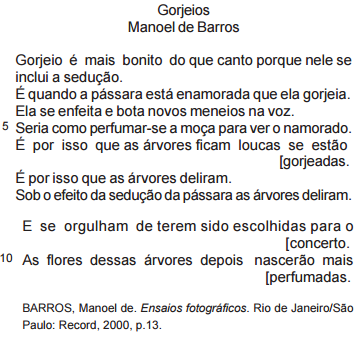
Na frase “É por isso que as árvores deliram", “isso"
se refere a
Q594169
Português
No processo de coesão lexical, o mecanismo de
substituição pode se realizado por meio da sinonímia,
em que há a substituição de expressões que
compartilham os mesmos traços semânticos. Sabe-se,
no entanto, que não existem sinônimos perfeitos.
Justifique essa afirmativa – de que não existem sinônimos
perfeitos – levando em consideração os termos
sublinhados em:
Q594168
Português
Para expressar a beleza do gorjeio da pássara, no
verso “Seria como perfumar-se a moça para ver o
namorado", é utilizado o seguinte recurso:
Q594167
Português
Texto associado
O Jardineiro
Lygia Fagundes Telles
Só colhia rosas ao anoitecer porque durante o sono elas não sentiam o aço frio da tesoura. Uma noite ele sonhou que cortava as hastes de manhã, em pleno sol, as rosas despertas e gritando, sangrando na altura do corte das cabeças decepadas. Quando ele acordou viu que estava com as mãos sujas de sangue.
TELLES, Lygia Fagundes. A disciplina do amor. 6.ed. Rio de Janeiro: Nova Fronteira, 1980, p. 78
“Só colhia rosas ao anoitecer..." (linha 1). O conector
sublinhado expressa a ideia de
Q594166
Português
Texto associado
O Jardineiro
Lygia Fagundes Telles
Só colhia rosas ao anoitecer porque durante o sono elas não sentiam o aço frio da tesoura. Uma noite ele sonhou que cortava as hastes de manhã, em pleno sol, as rosas despertas e gritando, sangrando na altura do corte das cabeças decepadas. Quando ele acordou viu que estava com as mãos sujas de sangue.
TELLES, Lygia Fagundes. A disciplina do amor. 6.ed. Rio de Janeiro: Nova Fronteira, 1980, p. 78
O tipo textual predominante no texto é o:
Q582505
Inglês
Texto associado

What Your Tweets Say About You
By Maria Konnikov
How much can your tweets reveal about you? A lot! - would be the answer of psychologists James Pennebaker e Cindy Chung, at the University of Texas, who study how language relates to well-being and personality. One of Pennebaker’s most famous projects is a computer program called Linguistic Inquiry and Word Count (L.I.W.C.), which looks at the words we use, and in what frequency and context, and uses this information to study our psychological states and various aspects of our personality.
Since the creation of the L.I.W.C., in 1993, studies utilizing the program have suggested a close connection between our language, our state of mind, and our behavior. They have shown, for instance, that a person’s word choices can reveal her place in a social or professional hierarchy; and that the use of different filler words (“I mean”; “You know”) can suggest whether a speaker is male or female, younger or older, and more or less conscientious. “The words we use in natural language reflect our thoughts and feelings in often unpredictable ways,” Pennebaker and Cindy Chung have written.
The psychologist Johannes Eichstaedt and his colleagues analyzed eight hundred and twenty-six million tweets across fourteen hundred American counties(1). Then, using lists of words that can be reliably associated with positive and negative emotions, they gave each county an emotional profile. Finally, they asked a simple question: Could those profiles help determine which counties were likely to have more deaths from heart disease?
The answer was yes. Counties where residents’ tweets included words related to hostility, aggression, hate, and, fatigue — words such as “jealous,” and “bored”— had significantly higher rates of heart-related deaths. On the other hand, where people’s tweets reflected more positive emotions and engagement, heart disease was less common. The tweet-based model even had more predictive power than other models based on traditional demographic, socioeconomic, and health-risk factors.
(1) Um condado (county/counties) ou província é um aglomerado de cidades, não tão grande quanto um estado.
From: http://www.newyorker.com/science/maria-konnikova/can-tweets-predict-heart-disease
GLOSSARY: conscientious: consciencioso/cuidadoso; reliably: seguramente; profile: perfil; heart disease: doença do coração; hate: ódio; jealous: com ciúmes; bored: entediado; higher rates: taxas mais altas; engagement: comprometimento; predictive: previsível.
Leia o texto e responda à questão.
O conector “on the other hand", na quinta linha do último parágrafo, estabelece uma relação de:
Q582504
Inglês
Texto associado
What Your Tweets Say About You
By Maria Konnikov
How much can your tweets reveal about you? A lot! - would be the answer of psychologists James Pennebaker e Cindy Chung, at the University of Texas, who study how language relates to well-being and personality. One of Pennebaker’s most famous projects is a computer program called Linguistic Inquiry and Word Count (L.I.W.C.), which looks at the words we use, and in what frequency and context, and uses this information to study our psychological states and various aspects of our personality.
Since the creation of the L.I.W.C., in 1993, studies utilizing the program have suggested a close connection between our language, our state of mind, and our behavior. They have shown, for instance, that a person’s word choices can reveal her place in a social or professional hierarchy; and that the use of different filler words (“I mean”; “You know”) can suggest whether a speaker is male or female, younger or older, and more or less conscientious. “The words we use in natural language reflect our thoughts and feelings in often unpredictable ways,” Pennebaker and Cindy Chung have written.
The psychologist Johannes Eichstaedt and his colleagues analyzed eight hundred and twenty-six million tweets across fourteen hundred American counties(1). Then, using lists of words that can be reliably associated with positive and negative emotions, they gave each county an emotional profile. Finally, they asked a simple question: Could those profiles help determine which counties were likely to have more deaths from heart disease?
The answer was yes. Counties where residents’ tweets included words related to hostility, aggression, hate, and, fatigue — words such as “jealous,” and “bored”— had significantly higher rates of heart-related deaths. On the other hand, where people’s tweets reflected more positive emotions and engagement, heart disease was less common. The tweet-based model even had more predictive power than other models based on traditional demographic, socioeconomic, and health-risk factors.
(1) Um condado (county/counties) ou província é um aglomerado de cidades, não tão grande quanto um estado.
From: http://www.newyorker.com/science/maria-konnikova/can-tweets-predict-heart-disease
GLOSSARY: conscientious: consciencioso/cuidadoso; reliably: seguramente; profile: perfil; heart disease: doença do coração; hate: ódio; jealous: com ciúmes; bored: entediado; higher rates: taxas mais altas; engagement: comprometimento; predictive: previsível.
Leia o texto e responda à questão.
No terceiro parágrafo, o pronome “they" se refere:
Q582503
Inglês
Texto associado

What Your Tweets Say About You
By Maria Konnikov
How much can your tweets reveal about you? A lot! - would be the answer of psychologists James Pennebaker e Cindy Chung, at the University of Texas, who study how language relates to well-being and personality. One of Pennebaker’s most famous projects is a computer program called Linguistic Inquiry and Word Count (L.I.W.C.), which looks at the words we use, and in what frequency and context, and uses this information to study our psychological states and various aspects of our personality.
Since the creation of the L.I.W.C., in 1993, studies utilizing the program have suggested a close connection between our language, our state of mind, and our behavior. They have shown, for instance, that a person’s word choices can reveal her place in a social or professional hierarchy; and that the use of different filler words (“I mean”; “You know”) can suggest whether a speaker is male or female, younger or older, and more or less conscientious. “The words we use in natural language reflect our thoughts and feelings in often unpredictable ways,” Pennebaker and Cindy Chung have written.
The psychologist Johannes Eichstaedt and his colleagues analyzed eight hundred and twenty-six million tweets across fourteen hundred American counties(1). Then, using lists of words that can be reliably associated with positive and negative emotions, they gave each county an emotional profile. Finally, they asked a simple question: Could those profiles help determine which counties were likely to have more deaths from heart disease?
The answer was yes. Counties where residents’ tweets included words related to hostility, aggression, hate, and, fatigue — words such as “jealous,” and “bored”— had significantly higher rates of heart-related deaths. On the other hand, where people’s tweets reflected more positive emotions and engagement, heart disease was less common. The tweet-based model even had more predictive power than other models based on traditional demographic, socioeconomic, and health-risk factors.
(1) Um condado (county/counties) ou província é um aglomerado de cidades, não tão grande quanto um estado.
From: http://www.newyorker.com/science/maria-konnikova/can-tweets-predict-heart-disease
GLOSSARY: conscientious: consciencioso/cuidadoso; reliably: seguramente; profile: perfil; heart disease: doença do coração; hate: ódio; jealous: com ciúmes; bored: entediado; higher rates: taxas mais altas; engagement: comprometimento; predictive: previsível.
Read the text and answer question.
What is the relationship between the words used in tweets and the health condition of a county's residents?
Q582502
Inglês
Texto associado
What Your Tweets Say About You
By Maria Konnikov
How much can your tweets reveal about you? A lot! - would be the answer of psychologists James Pennebaker e Cindy Chung, at the University of Texas, who study how language relates to well-being and personality. One of Pennebaker’s most famous projects is a computer program called Linguistic Inquiry and Word Count (L.I.W.C.), which looks at the words we use, and in what frequency and context, and uses this information to study our psychological states and various aspects of our personality.
Since the creation of the L.I.W.C., in 1993, studies utilizing the program have suggested a close connection between our language, our state of mind, and our behavior. They have shown, for instance, that a person’s word choices can reveal her place in a social or professional hierarchy; and that the use of different filler words (“I mean”; “You know”) can suggest whether a speaker is male or female, younger or older, and more or less conscientious. “The words we use in natural language reflect our thoughts and feelings in often unpredictable ways,” Pennebaker and Cindy Chung have written.
The psychologist Johannes Eichstaedt and his colleagues analyzed eight hundred and twenty-six million tweets across fourteen hundred American counties(1). Then, using lists of words that can be reliably associated with positive and negative emotions, they gave each county an emotional profile. Finally, they asked a simple question: Could those profiles help determine which counties were likely to have more deaths from heart disease?
The answer was yes. Counties where residents’ tweets included words related to hostility, aggression, hate, and, fatigue — words such as “jealous,” and “bored”— had significantly higher rates of heart-related deaths. On the other hand, where people’s tweets reflected more positive emotions and engagement, heart disease was less common. The tweet-based model even had more predictive power than other models based on traditional demographic, socioeconomic, and health-risk factors.
(1) Um condado (county/counties) ou província é um aglomerado de cidades, não tão grande quanto um estado.
From: http://www.newyorker.com/science/maria-konnikova/can-tweets-predict-heart-disease
GLOSSARY: conscientious: consciencioso/cuidadoso; reliably: seguramente; profile: perfil; heart disease: doença do coração; hate: ódio; jealous: com ciúmes; bored: entediado; higher rates: taxas mais altas; engagement: comprometimento; predictive: previsível.
Read the text and answer question.
According to the text, studies using the L.I.W.C. program have suggested a “close connection between our language, our state of mind, and our behavior." What statement bellow corroborates this conclusion?
Q582501
Inglês
Texto associado
What Your Tweets Say About You
By Maria Konnikov
How much can your tweets reveal about you? A lot! - would be the answer of psychologists James Pennebaker e Cindy Chung, at the University of Texas, who study how language relates to well-being and personality. One of Pennebaker’s most famous projects is a computer program called Linguistic Inquiry and Word Count (L.I.W.C.), which looks at the words we use, and in what frequency and context, and uses this information to study our psychological states and various aspects of our personality.
Since the creation of the L.I.W.C., in 1993, studies utilizing the program have suggested a close connection between our language, our state of mind, and our behavior. They have shown, for instance, that a person’s word choices can reveal her place in a social or professional hierarchy; and that the use of different filler words (“I mean”; “You know”) can suggest whether a speaker is male or female, younger or older, and more or less conscientious. “The words we use in natural language reflect our thoughts and feelings in often unpredictable ways,” Pennebaker and Cindy Chung have written.
The psychologist Johannes Eichstaedt and his colleagues analyzed eight hundred and twenty-six million tweets across fourteen hundred American counties(1). Then, using lists of words that can be reliably associated with positive and negative emotions, they gave each county an emotional profile. Finally, they asked a simple question: Could those profiles help determine which counties were likely to have more deaths from heart disease?
The answer was yes. Counties where residents’ tweets included words related to hostility, aggression, hate, and, fatigue — words such as “jealous,” and “bored”— had significantly higher rates of heart-related deaths. On the other hand, where people’s tweets reflected more positive emotions and engagement, heart disease was less common. The tweet-based model even had more predictive power than other models based on traditional demographic, socioeconomic, and health-risk factors.
(1) Um condado (county/counties) ou província é um aglomerado de cidades, não tão grande quanto um estado.
From: http://www.newyorker.com/science/maria-konnikova/can-tweets-predict-heart-disease
GLOSSARY: conscientious: consciencioso/cuidadoso; reliably: seguramente; profile: perfil; heart disease: doença do coração; hate: ódio; jealous: com ciúmes; bored: entediado; higher rates: taxas mais altas; engagement: comprometimento; predictive: previsível.
Read the text and answer question.
Why would psychologists James Pennebaker e Cindy Chung be qualified to answer the opening question of the first paragraph (“How much can your tweets reveal about you?")?
Q582500
Química
As reações de adição são aquelas em que um átomo proveniente de uma substância orgânica ou inorgânica se adiciona a uma substância orgânica. Ocorre em hidrocarbonetos insaturados especialmente nos alcenos e nos alcinos. São caracterizadas pela quebra das ligações duplas e triplas. Uma das principais reações de adição é aquela denominada “adição de HX". Esta reação (hidrohalogenação) é feita adicionando HX (X é o halogênio), por exemplo, nos alcenos.
Considerando a informação, assinale a alternativa que apresenta o produto da reação entre o 2 metil 2 buteno e o HCl:
Considerando a informação, assinale a alternativa que apresenta o produto da reação entre o 2 metil 2 buteno e o HCl:
Q582499
Química
Vinagre, o ácido acético comercial (CH3COOH),. é um contaminante indesejável na fabricação de vinhos, embora seja um composto bastante utilizado no preparo de alimentos. O pH e o grau de ionização (α) de uma solução de CH3COOH 0,10 mol.L-1 à 250C são aproximada e respectivamente:
Dados: Ka (CH3COOH) = 1,8 x 10⁻⁵ (250C), log 2 = 0,30 e log 3 = 0,47.
Dados: Ka (CH3COOH) = 1,8 x 10⁻⁵ (250C), log 2 = 0,30 e log 3 = 0,47.
Q582498
Química
O ácido metanoico, também conhecido como ácido fórmico, foi obtido há bastante tempo a partir da maceração de formigas. Trata-se de um líquido incolor, de cheiro irritante, que, quando injetado nos tecidos, provoca dor e irritação característica. Sua reação de neutralização total com hidróxido de sódio origina um produto orgânico que pode ser denominado de:
Q582497
Química
O ácido perclórico (HClO4) é um oxiácido do cloro e é um líquido oleoso incolor solúvel em água. Em concentração superior a 72,0%, tende facilmente a explodir e, por isso, dificilmente é produzido puro. O ácido perclórico, de massa molar 100,5 g, tem densidade de 1,54 g.mL-1 e concentração de 9,20 mol.L-1. A massa percentual (p/p) do ácido perclórico na solução é, nas condições apresentadas, aproximadamente:
Q582496
Química
Texto associado
O balanceamento de equações químicas consiste em igualar o número de elementos do produto com os reagentes. Numa equação química, não podemos deixar de verificar sempre se o número de átomos de cada elemento é o mesmo em ambos os lados da equação, ou seja, se ela está balanceada. Para realizar o balanceamento, é necessário colocar um número denominado coeficiente estequiométrico antes dos símbolos. Considere a seguinte reação não balanceada:
C3H8O + CrO3 + H2SO4 Cr2(SO4)3 + C3H6O + H2O.
É correto afirmar que os números que tornam esta reação balanceada, no que se refere apenas aos produtos, são:
Q582494
Matemática
Seja f: IR → IR uma função. Sabe-se que f(1) = 37 e f (x+1) = 5 f(x) – 3 para todo x real. O valor de f(0) é igual a:
Q582493
Matemática
Se os números a1 = x, a2 = x + 10, a3 = x + 40 são termos consecutivos de uma PG, então a soma a1 + a2 + a3 é igual a:
Q582492
Matemática
Sabendo-se que 2,777...= 2 + 7/10 + 7/10² +...+ 7/10n +... e 0,111...= 1/10 + 1/10² +...+ 1/10n +... , conclui-se que (2,777...)0,5 + (0,111...)0,5 é igual a:
Q582491
Raciocínio Lógico
Sejam A e B dois conjuntos disjuntos, tendo B três elementos. Se o número de subconjuntos de AUB é 128, o número de elementos do conjunto A é:
Q582490
História
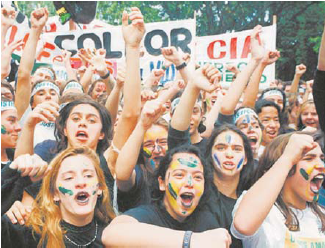
h t t p s : / / w w w . g o o g l e . c o m . b r /search?q=diretas+j%C3%A1+collor
O Movimento conhecido como Caras Pintadas teve entre seus principais objetivos:
 Conheça nossos planos