Foram encontradas 878 questões
Resolva questões gratuitamente!
Junte-se a mais de 4 milhões de concurseiros!


Text 1
Fighting Poverty and Social Exclusion

Poverty and social exclusion are a major challenge for humanity. According to the Human Development Report 1997, a quarter of the world's population remains in severe poverty, despite the major advances in reducing poverty made during the 20th century. At the same time, social inequality, marginalization and discrimination still exclude many people from full participation in economic, political and cultural life. While poverty and social exclusion represent common problems to policy makers in both poor and rich countries, new initiatives have been developed to combat these problems, initiatives which merit being called "Best Practices".
What are Best Practices? The idea of creating a database for Best Practices is based on the observation that carefully documented case histories can provide excellent guidelines for policy making and planning of new projects. The goal of a database on Best Practices is to present and promote creative, successful and sustainable solutions to social problems arising from poverty and social exclusion in order to build a bridge between experimental solutions, research and policy.
Best Practices are model projects or policies aimed at improving the quality of life of individuals or groups suffering from poverty or social exclusion. They are typically based on the cooperation between national or local authorities, non-governmental organizations (NGOs) and local communities, the private sector, and academic communities. They include a variety of activities in all parts of the world:
• In England: “The Big Issue”, a magazine sold by homeless people so they can earn a living and re-integrate into society.
• In India: 4,000 women established the Shri Mahila SEWA Sahakari Bank to provide credit at reasonable rates to self-employed women workers.
• In Brazil: the “Living Library” was created to make reading and writing an everyday activity for poor children to combat high rates of failure at elementary school.
Calling these activities Best Practices is to suggest that they can and should be replicated, that
ideas can and should be generated from them, and that they can and should contribute to policy
development.
From: <http://www.unesco.org/most/bphome.htm
Considering text 1, select the proposition in which the meanings of the expressions highlighted in the sentences are SIMILAR.
At the same time / In contrast, social inequality, marginalization and discrimination still
exclude many people from full participation in economic, political and cultural life.
Text 1
Fighting Poverty and Social Exclusion
Poverty and social exclusion are a major challenge for humanity. According to the Human Development Report 1997, a quarter of the world's population remains in severe poverty, despite the major advances in reducing poverty made during the 20th century. At the same time, social inequality, marginalization and discrimination still exclude many people from full participation in economic, political and cultural life. While poverty and social exclusion represent common problems to policy makers in both poor and rich countries, new initiatives have been developed to combat these problems, initiatives which merit being called "Best Practices".
What are Best Practices? The idea of creating a database for Best Practices is based on the observation that carefully documented case histories can provide excellent guidelines for policy making and planning of new projects. The goal of a database on Best Practices is to present and promote creative, successful and sustainable solutions to social problems arising from poverty and social exclusion in order to build a bridge between experimental solutions, research and policy.
Best Practices are model projects or policies aimed at improving the quality of life of individuals or groups suffering from poverty or social exclusion. They are typically based on the cooperation between national or local authorities, non-governmental organizations (NGOs) and local communities, the private sector, and academic communities. They include a variety of activities in all parts of the world:
• In England: “The Big Issue”, a magazine sold by homeless people so they can earn a living and re-integrate into society.
• In India: 4,000 women established the Shri Mahila SEWA Sahakari Bank to provide credit at reasonable rates to self-employed women workers.
• In Brazil: the “Living Library” was created to make reading and writing an everyday activity for poor children to combat high rates of failure at elementary school.
Calling these activities Best Practices is to suggest that they can and should be replicated, that
ideas can and should be generated from them, and that they can and should contribute to policy
development.
From: <http://www.unesco.org/most/bphome.htm
Considering text 1, select the proposition in which the meanings of the expressions highlighted in the sentences are SIMILAR.
According to / As stated by the Human Development Report 1997, a quarter of the world's
population remains in severe poverty.
Text 1
Fighting Poverty and Social Exclusion
Poverty and social exclusion are a major challenge for humanity. According to the Human Development Report 1997, a quarter of the world's population remains in severe poverty, despite the major advances in reducing poverty made during the 20th century. At the same time, social inequality, marginalization and discrimination still exclude many people from full participation in economic, political and cultural life. While poverty and social exclusion represent common problems to policy makers in both poor and rich countries, new initiatives have been developed to combat these problems, initiatives which merit being called "Best Practices".
What are Best Practices? The idea of creating a database for Best Practices is based on the observation that carefully documented case histories can provide excellent guidelines for policy making and planning of new projects. The goal of a database on Best Practices is to present and promote creative, successful and sustainable solutions to social problems arising from poverty and social exclusion in order to build a bridge between experimental solutions, research and policy.
Best Practices are model projects or policies aimed at improving the quality of life of individuals or groups suffering from poverty or social exclusion. They are typically based on the cooperation between national or local authorities, non-governmental organizations (NGOs) and local communities, the private sector, and academic communities. They include a variety of activities in all parts of the world:
• In England: “The Big Issue”, a magazine sold by homeless people so they can earn a living and re-integrate into society.
• In India: 4,000 women established the Shri Mahila SEWA Sahakari Bank to provide credit at reasonable rates to self-employed women workers.
• In Brazil: the “Living Library” was created to make reading and writing an everyday activity for poor children to combat high rates of failure at elementary school.
Calling these activities Best Practices is to suggest that they can and should be replicated, that
ideas can and should be generated from them, and that they can and should contribute to policy
development.
From: <http://www.unesco.org/most/bphome.htm
As for initiatives to fight poverty and social exclusion, we can CONCLUDE from text 1 that:
in Brazil, a model project is being implemented to improve students’ performance.
Text 1
Fighting Poverty and Social Exclusion
Poverty and social exclusion are a major challenge for humanity. According to the Human Development Report 1997, a quarter of the world's population remains in severe poverty, despite the major advances in reducing poverty made during the 20th century. At the same time, social inequality, marginalization and discrimination still exclude many people from full participation in economic, political and cultural life. While poverty and social exclusion represent common problems to policy makers in both poor and rich countries, new initiatives have been developed to combat these problems, initiatives which merit being called "Best Practices".
What are Best Practices? The idea of creating a database for Best Practices is based on the observation that carefully documented case histories can provide excellent guidelines for policy making and planning of new projects. The goal of a database on Best Practices is to present and promote creative, successful and sustainable solutions to social problems arising from poverty and social exclusion in order to build a bridge between experimental solutions, research and policy.
Best Practices are model projects or policies aimed at improving the quality of life of individuals or groups suffering from poverty or social exclusion. They are typically based on the cooperation between national or local authorities, non-governmental organizations (NGOs) and local communities, the private sector, and academic communities. They include a variety of activities in all parts of the world:
• In England: “The Big Issue”, a magazine sold by homeless people so they can earn a living and re-integrate into society.
• In India: 4,000 women established the Shri Mahila SEWA Sahakari Bank to provide credit at reasonable rates to self-employed women workers.
• In Brazil: the “Living Library” was created to make reading and writing an everyday activity for poor children to combat high rates of failure at elementary school.
Calling these activities Best Practices is to suggest that they can and should be replicated, that
ideas can and should be generated from them, and that they can and should contribute to policy
development.
From: <http://www.unesco.org/most/bphome.htm
As for initiatives to fight poverty and social exclusion, we can CONCLUDE from text 1 that:
the use of a database on Best Practices is a good way to obtain strategies for policy making.
Text 1
Fighting Poverty and Social Exclusion
Poverty and social exclusion are a major challenge for humanity. According to the Human Development Report 1997, a quarter of the world's population remains in severe poverty, despite the major advances in reducing poverty made during the 20th century. At the same time, social inequality, marginalization and discrimination still exclude many people from full participation in economic, political and cultural life. While poverty and social exclusion represent common problems to policy makers in both poor and rich countries, new initiatives have been developed to combat these problems, initiatives which merit being called "Best Practices".
What are Best Practices? The idea of creating a database for Best Practices is based on the observation that carefully documented case histories can provide excellent guidelines for policy making and planning of new projects. The goal of a database on Best Practices is to present and promote creative, successful and sustainable solutions to social problems arising from poverty and social exclusion in order to build a bridge between experimental solutions, research and policy.
Best Practices are model projects or policies aimed at improving the quality of life of individuals or groups suffering from poverty or social exclusion. They are typically based on the cooperation between national or local authorities, non-governmental organizations (NGOs) and local communities, the private sector, and academic communities. They include a variety of activities in all parts of the world:
• In England: “The Big Issue”, a magazine sold by homeless people so they can earn a living and re-integrate into society.
• In India: 4,000 women established the Shri Mahila SEWA Sahakari Bank to provide credit at reasonable rates to self-employed women workers.
• In Brazil: the “Living Library” was created to make reading and writing an everyday activity for poor children to combat high rates of failure at elementary school.
Calling these activities Best Practices is to suggest that they can and should be replicated, that
ideas can and should be generated from them, and that they can and should contribute to policy
development.
From: <http://www.unesco.org/most/bphome.htm
As for initiatives to fight poverty and social exclusion, we can CONCLUDE from text 1 that:
in England, a big issue was planned for building a community center.
Text 1
Fighting Poverty and Social Exclusion
Poverty and social exclusion are a major challenge for humanity. According to the Human Development Report 1997, a quarter of the world's population remains in severe poverty, despite the major advances in reducing poverty made during the 20th century. At the same time, social inequality, marginalization and discrimination still exclude many people from full participation in economic, political and cultural life. While poverty and social exclusion represent common problems to policy makers in both poor and rich countries, new initiatives have been developed to combat these problems, initiatives which merit being called "Best Practices".
What are Best Practices? The idea of creating a database for Best Practices is based on the observation that carefully documented case histories can provide excellent guidelines for policy making and planning of new projects. The goal of a database on Best Practices is to present and promote creative, successful and sustainable solutions to social problems arising from poverty and social exclusion in order to build a bridge between experimental solutions, research and policy.
Best Practices are model projects or policies aimed at improving the quality of life of individuals or groups suffering from poverty or social exclusion. They are typically based on the cooperation between national or local authorities, non-governmental organizations (NGOs) and local communities, the private sector, and academic communities. They include a variety of activities in all parts of the world:
• In England: “The Big Issue”, a magazine sold by homeless people so they can earn a living and re-integrate into society.
• In India: 4,000 women established the Shri Mahila SEWA Sahakari Bank to provide credit at reasonable rates to self-employed women workers.
• In Brazil: the “Living Library” was created to make reading and writing an everyday activity for poor children to combat high rates of failure at elementary school.
Calling these activities Best Practices is to suggest that they can and should be replicated, that
ideas can and should be generated from them, and that they can and should contribute to policy
development.
From: <http://www.unesco.org/most/bphome.htm
What does text 1 say about “Best Practices”?
Select the CORRECT proposition.
They are projects aimed only at helping people who live in poor countries.
Text 1
Fighting Poverty and Social Exclusion
Poverty and social exclusion are a major challenge for humanity. According to the Human Development Report 1997, a quarter of the world's population remains in severe poverty, despite the major advances in reducing poverty made during the 20th century. At the same time, social inequality, marginalization and discrimination still exclude many people from full participation in economic, political and cultural life. While poverty and social exclusion represent common problems to policy makers in both poor and rich countries, new initiatives have been developed to combat these problems, initiatives which merit being called "Best Practices".
What are Best Practices? The idea of creating a database for Best Practices is based on the observation that carefully documented case histories can provide excellent guidelines for policy making and planning of new projects. The goal of a database on Best Practices is to present and promote creative, successful and sustainable solutions to social problems arising from poverty and social exclusion in order to build a bridge between experimental solutions, research and policy.
Best Practices are model projects or policies aimed at improving the quality of life of individuals or groups suffering from poverty or social exclusion. They are typically based on the cooperation between national or local authorities, non-governmental organizations (NGOs) and local communities, the private sector, and academic communities. They include a variety of activities in all parts of the world:
• In England: “The Big Issue”, a magazine sold by homeless people so they can earn a living and re-integrate into society.
• In India: 4,000 women established the Shri Mahila SEWA Sahakari Bank to provide credit at reasonable rates to self-employed women workers.
• In Brazil: the “Living Library” was created to make reading and writing an everyday activity for poor children to combat high rates of failure at elementary school.
Calling these activities Best Practices is to suggest that they can and should be replicated, that
ideas can and should be generated from them, and that they can and should contribute to policy
development.
From: <http://www.unesco.org/most/bphome.htm
What does text 1 say about “Best Practices”?
Select the CORRECT proposition.
They should serve as examples for the planning of new actions to combat social problems.
Text 1
Fighting Poverty and Social Exclusion
Poverty and social exclusion are a major challenge for humanity. According to the Human Development Report 1997, a quarter of the world's population remains in severe poverty, despite the major advances in reducing poverty made during the 20th century. At the same time, social inequality, marginalization and discrimination still exclude many people from full participation in economic, political and cultural life. While poverty and social exclusion represent common problems to policy makers in both poor and rich countries, new initiatives have been developed to combat these problems, initiatives which merit being called "Best Practices".
What are Best Practices? The idea of creating a database for Best Practices is based on the observation that carefully documented case histories can provide excellent guidelines for policy making and planning of new projects. The goal of a database on Best Practices is to present and promote creative, successful and sustainable solutions to social problems arising from poverty and social exclusion in order to build a bridge between experimental solutions, research and policy.
Best Practices are model projects or policies aimed at improving the quality of life of individuals or groups suffering from poverty or social exclusion. They are typically based on the cooperation between national or local authorities, non-governmental organizations (NGOs) and local communities, the private sector, and academic communities. They include a variety of activities in all parts of the world:
• In England: “The Big Issue”, a magazine sold by homeless people so they can earn a living and re-integrate into society.
• In India: 4,000 women established the Shri Mahila SEWA Sahakari Bank to provide credit at reasonable rates to self-employed women workers.
• In Brazil: the “Living Library” was created to make reading and writing an everyday activity for poor children to combat high rates of failure at elementary school.
Calling these activities Best Practices is to suggest that they can and should be replicated, that
ideas can and should be generated from them, and that they can and should contribute to policy
development.
From: <http://www.unesco.org/most/bphome.htm
Select the CORRECT proposition, according to text 1.
In the 20th century, much progress was made in decreasing poverty.
Text 1
Fighting Poverty and Social Exclusion
Poverty and social exclusion are a major challenge for humanity. According to the Human Development Report 1997, a quarter of the world's population remains in severe poverty, despite the major advances in reducing poverty made during the 20th century. At the same time, social inequality, marginalization and discrimination still exclude many people from full participation in economic, political and cultural life. While poverty and social exclusion represent common problems to policy makers in both poor and rich countries, new initiatives have been developed to combat these problems, initiatives which merit being called "Best Practices".
What are Best Practices? The idea of creating a database for Best Practices is based on the observation that carefully documented case histories can provide excellent guidelines for policy making and planning of new projects. The goal of a database on Best Practices is to present and promote creative, successful and sustainable solutions to social problems arising from poverty and social exclusion in order to build a bridge between experimental solutions, research and policy.
Best Practices are model projects or policies aimed at improving the quality of life of individuals or groups suffering from poverty or social exclusion. They are typically based on the cooperation between national or local authorities, non-governmental organizations (NGOs) and local communities, the private sector, and academic communities. They include a variety of activities in all parts of the world:
• In England: “The Big Issue”, a magazine sold by homeless people so they can earn a living and re-integrate into society.
• In India: 4,000 women established the Shri Mahila SEWA Sahakari Bank to provide credit at reasonable rates to self-employed women workers.
• In Brazil: the “Living Library” was created to make reading and writing an everyday activity for poor children to combat high rates of failure at elementary school.
Calling these activities Best Practices is to suggest that they can and should be replicated, that
ideas can and should be generated from them, and that they can and should contribute to policy
development.
From: <http://www.unesco.org/most/bphome.htm
Select the CORRECT proposition, according to text 1.
Marginalization is the main cause of economic and political crises.
Text 1
Fighting Poverty and Social Exclusion
Poverty and social exclusion are a major challenge for humanity. According to the Human Development Report 1997, a quarter of the world's population remains in severe poverty, despite the major advances in reducing poverty made during the 20th century. At the same time, social inequality, marginalization and discrimination still exclude many people from full participation in economic, political and cultural life. While poverty and social exclusion represent common problems to policy makers in both poor and rich countries, new initiatives have been developed to combat these problems, initiatives which merit being called "Best Practices".
What are Best Practices? The idea of creating a database for Best Practices is based on the observation that carefully documented case histories can provide excellent guidelines for policy making and planning of new projects. The goal of a database on Best Practices is to present and promote creative, successful and sustainable solutions to social problems arising from poverty and social exclusion in order to build a bridge between experimental solutions, research and policy.
Best Practices are model projects or policies aimed at improving the quality of life of individuals or groups suffering from poverty or social exclusion. They are typically based on the cooperation between national or local authorities, non-governmental organizations (NGOs) and local communities, the private sector, and academic communities. They include a variety of activities in all parts of the world:
• In England: “The Big Issue”, a magazine sold by homeless people so they can earn a living and re-integrate into society.
• In India: 4,000 women established the Shri Mahila SEWA Sahakari Bank to provide credit at reasonable rates to self-employed women workers.
• In Brazil: the “Living Library” was created to make reading and writing an everyday activity for poor children to combat high rates of failure at elementary school.
Calling these activities Best Practices is to suggest that they can and should be replicated, that
ideas can and should be generated from them, and that they can and should contribute to policy
development.
From: <http://www.unesco.org/most/bphome.htm
Select the CORRECT proposition, according to text 1.
Actions are being taken to diminish poverty and social exclusion.
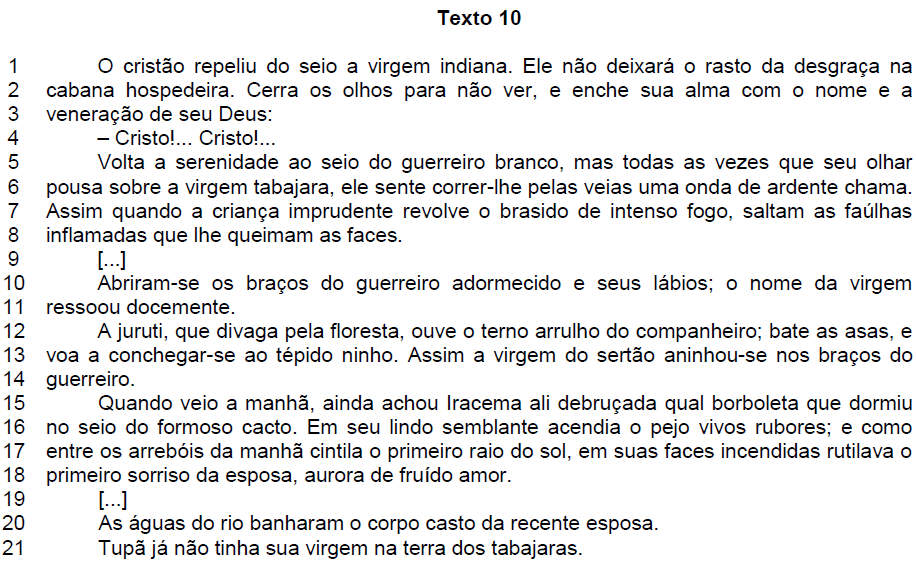
A partir da leitura do texto 10 e do romance Iracema, e considerando o contexto do Romantismo brasileiro, assinale a proposição CORRETA.
Além de indianista, Iracema é também um romance histórico; serve assim duplamente ao
projeto nacionalista da literatura romântica brasileira.
A partir da leitura do texto 10 e do romance Iracema, e considerando o contexto do Romantismo brasileiro, assinale a proposição CORRETA.
Entre as várias manifestações do nacionalismo romântico presentes em Iracema, está o
desejo de mostrar o povo brasileiro como híbrido, constituído pela fusão das raças negra,
indígena e branca.
A partir da leitura do texto 10 e do romance Iracema, e considerando o contexto do Romantismo brasileiro, assinale a proposição CORRETA.
Ao entregar-se a Martim, Iracema deixa de ser virgem e, portanto, não poderia mais ser a
guardiã do segredo da jurema; ainda assim continua a sê-lo, só deixando de preparar e servir
a bebida quando Caubi descobre sua gravidez e a expulsa da tribo.
A partir da leitura do texto 10 e do romance Iracema, e considerando o contexto do Romantismo brasileiro, assinale a proposição CORRETA.
A adjetivação abundante (“ardente chama”; “intenso fogo”; “tépido ninho”; “vivos rubores”) é
uma importante característica da prosa romântica, que será mais tarde evitada por escritores
realistas.
A partir da leitura do texto 10 e do romance Iracema, e considerando o contexto do Romantismo brasileiro, assinale a proposição CORRETA.
Em Iracema, os elementos humanos e naturais não se mesclam. Nas descrições que faz de
Iracema, por exemplo, Alencar evita compará-la a seres da natureza, pois isso seria contrário
ao princípio romântico de valorização de uma natureza pura, não contaminada pela presença
humana.
A partir da leitura do texto 10 e do romance Iracema, e considerando o contexto do Romantismo brasileiro, assinale a proposição CORRETA.
Ao seduzir e possuir Iracema, Martim está consciente dos seus atos, e isso constitui traição
tanto aos seus valores cristãos quanto à hospitalidade de Araquém. Quebra-se aqui, portanto,
uma importante característica do Romantismo, a idealização do herói, que jamais comete
ações vis.
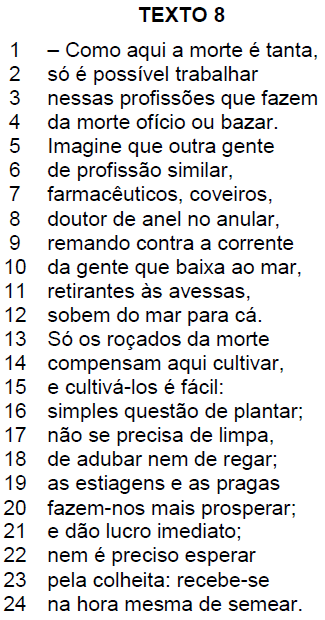
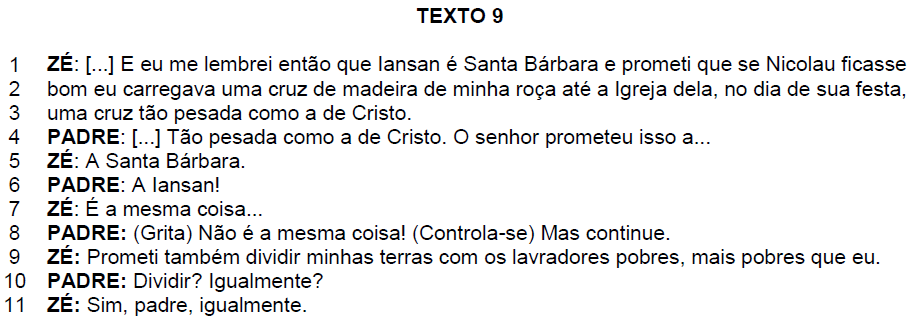
Com base na leitura dos textos 8 e 9, do poema Morte e vida severina e da peça O pagador de promessas, e considerando o contexto do Modernismo brasileiro, assinale a proposição CORRETA.
O conflito agrário é assunto recorrente em nossa literatura e pode ser encontrado tanto em O
pagador de promessas quanto em Morte e vida severina.
Com base na leitura dos textos 8 e 9, do poema Morte e vida severina e da peça O pagador de promessas, e considerando o contexto do Modernismo brasileiro, assinale a proposição CORRETA.
A decisão de Zé-do-Burro de dividir metade de suas terras com os pobres tem para ele um
sentido essencialmente religioso e humanitário, não sendo propriamente resultado de uma
tomada de consciência política.
Com base na leitura dos textos 8 e 9, do poema Morte e vida severina e da peça O pagador de promessas, e considerando o contexto do Modernismo brasileiro, assinale a proposição CORRETA.
No texto 9, vê-se que o padre, que a princípio se mostra irritado com o fato de Zé-do-Burro ter
feito sua promessa em um terreiro de candomblé, vai aos poucos entendendo a assimilação
que Zé-do-Burro faz entre Iansã e Santa Bárbara como resultante de um processo de
sincretismo religioso comum na cultura brasileira.
Com base na leitura dos textos 8 e 9, do poema Morte e vida severina e da peça O pagador de promessas, e considerando o contexto do Modernismo brasileiro, assinale a proposição CORRETA.
Apesar de um dos princípios norteadores da poética de João Cabral de Melo Neto ser a busca
de uma linguagem seca, destituída de figuras, ocorrem no poema Morte e vida severina
algumas figuras de linguagem, como a ironia, perceptível nos versos 13 a 24 do texto 8.
 Conheça nossos planos