Questões de Vestibular FAMERP 2024 para Vestibular - Conhecimentos Gerais
Foram encontradas 10 questões


Leia o texto e examine o gráfico para responder à questão.
When Tinder (a mobile dating app) was launched on college campuses in America in 2012, it quickly became a hit. Although online dating had been around since Match.com, a website for lonely hearts, launched in 1995, it had long struggled to shed1 an image of desperation. But Tinder, by letting users sift through photos of countless potential dates with a simple swipe, made it easy and fun.
Soon Tinder and its rivals had transformed dating. A report found that 30% of American adults had used an online dating service, including more than half of those aged between 18 and 29. One in five couples of that age had met through such a service. Usage surged during the pandemic, as lonely locked- -down singles searched for partners. The market capitalisation of Bumble, a rival to Tinder, surged to $13 billion on its first day of trading2 in February 2021. Later that year the value of Match Group, which owns Tinder, Hinge and scores of other dating services, reached nearly $50 billion.
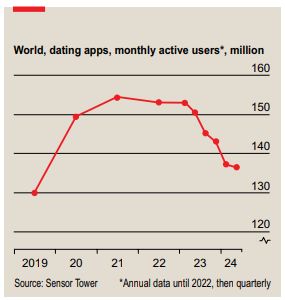
Today roughly 350 million people around the world have a dating app on their phone, up from 250 million in 2018, according to a research firm. In June 2024 Tokyo’s government even said it would launch a matchmaking app of its own to pair up singles in the city. Yet lately online dating has lost its spark. The apps were downloaded 237 million times globally in 2023, down from 287 million in 2020. According to a research firm, the number of people who use them at least once a month has dwindled from 154 million in 2021 to 137 million in the second quarter of 2024.
(www.economist.com, 08.08.2024. Adaptado.)
1 to shed: to get rid of something that is no longer wanted.
2 trading: the activity of buying and selling things.
Leia o texto e examine o gráfico para responder à questão.
When Tinder (a mobile dating app) was launched on college campuses in America in 2012, it quickly became a hit. Although online dating had been around since Match.com, a website for lonely hearts, launched in 1995, it had long struggled to shed1 an image of desperation. But Tinder, by letting users sift through photos of countless potential dates with a simple swipe, made it easy and fun.
Soon Tinder and its rivals had transformed dating. A report found that 30% of American adults had used an online dating service, including more than half of those aged between 18 and 29. One in five couples of that age had met through such a service. Usage surged during the pandemic, as lonely locked- -down singles searched for partners. The market capitalisation of Bumble, a rival to Tinder, surged to $13 billion on its first day of trading2 in February 2021. Later that year the value of Match Group, which owns Tinder, Hinge and scores of other dating services, reached nearly $50 billion.
Today roughly 350 million people around the world have a dating app on their phone, up from 250 million in 2018, according to a research firm. In June 2024 Tokyo’s government even said it would launch a matchmaking app of its own to pair up singles in the city. Yet lately online dating has lost its spark. The apps were downloaded 237 million times globally in 2023, down from 287 million in 2020. According to a research firm, the number of people who use them at least once a month has dwindled from 154 million in 2021 to 137 million in the second quarter of 2024.
(www.economist.com, 08.08.2024. Adaptado.)
1 to shed: to get rid of something that is no longer wanted.
2 trading: the activity of buying and selling things.
Leia o texto e examine o gráfico para responder à questão.
When Tinder (a mobile dating app) was launched on college campuses in America in 2012, it quickly became a hit. Although online dating had been around since Match.com, a website for lonely hearts, launched in 1995, it had long struggled to shed1 an image of desperation. But Tinder, by letting users sift through photos of countless potential dates with a simple swipe, made it easy and fun.
Soon Tinder and its rivals had transformed dating. A report found that 30% of American adults had used an online dating service, including more than half of those aged between 18 and 29. One in five couples of that age had met through such a service. Usage surged during the pandemic, as lonely locked- -down singles searched for partners. The market capitalisation of Bumble, a rival to Tinder, surged to $13 billion on its first day of trading2 in February 2021. Later that year the value of Match Group, which owns Tinder, Hinge and scores of other dating services, reached nearly $50 billion.
Today roughly 350 million people around the world have a dating app on their phone, up from 250 million in 2018, according to a research firm. In June 2024 Tokyo’s government even said it would launch a matchmaking app of its own to pair up singles in the city. Yet lately online dating has lost its spark. The apps were downloaded 237 million times globally in 2023, down from 287 million in 2020. According to a research firm, the number of people who use them at least once a month has dwindled from 154 million in 2021 to 137 million in the second quarter of 2024.
(www.economist.com, 08.08.2024. Adaptado.)
1 to shed: to get rid of something that is no longer wanted.
2 trading: the activity of buying and selling things.
Leia o texto e examine o gráfico para responder à questão.
When Tinder (a mobile dating app) was launched on college campuses in America in 2012, it quickly became a hit. Although online dating had been around since Match.com, a website for lonely hearts, launched in 1995, it had long struggled to shed1 an image of desperation. But Tinder, by letting users sift through photos of countless potential dates with a simple swipe, made it easy and fun.
Soon Tinder and its rivals had transformed dating. A report found that 30% of American adults had used an online dating service, including more than half of those aged between 18 and 29. One in five couples of that age had met through such a service. Usage surged during the pandemic, as lonely locked- -down singles searched for partners. The market capitalisation of Bumble, a rival to Tinder, surged to $13 billion on its first day of trading2 in February 2021. Later that year the value of Match Group, which owns Tinder, Hinge and scores of other dating services, reached nearly $50 billion.
Today roughly 350 million people around the world have a dating app on their phone, up from 250 million in 2018, according to a research firm. In June 2024 Tokyo’s government even said it would launch a matchmaking app of its own to pair up singles in the city. Yet lately online dating has lost its spark. The apps were downloaded 237 million times globally in 2023, down from 287 million in 2020. According to a research firm, the number of people who use them at least once a month has dwindled from 154 million in 2021 to 137 million in the second quarter of 2024.
(www.economist.com, 08.08.2024. Adaptado.)
1 to shed: to get rid of something that is no longer wanted.
2 trading: the activity of buying and selling things.
Leia o texto e examine o gráfico para responder à questão.
When Tinder (a mobile dating app) was launched on college campuses in America in 2012, it quickly became a hit. Although online dating had been around since Match.com, a website for lonely hearts, launched in 1995, it had long struggled to shed1 an image of desperation. But Tinder, by letting users sift through photos of countless potential dates with a simple swipe, made it easy and fun.
Soon Tinder and its rivals had transformed dating. A report found that 30% of American adults had used an online dating service, including more than half of those aged between 18 and 29. One in five couples of that age had met through such a service. Usage surged during the pandemic, as lonely locked- -down singles searched for partners. The market capitalisation of Bumble, a rival to Tinder, surged to $13 billion on its first day of trading2 in February 2021. Later that year the value of Match Group, which owns Tinder, Hinge and scores of other dating services, reached nearly $50 billion.
Today roughly 350 million people around the world have a dating app on their phone, up from 250 million in 2018, according to a research firm. In June 2024 Tokyo’s government even said it would launch a matchmaking app of its own to pair up singles in the city. Yet lately online dating has lost its spark. The apps were downloaded 237 million times globally in 2023, down from 287 million in 2020. According to a research firm, the number of people who use them at least once a month has dwindled from 154 million in 2021 to 137 million in the second quarter of 2024.
(www.economist.com, 08.08.2024. Adaptado.)
1 to shed: to get rid of something that is no longer wanted.
2 trading: the activity of buying and selling things.
Leia o texto e examine o gráfico para responder à questão.
When Tinder (a mobile dating app) was launched on college campuses in America in 2012, it quickly became a hit. Although online dating had been around since Match.com, a website for lonely hearts, launched in 1995, it had long struggled to shed1 an image of desperation. But Tinder, by letting users sift through photos of countless potential dates with a simple swipe, made it easy and fun.
Soon Tinder and its rivals had transformed dating. A report found that 30% of American adults had used an online dating service, including more than half of those aged between 18 and 29. One in five couples of that age had met through such a service. Usage surged during the pandemic, as lonely locked- -down singles searched for partners. The market capitalisation of Bumble, a rival to Tinder, surged to $13 billion on its first day of trading2 in February 2021. Later that year the value of Match Group, which owns Tinder, Hinge and scores of other dating services, reached nearly $50 billion.
Today roughly 350 million people around the world have a dating app on their phone, up from 250 million in 2018, according to a research firm. In June 2024 Tokyo’s government even said it would launch a matchmaking app of its own to pair up singles in the city. Yet lately online dating has lost its spark. The apps were downloaded 237 million times globally in 2023, down from 287 million in 2020. According to a research firm, the number of people who use them at least once a month has dwindled from 154 million in 2021 to 137 million in the second quarter of 2024.
(www.economist.com, 08.08.2024. Adaptado.)
1 to shed: to get rid of something that is no longer wanted.
2 trading: the activity of buying and selling things.
Leia o texto e examine o gráfico para responder à questão.
When Tinder (a mobile dating app) was launched on college campuses in America in 2012, it quickly became a hit. Although online dating had been around since Match.com, a website for lonely hearts, launched in 1995, it had long struggled to shed1 an image of desperation. But Tinder, by letting users sift through photos of countless potential dates with a simple swipe, made it easy and fun.
Soon Tinder and its rivals had transformed dating. A report found that 30% of American adults had used an online dating service, including more than half of those aged between 18 and 29. One in five couples of that age had met through such a service. Usage surged during the pandemic, as lonely locked- -down singles searched for partners. The market capitalisation of Bumble, a rival to Tinder, surged to $13 billion on its first day of trading2 in February 2021. Later that year the value of Match Group, which owns Tinder, Hinge and scores of other dating services, reached nearly $50 billion.
Today roughly 350 million people around the world have a dating app on their phone, up from 250 million in 2018, according to a research firm. In June 2024 Tokyo’s government even said it would launch a matchmaking app of its own to pair up singles in the city. Yet lately online dating has lost its spark. The apps were downloaded 237 million times globally in 2023, down from 287 million in 2020. According to a research firm, the number of people who use them at least once a month has dwindled from 154 million in 2021 to 137 million in the second quarter of 2024.
(www.economist.com, 08.08.2024. Adaptado.)
1 to shed: to get rid of something that is no longer wanted.
2 trading: the activity of buying and selling things.
Read the campaign poster published on a company’s website to answer question.

(https://www.hutsix.io. Adaptado.)
Read the campaign poster published on a company’s website to answer question.
(https://www.hutsix.io. Adaptado.)
Read the comic strip by Sarah Andersen.

(Sarah Andersen. Adulthood is a myth, 2016.)
According to the comic strip, phrases from 1 to 4 make the girl feel

 Conheça nossos planos