Questões de Vestibular UFRGS 2023 para Vestibular - 2º Dia
Foram encontradas 10 questões


Instrução: A questão está relacionada ao texto abaixo.
Adaptado de: ÁLVAREZ, J. Snow. In: Castillo-Speed, L. Latina – Women’s voices from the borderlands. New York: Touchstone, 1995.
Instrução: A questão está relacionada ao texto abaixo.
Adaptado de: ÁLVAREZ, J. Snow. In: Castillo-Speed, L. Latina – Women’s voices from the borderlands. New York: Touchstone, 1995.
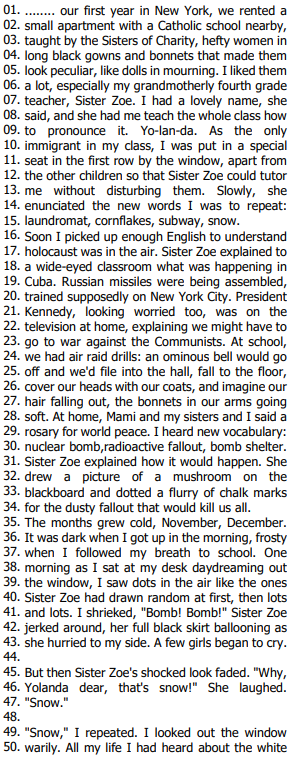
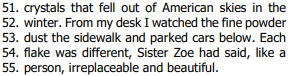
( ) Embora já conhecesse e mesmo repetisse a palavra snow, Yolanda nunca entendera do que se tratava, razão pela qual ficou assustada quando viu neve pela primeira vez.
( ) Apesar do tom leve, o texto faz uma crítica à forma assustadora com que até mesmo crianças foram envolvidas na paranoia atômica da Guerra Fria.
( ) Com carinho, Yolanda lembra a Irmã Zoe pelo esforço da religiosa em fazer com a menina, uma imigrante hispânica, não se sentisse agredida por manifestações xenófobas, em função da crise dos mísseis em Cuba.
( ) Apesar de seu favoritismo na infância, Yolanda deixa clara sua reprovação à forma como a Irmã Zoe incutiu medos infundados e gerou traumas nas crianças de sua turma.
A sequência correta de preenchimento dos parênteses, de cima para baixo, é
Instrução: A questão está relacionada ao texto abaixo.
Adaptado de: ÁLVAREZ, J. Snow. In: Castillo-Speed, L. Latina – Women’s voices from the borderlands. New York: Touchstone, 1995.
( ) O trecho taught by the Sisters of Charity (l. 03) pode ser substituído por which was taught by the Sisters of Charity, sem prejuízo da correção gramatical e do significado original do texto.
( ) O trecho I was put in a special seat (l. 10-11) pode ser substituído por Sister Zoe put me in a special sit, sem prejuízo da correção gramatical e do significado original do texto.
( ) A expressão so that (l. 12) pode ser substituída por in order to, sem prejuízo da correção gramatical e do significado original do texto.
( ) A oração I follow ed my breath to school (l. 37) faz referência ao fato de a respiração da menina gerar um vapor visível à sua frente, nas manhãs geladas de Nova Iorque.
A sequência correta de preenchimento dos parênteses, de cima para baixo, é
Instrução: A questão está relacionada ao texto abaixo.
Adaptado de: ÁLVAREZ, J. Snow. In: Castillo-Speed, L. Latina – Women’s voices from the borderlands. New York: Touchstone, 1995.
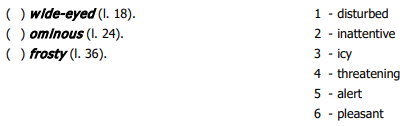
A sequência correta de preenchimento dos parênteses, de cima para baixo, é
Instrução: A questão está relacionada ao texto abaixo.
Adaptado de: ÁLVAREZ, J. Snow. In: Castillo-Speed, L. Latina – Women’s voices from the borderlands. New York: Touchstone, 1995.
Instrução: A questão está relacionada ao texto abaixo.
Adapted from: DEHAENE, Stanislas. How we learn: Why brains learn better than any machine… for now. New York: Viking Press, 2020.
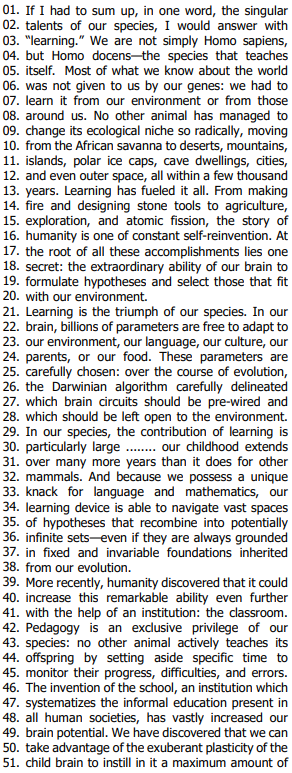
I - According to the text, pedagogy and the creation of schools are the phenomena that have transformed Homo sapiens into Homo docens, a species that teaches itself.
II - The author states that the Darwinist evolutionary theory does not account for our species’ triumph of learning because what we inherit through our genes are fixed and invariable foundations.
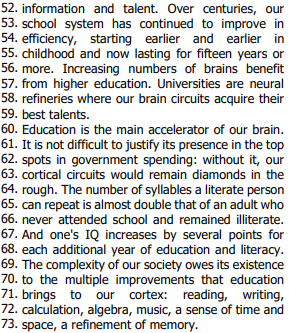
III- The text implies that without education human societies might still be much more evolved than those of other species, but hardly as complex as they are today.
Which ones are correct according to the text?
Instrução: A questão está relacionada ao texto abaixo.
Adapted from: DEHAENE, Stanislas. How we learn: Why brains learn better than any machine… for now. New York: Viking Press, 2020.
( ) By using the phrase Darwinian algorithm (l. 26), the author stresses that human intelligence and Artificial Intelligence evolve by means of the same processes.
( ) The author draws a parallel between the number of years one spends at school with the increasing efficiency of education.
( ) The human tendency for abstract thinking through language and mathematics is one of the keys to our unique learning skills because it allows us to raise hypotheses.
( ) The author fears that without public investment in education human societies will become more complex due to lower IQ and memory rates.
The sequence that adequately fills in the parentheses, from top to bottom, is
Instrução: A questão está relacionada ao texto abaixo.
Adapted from: DEHAENE, Stanislas. How we learn: Why brains learn better than any machine… for now. New York: Viking Press, 2020.
I – The pronoun itself (l. 05) refers to species (l. 04).
II – The pronoun it (l. 07) refers to world (l. 05).
III – The possessive adjective its (l. 69) refers to society (l. 69).
Which ones are correct according to the text?
Instrução: A questão está relacionada ao texto abaixo.
Adapted from: DEHAENE, Stanislas. How we learn: Why brains learn better than any machine… for now. New York: Viking Press, 2020.
Instrução: A questão está relacionada ao texto abaixo.
Adapted from: DEHAENE, Stanislas. How we learn: Why brains learn better than any machine… for now. New York: Viking Press, 2020.
 Conheça nossos planos