Questões de Vestibular FUVEST 2025 para Vestibular - 1ª Fase - Conhecimentos Gerais
Foram encontradas 3 questões


Ano: 2025
Banca:
FUVEST
Órgão:
FUVEST
Prova:
FUVEST - 2025 - FUVEST - Vestibular - 1ª Fase - Conhecimentos Gerais |
Q3946322
Biologia
Texto associado
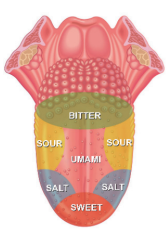
Think for a minute about the
little bumps on your tongue. You
probably saw a diagram of those
taste bud arrangements once in
a biology textbook — sweet
sensors at the tip, salty on either
side, sour behind them, bitter in
the back.
But the idea that specific
tastes are confined to certain
areas of the tongue is a myth that
“persists in the collective
consciousness, despite decades
of research debunking it”,
according to a review published this month in The New
England Journal of Medicine. Also wrong: the notion that taste
is limited to the mouth.
The old diagram, which has been used in many textbooks
over the years, originated in a study published by David Hanig,
a German scientist, in 1901. But the scientist was not
suggesting that various tastes are segregated on the tongue.
He was actually measuring the sensitivity of different areas,
said Paul Breslin, a researcher at Monell Chemical Senses
Center in Philadelphia. “What he found was that you could
detect things at a lower concentration in one part relative to
another,” Dr. Breslin said. The tip of the tongue, for example, is
dense with sweet sensors but contains the others as well.
The map’s mistakes are easy to confirm. If you place a
lemon wedge at the tip of your tongue, it will taste sour, and if
you put a bit of honey toward the side, it will be sweet.
The perception of taste is a remarkably complex process,
starting from that first encounter with the tongue. Taste cells
have a variety of sensors that signal the brain when they
encounter nutrients or toxins. For some tastes, tiny pores in cell
membranes let taste chemicals in.
Such taste receptors aren’t limited to the tongue; they are
also found in the gastrointestinal tract, liver, pancreas, fat cells,
brain, muscle cells, thyroid and lungs. We don’t generally think
of these organs as tasting anything, but they use the receptors
to pick up the presence of various molecules and metabolize
them, said Diego Bohórquez, a self-described gut-brain
neuroscientist at Duke University. For example, when the gut
notices sugar in food, it tells the brain to alert other organs to
get ready for digestion.
New York Times. May 29, 2024. Adaptado.
Nós sentimos o sabor dos alimentos com o cérebro!
Esta afirmação à primeira vista nos parece estranha. No entanto, assim como ocorre em todos os sentidos do sistema sensorial, no caso do paladar, a percepção consciente do sabor só acontece quando sinais específicos chegam ao cérebro. Assinale a alternativa que apresenta corretamente a informação descrita neste processo.
Esta afirmação à primeira vista nos parece estranha. No entanto, assim como ocorre em todos os sentidos do sistema sensorial, no caso do paladar, a percepção consciente do sabor só acontece quando sinais específicos chegam ao cérebro. Assinale a alternativa que apresenta corretamente a informação descrita neste processo.
Ano: 2025
Banca:
FUVEST
Órgão:
FUVEST
Prova:
FUVEST - 2025 - FUVEST - Vestibular - 1ª Fase - Conhecimentos Gerais |
Q3946333
Biologia
Texto associado
During the nineteen-seventies and eighties, a researcher at
the University of Washington started noticing something strange
in the college’s experimental forest. For years, a blight of
caterpillars had been munching the trees to death. Then,
suddenly, the caterpillars themselves started dying off. The forest
was able to recover. But what had happened to the caterpillars?
The researcher, David Rhoades, who had a background in
chemistry and zoology, found that the trees in the forest had
changed the chemistry of their leaves, to the detriment of the
caterpillars. Even more surprising, trees that had been nibbled by
caterpillars weren’t the only ones that had changed their
chemistry. Some were changing their leaves before caterpillars
reached them, as if they’d received a warning. A shocking
possibility presented itself: the trees were signalling to one
another.
Zoë Schlanger recounts Rhoades’s story in her new book,
“The Light Eaters: How the Unseen World of Plant Intelligence
Offers a New Understanding of Life on Earth.”
The contemporary world of botany that Schlanger explores in
“The Light Eaters” is still divided over the matter of how plants
sense the world and whether they can be said to communicate.
But, in the past twenty years, the idea that plants communicate
has gained broader acceptance. Research in recent decades has
shown garden-variety lima beans protecting themselves by
synthesizing and releasing chemicals to summon the predators of
the insects that eat them; lab-grown pea shoots navigating mazes
and responding to the sound of running water; and a chameleonic
vine in the jungles of Chile mimicking the shape and color of
nearby plants by a mechanism that’s not yet understood.
Schlanger acknowledges that some of the research yields as
many questions as answers. It’s not clear how the vine gathers
information about surrounding plants to perform its mimicry.
New Yorker. 12 June 2024. Adaptado.
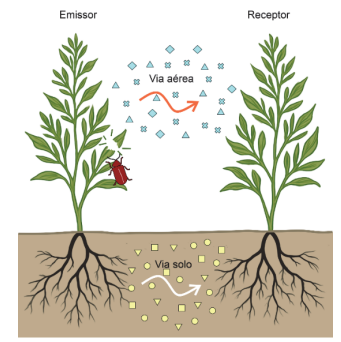
O processo de comunicação entre plantas discutido no texto
pode ocorrer de diversas formas. Uma delas baseia-se na
emissão de moléculas por uma planta atacada, chamada de
emissor, e a recepção dessas moléculas por uma outra planta,
chamada de receptor. Dependendo do tipo de ataque e das
espécies envolvidas, essa comunicação pode acontecer tanto
por via aérea, quanto por via do solo, facilitada pela água
presente.
Considerando os processos de sinalização entre plantas descritos, é correto afirmar:
Considerando os processos de sinalização entre plantas descritos, é correto afirmar:
Ano: 2025
Banca:
FUVEST
Órgão:
FUVEST
Prova:
FUVEST - 2025 - FUVEST - Vestibular - 1ª Fase - Conhecimentos Gerais |
Q3946336
Biologia
A figura a seguir corresponde a células estomáticas da folha
de uma planta de mata atlântica, em dois momentos distintos.
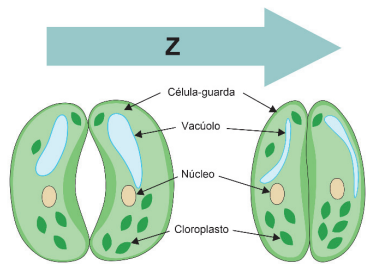
É correto afirmar que a seta Z representa
É correto afirmar que a seta Z representa

 Conheça nossos planos