Questões de Vestibular ACAFE 2024 para Vestibular - Verão - Medicina
Foram encontradas 7 questões


Q3389973
Inglês
The image below represents a phenomenon widely recognized around the world, particularly in poorer and developing countries, known as 'Brain Drain.'
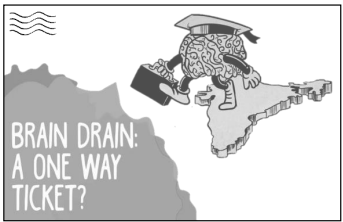
(Source: https://4.bp.blogspot.com/-KvIwfjxiZu4/V6KAlfPrSYI/AAAAAAAAAAM/ya3cGDKxfrc7LodtbR8qSQAtOTyGmhlgCLcB/s1600/maxresdefault.jpg, retrieved on 23rd Sep, 2024)
Choose the alternative which CORRECTLY explains the meaning of 'Brain Drain', according to the image above.
(Source: https://4.bp.blogspot.com/-KvIwfjxiZu4/V6KAlfPrSYI/AAAAAAAAAAM/ya3cGDKxfrc7LodtbR8qSQAtOTyGmhlgCLcB/s1600/maxresdefault.jpg, retrieved on 23rd Sep, 2024)
Choose the alternative which CORRECTLY explains the meaning of 'Brain Drain', according to the image above.
Q3389974
Inglês
Read the information in Text 1, published by the Johns Hopkins Bloomberg School of Public Health.
Text 1
Monkeypox is nothing new, and the virus is endemic in several countries. But when cases started appearing beyond the expected places—and among people who didn’t travel to those endemic regions—researchers paid attention. [...] We’ve been aware of monkeypox for decades, and we have been interested in it mostly because it’s a cousin of smallpox. It is a related orthopoxvirus. The symptoms, although somewhat less severe, are quite similar to smallpox. In most cases, it causes relatively mild illness, meaning most people don’t end up in the hospital with it. [...] It spreads through large respiratory droplets and bodily fluids, so mostly it spreads through close or intimate contact with other people. It’s not highly contagious— nothing like COVID, for example. [...] The Monkeypox virus does tend to be a very stable virus. Unlike COVID, or flu that’s mutating constantly, the orthopoxviruses tend to be quite stable. I think the expectation is that the vaccines would still be effective.
(Source: Adapted from What You Need to Know About Monkeypox | Johns Hopkins | Bloomberg School of Public Health (jhu.edu), retrieved on 23rd Sep, 2024)
According to Text 1, analyse whether the statements that follow are true (T) or false (F).
I ( ) Monkeypox is a recently discovered virus that has drawn researchers' attention.
II ( ) Monkeypox and smallpox are caused by viruses that belong to the same family.
III ( ) Usually, the symptoms of smallpox do not result in severe manifestations or health problems and are generally not serious, unlike those of the monkeypox.
IV ( ) The monkeypox virus mutates constantly. Covid and the flu viruses are likely to be quite stable.
V ( ) It's expected that the vaccines for monkeypox, smallpox, Covid, and the flu are effective because these viruses are relatively stable.
VI ( ) Some regions of the world experience ongoing levels of monkeypox rather than occasional outbreaks.
The statements I to VI are respectively:
Text 1
Monkeypox is nothing new, and the virus is endemic in several countries. But when cases started appearing beyond the expected places—and among people who didn’t travel to those endemic regions—researchers paid attention. [...] We’ve been aware of monkeypox for decades, and we have been interested in it mostly because it’s a cousin of smallpox. It is a related orthopoxvirus. The symptoms, although somewhat less severe, are quite similar to smallpox. In most cases, it causes relatively mild illness, meaning most people don’t end up in the hospital with it. [...] It spreads through large respiratory droplets and bodily fluids, so mostly it spreads through close or intimate contact with other people. It’s not highly contagious— nothing like COVID, for example. [...] The Monkeypox virus does tend to be a very stable virus. Unlike COVID, or flu that’s mutating constantly, the orthopoxviruses tend to be quite stable. I think the expectation is that the vaccines would still be effective.
(Source: Adapted from What You Need to Know About Monkeypox | Johns Hopkins | Bloomberg School of Public Health (jhu.edu), retrieved on 23rd Sep, 2024)
According to Text 1, analyse whether the statements that follow are true (T) or false (F).
I ( ) Monkeypox is a recently discovered virus that has drawn researchers' attention.
II ( ) Monkeypox and smallpox are caused by viruses that belong to the same family.
III ( ) Usually, the symptoms of smallpox do not result in severe manifestations or health problems and are generally not serious, unlike those of the monkeypox.
IV ( ) The monkeypox virus mutates constantly. Covid and the flu viruses are likely to be quite stable.
V ( ) It's expected that the vaccines for monkeypox, smallpox, Covid, and the flu are effective because these viruses are relatively stable.
VI ( ) Some regions of the world experience ongoing levels of monkeypox rather than occasional outbreaks.
The statements I to VI are respectively:
Q3389975
Inglês
Mark the alternative in which the Passive Voice sentence corresponds to its Active Voice form, in accordance with standard grammar rules.
Q3389976
Inglês
The text below was extracted from the article What excessive screen time does to the adult brain, and some words have been removed from it.
Binge-watching television, watching YouTube videos for hours, or scrolling on your phone every morning may seem (I) ____________, but research shows that too much screen time may be (II) ____________ to your health. [...] Too much (III) ____________ can impact our health in a myriad of ways, (IV) ____________ eye strain and neck pain (V)________social isolation and mental health issues, and in some cases, it may cause harm (VI) ____________ our brains.
(Source: Adapted from What Excessive Screen Time Does to the Adult Brain | Cognitive Enhancement (stanford.edu), retrieved on 23rd Sep, 2024)
Select the option that contains the CORRECT sequence of words to accurately complete the excerpt.
Binge-watching television, watching YouTube videos for hours, or scrolling on your phone every morning may seem (I) ____________, but research shows that too much screen time may be (II) ____________ to your health. [...] Too much (III) ____________ can impact our health in a myriad of ways, (IV) ____________ eye strain and neck pain (V)________social isolation and mental health issues, and in some cases, it may cause harm (VI) ____________ our brains.
(Source: Adapted from What Excessive Screen Time Does to the Adult Brain | Cognitive Enhancement (stanford.edu), retrieved on 23rd Sep, 2024)
Select the option that contains the CORRECT sequence of words to accurately complete the excerpt.
Q3389977
Inglês
Complete the sentences with one of the Relative Pronouns, in parentheses, in order to make them grammatically CORRECT, based on the standard rules.
I. The person to .......... you spoke yesterday is my neighbour. (whom - which)
II. The car, ............. is parked outside, needs a wash. (which - that)
III. The boy .............. bike was stolen reported it to the police. (which - whose)
IV. The house ............. we bought last year needs some repairs. (that - whom)
V. He is the teacher ......... inspired me to study science. (who - which)
VI. He’s the author of the book about ........ everyone is talking. (who - whom)
Mark the alternative that corresponds to the CORRECT sequence from I to VI, respectively, to complete the sentences.
I. The person to .......... you spoke yesterday is my neighbour. (whom - which)
II. The car, ............. is parked outside, needs a wash. (which - that)
III. The boy .............. bike was stolen reported it to the police. (which - whose)
IV. The house ............. we bought last year needs some repairs. (that - whom)
V. He is the teacher ......... inspired me to study science. (who - which)
VI. He’s the author of the book about ........ everyone is talking. (who - whom)
Mark the alternative that corresponds to the CORRECT sequence from I to VI, respectively, to complete the sentences.
Q3389978
Inglês
Read Text 2 and pay very close attention to the words that are underlined and in bold
Text 2
White Blood
Doctors in Germany faced something they had never seen before. A 39-year-old patient’s blood was so pale and thick that it looked like milk. The medical condition was not a mystery. The (1) nearly comatose patient suffered from extreme hypertriglyceridemia. It is caused by too much fat in the blood.
Siphoning off the offending triglyceride molecules and returning the cleaned plasma to the body usually solves the problem. However, when staff tried the normal route, his viscous blood clogged the hospital’s filtering equipment. Not once, but twice. The problem was a record amount of triglycerides. Around 500 mg/dL is considered “high.” The man’s count read (2) an astonishing 18,000 mg/dL.
Desperate to save his life, doctors (3) resorted to an ancient remedy abandoned by modern medicinebloodletting. A good amount of the white gunk was drained and replaced with red blood cell concentrates and saline solution. It worked. (4) Although the cause of the severity is unknown, the patient’s genes, obesity, and irregular consumption of his diabetes medication might have combined to cause the mother of all hypertriglyceridemia cases.
(Source: 10 Fascinating Facts And Stories Involving Body Parts - Listverse - Adapted. Retrieved on 23rd Sep, 2024)
Select the option that provides the CORRECT sequence to replace the underlined words in Text 2, while maintaining the original meaning as closely as possible.
Text 2
White Blood
Doctors in Germany faced something they had never seen before. A 39-year-old patient’s blood was so pale and thick that it looked like milk. The medical condition was not a mystery. The (1) nearly comatose patient suffered from extreme hypertriglyceridemia. It is caused by too much fat in the blood.
Siphoning off the offending triglyceride molecules and returning the cleaned plasma to the body usually solves the problem. However, when staff tried the normal route, his viscous blood clogged the hospital’s filtering equipment. Not once, but twice. The problem was a record amount of triglycerides. Around 500 mg/dL is considered “high.” The man’s count read (2) an astonishing 18,000 mg/dL.
Desperate to save his life, doctors (3) resorted to an ancient remedy abandoned by modern medicinebloodletting. A good amount of the white gunk was drained and replaced with red blood cell concentrates and saline solution. It worked. (4) Although the cause of the severity is unknown, the patient’s genes, obesity, and irregular consumption of his diabetes medication might have combined to cause the mother of all hypertriglyceridemia cases.
(Source: 10 Fascinating Facts And Stories Involving Body Parts - Listverse - Adapted. Retrieved on 23rd Sep, 2024)
Select the option that provides the CORRECT sequence to replace the underlined words in Text 2, while maintaining the original meaning as closely as possible.
Q3389979
Inglês
Classify the underlined and bolded words (1 to 4), according to their grammatical category as used in Text 2.

 Conheça nossos planos