Questões de Vestibular Comentadas sobre vocabulário | vocabulary em inglês

Foram encontradas 209 questões

Ano: 2019 Banca: Instituto Consulplan Órgão: FIMCA Prova: Instituto Consulplan - 2019 - FIMCA - Vestibular de Medicina - Edital nº 01/ 2020 |
Q1790467 Inglês
Science Education in the United States of America

(Audrey B. Champagne.)

    Science education in the United States of America is in the midst of an unprecedented reform movement-unprecedented because the movement is driven by national standards developed with support from the federal government. The standards for science education are redefining the character of science education from kindergarten to the postgraduate education of scientists and science teachers. Unlike the education in most countries of the world, education of students in kindergarten through grade twelve in the United States is not the responsibility of the federal government but is controlled by the individual states. States have the right to regulate all elements of the curriculum-the content all students are expected to learn, the structural organization of programs across all grades, the structural organization of the yearly curriculum in each subject, teaching methods, and textbooks. Historically, and even now, the states jealously guard all their rights and resist efforts by the federal government to exercise control over matters that are the responsibility of the states. The federal government's involvement in education has been to identify matters of national priority and to provide funds and other resources to the states to meet the national priorities. So, for instance, in the late 1960s and early 1970s, when the United States felt that its perceived preeminence in scientific research and its national safety were threatened, science education was identified as a national priority. The primary purpose of the federal government's initiatives was to encourage and upgrade the science education of young people who would become practicing scientists. This effort was not perceived by the states as an erosion of their rights because it was a response to a threat to the nation and was targeted on the science education of a relatively few students. The current situation is quite different.
    The federal government's underwriting of the development of national standards for education has the potential for shifting the control of the curriculum from the states to the federal government. This initiative, supported by the National Association of Governors, is the result of the concern of political, business and industrial leaders with the poor quality of education across the nation and with the effect this poor quality has on the U.S. position in the world economy. The goal of the standards movement from the prospective of political, business, and industrial leaders is to strengthen education so that the schools will produce graduates with the knowledge and skills required of them to be productive in the workplace.
   The pedagogy and attitudes of many teachers and professors alike has been that science is for the few. So little concern or effort was applied to make science interesting or to make learning it easy. Consequently, only highly motivated and highly intelligent students survived science courses. Thus it appears education in the natural sciences develops individuals who reason well, are critical thinkers, are creative problem solvers-in short, are intelligent. But, we must ask, does education in the natural sciences produce smarter people or do smart people survive science as it is taught? While historically the answer to the question may well have been survival, the national standards are based on the beliefs that science is for all and can produce smarter people.

(Available: https://files.eric.ed.gov/fulltext/EJ608194.pdf. Adapted.)
For Instance (L22) sets:
Alternativas
Ano: 2019 Banca: Instituto Consulplan Órgão: FIMCA Prova: Instituto Consulplan - 2019 - FIMCA - Vestibular de Medicina - Edital nº 01/ 2020 |
Q1790465 Inglês
Science Education in the United States of America

(Audrey B. Champagne.)

    Science education in the United States of America is in the midst of an unprecedented reform movement-unprecedented because the movement is driven by national standards developed with support from the federal government. The standards for science education are redefining the character of science education from kindergarten to the postgraduate education of scientists and science teachers. Unlike the education in most countries of the world, education of students in kindergarten through grade twelve in the United States is not the responsibility of the federal government but is controlled by the individual states. States have the right to regulate all elements of the curriculum-the content all students are expected to learn, the structural organization of programs across all grades, the structural organization of the yearly curriculum in each subject, teaching methods, and textbooks. Historically, and even now, the states jealously guard all their rights and resist efforts by the federal government to exercise control over matters that are the responsibility of the states. The federal government's involvement in education has been to identify matters of national priority and to provide funds and other resources to the states to meet the national priorities. So, for instance, in the late 1960s and early 1970s, when the United States felt that its perceived preeminence in scientific research and its national safety were threatened, science education was identified as a national priority. The primary purpose of the federal government's initiatives was to encourage and upgrade the science education of young people who would become practicing scientists. This effort was not perceived by the states as an erosion of their rights because it was a response to a threat to the nation and was targeted on the science education of a relatively few students. The current situation is quite different.
    The federal government's underwriting of the development of national standards for education has the potential for shifting the control of the curriculum from the states to the federal government. This initiative, supported by the National Association of Governors, is the result of the concern of political, business and industrial leaders with the poor quality of education across the nation and with the effect this poor quality has on the U.S. position in the world economy. The goal of the standards movement from the prospective of political, business, and industrial leaders is to strengthen education so that the schools will produce graduates with the knowledge and skills required of them to be productive in the workplace.
   The pedagogy and attitudes of many teachers and professors alike has been that science is for the few. So little concern or effort was applied to make science interesting or to make learning it easy. Consequently, only highly motivated and highly intelligent students survived science courses. Thus it appears education in the natural sciences develops individuals who reason well, are critical thinkers, are creative problem solvers-in short, are intelligent. But, we must ask, does education in the natural sciences produce smarter people or do smart people survive science as it is taught? While historically the answer to the question may well have been survival, the national standards are based on the beliefs that science is for all and can produce smarter people.

(Available: https://files.eric.ed.gov/fulltext/EJ608194.pdf. Adapted.)
“Meet” (L22) does NOT mean:
Alternativas
Q1785730 Inglês
Read the dialogue to answer.
Doctor: Have you ever fainted before? Patient: Yes, the last time you told me your fees.
(Available in:https://pages2cool.blogspot.com.)
Mark the item that does NOT match the dialogue:
Alternativas
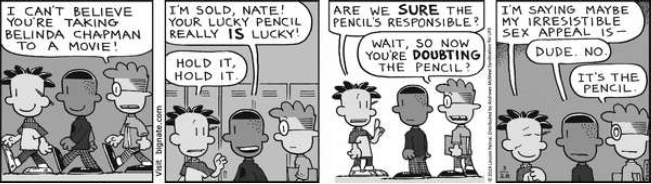
Q1404651 Inglês

Imagem associada para resolução da questão

Available at: www.comics.azcentral.com. Accessed on March 28th, 2019.


Answer the question according to Text.


The expression: “I`m sold, Nate”, in the second picture, means:

Alternativas
Ano: 2019 Banca: VUNESP Órgão: UNIFESP Prova: VUNESP - 2019 - UNIFESP - Vestibular |
Q1399577 Inglês

Leia o texto para responder à questão.


America’s social-media addiction is getting worse


(Sources: Pew Research Centre; e Marketer)


   A survey in January and February 2019 from the Pew Research Centre, a think tank, found that 69% of American adults use Facebook; of these users, more than half visit the site “several times a day”. YouTube is even more popular, with 73% of adults saying they watch videos on the platform. For those aged 18 to 24, the figure is 90%. Instagram, a photo-sharing app, is used by 37% of adults. When Pew first conducted the survey in 2012, only a slim majority of Americans used Facebook. Fewer than one in ten had an Instagram account.

    Americans are also spending more time than ever on social-media sites like Facebook. There is evidence that limiting such services might yield health benefits. A paper published last year by Melissa Hunt, Rachel Marx, Courtney Lipson and Jordyn Young, all of the University of Pennsylvania, found that limiting social-media usage to 10 minutes a day led to reductions in loneliness, depression, anxiety and fear. Another paper from 2014 identified a link between heavy social-media usage and depression, largely due to a “social comparison” phenomenon, whereby users compare themselves to others and come away with lower evaluations of themselves. 

(www.economist.com, 08.08.2019. Adaptado.)

No trecho do segundo parágrafo “largely due to a ‘social comparison’ phenomenon”, a expressão sublinhada pode ser substituída, sem alteração de sentido, por
Alternativas
Ano: 2019 Banca: Cepros Órgão: CESMAC Prova: Cepros - 2019 - CESMAC - Prova de Medicina-2020.1- 1° DIA |
Q1391676 Inglês
Read the text below and answer the following  question based on it.

Can lifestyle changes reverse coronary heart disease? The Lifestyle Heart Trial.

Abstract

In a prospective, randomised, controlled trial to determine whether comprehensive lifestyle changes affect coronary atherosclerosis after 1 year, 28 patients were assigned to an experimental group (low-fat vegetarian diet, stopping smoking, stress management training, and moderate exercise) and 20 to a usual-care control group. 195 coronary artery lesions were analysed by quantitative coronary angiography. The average percentage diameter stenosis regressed from 40.0 (SD 16.9)% to 37.8 (16.5)% in the experimental group yet progressed from 42.7 (15.5)% to 46.1 (18.5)% in the control group. When only lesions greater than 50% stenosed were analysed, the average percentage diameter stenosis regressed from 61.1 (8.8)% to 55.8 (11.0)% in the experimental group and progressed from 61.7 (9.5)% to 64.4 (16.3)% in the control group. Overall, 82% of experimental-group patients had an average change towards regression. Comprehensive lifestyle changes may be able to bring about regression of even severe coronary atherosclerosis after only 1 year, without use of lipidlowering drugs

Adaptado de:
<https://www.ncbi.nlm.nih.gov/pubmed/1973470> Acessado
em 27 de outubro de 2017.
In “Comprehensive lifestyle changes may be able to bring about regression…” may expresses:
Alternativas
Ano: 2019 Banca: Inatel Órgão: Inatel Prova: Inatel - 2019 - Inatel - Vestibular - Julho |
Q1386890 Inglês
[…] “whereas our bees can collect data for hours […] (Singular Form)
Alternativas
Ano: 2019 Banca: Inatel Órgão: Inatel Prova: Inatel - 2019 - Inatel - Vestibular - Julho |
Q1386888 Inglês
[…]”requires only a tiny battery” […] (Synonym)
Alternativas
Ano: 2019 Banca: CÁSPER LÍBERO Órgão: CÁSPER LÍBERO Prova: CÁSPER LÍBERO - 2019 - CÁSPER LÍBERO - Vestibular |
Q1380988 Inglês
Quais expressões a seguir não configuram um oximoro?
Alternativas
Ano: 2019 Banca: CÁSPER LÍBERO Órgão: CÁSPER LÍBERO Prova: CÁSPER LÍBERO - 2019 - CÁSPER LÍBERO - Vestibular |
Q1380987 Inglês
1. Once upon a time there ______________ a king called Arthur. 2. I ___________ to visit my cousins to enjoy ________ hospitality. 3. Something ________ to be done about this pathetic situation.

Assinale a opção que contém a sequência de palavras que preenche corretamente as lacunas das três frases 1, 2 e 3, nessa ordem.
Alternativas
Ano: 2019 Banca: FAG Órgão: FAG Prova: FAG - 2019 - FAG - Vestibular - Segundo Semestre - Medicina |
Q1369795 Inglês
Text 2


Text 2a. Second Language Learning


    One of the principles of all learning is that we make sense of new information and ideas by relating them to our previous knowledge. There are two main kinds of previous language knowledge which second language learners can use in order to make sense of the new language they encounter: the first is their knowledge of their mother tongue and the second is the knowledge they already possess about the second language itself.
LITTLEWOOD, W. Second Language Learning. In DAVIES, A. e ELDER, C. The Handbook of Applied Linguistics, pp.504/5, Blackwell Publishing, 2010.

Text 2b. National Curriculum Parameters


    Every text is organized within a specific genre according to its communicative purposes, as part of the conditions of discourse production, which generate social uses that determine any and every text. Genres are, therefore, historically determined, and constitute relatively stable forms of utterances available in a culture. (National Curriculum Parameters, Brasil, 1988, p.21) (adaptado) Answer the two questions below considering also texts "Second Language Learning" and "National Curriculum Parameters", above.
Choose the correct option about some features of the texts 2a and 2b above:
Alternativas
Ano: 2019 Banca: Inatel Órgão: Inatel Prova: Inatel - 2019 - Inatel - Vestibular - Junho |
Q1369370 Inglês
First ever black hole image released.

Astronomers have taken the first ever image of a black hole, which is located in a distant galaxy. It measures 40 billion km across - three million times the size of the Earth - and has been described by scientists as "a monster".

The black hole is 500 million trillion km away and was photographed by a network of eight telescopes across the world It was captured by the Event Horizon Telescope (EHT), a network of eight linked telescopes. 

Prof Heino Falcke, of Radboud University in the Netherlands, who proposed the experiment, told BBC News that the black hole was found in a galaxy called M87.

"What we see is larger than the size of our entire Solar System," he said.

"It has a mass 6.5 billion times that of the Sun. And it is one of the heaviest black holes that we think exists. It is an absolute monster, the heavyweight champion of black holes in the Universe."

The image shows an intensely bright "ring of fire", as Prof Falcke describes it, surrounding a perfectly circular dark hole. The bright halo is caused by superheated gas falling into the hole. The light is brighter than all the billions of other stars in the galaxy combined - which is why it can be seen at such distance from Earth.

The edge of the dark circle at the centre is the point at which the gas enters the black hole, which is an object that has such a large gravitational pull, not even light can escape.

The image matches what theoretical physicists and indeed, Hollywood directors, imagined black holes would look like, according to Dr Ziri Younsi, of University College London - who is part of the EHT collaboration.

"Although they are relatively simple objects, black holes raise some of the most complex questions about the nature of space and time, and ultimately of our existence," he said.

"It is remarkable that the image we observe is so similar to that which we obtain from our theoretical calculations. So far, it looks like Einstein is correct once again."

But having the first image will enable researchers to learn more about these mysterious objects. They will be keen to look out for ways in which the black hole departs from what's expected in physics. No-one really knows how the bright ring around the hole is created. Even more intriguing is the question of what happens when an object falls into a black hole.

Source: www.bbc.com/news/science-environment-47873592
“The image matches what theoretical physicists and indeed, Hollywood directors, imagined black holes would look like, according to Dr.Ziri Younsi” […] (Verb Synonym)
Alternativas
Ano: 2019 Banca: VUNESP Órgão: FAMEMA Prova: VUNESP - 2019 - FAMEMA - Vestibular 2020 - Prova II |
Q1339319 Inglês

               An increasing body of evidence suggests that the time we spend on our smartphones is interfering with our sleep, self-esteem, relationships, memory, attention spans, creativity, productivity and problem-solving and decision-making skills. But there is another reason for us to rethink our relationships with our devices. By chronically raising levels of cortisol, the body’s main stress hormone, our phones may be threatening our health and shortening our lives.

          If they happened only occasionally, phone-induced cortisol spikes might not matter. But the average American spends four hours a day staring at their smartphone and keeps it within arm’s reach nearly all the time, according to a tracking app called Moment.

         “Your cortisol levels are elevated when your phone is in sight or nearby, or when you hear it or even think you hear it,” says David Greenfield, professor of clinical psychiatry at the University of Connecticut School of Medicine and founder of the Center for Internet and Technology Addiction. “It’s a stress response, and it feels unpleasant, and the body’s natural response is to want to check the phone to make the stress go away.”

          But while doing so might soothe you for a second, it probably will make things worse in the long run. Any time you check your phone, you’re likely to find something else stressful waiting for you, leading to another spike in cortisol and another craving to check your phone to make your anxiety go away. This cycle, when continuously reinforced, leads to chronically elevated cortisol levels. And chronically elevated cortisol levels have been tied to an increased risk of serious health problems, including depression, obesity, metabolic syndrome, Type 2 diabetes, fertility issues, high blood pressure, heart attack, dementia and stroke.


(Catherine Price. www.nytimes.com, 24.04.2019. Adaptado.)

No trecho do último parágrafo “while doing so might soothe you for a second”, o termo sublinhado equivale, em português, a
Alternativas
Ano: 2019 Banca: UERJ Órgão: UERJ Prova: UERJ - 2019 - UERJ - Vestibular - Primeiro Exame |
Q998938 Inglês

Had the Earth been flat, a total of three satellites would have been enough to provide this information (l. 30-31)

In relation to the rest of the statement, the underlined fragment has the objective of:

Alternativas
Ano: 2019 Banca: UERJ Órgão: UERJ Prova: UERJ - 2019 - UERJ - Vestibular - Primeiro Exame |
Q998937 Inglês

These and other flat-Earth assertions appear on the website of the FES, allegedly the world’s oldest official flat Earth organization, dating to the early 1800s. (l. 16-17)

In relation to the fragment above, the pieces of information introduced in the fifth paragraph (l. 18-20) serve the following purpose:

Alternativas
Ano: 2018 Banca: VUNESP Órgão: UNIVESP Prova: VUNESP - 2018 - UNIVESP - Vestibular |
Q1686603 Inglês
Leia o texto para responder a questão.

Modern-day slavery: an explainer
Photograph: Mario Tama/Getty

What is modern-day slavery?
   About 150 years after most countries banned slavery – Brazil was the last to abolish its participation in the transatlantic slave trade, in 1888 – millions of men, women and children are still enslaved. Contemporary slavery takes many forms, from women forced into prostitution, to child slavery in agriculture supply chains or whole families working for nothing to pay off generational debts. Slavery thrives on every continent and in almost every country. Forced labour, people trafficking, debt bondage and child marriage are all forms of modern-day slavery that affect the world’s most vulnerable people.

How is slavery defined?
  Slavery is prohibited under the 1948 Universal Declaration of Human Rights, which states: “No one shall be held in slavery or servitude: slavery and the slave trade shall be prohibited in all their forms.”
  Definitions of modern-day slavery are mainly taken from the 1956 UN supplementary convention, which says: “debt bondage, serfdom, forced marriage and the delivery of a child for the exploitation of that child are all slavery-like practices and require criminalisation and abolishment”. The 1930 Forced Labour Convention defines forced labour as “all work or service which is exacted from any person under the menace of any penalty and for which the said person has not offered himself voluntarily”. As contemporary systems of slavery have evolved, new definitions, including trafficking and distinguishing child slavery from child labour, have developed. 

How many people are enslaved across the world?
  Due to its illegality, data on modern-day slavery is difficult to collate. The UN’s International Labour Organisation (ILO) estimates that about 21 million people are in forced labour at any point in time. The ILO says this estimate includes trafficking and other forms of modern slavery. The only exceptions are trafficking for organ removal, forced marriage and adoption, unless the last two practices result in forced labour. The ILO calculates that 90% of the 21 million are exploited by individuals or companies, while 10% are forced to work by the state, rebel military groups, or in prisons under conditions that violate ILO standards. Sexual exploitation accounts for 22% of slaves.

(www.theguardian.com/global-development/2013/apr/03/modern-day-slavery-explainer. Adaptado)
No trecho do quarto parágrafo unless the last two practices result in forced labour – o termo em destaque indica ideia de
Alternativas
Ano: 2018 Banca: PUC - RS Órgão: PUC - RS Prova: PUC - RS - 2018 - PUC - RS - Vestibular - Segundo Dia |
Q1399020 Inglês

INSTRUÇÃO: Responder à questão com base no texto. 


Rip Van Winkle is a classic American short story written by Washington Irving based on local history _____ with influences from European folklore. It tells the story of a man who lived near the Catskill Mountains in New York before the Revolutionary War and fell asleep for twenty years. Everything he knew _____ in the town was gone. _____, he learned that he had to navigate this new world as a free citizen of the United States.

Adapted from: http://www.supersummary.com/rip-van-winkle/summary/ and https://www.bookreports.info/rip-van-winkle-summary/

The alternative that brings words that fill in the blanks in text, respectively, is
Alternativas
Ano: 2018 Banca: VUNESP Órgão: FAMERP Prova: VUNESP - 2018 - FAMERP - Conhecimentos Gerais |
Q1335857 Inglês

Leia o texto para responder à questão.


    There is nothing conventional about 17-year-old Michael Fuller’s relationship with music. As someone with high-functioning autism who sees the world through sound, creating melodies from the bustle of the high street or trains on the tracks feels more natural than any social interaction. This hardwired connection to sound has been with him for as long as he can remember.

    By the age of 11, Michael could play Mozart by ear, having taught himself to play the piano through a mobile phone app. The app highlighted notes on a keyboard as classical music played. He describes his unusual musical talent as “downloading” music into his head. His mother, Nadine, remembers that as a child Michael would “suddenly pop up and say: ‘I’ve got a symphony’”. Michael took to the piano and found he could quickly perform complex pieces from memory.

    “I liked what I was hearing, sought more music and began studying through Google and YouTube,” he remembers. “It was very organic. I would listen in great depth and the music would be implanted in my mind. I could then just play it on the piano – all without being taught.”

    Growing up in a family that listened to reggae over classical music, Michael feels “very much aware” of how different his approach is to music – symbolised by the way he taught himself piano as a child. This, his mother says, came as a “surprise to the family and myself – I’d never listened to classical music in my life”.

    It was not long after learning to play the piano that Michael started composing his own works. Describing this process as “making music with my mind”, Michael says composing classical symphonies “helps me to express myself through music – it makes me calm”. Michael wants to nurture his song writing to achieve his ambition of becoming a modern mainstream classical artist. He wants to control the creative process, unlike typical modern-day composers, who he says “write blobs on a page, hand it over to the musicians – then say bye-bye and stay in the background and get no recognition”. Instead, Michael is determined to take centre stage.


(Alex Taylor. www.bbc.com, 27.03.2018. Adaptado.)

No trecho do terceiro parágrafo “sought more music”, o termo sublinhado tem sentido semelhante, em português, a
Alternativas
Ano: 2018 Banca: VUNESP Órgão: FAMERP Prova: VUNESP - 2018 - FAMERP - Conhecimentos Gerais |
Q1335853 Inglês

Leia o texto para responder à questão.


    There is nothing conventional about 17-year-old Michael Fuller’s relationship with music. As someone with high-functioning autism who sees the world through sound, creating melodies from the bustle of the high street or trains on the tracks feels more natural than any social interaction. This hardwired connection to sound has been with him for as long as he can remember.

    By the age of 11, Michael could play Mozart by ear, having taught himself to play the piano through a mobile phone app. The app highlighted notes on a keyboard as classical music played. He describes his unusual musical talent as “downloading” music into his head. His mother, Nadine, remembers that as a child Michael would “suddenly pop up and say: ‘I’ve got a symphony’”. Michael took to the piano and found he could quickly perform complex pieces from memory.

    “I liked what I was hearing, sought more music and began studying through Google and YouTube,” he remembers. “It was very organic. I would listen in great depth and the music would be implanted in my mind. I could then just play it on the piano – all without being taught.”

    Growing up in a family that listened to reggae over classical music, Michael feels “very much aware” of how different his approach is to music – symbolised by the way he taught himself piano as a child. This, his mother says, came as a “surprise to the family and myself – I’d never listened to classical music in my life”.

    It was not long after learning to play the piano that Michael started composing his own works. Describing this process as “making music with my mind”, Michael says composing classical symphonies “helps me to express myself through music – it makes me calm”. Michael wants to nurture his song writing to achieve his ambition of becoming a modern mainstream classical artist. He wants to control the creative process, unlike typical modern-day composers, who he says “write blobs on a page, hand it over to the musicians – then say bye-bye and stay in the background and get no recognition”. Instead, Michael is determined to take centre stage.


(Alex Taylor. www.bbc.com, 27.03.2018. Adaptado.)

In the excerpt from the first paragraph “has been with him for as long as he can remember”, the underlined expression indicates
Alternativas
Ano: 2018 Banca: Cepros Órgão: CESMAC Prova: Cepros - 2018 - CESMAC - Prova de Medicina-2018.2- 1° DIA- PROVA TIPO 1 |
Q1331514 Inglês
Read the text below and answer the following question based on it.


Loneliness may harm sleep quality for young adults

Researchers from King's College London have found that young adults who reported feeling lonely were more likely to experience poor sleep quality, daytime tiredness, and poor concentration than their non-lonely counterparts.
Although loneliness is often perceived as a problem that primarily affects older adults, recent research has suggested that this is not the case.
However, according to the researchers of the new study, less is known about how loneliness affects the health of young adults - in particular, how it impacts sleep quality.
"In the present study, we tested associations between loneliness and sleep quality in a nationally representative sample of young adults," say Prof. Louise Arseneault, of the Institute of Psychiatry, Psychology & Neuroscience at King's, and colleagues.
The researchers analyzed the data of 2,232 young adults aged 18 to 19 years. They asked the participants four questions to measure their feelings of loneliness, including, "How often do you feel that you lack companionship?" and "How often do you feel alone?"
Additionally, the researchers gathered information on the participants' sleep quality over the past month, including sleep duration, sleep disturbances, and how long it takes them to fall asleep.
The analysis revealed that the lonely participants were 10 percent more likely to have poor sleep quality than subjects who did not report loneliness, and they were 24 percent more likely to experience daytime tiredness and problems with concentration.
These findings remained after accounting for a number of possible confounding factors, including symptoms of anxiety, depression, and other mental health disorders.
Although the study was not designed to investigate the mechanisms underlying the link between loneliness and poor sleep quality, the researchers have some theories.
For example, they point to previous studies that have identified a link between loneliness and an increase in the "stress hormone" cortisol, which could lead to sleep disruption.
Adaptado de: < https://www.medicalnewstoday.com/articles/317563.php?sr> Acessado em 02 de abril de 2018. 
In the sentence "...the lonely participants were 10 percent more likely to have poor sleep quality than subjects who did not report loneliness..." a synonym for likely is
Alternativas
Respostas
41: B
42: B
43: D
44: E
45: B
46: E
47: E
48: D
49: C
50: E
51: E
52: E
53: A
54: A
55: D
56: C
57: A
58: B
59: A
60: E