Questões de Vestibular Comentadas sobre vocabulário | vocabulary em inglês

Foram encontradas 209 questões

Q2182187 Inglês
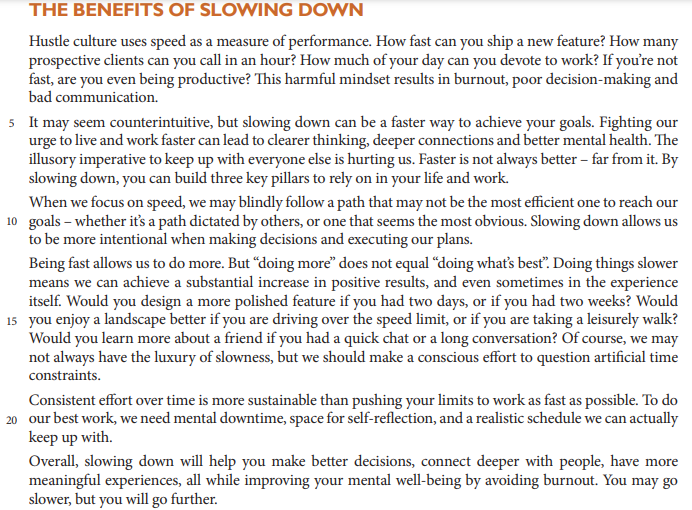
In the second paragraph, the author mentions three principles we can count on in our life and work. Each is presented in a separate paragraph, along lines 09 to 21. The words that best represent the topic of each of the three paragraphs, respectively, are:
Alternativas
Q2092711 Inglês
INSTRUÇÃO: Responder à questão com base no texto 2. 

TEXTO 2

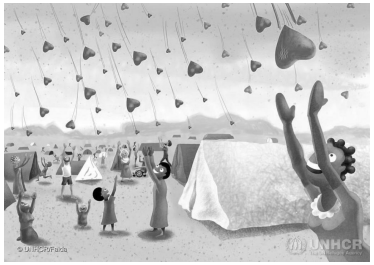
STATELESSNESS
NEWSLETTER
#IBELONG CAMPAIGN
Celebrating its 6th anniversary

2_-10.png (374×265)

UNHCR 2020 Youth With Refugees Art Contest.
©UNHCR/Faida
The alternative that presents three verbs that can relate to the message of Text 2 is
Alternativas
Q2092708 Inglês
TEXTO 1

Asylum-seeker smuggling is a
symptom, not a root cause

Robert Falconer/Craig D. Smith - Jan 31, 2022

1_- 7.png (369×777)
1_- 40.png (371×212)

Source: https://www.theglobeandmail.com/opinion/
article-asylum-seeker-smuggling-is-a-symptom-not-a-root-cause/
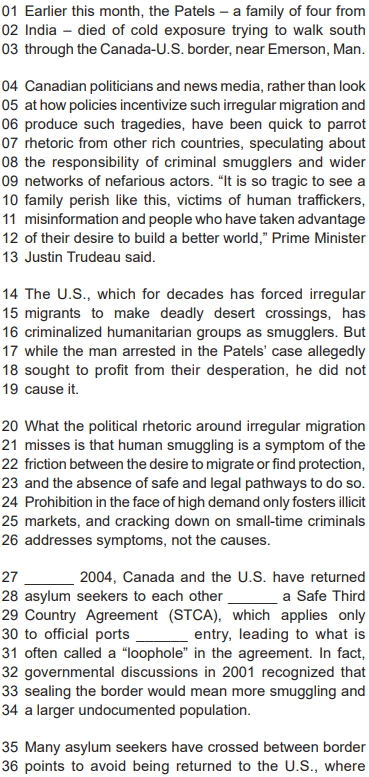
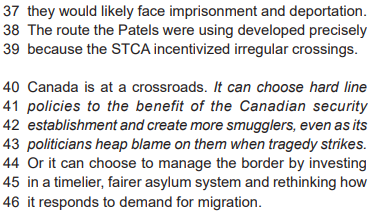
The verb forms “fosters” (line 24) and “cracking down” (line 25), and the adjective “small-time” (line 25), in the context, mean, respectively,
Alternativas
Q2092705 Inglês
TEXTO 1

Asylum-seeker smuggling is a
symptom, not a root cause

Robert Falconer/Craig D. Smith - Jan 31, 2022

1_- 7.png (369×777)
1_- 40.png (371×212)

Source: https://www.theglobeandmail.com/opinion/
article-asylum-seeker-smuggling-is-a-symptom-not-a-root-cause/
The word “loophole” (line 31), in this context, denotes
Alternativas
Ano: 2022 Banca: CESPE / CEBRASPE Órgão: UNB Prova: CESPE / CEBRASPE - 2022 - UNB - Vestibular - Inglês |
Q2032751 Inglês

Read the following infographic.


                                                                                                          Internet: <www.vricares.com> (adapted)

Based on the infographic presented, judge the follow item. 

In section 1, it would be correct to use Exercising instead of “Exercise”, which, despite causing a slight difference in meaning, would not change the message conveyed.
Alternativas
Ano: 2022 Banca: CESPE / CEBRASPE Órgão: UNB Prova: CESPE / CEBRASPE - 2022 - UNB - Vestibular - Inglês |
Q2032742 Inglês
  Freedom is a general term, like liberty, independence, autonomy, and equality. In reality, freedom cannot be absolute; no one can be completely free. Your talents, family situation, job, wealth, cultural norms, and laws against murder, for example, constrain and circumscribe your choices. And then there is the freedom of others, which necessarily limits yours.
  Broadly speaking, your rights, whatever they may be, define the limits to your freedom. In the Western tradition of freedom, these are your civil and political rights, including your freedom of speech, religion, and association. Some philosophers see these not only as morally justified rights in themselves, but also as the means for fulfilling other possible rights, like happiness.
  The international justification for your freedom is by reference to human rights, those due to you as a human being and object of international conventions. The most basic of all these rights are those defining what governments cannot do to you. In effect, these human rights define what many mean by democratic freedom. Your freedom of thought, expression, religion, association, is basic, as are the secret ballot, periodic elections, and the right to representation. In short, these rights say that you have a right to be free. This is universal: we all have internationally defined and protected human rights.

Rudolph Joseph Rummel. Why should you be
free?.Internet:<www.hawaii.edu> (adapted). 

Judge the follow item concerning the ideas and linguistic features of the previous text.


In the last sentence of the first paragraph, the words “others” and “yours” are both in their plural form.

Alternativas
Ano: 2022 Banca: FUVEST Órgão: USP Prova: FUVEST - 2022 - USP - Vestibular - 1ª Fase |
Q1994358 Inglês
    The expression “dark doldrums” chills the hearts of renewable-energy engineers, who use it to refer to the lulls when solar panels and wind turbines are thwarted by clouds, night, or still air. On a bright, cloudless day, a solar farm can generate prodigious amounts of electricity. But at night solar cells do little, and in calm air turbines sit useless.
     The dark doldrums make it difficult for us to rely totally on renewable energy. Power companies need to plan not just for individual storms or windless nights but for difficulties that can stretch for days. Last year, Europe experienced a weekslong “wind drought,” and in 2006 Hawaii endured six weeks of consecutive rainy days. On a smaller scale, communities that want to go all-renewable need to fill the gaps. The obvious solution is batteries, which power everything from mobile phones to electric vehicles; they are relatively inexpensive to make and getting cheaper. But typical models exhaust their stored energy after only three or four hours of maximum output, and—as every smartphone owner knows—their capacity dwindles with each recharge. Moreover, it is expensive to collect enough batteries to cover longer discharges.
    We already have one kind of renewable energy storage: more than ninety per cent of the world’s energy-storage capacity is in reservoirs, as part of a technology called pumped-storage hydropower, used to smooth out sharp increases in electricity demand. Motors pump water uphill from a river or a reservoir to a higher reservoir; when the water is released downhill, it spins a turbine, generating power. A pumped-hydro installation is like a giant, permanent battery, charged when water is pumped uphill and depleted as it flows down. Some countries are expanding their use of pumped hydro, but the right geography is hard to find, permits are difficult to obtain, and construction is slow and expensive. The hunt is on for new approaches to energy storage.

The New Yorker. Abril, 2022. Adaptado. 
Na frase “But typical models exhaust their stored energy after only three or four hours of maximum output, and—as every smartphone owner knows—their capacity dwindles with each recharge.” (2º parágrafo), “dwindles” poderia ser substituído, sem prejuízo de sentido, por 
Alternativas
Ano: 2021 Banca: CECIERJ Órgão: CEDERJ Prova: CECIERJ - 2021 - CEDERJ - Vestibular - Língua Inglesa - 2022.1 |
Q1859703 Inglês

TEXT 2

Imagem associada para resolução da questão

Available from: www.nature.com/naturemedicine. Access: 10 Oct. 2021. Adapted.


The linking word “although” (underlined in two sentences of the text) establishes a contrast between ideas, and it may be replaced by “but”. The alternative which correctly expresses the ideas which are contrasted in the two sentences is: 

Alternativas
Ano: 2021 Banca: FUVEST Órgão: USP Prova: FUVEST - 2021 - USP - Vestibular - Edital 2022 |
Q1858894 Inglês

        If you take a look at my smartphone, you’ll know that I like to order out. But am I helping the small local businesses? You would think that if you own a restaurant you’d be thrilled to have an outsourced service that would take care of your delivery operations while leveraging their marketing might to expand your businesses’ brand. However, restaurant owners have complained of lack of quality control once their food goes out the door. They don’t like that the delivery people are the face of their product when it gets into the customer’s hand. Some of the delivery services have been accused of listing restaurants on their apps without the owners’ permission, and oftentimes publish menu items and prices that are incorrect or out of date.

        But there is another reason why restaurant owners aren’t fond of delivery services. It’s the costs, which, for some, are becoming unsustainable. Even with the increased revenues from the delivery services, the fees wind up killing a restaurant’s margins to the extent that it’s at best marginally profitable. Therefore, some restaurants are pushing harder to drive orders from their own websites and offering special deals for customers that use their in-house delivery people.

        The simple fact is that these delivery apps are here to stay. They are enormously popular and have significantly grown. I believe that restaurant owners that resist these apps are hurting their brands by missing out on potential customers. The good news is that the delivery platforms are not as evil as some would portray them. They have some skin in the game. They are competing against other services. They want their listed restaurants to profit. Maybe instead of fighting, the nation’s restaurant industry needs to proactively embrace the delivery service industry and figure out ways to profitably work together.

The Guardian. 02 December, 2020. Adaptado.

Em “I believe that restaurant owners that resist these apps are hurting their brands by missing out on potential customers” (3º parágrafo), a expressão sublinhada pode ser substituída, sem prejuízo de sentido, por: 
Alternativas
Q1682919 Inglês
    Remember the good old days, when you could have a heated-yet-enjoyable debate with your friends about things that didn’t matter that much — times when you could be a true fan of the Manchester United soccer team when you didn’t come from the city of Manchester?

    How things have changed.

    Now disagreements feel deadly serious. Like when your colleague pronounces that wearing a face mask in public is a threat to his liberty. Or when you see that one of your friends has just tweeted that, actually, all lives matter. Before you know it, you’re feeling angry and forming harsh new judgments about your colleagues and friends. Let’s take a collective pause and breathe: there are some ways we can all try to have more civil disagreements in this febrile age of culture wars.

1. ‘Coupling’ and ‘decoupling’

    The first is to consider how inclined people are to ‘couple’ or ‘decouple’ topics involving wider political and social factors. Swedish data analyst John Nerst has used the terms to describe the contrasting ways in which people approach contentious issues. Those of us more inclined to ‘couple’ see them as inextricably related to a broader matrix of factors, whereas those more predisposed to ‘decouple’ prefer to consider an issue in isolation. To take a crude example, a decoupler might consider in isolation the question of whether a vaccine provides a degree of immunity to a virus; a coupler, by contrast, would immediately see the issue as inextricably entangled in a mesh of factors, such as pharmaceutical industry power and parental choice.

2.____________________

    Most of us are deeply committed to our beliefs, especially concerning moral and social issues, such that when we’re presented with facts that contradict our beliefs, we often choose to dismiss those facts, rather than update our beliefs.

    A study at Arizona State University, U.S., analysed more than 100,000 comments on a forum where users post their views on an issue and invite others to persuade them to change their mind. The researchers found that regardless of the kind of topic, people were more likely to change their mind when confronted with more evidence-based arguments. “Our work may suggest that while attitude change is hard-won, providing facts, statistics and citations for one’s arguments can convince people to change their minds,” they concluded.

3. Just be nicer?

    Finally, it’s easier said than done, but let’s all try to be more respectful of and attentive to each other’s positions. We should do this not just for virtuous reasons, but because the more we create that kind of a climate, the more open-minded and intellectually flexible we will all be inclined to be. And then hopefully, collectively, we can start having more constructive disagreements — even in our present very difficult times.

(Christian Jarrett. www.bbc.com, 14.10.2020. Adaptado.)
No trecho do último parágrafo “we will all be inclined to be”, o termo sublinhado indica uma
Alternativas
Q1682917 Inglês
    Remember the good old days, when you could have a heated-yet-enjoyable debate with your friends about things that didn’t matter that much — times when you could be a true fan of the Manchester United soccer team when you didn’t come from the city of Manchester?

    How things have changed.

    Now disagreements feel deadly serious. Like when your colleague pronounces that wearing a face mask in public is a threat to his liberty. Or when you see that one of your friends has just tweeted that, actually, all lives matter. Before you know it, you’re feeling angry and forming harsh new judgments about your colleagues and friends. Let’s take a collective pause and breathe: there are some ways we can all try to have more civil disagreements in this febrile age of culture wars.

1. ‘Coupling’ and ‘decoupling’

    The first is to consider how inclined people are to ‘couple’ or ‘decouple’ topics involving wider political and social factors. Swedish data analyst John Nerst has used the terms to describe the contrasting ways in which people approach contentious issues. Those of us more inclined to ‘couple’ see them as inextricably related to a broader matrix of factors, whereas those more predisposed to ‘decouple’ prefer to consider an issue in isolation. To take a crude example, a decoupler might consider in isolation the question of whether a vaccine provides a degree of immunity to a virus; a coupler, by contrast, would immediately see the issue as inextricably entangled in a mesh of factors, such as pharmaceutical industry power and parental choice.

2.____________________

    Most of us are deeply committed to our beliefs, especially concerning moral and social issues, such that when we’re presented with facts that contradict our beliefs, we often choose to dismiss those facts, rather than update our beliefs.

    A study at Arizona State University, U.S., analysed more than 100,000 comments on a forum where users post their views on an issue and invite others to persuade them to change their mind. The researchers found that regardless of the kind of topic, people were more likely to change their mind when confronted with more evidence-based arguments. “Our work may suggest that while attitude change is hard-won, providing facts, statistics and citations for one’s arguments can convince people to change their minds,” they concluded.

3. Just be nicer?

    Finally, it’s easier said than done, but let’s all try to be more respectful of and attentive to each other’s positions. We should do this not just for virtuous reasons, but because the more we create that kind of a climate, the more open-minded and intellectually flexible we will all be inclined to be. And then hopefully, collectively, we can start having more constructive disagreements — even in our present very difficult times.

(Christian Jarrett. www.bbc.com, 14.10.2020. Adaptado.)
No trecho do quarto parágrafo “whereas those more predisposed to ‘decouple’ prefer to consider an issue in isolation”, o termo sublinhado introduz
Alternativas
Ano: 2021 Banca: UPENET/IAUPE Órgão: UPE Prova: UPENET/IAUPE - 2021 - UPE - Vestibular - 3º Fase - 1º Dia |
Q1679743 Inglês
Observe as falas do texto e a análise atribuída a cada uma delas; em seguida, assinale a alternativa que está INCORRETA.
Alternativas
Ano: 2021 Banca: UPENET/IAUPE Órgão: UPE Prova: UPENET/IAUPE - 2021 - UPE - Vestibular - 2º Fase - 1º Dia |
Q1675849 Inglês

Text 2

Home


No one leaves

home unless home is the mouth of a shark

you only run for the border

when you see the whole city running as well


Your neighbors running faster than you

breath bloody in their throats

the boy you went to school with

who kissed you dizzy behind the old tin factory

is holding a gun bigger than his body

you only leave homewhen

home won‘t let you stay.


No one leaves home unless home chases you

fire under feet

hot blood in your belly

it‘s not something you ever thought of doing

until the blade burnt threats into

your neck

and even then you carried the anthem under

your breath

only tearing up your passport in an airport toilet

sobbing as each mouthful of paper

made it clear that you wouldn‘t be going back.


You have to understand,

that no one puts their children in a boat

unless the water is safer than the land

no one burns their palms

under trains

beneath carriages (…)


I want to go home,

but home is the mouth of a shark

home is the barrel of the gun

and no one would leave home

unless home chased you to the shore

unless home told you to quicken your legs

leave your clothes behind

crawl through the desert

wade through the oceans (…)


No one leaves home until home is a sweaty voice in your ear

saying –

leave,

run away from me now

I dont know what I‘ve become

but I know that anywhere

is safer than here.


By Warsan Shire. Disponível em: https://www.facinghistory.org/educator-resources/current-events/many-faces-global-migration#8 Excertos. Acesso em: set. 2020.

Considere o gênero textual, o contexto e a gramática da língua inglesa, e assinale a afirmativa INCORRETA para a análise linguística apresentada.
Alternativas
Q1675414 Inglês


*TV and/or radio

     Three-quarters of the world’s children live in countries where classrooms are closed. As lockdowns ease, schools should be among the first places to reopen. Children seem to be less likely than adults to catch covid-19. And the costs of closure are staggering: in the lost productivity of home schooling parents; and, far more important, in the damage done to children by lost learning. The costs fall most heavily on the youngest, who among other things miss out on picking up social and emotional skills; and on the less welloff, who are less likely to attend online lessons and who may be missing meals as well as classes. West African children whose schools were closed during the Ebola epidemic in 2014 are still paying the price.

(www.economist.com, 01.05.2020. Adaptado.)
No trecho “As lockdowns ease, schools should be among the first places to reopen”, o termo sublinhado indica
Alternativas
Q1672560 Inglês

No livro Sapiens: A brief history of humankind, do autor Yuval Noah Harari, há o seguinte trecho:

Like it or not, we are members of a large and particularly noisy family called the great apes. Our closest living relatives include chimpanzees, gorillas and orangutans. The chimpanzees are the closest. Just 6 million years ago, a single female ape had two daughters. One became the ancestor of all chimpanzees, the other is our own grandmother.

(Sapiens: A brief history of humankind, 2014.)


Em trecho anterior, o autor indica que o surgimento de organismos vivos data de 3,8 bilhões de anos atrás. Comparada a essa informação anterior, a expressão “Just 6 million years ago”, presente no trecho transcrito, justifica-se por indicar que a origem da espécie humana é ____________ , pois corresponde a __________ do período do surgimento dos organismos vivos.


Os termos que completam as lacunas da frase são, respectivamente:

Alternativas
Q1796824 Inglês
Read the text to answer question.

The aliens among us

     Humans think of themselves as the world’s apex predators. Hence the silence of sabre-tooth tigers, the absence of moas from New Zealand and the long list of endangered megafauna. But sars-cov-2 shows how people can also end up as prey. Viruses have caused a litany of modern pandemics, from Covid-19, to hiv/aids to the influenza outbreak in 1918-20, which killed many more people than the first world war. Before that, the colonisation of the Americas by Europeans was abetted – and perhaps made possible – by epidemics of smallpox, measles and influenza brought unwittingly by the invaders, which annihilated many of the original inhabitants.

(www.economist.com, 22.08.2020. Adapted.)
In the fragment “epidemics of smallpox, measles and influenza brought unwittingly by the invaders”, the underlined word can be replaced, with no change in meaning, by
Alternativas
Q1796822 Inglês
Read the text to answer question.

The aliens among us

     Humans think of themselves as the world’s apex predators. Hence the silence of sabre-tooth tigers, the absence of moas from New Zealand and the long list of endangered megafauna. But sars-cov-2 shows how people can also end up as prey. Viruses have caused a litany of modern pandemics, from Covid-19, to hiv/aids to the influenza outbreak in 1918-20, which killed many more people than the first world war. Before that, the colonisation of the Americas by Europeans was abetted – and perhaps made possible – by epidemics of smallpox, measles and influenza brought unwittingly by the invaders, which annihilated many of the original inhabitants.

(www.economist.com, 22.08.2020. Adapted.)
In the second sentence in the text, the term “hence” can be replaced, with no change in meaning, by
Alternativas
Ano: 2020 Banca: SELECON Órgão: CEDERJ Prova: SELECON - 2020 - CEDERJ - Vestibular - Opção Inglês |
Q1705834 Inglês
Social Distancing, Without the Police

Letting members of the community enforce social distancing is the better way.

   Of the 125 people arrested over offenses that law enforcement officials described as related to the coronavirus pandemic, 113 were black or Hispanic. Of the 374 summonses from March 16 to May 5, a vast majority — 300 — were given to black and Hispanic New Yorkers.
   Videos of some of the arrests are hard to watch. In one posted to Facebook last week, a group of some six police officers are seen tackling a black woman in a subway station as heryoung child looks on. “She's got a baby with her!” a bystander shouts. Police officials told The Daily News the woman had refused to comply when officers directed her to put the mask she was wearing over her nose and mouth.
   Contrast that with photographs across social media showing crowds of sun-seekers packed into parks in wealthy, whiter areas of the city, lounging undisturbed as police officers hand out masks.
   So it is obvious that the city needs a different approach to enforcing public health measures during the pandemic. Mayor Bill de Blasio seems to understand this, and he has promised to hire 2,300 people to serve as social distancing “ambassadors.”
   Hopefully, the mayor will think bigger.
  One promising idea , promoted by City Councilman Brad Lander and others, is to build quickly a kind of “public health corps" to enforce social-distancing measures.
  In this approach, specially trained civilians could fan out across the neighborhoods and parks, helping with pedestrian traffic control and politely encouraging New Yorkers entering parks to protect one another by wearing masks and keeping their distance. Police Department school safety agents, who are not armed, could help. Such a program could also provide muchneeded employment for young people, especially with New York's summer jobs program, which serves people 14 to 24, threatened by budget cuts.
   Another method to help social-distancing efforts may be the community-based groups that have been effective in reducing gun violence in some of the city's toughest neighborhoods.
   The Police Department would play only a minimal role in this approach, stepping in to help with crowd control, for example, something it does extremely well.
   Without a significant course correction, the department's role in the pandemic may look more and more like stop-and-frisk, the policing tactic that led to the harassment of hundreds of thousands of innocent people, most of them black and Hispanic, while rarely touching white New Yorkers. Mr. de Blasio has scoffed at the comparison, though it's not clear why.
   Aggressive police enforcement of socialdistancing measures is nearly certain to harm the health and dignity of the city's black and Hispanic residents. 
   It could also diminish respect for the Police Department. Which is why it makes sense that the city's largest police union has said that its members want little to do with social-distancing enforcement. “The N.Y.P.D. needs to get cops out of the socialdistancing-enforcement business altogether,” Patrick Lynch, president of the Police Benevolent Association, said in a statement on May 4. On this issue, Mr. Lynch gets it.
   New York is facing a public health crisis, not a spike in crime. Black and Hispanic New Yorkers are already suffering disproportionately from the coronavirus. They don't need more policing. They need more help. 

Available at https://www.nytimes.com/2020/05/18/opinion/nypdcoronavirus-arrests-nyc.html. Accessed May 18,2020. 
The adverb that best conveys the of the underlined word in the sentence "Hopefully, the mayor will think bigger" (paragraph 5) is:
Alternativas
Ano: 2019 Banca: Universidade Presbiteriana Mackenzie Órgão: MACKENZIE Prova: Universidade Presbiteriana Mackenzie - 2019 - MACKENZIE - Vestibular Mackenzie - Grupos II e III |
Q1793869 Inglês

Read the text and answer question


How to Make Friends While Traveling Solo

Even in the best cases, traveling alone can get lonely. Here’s how to connect safely with the people you meet along the way.

By Aric Jenkins April 16, 2019

Experiencing another culture on your own terms, at your own pace, with a budget of your own choosing can be an incredibly rewarding and insightful adventure. But while some may find such a journey liberating, others might worry about safety or a period of solitude in a strange, unfamiliar place. Humans, after all, are social animals.
Prospective solo travelers should know that, despite its label, solo travel does not have to mean you’re alone all the time. There are local communities to safely interact with as well as fellow globe-trotters in a similar position.
A 2016 report from travel research company Phocuswright found that a whopping 72 percent of hostel guests in the United States were traveling alone. Airbnb saw similar a trend in its data, with cities like Ho Chi Minh City, Cologne, and Johannesburg experiencing more than a 130 percent increase in individual bookings in 2016.
With solo traveling growing in popularity, it’s clear there are options to socialize with other travelers — it’s just a matter of putting yourself in the right position to do so. Here are some tactics you can use to meet and befriend people abroad, from tried-and-true methods to innovative new apps and technology.
Go on ‘free’ walking tours
The word free is in quotations because, assuming your tour guide is at least half-decent, you should tip them at the end (many earn the majority of their income on commission). But these walking tours can be worth every penny. Not only will the guide give you an informed and hopefully entertaining view of the locale, but you’ll have a chance to interact with other tourists and possibly come away with a new friend.
(…)
Use Airbnb to go on unique experiences hosted by locals
Airbnb may be known more for its lodging arrangements, but it also wants to give you something to do at your destination. Airbnb Experiences connects travelers with local guides who lead guests on paid activities ranging from city tours to bar crawls and hobby and skill classes. Launched in late 2016, Experiences quickly became a popular feature.
Connect with like-minded explorers on social travel apps
Prefer to cut out the middleman and connect directly with other travelers? Try your hand at the crop of social networking apps specifically designed for travel. Travello, free on iOS and Android, allows you to discover other travelers nearby, match itineraries for planned trips and join groups based on similar interests. You can also create a feed by posting photos and updates.
(…)
Stay in hostels
In a world of hospitable hotels and authentic Airbnbs, why do travelers elect to stay in hostels? Two reasons, really: Hostels are cheap and sociable. You’ll find college-esque dormitories with common lounge rooms and kitchens, and sometimes a bar or cafe.
It’s an ideal environment to meet other travelers, and hostel staffs are well aware of this — some will lead city tours or pub crawls designed to foster interaction between hostel mates. Others might host game nights in the common room or arrange family dinners.
(…)
Adapted from the digital edition of The New York Times: www.nytimes.com

Select the alternative that gives the correct meanings for these words from the text:


A – Feature

B – Nearby

C – Environment

Alternativas
Ano: 2019 Banca: Instituto Consulplan Órgão: FIMCA Prova: Instituto Consulplan - 2019 - FIMCA - Vestibular de Medicina - Edital nº 01/ 2020 |
Q1790468 Inglês
Science Education in the United States of America

(Audrey B. Champagne.)

    Science education in the United States of America is in the midst of an unprecedented reform movement-unprecedented because the movement is driven by national standards developed with support from the federal government. The standards for science education are redefining the character of science education from kindergarten to the postgraduate education of scientists and science teachers. Unlike the education in most countries of the world, education of students in kindergarten through grade twelve in the United States is not the responsibility of the federal government but is controlled by the individual states. States have the right to regulate all elements of the curriculum-the content all students are expected to learn, the structural organization of programs across all grades, the structural organization of the yearly curriculum in each subject, teaching methods, and textbooks. Historically, and even now, the states jealously guard all their rights and resist efforts by the federal government to exercise control over matters that are the responsibility of the states. The federal government's involvement in education has been to identify matters of national priority and to provide funds and other resources to the states to meet the national priorities. So, for instance, in the late 1960s and early 1970s, when the United States felt that its perceived preeminence in scientific research and its national safety were threatened, science education was identified as a national priority. The primary purpose of the federal government's initiatives was to encourage and upgrade the science education of young people who would become practicing scientists. This effort was not perceived by the states as an erosion of their rights because it was a response to a threat to the nation and was targeted on the science education of a relatively few students. The current situation is quite different.
    The federal government's underwriting of the development of national standards for education has the potential for shifting the control of the curriculum from the states to the federal government. This initiative, supported by the National Association of Governors, is the result of the concern of political, business and industrial leaders with the poor quality of education across the nation and with the effect this poor quality has on the U.S. position in the world economy. The goal of the standards movement from the prospective of political, business, and industrial leaders is to strengthen education so that the schools will produce graduates with the knowledge and skills required of them to be productive in the workplace.
   The pedagogy and attitudes of many teachers and professors alike has been that science is for the few. So little concern or effort was applied to make science interesting or to make learning it easy. Consequently, only highly motivated and highly intelligent students survived science courses. Thus it appears education in the natural sciences develops individuals who reason well, are critical thinkers, are creative problem solvers-in short, are intelligent. But, we must ask, does education in the natural sciences produce smarter people or do smart people survive science as it is taught? While historically the answer to the question may well have been survival, the national standards are based on the beliefs that science is for all and can produce smarter people.

(Available: https://files.eric.ed.gov/fulltext/EJ608194.pdf. Adapted.)
Analyse the items usage in the text. Mark the one which is a modifier.
Alternativas
Respostas
21: D
22: C
23: A
24: C
25: C
26: E
27: E
28: D
29: D
30: D
31: C
32: B
33: D
34: A
35: B
36: D
37: B
38: B
39: A
40: C