Questões de Vestibular
Comentadas sobre verbos | verbs em inglês
Foram encontradas 130 questões


Examine a tira para responder à questão.


factors yet to be found. (l. 31)
The expression yet to be found is used to represent an action which:
“One never builds something finished”:
the brilliance of architect Paulo Mendes da Rocha
Oliver Wainwright
February 4, 2017
“All space is public,” says Paulo Mendes da Rocha. “The only private space that you can imagine is in the human mind.” It is an optimistic statement from the 88-year-old Brazilian architect, given he is a resident of São Paulo, a city where the triumph of the private realm over the public could not be more stark. The sprawling megalopolis is a place of such marked inequality that its superrich hop between their rooftop helipads because they are too scared of street crime to come down from the clouds.
But for Mendes da Rocha, who received the 2017 gold medal from the Royal Institute of British Architects this week – an accolade previously bestowed on such luminaries as Le Corbusier and Frank Lloyd Wright – the ground is everything. He has spent his 60-year career lifting his massive concrete buildings up, in gravity-defying balancing acts, or else burying them below ground in an attempt to liberate the Earth’s surface as a continuous democratic public realm. “The city has to be for everybody,” he says, “not just for the very few.”
(www.theguardian.com. Adaptado.)
Published in 1981, Todd Strasser’s The Wave recounts a true incident that took place in a history class at a Palo Alto, California, high school in 1969. The teacher of the class, Ron Jones, (1)__________ is fictionally renamed Ben Ross in the book, actually formulated the experiment described in the narrative in an effort to help his students understand how the Holocaust could have happened without the mass condemnation of the German people. What begins as a simple class project quickly takes on a life of its own, (2) __________, as students conform mindlessly to the experimental system, and others are pressured ruthlessly to join in. Group dynamics and peer influence bordering on coercion create a sinister atmosphere of fear and mistrust, The Wave spontaneously takes on the characteristics of a cult. The event disrupts an entire school (3) __________ raises a plethora of dark questions concerning responsibility, freedom, and group dynamics. Ron Jones calls it “one of the most frightening events ever experienced in the classroom.” As a novelization of a teleplay by Johnny Dawkins, based on a short story by Ron Jones, Strasser’s book (4) __________ not have attracted an abundance of criticism as a literary entity in itself, (5) __________ The Wave clearly holds an important place in the canon of young adult literature. (…) Available at: <http://www.enotes.com/topics/the-wave/critical-essays>. Accessed on: 20 set. 2016
Choose the CORRECT alternative..
Leia o texto a seguir para responder à questão.
Migrant or Refugee? There Is a Difference, With Legal Implications
In the first half of this year alone, at least 137,000 men, women and children crossed the Mediterranean Sea to reach the shores of Europe, according to the United Nations. Thousands are traveling across the Balkans now. However, are they refugee or migrants? Does it make any difference? In search for these answers, let’s read the interview.
Q. Does it matter what you call them?
A. Yes. The terms “migrant” and “refugee” are sometimes used interchangeably, but there is a crucial legal difference between the two.
Q. Who is a refugee?
A. Briefly, a refugee is a person who has fled his or her country to escape war or persecution, and can prove it.
Q. What does the distinction mean for European countries?
A. Refugees are entitled to basic protections under the 1951 convention and other international agreements. Once in Europe, refugees can apply for political asylum or another protected status, sometimes temporary. By law, refugees cannot be sent back to countries where their lives would be in danger. “One of the most fundamental principles laid down in international law is that refugees should not be expelled or returned to situations where their life and freedom would be under threat,” the refugee agency said in a statement on Thursday.
Q. Who is a migrant?
A. Anyone moving from one country to another is considered a migrant unless he or she is specifically fleeing war or persecution. Migrants may be fleeing dire poverty, or may be well-off and merely seeking better opportunities, or may be migrating to join relatives who have gone before them. There is an emerging debate about whether migrants fleeing their homes because of the effects of climate change – the desertification of the Sahel region, for example, or the sinking of coastal islands in Bangladesh – ought to be reclassified as refugees.
Q. Are migrants treated differently from refugees?
A. Countries are free to deport migrants who arrive without legal papers, which they cannot do with refugees under the 1951 convention. So it is not surprising that many politicians in Europe prefer to refer to everyone fleeing to the continent as migrants.
Disponível em: <https://www.nytimes.com/2015/08/28/world/migrants-refugees-europe-syria.html?_r=0>. Acesso em: 15 set. 2015.
Leia a tirinha abaixo e marque a alternativa correta.
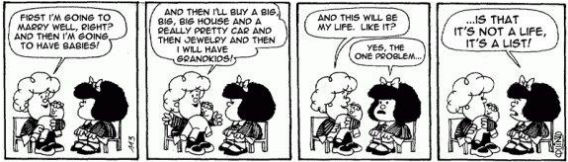
Qual é o tempo verbal predominante nos dois primeiros quadrinhos?
Text 3
Al Capone
Born in 1899 in Brooklyn, New York, to poor immigrant parents, Al Capone went on to become the most infamous gangster in American history. In 1920 during the height of Prohibition, Capone’s multi-million dollar Chicago operation in bootlegging, prostitution and gambling dominated the organized crime scene. Capone was responsible for many brutal acts of violence, mainly against other gangsters. The most famous of these was the St. Valentine’s Day Massacre in 1929, in which he ordered the assassination of seven rivals. Capone was never indicted for his racketeering but was finally brought to justice for income-tax evasion in 1931. After serving six-and-a-half years, Capone was released. He died in 1947 in Miami. Capone’s life captured the public imagination, and his gangster persona has been immortalized in the many movies and books inspired by his exploits.
(Excerpt from the site: http://www.history.com/topics/alcapone. Researched on: October 2015)
Text 2
Green sea turtle
Green sea turtles spend most of their lives underwater, where they can rest for up to five hours at a time before coming up for air. When active, they typically alternate between being underwater for a few minutes and coming up to the surface to breathe air for a few seconds. Green sea turtles are also known to sunbathe on land.Unlike most other sea turtles, adult green sea turtles eat a primarily plant-based diet consisting of seaweed and sea grass. Scientists believe these green foods give the sea turtle’s fat its green color. The shell of the green sea turtle is usually shades of a brown or olive color.
(Excerpt from the site: http://kids.nationalgeographic.com/animals/green-seaturtle/#green-sea-turtle-closeup-underwater.jpg. Researched on: October 2015)
Learn ‘n’ go
How quickly can people learn new skills?
Jan 25th 2014 – from the print edition
In 2012, Erik Brynjolfsson and Andrew McAfee took a ride in one of Google’s driverless cars. The car’s performance, they report, was flawless, boring and, above all, “weird”. Only a few years earlier, “We were sure that computers would not be able to drive cars.” Only humans, they thought, could make sense of the countless, shifting patterns of driving a car – with oncoming1 traffic, changing lights and wayward2 jaywalkers3 .
Machines have mastered driving. And not just driving. In ways that are only now becoming apparent, the authors argue, machines can forecast home prices, design beer bottles, teach at universities, grade exams and do countless other things better and more cheaply than humans. (…)
This will have one principal good consequence, and one bad. The good is bounty4 . Households will spend less on groceries, utilities and clothing; the deaf will be able to hear, the blind to see. The bad is spread5 . The gap is growing between the lucky few whose abilities and skills are enhanced6 by technology, and the far more numerous middle-skilled people competing for the remaining7 jobs that machines cannot do, such as folding towels and waiting at tables. (…) People should develop skills that complement, rather than compete with computers, such as idea generation and complex communication. (…)
When Garfield says “could’ve used a little salt”, what is he expressing?

TEXT
A library tradition is being refashioned to emphasize early literacy and better prepare young children for school, and drawing many new fans in the process.
Among parents of the under-5 set, spots for story time have become as coveted as seats for a hot Broadway show like “Hamilton.” Lines stretch down the block at some branches, with tickets given out on a first-come-first-served basis because there is not enough room to accommodate all of the children who show up.
Workers at the 67th Street Library on the Upper East Side of Manhattan turn away at least 10 people from every reading. They have been so overwhelmed by the rush at story time — held in the branch’s largest room, on the third floor — that once the space is full, they close the door and shut down the elevator. “It is so crowded and so popular, it’s insane,” Jacqueline Schector, a librarian, said.
Story time is drawing capacity crowds at public libraries across New York and across the country at a time when, more than ever, educators are emphasizing the importance of early literacy in preparing children for school and for developing critical thinking skills. The demand crosses economic lines, with parents at all income levels vying to get in.
Many libraries have refashioned the traditional readings to include enrichment activities such as counting numbers and naming colors, as well as music and dance. And many parents have made story time a fixture in their family routines alongside school pickups and playground outings — and, for those who employ nannies, a nonnegotiable requirement of the job.
In New York, demand for story time has surged across the city’s three library systems — the New York Public Library, the Brooklyn Public Library, and the Queens Library — and has posed logistical challenges for some branches, particularly those in small or cramped buildings. Citywide, story time attendance rose to 510,367 people in fiscal year 2015, up nearly 28 percent from 399,751 in fiscal 2013.
“The secret’s out,” said Lucy Yates, 44, an opera coach with two sons who goes to story time at the Fort Washington Library every week.
Stroller-pushing parents and nannies begin to line up for story time outside some branches an hour before doors open. To prevent overcrowding, tickets are given out at the New Amsterdam and Webster branches, both in Manhattan, the Parkchester branch in the Bronx, and a half-dozen branches in Brooklyn, including in Park Slope, Kensington and Bay Ridge.
The 67th Street branch keeps adding story times — there are now six a week — and holds sessions outdoors in the summer, when crowds can swell to 200 people.
In Queens, 41 library branches are scheduled to add weekend hours this month, and many will undoubtedly include weekend story times. As Joanne King, a spokeswoman for the library explained, parents have been begging for them and “every story time is full, every time we have one.”
Long a library staple, story time has typically been an informal reading to a small group of boys and girls sitting in a circle. Today’s story times involve carefully planned lessons by specially trained librarians that emphasize education as much as entertainment, and often include suggestions for parents and caregivers about how to reinforce what children have learned, library officials said.
Libraries around the country have expanded story time and other children’s programs in recent years, attracting a new generation of patrons in an age when online offerings sometimes make trips to the book stacks unnecessary. Sari Feldman, president of the American Library Association, said such early-literacy efforts are part of a larger transformation libraries are undergoing to become active learning centers for their communities by offering services like classes in English as a second language, computer skills and career counseling.
Ms. Feldman said the increased demand for story time was a product, in part, of more than a decade of work by the library association and others to encourage libraries to play a larger role in preparing young children for school. In 2004, as part of that effort, the association developed a curriculum, “Every Child Ready to Read,” that she said is now used by thousands of libraries.
The New York Public Library is adding 45 children’s librarians to support story time and other programs, some of which are run in partnership with the city government. It has also designated 20 of its 88 neighborhood branches, including the Fort Washington Library, as “enhanced literary sites.” As such, they will double their story time sessions, to an average of four a week, and distribute 15,000 “family literacy kits” that include a book and a schedule of story times.
“It is clear that reading and being exposed to books early in life are critical factors in student success,” Anthony W. Marx, president of the New York Public Library, said. “The library is playing an increasingly important role in strengthening early literacy in this city, expanding efforts to bring reading to children and their families through quality, free story times, curated literacy programs, after-school programs and more.”
For its part, the Queens Library plans to expand a “Kick Off to Kindergarten” program that attracted more than 180 families for a series of workshops last year. Library officials said that more than three-quarters of the children who enrolled, many of whom spoke a language other than English at home, developed measurable classroom skills.
From: www.nytimes.com/2015/11/02
TEXT
A library tradition is being refashioned to emphasize early literacy and better prepare young children for school, and drawing many new fans in the process.
Among parents of the under-5 set, spots for story time have become as coveted as seats for a hot Broadway show like “Hamilton.” Lines stretch down the block at some branches, with tickets given out on a first-come-first-served basis because there is not enough room to accommodate all of the children who show up.
Workers at the 67th Street Library on the Upper East Side of Manhattan turn away at least 10 people from every reading. They have been so overwhelmed by the rush at story time — held in the branch’s largest room, on the third floor — that once the space is full, they close the door and shut down the elevator. “It is so crowded and so popular, it’s insane,” Jacqueline Schector, a librarian, said.
Story time is drawing capacity crowds at public libraries across New York and across the country at a time when, more than ever, educators are emphasizing the importance of early literacy in preparing children for school and for developing critical thinking skills. The demand crosses economic lines, with parents at all income levels vying to get in.
Many libraries have refashioned the traditional readings to include enrichment activities such as counting numbers and naming colors, as well as music and dance. And many parents have made story time a fixture in their family routines alongside school pickups and playground outings — and, for those who employ nannies, a nonnegotiable requirement of the job.
In New York, demand for story time has surged across the city’s three library systems — the New York Public Library, the Brooklyn Public Library, and the Queens Library — and has posed logistical challenges for some branches, particularly those in small or cramped buildings. Citywide, story time attendance rose to 510,367 people in fiscal year 2015, up nearly 28 percent from 399,751 in fiscal 2013.
“The secret’s out,” said Lucy Yates, 44, an opera coach with two sons who goes to story time at the Fort Washington Library every week.
Stroller-pushing parents and nannies begin to line up for story time outside some branches an hour before doors open. To prevent overcrowding, tickets are given out at the New Amsterdam and Webster branches, both in Manhattan, the Parkchester branch in the Bronx, and a half-dozen branches in Brooklyn, including in Park Slope, Kensington and Bay Ridge.
The 67th Street branch keeps adding story times — there are now six a week — and holds sessions outdoors in the summer, when crowds can swell to 200 people.
In Queens, 41 library branches are scheduled to add weekend hours this month, and many will undoubtedly include weekend story times. As Joanne King, a spokeswoman for the library explained, parents have been begging for them and “every story time is full, every time we have one.”
Long a library staple, story time has typically been an informal reading to a small group of boys and girls sitting in a circle. Today’s story times involve carefully planned lessons by specially trained librarians that emphasize education as much as entertainment, and often include suggestions for parents and caregivers about how to reinforce what children have learned, library officials said.
Libraries around the country have expanded story time and other children’s programs in recent years, attracting a new generation of patrons in an age when online offerings sometimes make trips to the book stacks unnecessary. Sari Feldman, president of the American Library Association, said such early-literacy efforts are part of a larger transformation libraries are undergoing to become active learning centers for their communities by offering services like classes in English as a second language, computer skills and career counseling.
Ms. Feldman said the increased demand for story time was a product, in part, of more than a decade of work by the library association and others to encourage libraries to play a larger role in preparing young children for school. In 2004, as part of that effort, the association developed a curriculum, “Every Child Ready to Read,” that she said is now used by thousands of libraries.
The New York Public Library is adding 45 children’s librarians to support story time and other programs, some of which are run in partnership with the city government. It has also designated 20 of its 88 neighborhood branches, including the Fort Washington Library, as “enhanced literary sites.” As such, they will double their story time sessions, to an average of four a week, and distribute 15,000 “family literacy kits” that include a book and a schedule of story times.
“It is clear that reading and being exposed to books early in life are critical factors in student success,” Anthony W. Marx, president of the New York Public Library, said. “The library is playing an increasingly important role in strengthening early literacy in this city, expanding efforts to bring reading to children and their families through quality, free story times, curated literacy programs, after-school programs and more.”
For its part, the Queens Library plans to expand a “Kick Off to Kindergarten” program that attracted more than 180 families for a series of workshops last year. Library officials said that more than three-quarters of the children who enrolled, many of whom spoke a language other than English at home, developed measurable classroom skills.
From: www.nytimes.com/2015/11/02
TEXT
A library tradition is being refashioned to emphasize early literacy and better prepare young children for school, and drawing many new fans in the process.
Among parents of the under-5 set, spots for story time have become as coveted as seats for a hot Broadway show like “Hamilton.” Lines stretch down the block at some branches, with tickets given out on a first-come-first-served basis because there is not enough room to accommodate all of the children who show up.
Workers at the 67th Street Library on the Upper East Side of Manhattan turn away at least 10 people from every reading. They have been so overwhelmed by the rush at story time — held in the branch’s largest room, on the third floor — that once the space is full, they close the door and shut down the elevator. “It is so crowded and so popular, it’s insane,” Jacqueline Schector, a librarian, said.
Story time is drawing capacity crowds at public libraries across New York and across the country at a time when, more than ever, educators are emphasizing the importance of early literacy in preparing children for school and for developing critical thinking skills. The demand crosses economic lines, with parents at all income levels vying to get in.
Many libraries have refashioned the traditional readings to include enrichment activities such as counting numbers and naming colors, as well as music and dance. And many parents have made story time a fixture in their family routines alongside school pickups and playground outings — and, for those who employ nannies, a nonnegotiable requirement of the job.
In New York, demand for story time has surged across the city’s three library systems — the New York Public Library, the Brooklyn Public Library, and the Queens Library — and has posed logistical challenges for some branches, particularly those in small or cramped buildings. Citywide, story time attendance rose to 510,367 people in fiscal year 2015, up nearly 28 percent from 399,751 in fiscal 2013.
“The secret’s out,” said Lucy Yates, 44, an opera coach with two sons who goes to story time at the Fort Washington Library every week.
Stroller-pushing parents and nannies begin to line up for story time outside some branches an hour before doors open. To prevent overcrowding, tickets are given out at the New Amsterdam and Webster branches, both in Manhattan, the Parkchester branch in the Bronx, and a half-dozen branches in Brooklyn, including in Park Slope, Kensington and Bay Ridge.
The 67th Street branch keeps adding story times — there are now six a week — and holds sessions outdoors in the summer, when crowds can swell to 200 people.
In Queens, 41 library branches are scheduled to add weekend hours this month, and many will undoubtedly include weekend story times. As Joanne King, a spokeswoman for the library explained, parents have been begging for them and “every story time is full, every time we have one.”
Long a library staple, story time has typically been an informal reading to a small group of boys and girls sitting in a circle. Today’s story times involve carefully planned lessons by specially trained librarians that emphasize education as much as entertainment, and often include suggestions for parents and caregivers about how to reinforce what children have learned, library officials said.
Libraries around the country have expanded story time and other children’s programs in recent years, attracting a new generation of patrons in an age when online offerings sometimes make trips to the book stacks unnecessary. Sari Feldman, president of the American Library Association, said such early-literacy efforts are part of a larger transformation libraries are undergoing to become active learning centers for their communities by offering services like classes in English as a second language, computer skills and career counseling.
Ms. Feldman said the increased demand for story time was a product, in part, of more than a decade of work by the library association and others to encourage libraries to play a larger role in preparing young children for school. In 2004, as part of that effort, the association developed a curriculum, “Every Child Ready to Read,” that she said is now used by thousands of libraries.
The New York Public Library is adding 45 children’s librarians to support story time and other programs, some of which are run in partnership with the city government. It has also designated 20 of its 88 neighborhood branches, including the Fort Washington Library, as “enhanced literary sites.” As such, they will double their story time sessions, to an average of four a week, and distribute 15,000 “family literacy kits” that include a book and a schedule of story times.
“It is clear that reading and being exposed to books early in life are critical factors in student success,” Anthony W. Marx, president of the New York Public Library, said. “The library is playing an increasingly important role in strengthening early literacy in this city, expanding efforts to bring reading to children and their families through quality, free story times, curated literacy programs, after-school programs and more.”
For its part, the Queens Library plans to expand a “Kick Off to Kindergarten” program that attracted more than 180 families for a series of workshops last year. Library officials said that more than three-quarters of the children who enrolled, many of whom spoke a language other than English at home, developed measurable classroom skills.
From: www.nytimes.com/2015/11/02
TEXT
A library tradition is being refashioned to emphasize early literacy and better prepare young children for school, and drawing many new fans in the process.
Among parents of the under-5 set, spots for story time have become as coveted as seats for a hot Broadway show like “Hamilton.” Lines stretch down the block at some branches, with tickets given out on a first-come-first-served basis because there is not enough room to accommodate all of the children who show up.
Workers at the 67th Street Library on the Upper East Side of Manhattan turn away at least 10 people from every reading. They have been so overwhelmed by the rush at story time — held in the branch’s largest room, on the third floor — that once the space is full, they close the door and shut down the elevator. “It is so crowded and so popular, it’s insane,” Jacqueline Schector, a librarian, said.
Story time is drawing capacity crowds at public libraries across New York and across the country at a time when, more than ever, educators are emphasizing the importance of early literacy in preparing children for school and for developing critical thinking skills. The demand crosses economic lines, with parents at all income levels vying to get in.
Many libraries have refashioned the traditional readings to include enrichment activities such as counting numbers and naming colors, as well as music and dance. And many parents have made story time a fixture in their family routines alongside school pickups and playground outings — and, for those who employ nannies, a nonnegotiable requirement of the job.
In New York, demand for story time has surged across the city’s three library systems — the New York Public Library, the Brooklyn Public Library, and the Queens Library — and has posed logistical challenges for some branches, particularly those in small or cramped buildings. Citywide, story time attendance rose to 510,367 people in fiscal year 2015, up nearly 28 percent from 399,751 in fiscal 2013.
“The secret’s out,” said Lucy Yates, 44, an opera coach with two sons who goes to story time at the Fort Washington Library every week.
Stroller-pushing parents and nannies begin to line up for story time outside some branches an hour before doors open. To prevent overcrowding, tickets are given out at the New Amsterdam and Webster branches, both in Manhattan, the Parkchester branch in the Bronx, and a half-dozen branches in Brooklyn, including in Park Slope, Kensington and Bay Ridge.
The 67th Street branch keeps adding story times — there are now six a week — and holds sessions outdoors in the summer, when crowds can swell to 200 people.
In Queens, 41 library branches are scheduled to add weekend hours this month, and many will undoubtedly include weekend story times. As Joanne King, a spokeswoman for the library explained, parents have been begging for them and “every story time is full, every time we have one.”
Long a library staple, story time has typically been an informal reading to a small group of boys and girls sitting in a circle. Today’s story times involve carefully planned lessons by specially trained librarians that emphasize education as much as entertainment, and often include suggestions for parents and caregivers about how to reinforce what children have learned, library officials said.
Libraries around the country have expanded story time and other children’s programs in recent years, attracting a new generation of patrons in an age when online offerings sometimes make trips to the book stacks unnecessary. Sari Feldman, president of the American Library Association, said such early-literacy efforts are part of a larger transformation libraries are undergoing to become active learning centers for their communities by offering services like classes in English as a second language, computer skills and career counseling.
Ms. Feldman said the increased demand for story time was a product, in part, of more than a decade of work by the library association and others to encourage libraries to play a larger role in preparing young children for school. In 2004, as part of that effort, the association developed a curriculum, “Every Child Ready to Read,” that she said is now used by thousands of libraries.
The New York Public Library is adding 45 children’s librarians to support story time and other programs, some of which are run in partnership with the city government. It has also designated 20 of its 88 neighborhood branches, including the Fort Washington Library, as “enhanced literary sites.” As such, they will double their story time sessions, to an average of four a week, and distribute 15,000 “family literacy kits” that include a book and a schedule of story times.
“It is clear that reading and being exposed to books early in life are critical factors in student success,” Anthony W. Marx, president of the New York Public Library, said. “The library is playing an increasingly important role in strengthening early literacy in this city, expanding efforts to bring reading to children and their families through quality, free story times, curated literacy programs, after-school programs and more.”
For its part, the Queens Library plans to expand a “Kick Off to Kindergarten” program that attracted more than 180 families for a series of workshops last year. Library officials said that more than three-quarters of the children who enrolled, many of whom spoke a language other than English at home, developed measurable classroom skills.
From: www.nytimes.com/2015/11/02
Mind reading may one day be possible, researchers say
Disponível em: www.theguardian.com/us-news/2015/sep/24/mind-reading-may-one-day-be-possible-researchers-say
Acessado em 25/09/2015. Adaptado para fins educacionais.
Ellen Brait
According to a new study, 'a non-invasive brain-to-brain interface (BBI) can be used to allow one human to guess what is on the mind of another human'. Mind reading might not be as improbable as many people believe, says a study published by researchers at the University of Washington.

Dentre as alternativas abaixo, a expressão mais
apropriada em português para “might not be” no trecho
“Mind reading might not be as improbable as many
people believe” é
Genetically modified foods
Genetically modified (GM) foods are foods derived from organisms whose genetic material (DNA) has been modified in a way that does not occur naturally, e.g. through the introduction of a gene from a different organism. Currently available GM foods stem mostly from plants, but in the future foods derived from GM microorganisms or GM animals are likely to be introduced on the market. Most existing genetically modified crops have been developed to improve yield, through the introduction of resistance to plant diseases or of increased tolerance of herbicides.
In the future, genetic modification could be aimed at altering the nutrient content of food, reducing its allergenic potential, or improving the efficiency of food production systems. All GM foods should be assessed before being allowed on the market. FAO/WHO Codex guidelines exist for risk analysis of GM food.
(www.who.int)
TEXTO 8
CAPÍTULO IV
Este Quincas Borba, se acaso me fizeste o favor de ler as Memórias póstumas de Brás Cubas, é aquele mesmo náufrago da existência, que ali aparece, mendigo, herdeiro inopinado, e inventor de uma filosofia. Aqui o tens agora em Barbacena. Logo que chegou, enamorou-se de uma viúva, senhora de condição mediana e parcos meios de vida; mas, tão acanhada, que os suspiros no namorado ficavam sem eco. Chamava-se Maria da Piedade. Um irmão dela, que é o presente Rubião, fez todo o possível para casá-los. Piedade resistiu, um pleuris a levou.
Foi esse trechozinho de romance que ligou os dois homens. Saberia Rubião que o nosso Quincas Borba trazia aquele grãozinho de sandice, que um médico supôs achar-lhe? Seguramente, não; tinha-o por homem esquisito. É, todavia, certo que o grãozinho não se despegou do cérebro de Quincas Borba, — nem antes, nem depois da moléstia que lentamente o comeu. Quincas Borba tivera ali alguns parentes, mortos já agora em 1867; o último foi o tio que o deixou por herdeiro de seus bens. Rubião ficou sendo o único amigo do filósofo. Regia então uma escola de meninos, que fechou para tratar do enfermo. Antes de professor, metera ombros a algumas empresas, que foram a pique.
Durou o cargo de enfermeiro mais de cinco meses, perto de seis. Era real o desvelo de Rubião, paciente, risonho, múltiplo, ouvindo as ordens do médico, dando os remédios às horas marcadas, saindo a passeio com o doente, sem esquecer nada, nem o serviço da casa, nem a leitura dos jornais, logo que chegava a mala da Corte ou a de Ouro Preto.
— Tu és bom, Rubião, suspirava Quincas Borba.
— Grande façanha! Como se você fosse mau!
A opinião ostensiva do médico era que a doença do Quincas Borba iria saindo devagar. Um dia, o nosso Rubião, acompanhando o médico até à porta da rua, perguntou-lhe qual era o verdadeiro estado do amigo. Ouviu que estava perdido, completamente perdido; mas, que o fosse animando. Para que tornar-lhe a morte mais aflitiva pela certeza...?
— Lá isso, não, atalhou Rubião; para ele, morrer é negócio fácil. Nunca leu um livro que ele escreveu, há anos, não sei que negócio de filosofia...
— Não; mas filosofia é uma coisa, e morrer de verdade é outra; adeus.
(ASSIS, Machado de. Quincas Borba. São Paulo: Ática, 2011. p. 23-24.)
In Text 8, most of the verbs in Portuguese are conjugated in the past tense, such as “chegou”, “enamorou-se” e “resistiu”. Complete the following text using the correct past tense conjugation of the verbs in parenthesis in English:
Last night Susan (go) ____________ to her friend’s birthday party. She (dance) ____________ with her boyfriend, and (eat) ____________ cake. After they (leave) ____________ the party, Susan and her boyfriend (decide) ____________ to go and watch a movie at the theater. They (see) ____________ the new Transformer’s movie, and then they went home. When she (get) ____________ home, Susan (take) ____________ a shower and (fall) ____________ asleep quickly.
Choose the correct option from the ones listed below:

 Conheça nossos planos