Questões de Vestibular Comentadas sobre inglês
Foram encontradas 2.807 questões


O texto a seguir se refere a questão.
What's wrong with buying fake luxury goods?
By Bethan Bell, BBC News, 15 July 2016
Every time a new haul of fake designer goods is seized we're told that the people who buy them are ruining the reputation of brands, stealing revenue from companies, contributing to an unethical labour market and subsidising organised crime. But is this really the case?
A BBC investigation has found over the past two years, thousands of fake goods were seized from black markets across England.
But is there any harm in nabbing a pair of "Louboutins" from a market, or a "Chanel" handbag from a chap selling them on a foreign beach? To the average punter it might sound a bit far-fetched that their cash goes straight to a drugs cartel or gun-runners.
We're not talking about alcohol, tobacco or medications - buying such items clearly poses a health risk. The same can be said for toys which aren't up to safety standards, and sunglasses which don't have the recommended UV protection. Nor are we talking about people who genuinely believe the goods they buy are the real thing.
We're talking about those who are happy to get knock-off designer items for knock-down prices. The people who are well aware there may be issues about quality and copyright - but don't actually mind.
After all, are the people who buy fakes for a tenner really depriving the companies that sell goods for hundreds or even thousands of pounds? A woman who makes an impulse buy in a market almost certainly wouldn't otherwise invest in the real deal, while the wealthy buyers of the genuine brand pride themselves on knowing the difference and having the official article.
Fonte: http://www.bbc.com/news/uk-england-36782724
O texto a seguir se refere a questão.
What's wrong with buying fake luxury goods?
By Bethan Bell, BBC News, 15 July 2016
Every time a new haul of fake designer goods is seized we're told that the people who buy them are ruining the reputation of brands, stealing revenue from companies, contributing to an unethical labour market and subsidising organised crime. But is this really the case?
A BBC investigation has found over the past two years, thousands of fake goods were seized from black markets across England.
But is there any harm in nabbing a pair of "Louboutins" from a market, or a "Chanel" handbag from a chap selling them on a foreign beach? To the average punter it might sound a bit far-fetched that their cash goes straight to a drugs cartel or gun-runners.
We're not talking about alcohol, tobacco or medications - buying such items clearly poses a health risk. The same can be said for toys which aren't up to safety standards, and sunglasses which don't have the recommended UV protection. Nor are we talking about people who genuinely believe the goods they buy are the real thing.
We're talking about those who are happy to get knock-off designer items for knock-down prices. The people who are well aware there may be issues about quality and copyright - but don't actually mind.
After all, are the people who buy fakes for a tenner really depriving the companies that sell goods for hundreds or even thousands of pounds? A woman who makes an impulse buy in a market almost certainly wouldn't otherwise invest in the real deal, while the wealthy buyers of the genuine brand pride themselves on knowing the difference and having the official article.
Fonte: http://www.bbc.com/news/uk-england-36782724
O texto a seguir se refere a questão.
What's wrong with buying fake luxury goods?
By Bethan Bell, BBC News, 15 July 2016
Every time a new haul of fake designer goods is seized we're told that the people who buy them are ruining the reputation of brands, stealing revenue from companies, contributing to an unethical labour market and subsidising organised crime. But is this really the case?
A BBC investigation has found over the past two years, thousands of fake goods were seized from black markets across England.
But is there any harm in nabbing a pair of "Louboutins" from a market, or a "Chanel" handbag from a chap selling them on a foreign beach? To the average punter it might sound a bit far-fetched that their cash goes straight to a drugs cartel or gun-runners.
We're not talking about alcohol, tobacco or medications - buying such items clearly poses a health risk. The same can be said for toys which aren't up to safety standards, and sunglasses which don't have the recommended UV protection. Nor are we talking about people who genuinely believe the goods they buy are the real thing.
We're talking about those who are happy to get knock-off designer items for knock-down prices. The people who are well aware there may be issues about quality and copyright - but don't actually mind.
After all, are the people who buy fakes for a tenner really depriving the companies that sell goods for hundreds or even thousands of pounds? A woman who makes an impulse buy in a market almost certainly wouldn't otherwise invest in the real deal, while the wealthy buyers of the genuine brand pride themselves on knowing the difference and having the official article.
Fonte: http://www.bbc.com/news/uk-england-36782724
I- Life-saving drones are more economically viable than ordinary ambulances. II- As ambulance drones are lightweight, they can fly autonomously. III- Drones reach an average speed of 60mph, because their frame is made of carbon fiber. IV- Once drones are able to travel as the crow flies, they can escape from the traffic jams and arrive fast at the emergency scene.
The correct statements are
a) ( ) it (paragraph 5) – video. b) ( ) who (paragraph 4) – victim. c) ( ) them (paragraph 1) – drones. d) ( ) which (paragraph 1) – capabilities.
The correct sequence is
Born on April 15, 1452, in Vinci, Italy, Leonardo da Vinci was the son of a prominent attorney notary and a young peasant girl. Born out of wedlock, he was raised by his father, Ser Piero, and several stepmothers.
His early years were spent living on his father’s family estate in Vinci. Beyond basic reading, writing and mathematical skills, da Vinci did not receive much of a formal education. Recognizing his potential as an artist, his father sent him at the age of 14 or 15 to apprentice with sculptor and painter Andrea del Verrocchio of Florence.
He spent six years honing his technical skills, including metalworking, leather arts, carpentry, drawing and sculpting, and became a member of the Guild of Saint Luke by the age of 20. He remained with Verrocchio until he became an independent master in 1478. Around that time, he took on his first commissioned work, The Adoration of the Magi, for Florence’s San Donato, a Scopeto monastery, but departed for Milan the following year, leaving the painting unfinished. It has been in the Uffizi Gallery in Florence since 1670.
Leonardo was, and is, renowned primarily as a painter. Among his works, the Mona Lisa is the most famous and most parodied portrait and The Last Supper the most reproduced religious painting of all time, with their fame approached only by Michelangelo's The Creation of Adam. Leonardo's drawing of The Vitruvian Man, based on the correlations of ideal human proportions with geometry described by the ancient Roman architect Vitruvius, is also regarded as a cultural icon, being reproduced on items as varied as the euro coin, textbooks, and T-shirts.
Leonardo is also revered for his technological ingenuity. In the early 1490s, he began chronicling his thoughts about painting, architecture, mechanics and human anatomy. These notebooks contained wide-ranging ideas, including plans for a “flying machine,” bicycle and drawings of a fetus in the womb and the human skeleton.
His interests and intellect traversed so many disciplines that he symbolized the term “Renaissance Man”. Unfortunately, these notebooks were not published and his ideas did not advance scientific understanding in the Renaissance period.
Today, Leonardo is widely recognized as one of the most diversely talented individuals ever to have lived.
(Adapted form: http://www.livescience.com/39355-leonardo-da-vinci.html)
Born on April 15, 1452, in Vinci, Italy, Leonardo da Vinci was the son of a prominent attorney notary and a young peasant girl. Born out of wedlock, he was raised by his father, Ser Piero, and several stepmothers.
His early years were spent living on his father’s family estate in Vinci. Beyond basic reading, writing and mathematical skills, da Vinci did not receive much of a formal education. Recognizing his potential as an artist, his father sent him at the age of 14 or 15 to apprentice with sculptor and painter Andrea del Verrocchio of Florence.
He spent six years honing his technical skills, including metalworking, leather arts, carpentry, drawing and sculpting, and became a member of the Guild of Saint Luke by the age of 20. He remained with Verrocchio until he became an independent master in 1478. Around that time, he took on his first commissioned work, The Adoration of the Magi, for Florence’s San Donato, a Scopeto monastery, but departed for Milan the following year, leaving the painting unfinished. It has been in the Uffizi Gallery in Florence since 1670.
Leonardo was, and is, renowned primarily as a painter. Among his works, the Mona Lisa is the most famous and most parodied portrait and The Last Supper the most reproduced religious painting of all time, with their fame approached only by Michelangelo's The Creation of Adam. Leonardo's drawing of The Vitruvian Man, based on the correlations of ideal human proportions with geometry described by the ancient Roman architect Vitruvius, is also regarded as a cultural icon, being reproduced on items as varied as the euro coin, textbooks, and T-shirts.
Leonardo is also revered for his technological ingenuity. In the early 1490s, he began chronicling his thoughts about painting, architecture, mechanics and human anatomy. These notebooks contained wide-ranging ideas, including plans for a “flying machine,” bicycle and drawings of a fetus in the womb and the human skeleton.
His interests and intellect traversed so many disciplines that he symbolized the term “Renaissance Man”. Unfortunately, these notebooks were not published and his ideas did not advance scientific understanding in the Renaissance period.
Today, Leonardo is widely recognized as one of the most diversely talented individuals ever to have lived.
(Adapted form: http://www.livescience.com/39355-leonardo-da-vinci.html)
From the above text, one can infer that
Observe o cartum.
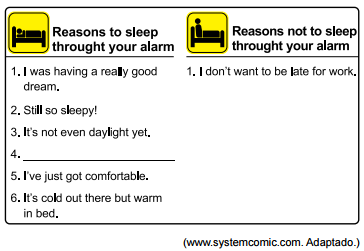
A alternativa que completa corretamente a lacuna do
número 4 do cartum, sem prejuízo de sentido, é
Question: Is there anything I can do to train my body to need less sleep?
Karen Weintraub
June 17, 2016

Many people think they can teach themselves to need less sleep, but they’re wrong, said Dr. Sigrid Veasey, a professor at the Center for Sleep and Circadian Neurobiology at the University of Pennsylvania’s Perelman School of Medicine. We might feel that we’re getting by fine on less sleep, but we’re deluding ourselves, Dr. Veasey said, largely because lack of sleep skews our self-awareness. “The more you deprive yourself of sleep over long periods of time, the less accurate you are of judging your own sleep perception,” she said.
Multiple studies have shown that people don’t functionally adapt to less sleep than their bodies need. There is a range of normal sleep times, with most healthy adults naturally needing seven to nine hours of sleep per night, according to the National Sleep Foundation. Those over 65 need about seven to eight hours, on average, while teenagers need eight to 10 hours, and school-age children nine to 11 hours. People’s performance continues to be poor while they are sleep deprived, Dr. Veasey said.
Health issues like pain, sleep apnea or autoimmune disease can increase people’s need for sleep, said Andrea Meredith, a neuroscientist at the University of Maryland School of Medicine. A misalignment of the clock that governs our sleep-wake cycle can also drive up the need for sleep, Dr. Meredith said. The brain’s clock can get misaligned by being stimulated at the wrong time of day, she said, such as from caffeine in the afternoon or evening, digital screen use too close to bedtime, or even exercise at a time of day when the body wants to be winding down.
(http://well.blogs.nytimes.com. Adaptado.)
Question: Is there anything I can do to train my body to need less sleep?
Karen Weintraub
June 17, 2016
Many people think they can teach themselves to need less sleep, but they’re wrong, said Dr. Sigrid Veasey, a professor at the Center for Sleep and Circadian Neurobiology at the University of Pennsylvania’s Perelman School of Medicine. We might feel that we’re getting by fine on less sleep, but we’re deluding ourselves, Dr. Veasey said, largely because lack of sleep skews our self-awareness. “The more you deprive yourself of sleep over long periods of time, the less accurate you are of judging your own sleep perception,” she said.
Multiple studies have shown that people don’t functionally adapt to less sleep than their bodies need. There is a range of normal sleep times, with most healthy adults naturally needing seven to nine hours of sleep per night, according to the National Sleep Foundation. Those over 65 need about seven to eight hours, on average, while teenagers need eight to 10 hours, and school-age children nine to 11 hours. People’s performance continues to be poor while they are sleep deprived, Dr. Veasey said.
Health issues like pain, sleep apnea or autoimmune disease can increase people’s need for sleep, said Andrea Meredith, a neuroscientist at the University of Maryland School of Medicine. A misalignment of the clock that governs our sleep-wake cycle can also drive up the need for sleep, Dr. Meredith said. The brain’s clock can get misaligned by being stimulated at the wrong time of day, she said, such as from caffeine in the afternoon or evening, digital screen use too close to bedtime, or even exercise at a time of day when the body wants to be winding down.
(http://well.blogs.nytimes.com. Adaptado.)
Question: Is there anything I can do to train my body to need less sleep?
Karen Weintraub
June 17, 2016
Many people think they can teach themselves to need less sleep, but they’re wrong, said Dr. Sigrid Veasey, a professor at the Center for Sleep and Circadian Neurobiology at the University of Pennsylvania’s Perelman School of Medicine. We might feel that we’re getting by fine on less sleep, but we’re deluding ourselves, Dr. Veasey said, largely because lack of sleep skews our self-awareness. “The more you deprive yourself of sleep over long periods of time, the less accurate you are of judging your own sleep perception,” she said.
Multiple studies have shown that people don’t functionally adapt to less sleep than their bodies need. There is a range of normal sleep times, with most healthy adults naturally needing seven to nine hours of sleep per night, according to the National Sleep Foundation. Those over 65 need about seven to eight hours, on average, while teenagers need eight to 10 hours, and school-age children nine to 11 hours. People’s performance continues to be poor while they are sleep deprived, Dr. Veasey said.
Health issues like pain, sleep apnea or autoimmune disease can increase people’s need for sleep, said Andrea Meredith, a neuroscientist at the University of Maryland School of Medicine. A misalignment of the clock that governs our sleep-wake cycle can also drive up the need for sleep, Dr. Meredith said. The brain’s clock can get misaligned by being stimulated at the wrong time of day, she said, such as from caffeine in the afternoon or evening, digital screen use too close to bedtime, or even exercise at a time of day when the body wants to be winding down.
(http://well.blogs.nytimes.com. Adaptado.)
Question: Is there anything I can do to train my body to need less sleep?
Karen Weintraub
June 17, 2016
Many people think they can teach themselves to need less sleep, but they’re wrong, said Dr. Sigrid Veasey, a professor at the Center for Sleep and Circadian Neurobiology at the University of Pennsylvania’s Perelman School of Medicine. We might feel that we’re getting by fine on less sleep, but we’re deluding ourselves, Dr. Veasey said, largely because lack of sleep skews our self-awareness. “The more you deprive yourself of sleep over long periods of time, the less accurate you are of judging your own sleep perception,” she said.
Multiple studies have shown that people don’t functionally adapt to less sleep than their bodies need. There is a range of normal sleep times, with most healthy adults naturally needing seven to nine hours of sleep per night, according to the National Sleep Foundation. Those over 65 need about seven to eight hours, on average, while teenagers need eight to 10 hours, and school-age children nine to 11 hours. People’s performance continues to be poor while they are sleep deprived, Dr. Veasey said.
Health issues like pain, sleep apnea or autoimmune disease can increase people’s need for sleep, said Andrea Meredith, a neuroscientist at the University of Maryland School of Medicine. A misalignment of the clock that governs our sleep-wake cycle can also drive up the need for sleep, Dr. Meredith said. The brain’s clock can get misaligned by being stimulated at the wrong time of day, she said, such as from caffeine in the afternoon or evening, digital screen use too close to bedtime, or even exercise at a time of day when the body wants to be winding down.
(http://well.blogs.nytimes.com. Adaptado.)
Question: Is there anything I can do to train my body to need less sleep?
Karen Weintraub
June 17, 2016
Many people think they can teach themselves to need less sleep, but they’re wrong, said Dr. Sigrid Veasey, a professor at the Center for Sleep and Circadian Neurobiology at the University of Pennsylvania’s Perelman School of Medicine. We might feel that we’re getting by fine on less sleep, but we’re deluding ourselves, Dr. Veasey said, largely because lack of sleep skews our self-awareness. “The more you deprive yourself of sleep over long periods of time, the less accurate you are of judging your own sleep perception,” she said.
Multiple studies have shown that people don’t functionally adapt to less sleep than their bodies need. There is a range of normal sleep times, with most healthy adults naturally needing seven to nine hours of sleep per night, according to the National Sleep Foundation. Those over 65 need about seven to eight hours, on average, while teenagers need eight to 10 hours, and school-age children nine to 11 hours. People’s performance continues to be poor while they are sleep deprived, Dr. Veasey said.
Health issues like pain, sleep apnea or autoimmune disease can increase people’s need for sleep, said Andrea Meredith, a neuroscientist at the University of Maryland School of Medicine. A misalignment of the clock that governs our sleep-wake cycle can also drive up the need for sleep, Dr. Meredith said. The brain’s clock can get misaligned by being stimulated at the wrong time of day, she said, such as from caffeine in the afternoon or evening, digital screen use too close to bedtime, or even exercise at a time of day when the body wants to be winding down.
(http://well.blogs.nytimes.com. Adaptado.)
Question: Is there anything I can do to train my body to need less sleep?
Karen Weintraub
June 17, 2016
Many people think they can teach themselves to need less sleep, but they’re wrong, said Dr. Sigrid Veasey, a professor at the Center for Sleep and Circadian Neurobiology at the University of Pennsylvania’s Perelman School of Medicine. We might feel that we’re getting by fine on less sleep, but we’re deluding ourselves, Dr. Veasey said, largely because lack of sleep skews our self-awareness. “The more you deprive yourself of sleep over long periods of time, the less accurate you are of judging your own sleep perception,” she said.
Multiple studies have shown that people don’t functionally adapt to less sleep than their bodies need. There is a range of normal sleep times, with most healthy adults naturally needing seven to nine hours of sleep per night, according to the National Sleep Foundation. Those over 65 need about seven to eight hours, on average, while teenagers need eight to 10 hours, and school-age children nine to 11 hours. People’s performance continues to be poor while they are sleep deprived, Dr. Veasey said.
Health issues like pain, sleep apnea or autoimmune disease can increase people’s need for sleep, said Andrea Meredith, a neuroscientist at the University of Maryland School of Medicine. A misalignment of the clock that governs our sleep-wake cycle can also drive up the need for sleep, Dr. Meredith said. The brain’s clock can get misaligned by being stimulated at the wrong time of day, she said, such as from caffeine in the afternoon or evening, digital screen use too close to bedtime, or even exercise at a time of day when the body wants to be winding down.
(http://well.blogs.nytimes.com. Adaptado.)

 Conheça nossos planos