Questões de Vestibular Comentadas sobre inglês
Foram encontradas 2.807 questões


Leia o texto para responder à questão.

(Claire Marshall. www.bbc.com, 15.05.2019. Adaptado.)
Thematic Discussion on Nuclear Weapons
The United States remains committed to the goal of nuclear disarmament, and to seeking to create conditions toward that end. And history makes clear that important progress can be made when security conditions allow. The easing of Cold War rivalries allowed the United States and Russia to make significant steps toward the shared dream of eventual nuclear disarmament after decades in which such movement was impossible. Disarmament success is predicated on patience, attention to detail, effective verification, and patient attention to the challenges of effecting the changes in the security environment that are necessary for progress. This last element is critical, considering the crucial role that nuclear deterrence plays in preserving and protecting international peace and security, and the potentially catastrophic consequences were deterrence’s restraining effect to be removed while it still remains necessary.
The “Treaty on the Prohibition of Nuclear Weapons” violates all these tenets. Its obligations are longstanding worded, imprecise, vaguely worded and sometimes internally contradictory, while offering only an empty shell for verification. Worse, it is fundamentally at odds with today’s security challenges. It is not simply an unproductive instrument; it is likely to be a counterproductive one, with the potential to cause lasting harm to the nonproliferation regime and to the cause of disarmament alike.
The ban treaty is based on the premise that addressing crucial international security issues is not necessary for disarmament. Ban treaty proponents would have us believe that we can do away with nuclear deterrence despite - to cite just one example - the danger posed by North Korea’s relentless pursuit of nuclear weapons and associated delivery systems, which stand in flagrant violation of international law.
Furthermore, the Treaty does not contain a credible verification mechanism, demurring on the issue almost entirely. It does run counter to decades of progress in nonproliferation verification by endorsing the International Atomic Energy Agency (IAEA) Comprehensive Safeguards Agreement as its standard for safeguarding nuclear material.
Finally, the ban treaty has the potential to do real damage to the Non Proliferation Treaty (NPT) in other ways. It exacerbates political tensions on disarmament, dividing states into overly-simplified camps of “nuclear weapons supporters” and “nuclear weapons banners,” rather than recognizing shared interests – especially on the challenges involved in creating the conditions that would make possible further disarmament progress. Reinforcing this false dichotomy and worsening the world’s polarization on disarmament will make further progress within the institutions that have been vehicles for success, such as the NPT review process, significantly more difficult.
Inspired by the NPT Preamble’s acknowledgement of the need to ease international tension and strengthen trust between States in order to facilitate disarmament, the United States stands ready to work with others on effective measures to create improved conditions for nuclear disarmament. This work is focused on overcoming technical challenges to make substantive progress when the security conditions improve. We also continue our longstanding work to support and strengthen the global nonproliferation regime against the many challenges it faces today, for who could deny that there can be no way to envision today’s nuclear weapons possessors ever putting down such tools without rock-solid assurances that no one else will take them up?
There are no shortcuts to nuclear disarmament. Unrealistic attempts to skip to the finish line have the
potential to undermine the institutions and standards we have worked so hard to build. Our collective experience
demonstrates that inclusiveness and the search for consensus can lead to progress, while polarization is a recipe
for failure. We urge all states to work with us in searching for common solutions to collective problems, pursuing a
more secure world.
Thematic Discussion on Nuclear Weapons
The United States remains committed to the goal of nuclear disarmament, and to seeking to create conditions toward that end. And history makes clear that important progress can be made when security conditions allow. The easing of Cold War rivalries allowed the United States and Russia to make significant steps toward the shared dream of eventual nuclear disarmament after decades in which such movement was impossible. Disarmament success is predicated on patience, attention to detail, effective verification, and patient attention to the challenges of effecting the changes in the security environment that are necessary for progress. This last element is critical, considering the crucial role that nuclear deterrence plays in preserving and protecting international peace and security, and the potentially catastrophic consequences were deterrence’s restraining effect to be removed while it still remains necessary.
The “Treaty on the Prohibition of Nuclear Weapons” violates all these tenets. Its obligations are longstanding worded, imprecise, vaguely worded and sometimes internally contradictory, while offering only an empty shell for verification. Worse, it is fundamentally at odds with today’s security challenges. It is not simply an unproductive instrument; it is likely to be a counterproductive one, with the potential to cause lasting harm to the nonproliferation regime and to the cause of disarmament alike.
The ban treaty is based on the premise that addressing crucial international security issues is not necessary for disarmament. Ban treaty proponents would have us believe that we can do away with nuclear deterrence despite - to cite just one example - the danger posed by North Korea’s relentless pursuit of nuclear weapons and associated delivery systems, which stand in flagrant violation of international law.
Furthermore, the Treaty does not contain a credible verification mechanism, demurring on the issue almost entirely. It does run counter to decades of progress in nonproliferation verification by endorsing the International Atomic Energy Agency (IAEA) Comprehensive Safeguards Agreement as its standard for safeguarding nuclear material.
Finally, the ban treaty has the potential to do real damage to the Non Proliferation Treaty (NPT) in other ways. It exacerbates political tensions on disarmament, dividing states into overly-simplified camps of “nuclear weapons supporters” and “nuclear weapons banners,” rather than recognizing shared interests – especially on the challenges involved in creating the conditions that would make possible further disarmament progress. Reinforcing this false dichotomy and worsening the world’s polarization on disarmament will make further progress within the institutions that have been vehicles for success, such as the NPT review process, significantly more difficult.
Inspired by the NPT Preamble’s acknowledgement of the need to ease international tension and strengthen trust between States in order to facilitate disarmament, the United States stands ready to work with others on effective measures to create improved conditions for nuclear disarmament. This work is focused on overcoming technical challenges to make substantive progress when the security conditions improve. We also continue our longstanding work to support and strengthen the global nonproliferation regime against the many challenges it faces today, for who could deny that there can be no way to envision today’s nuclear weapons possessors ever putting down such tools without rock-solid assurances that no one else will take them up?
There are no shortcuts to nuclear disarmament. Unrealistic attempts to skip to the finish line have the
potential to undermine the institutions and standards we have worked so hard to build. Our collective experience
demonstrates that inclusiveness and the search for consensus can lead to progress, while polarization is a recipe
for failure. We urge all states to work with us in searching for common solutions to collective problems, pursuing a
more secure world.
Thematic Discussion on Nuclear Weapons
The United States remains committed to the goal of nuclear disarmament, and to seeking to create conditions toward that end. And history makes clear that important progress can be made when security conditions allow. The easing of Cold War rivalries allowed the United States and Russia to make significant steps toward the shared dream of eventual nuclear disarmament after decades in which such movement was impossible. Disarmament success is predicated on patience, attention to detail, effective verification, and patient attention to the challenges of effecting the changes in the security environment that are necessary for progress. This last element is critical, considering the crucial role that nuclear deterrence plays in preserving and protecting international peace and security, and the potentially catastrophic consequences were deterrence’s restraining effect to be removed while it still remains necessary.
The “Treaty on the Prohibition of Nuclear Weapons” violates all these tenets. Its obligations are longstanding worded, imprecise, vaguely worded and sometimes internally contradictory, while offering only an empty shell for verification. Worse, it is fundamentally at odds with today’s security challenges. It is not simply an unproductive instrument; it is likely to be a counterproductive one, with the potential to cause lasting harm to the nonproliferation regime and to the cause of disarmament alike.
The ban treaty is based on the premise that addressing crucial international security issues is not necessary for disarmament. Ban treaty proponents would have us believe that we can do away with nuclear deterrence despite - to cite just one example - the danger posed by North Korea’s relentless pursuit of nuclear weapons and associated delivery systems, which stand in flagrant violation of international law.
Furthermore, the Treaty does not contain a credible verification mechanism, demurring on the issue almost entirely. It does run counter to decades of progress in nonproliferation verification by endorsing the International Atomic Energy Agency (IAEA) Comprehensive Safeguards Agreement as its standard for safeguarding nuclear material.
Finally, the ban treaty has the potential to do real damage to the Non Proliferation Treaty (NPT) in other ways. It exacerbates political tensions on disarmament, dividing states into overly-simplified camps of “nuclear weapons supporters” and “nuclear weapons banners,” rather than recognizing shared interests – especially on the challenges involved in creating the conditions that would make possible further disarmament progress. Reinforcing this false dichotomy and worsening the world’s polarization on disarmament will make further progress within the institutions that have been vehicles for success, such as the NPT review process, significantly more difficult.
Inspired by the NPT Preamble’s acknowledgement of the need to ease international tension and strengthen trust between States in order to facilitate disarmament, the United States stands ready to work with others on effective measures to create improved conditions for nuclear disarmament. This work is focused on overcoming technical challenges to make substantive progress when the security conditions improve. We also continue our longstanding work to support and strengthen the global nonproliferation regime against the many challenges it faces today, for who could deny that there can be no way to envision today’s nuclear weapons possessors ever putting down such tools without rock-solid assurances that no one else will take them up?
There are no shortcuts to nuclear disarmament. Unrealistic attempts to skip to the finish line have the
potential to undermine the institutions and standards we have worked so hard to build. Our collective experience
demonstrates that inclusiveness and the search for consensus can lead to progress, while polarization is a recipe
for failure. We urge all states to work with us in searching for common solutions to collective problems, pursuing a
more secure world.
Leia o texto a seguir para responder à questão.
Digitizing Healthcare: How Technology Is Improving Medical Care
by Tricia Hussung
A wide variety of digital innovations are revolutionizing healthcare — and technology in medicine is here to stay. How are these changes impacting the delivery of care, and what skills are needed to succeed in this bold new world? It’s no secret that, as a society, technology has become a part of our everyday lives. In fact, almost 60 percent of American adults own a smartphone, and 42 percent of that same population (American adults) owns a tablet computer. Though technology has been permeating almost every aspect of our lives, until recent years the medical field has been largely unaffected by the rapid pace of technological innovation that is characteristic of the Digital Age. However, this is changing.
This ubiquity of technology is beginning to extend into the medical field. Advances in medical technology are changing medicine by giving physicians more information — as well as better, more specific data.
New Medical Technology: Innovations
So just what are these new advances in technology? The following are just a few of the many innovations that have occurred in medical technology over the past year alone. Some of these leading technologies are still being developed, while others are slowly being introduced into mainstream medical practice.
- The modern hospital experience: Several medical technology companies are looking to update hospital stays to keep pace with the needs of modern patients. To more easily integrate changing technology, these new rooms would feature interchangeable parts that are easily adapted to the specific situation of a patient. The seamless design would have a minimal impact on facility operations while increasing patient comfort and connectivity.
- Surgery simulation: The Roswell Park Cancer Institute has partnered with the University of Buffalo’s School of Engineering and Applied Sciences to create the Robotic Surgery Simulator (RoSS). This innovation allows real-world views of surgeries while eliminating the need for a live environment to train aspiring surgeons. It gives these medical professionals the space to experiment in a simulated environment, rather than risking making mistakes on real patients.
- Cloud-based data and software: Applications like referralMD help healthcare providers create referrals digitally and reach millions of patients and providers who are in search of treatment options. The current, paper method of referrals causes almost 50 percent of patient referrals to never actually result in doctor’s visits. This present gap in care “causes patients to lose treatment (and) the healthcare facility to lose money.” Software innovations like these are part of the relatively new field of health informatics, which aims to collect, store, analyze and present health data in a digital format.
With widespread innovations like these affecting patient care practices, it is not surprising that the way medical
records and information are stored and shared is changing as well. These technological advancements are costeffective and improve the ability of medical professionals to diagnose and treat health issues of all kinds. Two of
the main changes that are revolutionizing the future of healthcare are electronic medical records and health
information exchange. Future won´t be the same for medical field. Are you ready for what is coming?
Disponível em:<https://online.king.edu/news/digitizing-healthcare-how-technology-is-improving-medical-care/>
Leia o texto a seguir para responder à questão.
Digitizing Healthcare: How Technology Is Improving Medical Care
by Tricia Hussung
A wide variety of digital innovations are revolutionizing healthcare — and technology in medicine is here to stay. How are these changes impacting the delivery of care, and what skills are needed to succeed in this bold new world? It’s no secret that, as a society, technology has become a part of our everyday lives. In fact, almost 60 percent of American adults own a smartphone, and 42 percent of that same population (American adults) owns a tablet computer. Though technology has been permeating almost every aspect of our lives, until recent years the medical field has been largely unaffected by the rapid pace of technological innovation that is characteristic of the Digital Age. However, this is changing.
This ubiquity of technology is beginning to extend into the medical field. Advances in medical technology are changing medicine by giving physicians more information — as well as better, more specific data.
New Medical Technology: Innovations
So just what are these new advances in technology? The following are just a few of the many innovations that have occurred in medical technology over the past year alone. Some of these leading technologies are still being developed, while others are slowly being introduced into mainstream medical practice.
- The modern hospital experience: Several medical technology companies are looking to update hospital stays to keep pace with the needs of modern patients. To more easily integrate changing technology, these new rooms would feature interchangeable parts that are easily adapted to the specific situation of a patient. The seamless design would have a minimal impact on facility operations while increasing patient comfort and connectivity.
- Surgery simulation: The Roswell Park Cancer Institute has partnered with the University of Buffalo’s School of Engineering and Applied Sciences to create the Robotic Surgery Simulator (RoSS). This innovation allows real-world views of surgeries while eliminating the need for a live environment to train aspiring surgeons. It gives these medical professionals the space to experiment in a simulated environment, rather than risking making mistakes on real patients.
- Cloud-based data and software: Applications like referralMD help healthcare providers create referrals digitally and reach millions of patients and providers who are in search of treatment options. The current, paper method of referrals causes almost 50 percent of patient referrals to never actually result in doctor’s visits. This present gap in care “causes patients to lose treatment (and) the healthcare facility to lose money.” Software innovations like these are part of the relatively new field of health informatics, which aims to collect, store, analyze and present health data in a digital format.
With widespread innovations like these affecting patient care practices, it is not surprising that the way medical
records and information are stored and shared is changing as well. These technological advancements are costeffective and improve the ability of medical professionals to diagnose and treat health issues of all kinds. Two of
the main changes that are revolutionizing the future of healthcare are electronic medical records and health
information exchange. Future won´t be the same for medical field. Are you ready for what is coming?
Disponível em:<https://online.king.edu/news/digitizing-healthcare-how-technology-is-improving-medical-care/>
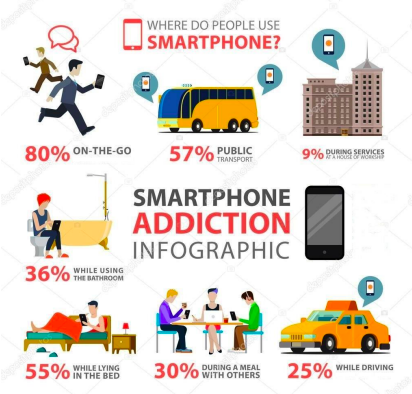
Observe o infográfico a seguir para responder à questão.
 .
.
Disponível em: <https://fr.depositphotos.com/90651634/stock-illustration-smartphone-addiction-infographics-concept.html>. Acesso em: 21 set. 2018.
According to the information expressed in the image and the data, smartphones are
Leia o texto a seguir para responder à questão.
Predictions for the future of 'smart' education
Posted by Charley Rogers - January 22, 2018
A wave of new technology has been introduced into schools up and down the country changing the way
teachers deliver lessons and how students learn.
A research by Randstad Education found schools and colleges have adopted the latest tech to improve teaching and make lessons more interactive and engaging. Some of the innovations already in use include ‘gamifying’ lessons by incorporating game-like rules and tasks to increase motivation. For example, Shireland Academy in the West Midlands included Minecraft on its curriculum.
Education, the research found, will become more project-based and include more interactive content to keep up with students’ changing attitudes towards traditional media. Classrooms, it is predicted, will join the Internet of Things – a network of devices like smartwatches that connect and share data with other items and systems – and create ‘smart schools’ where the teachers, students and devices become more connected.
Pressure on teachers – 75% find their workload unmanageable – as well as rising student numbers means technology will play a larger role performing tasks to save time. Teachers are also reaping the rewards as lessons and assessments move out of the classroom and onto platforms that make it easier for them to chart progress and achieve a better work-life balance. Education experts have highlighted the importance of new techniques that help teachers do their jobs.
However, while tech will become more commonplace in the classroom, it is expected to compliment teachers and not replace them. It´s important to understand that teaching tools have come a long way since the days when teachers used to write on chalkboards and present using an overhead projector.
The research says that students today benefit from some of the most exciting technology available to schools, but it’s not just the pupils who benefit from these innovations through invigorating lessons and virtual learning. Teachers are also reaping the rewards as lessons and assessments move out of the classroom and onto platforms that make it easier for them to chart progress and achieve a better work-life balance.
Technology has arrived and the teachers and classrooms of tomorrow are here today.
Disponível em: <https://edtechnology.co.uk/Article/predictions-for-the-future-of-education>. Acesso em: 19 set. 2018. (Adaptado).
Leia o texto a seguir para responder à questão.
Predictions for the future of 'smart' education
Posted by Charley Rogers - January 22, 2018
A wave of new technology has been introduced into schools up and down the country changing the way
teachers deliver lessons and how students learn.
A research by Randstad Education found schools and colleges have adopted the latest tech to improve teaching and make lessons more interactive and engaging. Some of the innovations already in use include ‘gamifying’ lessons by incorporating game-like rules and tasks to increase motivation. For example, Shireland Academy in the West Midlands included Minecraft on its curriculum.
Education, the research found, will become more project-based and include more interactive content to keep up with students’ changing attitudes towards traditional media. Classrooms, it is predicted, will join the Internet of Things – a network of devices like smartwatches that connect and share data with other items and systems – and create ‘smart schools’ where the teachers, students and devices become more connected.
Pressure on teachers – 75% find their workload unmanageable – as well as rising student numbers means technology will play a larger role performing tasks to save time. Teachers are also reaping the rewards as lessons and assessments move out of the classroom and onto platforms that make it easier for them to chart progress and achieve a better work-life balance. Education experts have highlighted the importance of new techniques that help teachers do their jobs.
However, while tech will become more commonplace in the classroom, it is expected to compliment teachers and not replace them. It´s important to understand that teaching tools have come a long way since the days when teachers used to write on chalkboards and present using an overhead projector.
The research says that students today benefit from some of the most exciting technology available to schools, but it’s not just the pupils who benefit from these innovations through invigorating lessons and virtual learning. Teachers are also reaping the rewards as lessons and assessments move out of the classroom and onto platforms that make it easier for them to chart progress and achieve a better work-life balance.
Technology has arrived and the teachers and classrooms of tomorrow are here today.
Disponível em: <https://edtechnology.co.uk/Article/predictions-for-the-future-of-education>. Acesso em: 19 set. 2018. (Adaptado).
Leia o texto a seguir para responder à questão.
Predictions for the future of 'smart' education
Posted by Charley Rogers - January 22, 2018
A wave of new technology has been introduced into schools up and down the country changing the way
teachers deliver lessons and how students learn.
A research by Randstad Education found schools and colleges have adopted the latest tech to improve teaching and make lessons more interactive and engaging. Some of the innovations already in use include ‘gamifying’ lessons by incorporating game-like rules and tasks to increase motivation. For example, Shireland Academy in the West Midlands included Minecraft on its curriculum.
Education, the research found, will become more project-based and include more interactive content to keep up with students’ changing attitudes towards traditional media. Classrooms, it is predicted, will join the Internet of Things – a network of devices like smartwatches that connect and share data with other items and systems – and create ‘smart schools’ where the teachers, students and devices become more connected.
Pressure on teachers – 75% find their workload unmanageable – as well as rising student numbers means technology will play a larger role performing tasks to save time. Teachers are also reaping the rewards as lessons and assessments move out of the classroom and onto platforms that make it easier for them to chart progress and achieve a better work-life balance. Education experts have highlighted the importance of new techniques that help teachers do their jobs.
However, while tech will become more commonplace in the classroom, it is expected to compliment teachers and not replace them. It´s important to understand that teaching tools have come a long way since the days when teachers used to write on chalkboards and present using an overhead projector.
The research says that students today benefit from some of the most exciting technology available to schools, but it’s not just the pupils who benefit from these innovations through invigorating lessons and virtual learning. Teachers are also reaping the rewards as lessons and assessments move out of the classroom and onto platforms that make it easier for them to chart progress and achieve a better work-life balance.
Technology has arrived and the teachers and classrooms of tomorrow are here today.
Disponível em: <https://edtechnology.co.uk/Article/predictions-for-the-future-of-education>. Acesso em: 19 set. 2018. (Adaptado).
When California police officers approached a Tesla stopped in the centre of a five-lane highway outside San Francisco last week, they found a man asleep at the wheel. The driver, who was arrested on suspicion of drunk driving, told them his car was in “autopilot”, Tesla’s semi-autonomous driver assist system.
In a separate incident, firefighters in Culver City reported that a Tesla vehicle parked at the rear of their fire truck as it attended an accident on the freeway. Again, the driver said the vehicle was in autopilot.
When California police officers approached a Tesla stopped in the centre of a five-lane highway outside San Francisco last week, they found a man asleep at the wheel. The driver, who was arrested on suspicion of drunk driving, told them his car was in “autopilot”, Tesla’s semi-autonomous driver assist system.
In a separate incident, firefighters in Culver City reported that a Tesla vehicle parked at the rear of their fire truck as it attended an accident on the freeway. Again, the driver said the vehicle was in autopilot.
Leia o texto e responda à questão.
Keywords: human beings are not very good at keyword searches. There's a fallacy that human beings looking at documents is the gold standard which cannot be, because human may miss things.
Database: the explosion in the amount of electronic data generated today makes it hard for human workers to keep up. This so much more data nowadays need these technologies find relevant material for lawyers. Also the AI could not just look at the text of a document or email, it can look at the tone of the conversation, who sent it, to check if the item should be flagged for review in litigation.
Restless: computers don't get tired, they don't get hungry, they don't sleep in and all of the things that are biological problems that can happen to a human being can't happen to computers.
An example of this technology is ROSS - it is a legal research platform based on IBM's cognitive computing system Watson. This technology is being used by a number of law firms, which state that the legal sector has being changing along the years. Firms, particularly larger ones, begin to see the advantage of AI, and their legal future possibly will completely change, with lawyers working from office, home office and other possibilities.
Leia o texto e responda à questão.
Keywords: human beings are not very good at keyword searches. There's a fallacy that human beings looking at documents is the gold standard which cannot be, because human may miss things.
Database: the explosion in the amount of electronic data generated today makes it hard for human workers to keep up. This so much more data nowadays need these technologies find relevant material for lawyers. Also the AI could not just look at the text of a document or email, it can look at the tone of the conversation, who sent it, to check if the item should be flagged for review in litigation.
Restless: computers don't get tired, they don't get hungry, they don't sleep in and all of the things that are biological problems that can happen to a human being can't happen to computers.
An example of this technology is ROSS - it is a legal research platform based on IBM's cognitive computing system Watson. This technology is being used by a number of law firms, which state that the legal sector has being changing along the years. Firms, particularly larger ones, begin to see the advantage of AI, and their legal future possibly will completely change, with lawyers working from office, home office and other possibilities.
Leia o texto e responda à questão.
Keywords: human beings are not very good at keyword searches. There's a fallacy that human beings looking at documents is the gold standard which cannot be, because human may miss things.
Database: the explosion in the amount of electronic data generated today makes it hard for human workers to keep up. This so much more data nowadays need these technologies find relevant material for lawyers. Also the AI could not just look at the text of a document or email, it can look at the tone of the conversation, who sent it, to check if the item should be flagged for review in litigation.
Restless: computers don't get tired, they don't get hungry, they don't sleep in and all of the things that are biological problems that can happen to a human being can't happen to computers.
An example of this technology is ROSS - it is a legal research platform based on IBM's cognitive computing system Watson. This technology is being used by a number of law firms, which state that the legal sector has being changing along the years. Firms, particularly larger ones, begin to see the advantage of AI, and their legal future possibly will completely change, with lawyers working from office, home office and other possibilities.
 Disponível em: <https://www.paradigmsports.ca/a-healthy-mind-in-a-healthy-body/>. Acesso em: 09 out. 2018.
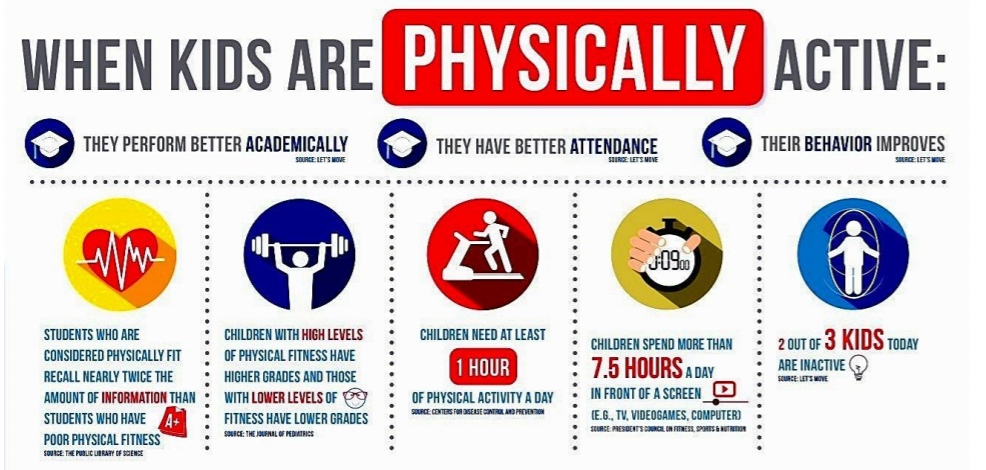
According to the information expressed in the image and data, when kids are physically active, we verify that
Leia o texto a seguir para responder a questão.
Global warming is intensifying El Niño weather
As humans put more and more heat-trapping gases into the atmosphere, the Earth warms. And the warming is causing changes that might surprise us. Not only is the warming causing long-term trends in heat, sea level rise, ice loss, etc.; it’s also making our weather more variable. It’s making otherwise natural cycles of weather more powerful.
Perhaps the most important natural fluctuation in the Earth’s climate is the El Niño process. El Niño refers to a short-term period of warm ocean surface temperatures in the tropical Pacific, basically stretching from South America towards Australia. When an El Niño happens, that region is warmer than usual. If the counterpart La Niña occurs, the region is colder than usual. Often times, neither an El Niño or La Niña is present and the waters are a normal temperature. This would be called a “neutral” state.
The ocean waters switch back and forth between El Niño and La Niña every few years. Not regularly, like a pendulum, but there is a pattern of oscillation. And regardless of which part of the cycle we are in (El Niño or La Niña), there are consequences for weather around the world. For instance, during an El Niño, we typically see cooler and wetter weather in the southern United States while it is hotter and drier in South America and Australia.
It’s really important to be able to predict El Niño/La Niña cycles in advance. It’s also important to be able to understand how these cycles will change in a warming planet.
El Niño cycles have been known for a long time. Their influence around the world has also been known for almost 100 years. Having observed the effects of El Niño for a century, scientists had the perspective to understand something might be changing.
The relationship between regional climate and the El Niño/La Niña status in climate model simulations of the past and future. It was found an intensification of El Niño/La Niña impacts in a warmer climate, especially for land regions in North America and Australia. Changes between El Niño/La Niña in other areas, like South America, were less clear. The intensification of weather was more prevalent over land regions.
And this conclusion can be extended to many other situations around the planet. Human pollution is making our Earth’s natural weather switch more strongly from one extreme to another. It’s a weather whiplash that will continue to get worse as we add pollution to the atmosphere.
Fortunately, every other country on the planet (with the exception of the US leadership) understands that climate change is an important issue and those countries are taking action. It isn’t too late to change our trajectory toward a better future for all of us. But the time is running out. The Earth is giving us a little nudge by showing us, via today’s intense weather, what tomorrow will be like if we don’t take action quickly.
Disponível em: <https://www.theguardian.com/environment/climate-consensus-97-per-cent/2018/aug/29/global-warming-is-intensifying-el-nino-weather>. Acesso
em: 19 set. 2018. (Adaptado)
Methods: Using data from the Survey of Lifestyle Attitudes and Nutrition (SLÁN) 2007 (), a protective lifestyle behaviour (PLB) score was constructed for 10 364 men and women (>18 years), and representative of the Republic of Ireland adult population (response rate 62%). Respondents scored a maximum of four points, one point each for being physically active, consuming five or more fruit and vegetable servings daily, a non-smoker and a moderate drinker.
Results: One-fifth of respondents (20%) adopted four PLBs, 35% adopted three, 29% two, 13% one and 2% adopted none. Compared to those with zero PLBs, those with four were seven times more likely to rate their general health as excellent/very good [OR 6.8 95% Cl (3.64- 12.82)] and four times more likely to have better mental health [OR 4.4 95% Cl (2.34-8.22)].
Conclusions: Adoption of core protective lifestyle factors known to increase life expectancy is associated with positive self-rated health, healthier weight and better mental health. These lifestyles have the potential to add quality and quantity to life.
Key words: lifestyle behaviours, self-rated, health, obesity, depression, protective factors.
Topic: ethanol, obesity, physical activity, smoking, depressive disorders, fruit, Ireland, life style, mental health, vegetables, overweight, feelings. Issue Section: Lifestyle and living conditions

 Conheça nossos planos