Questões de Vestibular Comentadas sobre inglês

Foram encontradas 2.761 questões

Ano: 2019 Banca: UECE-CEV Órgão: UECE Prova: UECE-CEV - 2019 - UECE - Vestibular - Língua Inglesa |
Q1280160 Inglês

T E X T


I Used to Fear Being a Nobody. Then I Left

Social Media.


By Bianca Brooks


“What’s happening?”

     I stare blankly at the little box as I try to think of something clever for my first tweet. I settle on what’s at the top of my mind: “My only #fear is being a nobody.” How could I know this exchange would begin a dialogue that would continue nearly every day for the next nine years of my life?

     I began using Twitter in 2010 as a newly minted high school freshman. Though it began as a hub for my quirky adolescent thoughts, over the years it became an archive of my emotional and intellectual voice — a kind of virtual display for the evolution of my politics and artistic identity. But after nine years, it was time to close the archive. My wanting to share my every waking thought became eclipsed by a desire for an increasingly rare commodity — a private life.

     Though I thought disappearing from social media would be as simple as logging off, my refusal to post anything caused a bit of a stir among my small but loyal following. I began to receive emails from strangers asking me where I had gone and when I would return. One message read: “Not to be over familiar, but you have to come back eventually. You’re a writer after all. How will we read your writing?” Another follower inquired, “Where will you go?” 

     The truth is I have not gone anywhere. I am, in fact, more present than ever

     Over time, I have begun to sense these messages reveal more than a lack of respect for privacy. I realize that to many millennials, a life without a social media presence is not simply a private life; it is no life at all: We possess a widespread, genuine fear of obscurity.

     When I consider the near-decade I have spent on social media, this worry makes sense. As with many in my generation, Twitter was my entry into conversations happening on a global scale; long before my byline graced any publication, tweeting was how I felt a part of the world. Twitter functions much like an echo chamber dependent on likes and retweets, and gaining notoriety is as easy as finding someone to agree with you. For years I poured my opinions, musings and outrage onto my timeline, believing I held an indispensable place in a vital sociopolitical experiment. 

     But these passionate, public observations were born of more than just a desire to speak my mind — I was measuring my individual worth in constant visibility. Implicit in my follower’s question “Where will you go?” is the resounding question “How will we know where you’ve gone?” Privacy is considered a small exchange for the security of being well known and well liked. 

     After all, a private life boasts no location markers or story updates. The idea that the happenings of our lives would be constrained to our immediate families, friends and real-life communities is akin to social death in a world measured by followers, views, likes and shares.

     I grow weary when I think of this as the new normal for what is considered to be a fruitful personal life. Social media is no longer a mere public extension of our private socialization; it has become a replacement for it. What happens to our humanity when we relegate our real lives to props for the performance of our virtual ones? 

     For one, a predominantly online existence can lull us into a dubious sense of having enacted concrete change, simply because of a tweet or Instagram post. As “hashtag activism” has obscured longstanding traditions of assembly and protest, there’s concern that a failure to transition from the keyboard to in-person organization will effectively stall or kill the momentum of political movements. (See: Occupy Wall Street.) 

     The sanctity of our most intimate experiences is also diminished. My grandfather Charles Shaw — a notable musician whose wisdoms and jazz scene tales I often shared on Twitter — passed away last year. Rather than take adequate time to privately mourn the loss of his giant influence in my life alongside those who loved him most, I quickly posted a lengthy tribute to him to my followers. At the time I thought, “How will they remember him if I don’t acknowledge his passing?”

     Perhaps at the root of this anxiety over being forgotten is an urgent question of how one ought to form a legacy; with the rise of automation, a widening wealth gap and an unstable political climate, it is easy to feel unimportant. It is almost as if the world is too big and we are much too small to excel in it in any meaningful way. We feel we need as many people as possible to witness our lives, so as not to be left out of a story that is being written too fast by people much more significant than ourselves.

     “The secret of a full life is to live and relate to others as if they might not be there tomorrow, as if you might not be there tomorrow,” the writer Anais Nin said. “This feeling has become a rarity, and rarer every day now that we have reached a hastier and more superficial rhythm, now that we believe we are in touch with a greater amount of people. This is the illusion which might cheat us of being in touch deeply with the one breathing next to us.”

     I think of those words and at once any fear of obscurity is eclipsed by much deeper ones — the fear of forgoing the sacred moments of life, of never learning to be completely alone, of not bearing witness to the incredible lives of those who surround me.

     I observe the world around me. It is big and moving fast. “What’s happening?” I think to myself. 

     I’m just beginning to find out. 


From:www.nytimes.com/Oct. 1, 2019

Considering the idea of living a “full life”, Bianca Brooks believes that the fast and superficial rhythm of today’s reality may prevent us from
Alternativas
Ano: 2019 Banca: UECE-CEV Órgão: UECE Prova: UECE-CEV - 2019 - UECE - Vestibular - Língua Inglesa |
Q1280159 Inglês

T E X T


I Used to Fear Being a Nobody. Then I Left

Social Media.


By Bianca Brooks


“What’s happening?”

     I stare blankly at the little box as I try to think of something clever for my first tweet. I settle on what’s at the top of my mind: “My only #fear is being a nobody.” How could I know this exchange would begin a dialogue that would continue nearly every day for the next nine years of my life?

     I began using Twitter in 2010 as a newly minted high school freshman. Though it began as a hub for my quirky adolescent thoughts, over the years it became an archive of my emotional and intellectual voice — a kind of virtual display for the evolution of my politics and artistic identity. But after nine years, it was time to close the archive. My wanting to share my every waking thought became eclipsed by a desire for an increasingly rare commodity — a private life.

     Though I thought disappearing from social media would be as simple as logging off, my refusal to post anything caused a bit of a stir among my small but loyal following. I began to receive emails from strangers asking me where I had gone and when I would return. One message read: “Not to be over familiar, but you have to come back eventually. You’re a writer after all. How will we read your writing?” Another follower inquired, “Where will you go?” 

     The truth is I have not gone anywhere. I am, in fact, more present than ever

     Over time, I have begun to sense these messages reveal more than a lack of respect for privacy. I realize that to many millennials, a life without a social media presence is not simply a private life; it is no life at all: We possess a widespread, genuine fear of obscurity.

     When I consider the near-decade I have spent on social media, this worry makes sense. As with many in my generation, Twitter was my entry into conversations happening on a global scale; long before my byline graced any publication, tweeting was how I felt a part of the world. Twitter functions much like an echo chamber dependent on likes and retweets, and gaining notoriety is as easy as finding someone to agree with you. For years I poured my opinions, musings and outrage onto my timeline, believing I held an indispensable place in a vital sociopolitical experiment. 

     But these passionate, public observations were born of more than just a desire to speak my mind — I was measuring my individual worth in constant visibility. Implicit in my follower’s question “Where will you go?” is the resounding question “How will we know where you’ve gone?” Privacy is considered a small exchange for the security of being well known and well liked. 

     After all, a private life boasts no location markers or story updates. The idea that the happenings of our lives would be constrained to our immediate families, friends and real-life communities is akin to social death in a world measured by followers, views, likes and shares.

     I grow weary when I think of this as the new normal for what is considered to be a fruitful personal life. Social media is no longer a mere public extension of our private socialization; it has become a replacement for it. What happens to our humanity when we relegate our real lives to props for the performance of our virtual ones? 

     For one, a predominantly online existence can lull us into a dubious sense of having enacted concrete change, simply because of a tweet or Instagram post. As “hashtag activism” has obscured longstanding traditions of assembly and protest, there’s concern that a failure to transition from the keyboard to in-person organization will effectively stall or kill the momentum of political movements. (See: Occupy Wall Street.) 

     The sanctity of our most intimate experiences is also diminished. My grandfather Charles Shaw — a notable musician whose wisdoms and jazz scene tales I often shared on Twitter — passed away last year. Rather than take adequate time to privately mourn the loss of his giant influence in my life alongside those who loved him most, I quickly posted a lengthy tribute to him to my followers. At the time I thought, “How will they remember him if I don’t acknowledge his passing?”

     Perhaps at the root of this anxiety over being forgotten is an urgent question of how one ought to form a legacy; with the rise of automation, a widening wealth gap and an unstable political climate, it is easy to feel unimportant. It is almost as if the world is too big and we are much too small to excel in it in any meaningful way. We feel we need as many people as possible to witness our lives, so as not to be left out of a story that is being written too fast by people much more significant than ourselves.

     “The secret of a full life is to live and relate to others as if they might not be there tomorrow, as if you might not be there tomorrow,” the writer Anais Nin said. “This feeling has become a rarity, and rarer every day now that we have reached a hastier and more superficial rhythm, now that we believe we are in touch with a greater amount of people. This is the illusion which might cheat us of being in touch deeply with the one breathing next to us.”

     I think of those words and at once any fear of obscurity is eclipsed by much deeper ones — the fear of forgoing the sacred moments of life, of never learning to be completely alone, of not bearing witness to the incredible lives of those who surround me.

     I observe the world around me. It is big and moving fast. “What’s happening?” I think to myself. 

     I’m just beginning to find out. 


From:www.nytimes.com/Oct. 1, 2019

The author thinks that always being on social media may reduce the holiness of intimate experiences and she exemplifies that by describing her attitude
Alternativas
Ano: 2019 Banca: UECE-CEV Órgão: UECE Prova: UECE-CEV - 2019 - UECE - Vestibular - Língua Inglesa |
Q1280158 Inglês

T E X T


I Used to Fear Being a Nobody. Then I Left

Social Media.


By Bianca Brooks


“What’s happening?”

     I stare blankly at the little box as I try to think of something clever for my first tweet. I settle on what’s at the top of my mind: “My only #fear is being a nobody.” How could I know this exchange would begin a dialogue that would continue nearly every day for the next nine years of my life?

     I began using Twitter in 2010 as a newly minted high school freshman. Though it began as a hub for my quirky adolescent thoughts, over the years it became an archive of my emotional and intellectual voice — a kind of virtual display for the evolution of my politics and artistic identity. But after nine years, it was time to close the archive. My wanting to share my every waking thought became eclipsed by a desire for an increasingly rare commodity — a private life.

     Though I thought disappearing from social media would be as simple as logging off, my refusal to post anything caused a bit of a stir among my small but loyal following. I began to receive emails from strangers asking me where I had gone and when I would return. One message read: “Not to be over familiar, but you have to come back eventually. You’re a writer after all. How will we read your writing?” Another follower inquired, “Where will you go?” 

     The truth is I have not gone anywhere. I am, in fact, more present than ever

     Over time, I have begun to sense these messages reveal more than a lack of respect for privacy. I realize that to many millennials, a life without a social media presence is not simply a private life; it is no life at all: We possess a widespread, genuine fear of obscurity.

     When I consider the near-decade I have spent on social media, this worry makes sense. As with many in my generation, Twitter was my entry into conversations happening on a global scale; long before my byline graced any publication, tweeting was how I felt a part of the world. Twitter functions much like an echo chamber dependent on likes and retweets, and gaining notoriety is as easy as finding someone to agree with you. For years I poured my opinions, musings and outrage onto my timeline, believing I held an indispensable place in a vital sociopolitical experiment. 

     But these passionate, public observations were born of more than just a desire to speak my mind — I was measuring my individual worth in constant visibility. Implicit in my follower’s question “Where will you go?” is the resounding question “How will we know where you’ve gone?” Privacy is considered a small exchange for the security of being well known and well liked. 

     After all, a private life boasts no location markers or story updates. The idea that the happenings of our lives would be constrained to our immediate families, friends and real-life communities is akin to social death in a world measured by followers, views, likes and shares.

     I grow weary when I think of this as the new normal for what is considered to be a fruitful personal life. Social media is no longer a mere public extension of our private socialization; it has become a replacement for it. What happens to our humanity when we relegate our real lives to props for the performance of our virtual ones? 

     For one, a predominantly online existence can lull us into a dubious sense of having enacted concrete change, simply because of a tweet or Instagram post. As “hashtag activism” has obscured longstanding traditions of assembly and protest, there’s concern that a failure to transition from the keyboard to in-person organization will effectively stall or kill the momentum of political movements. (See: Occupy Wall Street.) 

     The sanctity of our most intimate experiences is also diminished. My grandfather Charles Shaw — a notable musician whose wisdoms and jazz scene tales I often shared on Twitter — passed away last year. Rather than take adequate time to privately mourn the loss of his giant influence in my life alongside those who loved him most, I quickly posted a lengthy tribute to him to my followers. At the time I thought, “How will they remember him if I don’t acknowledge his passing?”

     Perhaps at the root of this anxiety over being forgotten is an urgent question of how one ought to form a legacy; with the rise of automation, a widening wealth gap and an unstable political climate, it is easy to feel unimportant. It is almost as if the world is too big and we are much too small to excel in it in any meaningful way. We feel we need as many people as possible to witness our lives, so as not to be left out of a story that is being written too fast by people much more significant than ourselves.

     “The secret of a full life is to live and relate to others as if they might not be there tomorrow, as if you might not be there tomorrow,” the writer Anais Nin said. “This feeling has become a rarity, and rarer every day now that we have reached a hastier and more superficial rhythm, now that we believe we are in touch with a greater amount of people. This is the illusion which might cheat us of being in touch deeply with the one breathing next to us.”

     I think of those words and at once any fear of obscurity is eclipsed by much deeper ones — the fear of forgoing the sacred moments of life, of never learning to be completely alone, of not bearing witness to the incredible lives of those who surround me.

     I observe the world around me. It is big and moving fast. “What’s happening?” I think to myself. 

     I’m just beginning to find out. 


From:www.nytimes.com/Oct. 1, 2019

As to the reasons that lead people to being so much on social media, the author raises the hypothesis that it might be related to a world in which people tend to feel
Alternativas
Ano: 2019 Banca: UECE-CEV Órgão: UECE Prova: UECE-CEV - 2019 - UECE - Vestibular - Língua Inglesa |
Q1280157 Inglês

T E X T


I Used to Fear Being a Nobody. Then I Left

Social Media.


By Bianca Brooks


“What’s happening?”

     I stare blankly at the little box as I try to think of something clever for my first tweet. I settle on what’s at the top of my mind: “My only #fear is being a nobody.” How could I know this exchange would begin a dialogue that would continue nearly every day for the next nine years of my life?

     I began using Twitter in 2010 as a newly minted high school freshman. Though it began as a hub for my quirky adolescent thoughts, over the years it became an archive of my emotional and intellectual voice — a kind of virtual display for the evolution of my politics and artistic identity. But after nine years, it was time to close the archive. My wanting to share my every waking thought became eclipsed by a desire for an increasingly rare commodity — a private life.

     Though I thought disappearing from social media would be as simple as logging off, my refusal to post anything caused a bit of a stir among my small but loyal following. I began to receive emails from strangers asking me where I had gone and when I would return. One message read: “Not to be over familiar, but you have to come back eventually. You’re a writer after all. How will we read your writing?” Another follower inquired, “Where will you go?” 

     The truth is I have not gone anywhere. I am, in fact, more present than ever

     Over time, I have begun to sense these messages reveal more than a lack of respect for privacy. I realize that to many millennials, a life without a social media presence is not simply a private life; it is no life at all: We possess a widespread, genuine fear of obscurity.

     When I consider the near-decade I have spent on social media, this worry makes sense. As with many in my generation, Twitter was my entry into conversations happening on a global scale; long before my byline graced any publication, tweeting was how I felt a part of the world. Twitter functions much like an echo chamber dependent on likes and retweets, and gaining notoriety is as easy as finding someone to agree with you. For years I poured my opinions, musings and outrage onto my timeline, believing I held an indispensable place in a vital sociopolitical experiment. 

     But these passionate, public observations were born of more than just a desire to speak my mind — I was measuring my individual worth in constant visibility. Implicit in my follower’s question “Where will you go?” is the resounding question “How will we know where you’ve gone?” Privacy is considered a small exchange for the security of being well known and well liked. 

     After all, a private life boasts no location markers or story updates. The idea that the happenings of our lives would be constrained to our immediate families, friends and real-life communities is akin to social death in a world measured by followers, views, likes and shares.

     I grow weary when I think of this as the new normal for what is considered to be a fruitful personal life. Social media is no longer a mere public extension of our private socialization; it has become a replacement for it. What happens to our humanity when we relegate our real lives to props for the performance of our virtual ones? 

     For one, a predominantly online existence can lull us into a dubious sense of having enacted concrete change, simply because of a tweet or Instagram post. As “hashtag activism” has obscured longstanding traditions of assembly and protest, there’s concern that a failure to transition from the keyboard to in-person organization will effectively stall or kill the momentum of political movements. (See: Occupy Wall Street.) 

     The sanctity of our most intimate experiences is also diminished. My grandfather Charles Shaw — a notable musician whose wisdoms and jazz scene tales I often shared on Twitter — passed away last year. Rather than take adequate time to privately mourn the loss of his giant influence in my life alongside those who loved him most, I quickly posted a lengthy tribute to him to my followers. At the time I thought, “How will they remember him if I don’t acknowledge his passing?”

     Perhaps at the root of this anxiety over being forgotten is an urgent question of how one ought to form a legacy; with the rise of automation, a widening wealth gap and an unstable political climate, it is easy to feel unimportant. It is almost as if the world is too big and we are much too small to excel in it in any meaningful way. We feel we need as many people as possible to witness our lives, so as not to be left out of a story that is being written too fast by people much more significant than ourselves.

     “The secret of a full life is to live and relate to others as if they might not be there tomorrow, as if you might not be there tomorrow,” the writer Anais Nin said. “This feeling has become a rarity, and rarer every day now that we have reached a hastier and more superficial rhythm, now that we believe we are in touch with a greater amount of people. This is the illusion which might cheat us of being in touch deeply with the one breathing next to us.”

     I think of those words and at once any fear of obscurity is eclipsed by much deeper ones — the fear of forgoing the sacred moments of life, of never learning to be completely alone, of not bearing witness to the incredible lives of those who surround me.

     I observe the world around me. It is big and moving fast. “What’s happening?” I think to myself. 

     I’m just beginning to find out. 


From:www.nytimes.com/Oct. 1, 2019

The author states that people are so much into social media that it has
Alternativas
Ano: 2019 Banca: UECE-CEV Órgão: UECE Prova: UECE-CEV - 2019 - UECE - Vestibular - Língua Inglesa |
Q1280156 Inglês

T E X T


I Used to Fear Being a Nobody. Then I Left

Social Media.


By Bianca Brooks


“What’s happening?”

     I stare blankly at the little box as I try to think of something clever for my first tweet. I settle on what’s at the top of my mind: “My only #fear is being a nobody.” How could I know this exchange would begin a dialogue that would continue nearly every day for the next nine years of my life?

     I began using Twitter in 2010 as a newly minted high school freshman. Though it began as a hub for my quirky adolescent thoughts, over the years it became an archive of my emotional and intellectual voice — a kind of virtual display for the evolution of my politics and artistic identity. But after nine years, it was time to close the archive. My wanting to share my every waking thought became eclipsed by a desire for an increasingly rare commodity — a private life.

     Though I thought disappearing from social media would be as simple as logging off, my refusal to post anything caused a bit of a stir among my small but loyal following. I began to receive emails from strangers asking me where I had gone and when I would return. One message read: “Not to be over familiar, but you have to come back eventually. You’re a writer after all. How will we read your writing?” Another follower inquired, “Where will you go?” 

     The truth is I have not gone anywhere. I am, in fact, more present than ever

     Over time, I have begun to sense these messages reveal more than a lack of respect for privacy. I realize that to many millennials, a life without a social media presence is not simply a private life; it is no life at all: We possess a widespread, genuine fear of obscurity.

     When I consider the near-decade I have spent on social media, this worry makes sense. As with many in my generation, Twitter was my entry into conversations happening on a global scale; long before my byline graced any publication, tweeting was how I felt a part of the world. Twitter functions much like an echo chamber dependent on likes and retweets, and gaining notoriety is as easy as finding someone to agree with you. For years I poured my opinions, musings and outrage onto my timeline, believing I held an indispensable place in a vital sociopolitical experiment. 

     But these passionate, public observations were born of more than just a desire to speak my mind — I was measuring my individual worth in constant visibility. Implicit in my follower’s question “Where will you go?” is the resounding question “How will we know where you’ve gone?” Privacy is considered a small exchange for the security of being well known and well liked. 

     After all, a private life boasts no location markers or story updates. The idea that the happenings of our lives would be constrained to our immediate families, friends and real-life communities is akin to social death in a world measured by followers, views, likes and shares.

     I grow weary when I think of this as the new normal for what is considered to be a fruitful personal life. Social media is no longer a mere public extension of our private socialization; it has become a replacement for it. What happens to our humanity when we relegate our real lives to props for the performance of our virtual ones? 

     For one, a predominantly online existence can lull us into a dubious sense of having enacted concrete change, simply because of a tweet or Instagram post. As “hashtag activism” has obscured longstanding traditions of assembly and protest, there’s concern that a failure to transition from the keyboard to in-person organization will effectively stall or kill the momentum of political movements. (See: Occupy Wall Street.) 

     The sanctity of our most intimate experiences is also diminished. My grandfather Charles Shaw — a notable musician whose wisdoms and jazz scene tales I often shared on Twitter — passed away last year. Rather than take adequate time to privately mourn the loss of his giant influence in my life alongside those who loved him most, I quickly posted a lengthy tribute to him to my followers. At the time I thought, “How will they remember him if I don’t acknowledge his passing?”

     Perhaps at the root of this anxiety over being forgotten is an urgent question of how one ought to form a legacy; with the rise of automation, a widening wealth gap and an unstable political climate, it is easy to feel unimportant. It is almost as if the world is too big and we are much too small to excel in it in any meaningful way. We feel we need as many people as possible to witness our lives, so as not to be left out of a story that is being written too fast by people much more significant than ourselves.

     “The secret of a full life is to live and relate to others as if they might not be there tomorrow, as if you might not be there tomorrow,” the writer Anais Nin said. “This feeling has become a rarity, and rarer every day now that we have reached a hastier and more superficial rhythm, now that we believe we are in touch with a greater amount of people. This is the illusion which might cheat us of being in touch deeply with the one breathing next to us.”

     I think of those words and at once any fear of obscurity is eclipsed by much deeper ones — the fear of forgoing the sacred moments of life, of never learning to be completely alone, of not bearing witness to the incredible lives of those who surround me.

     I observe the world around me. It is big and moving fast. “What’s happening?” I think to myself. 

     I’m just beginning to find out. 


From:www.nytimes.com/Oct. 1, 2019

For the author herself, Twitter was the platform for important things in her life, including the
Alternativas
Ano: 2019 Banca: UECE-CEV Órgão: UECE Prova: UECE-CEV - 2019 - UECE - Vestibular - Língua Inglesa |
Q1280155 Inglês

T E X T


I Used to Fear Being a Nobody. Then I Left

Social Media.


By Bianca Brooks


“What’s happening?”

     I stare blankly at the little box as I try to think of something clever for my first tweet. I settle on what’s at the top of my mind: “My only #fear is being a nobody.” How could I know this exchange would begin a dialogue that would continue nearly every day for the next nine years of my life?

     I began using Twitter in 2010 as a newly minted high school freshman. Though it began as a hub for my quirky adolescent thoughts, over the years it became an archive of my emotional and intellectual voice — a kind of virtual display for the evolution of my politics and artistic identity. But after nine years, it was time to close the archive. My wanting to share my every waking thought became eclipsed by a desire for an increasingly rare commodity — a private life.

     Though I thought disappearing from social media would be as simple as logging off, my refusal to post anything caused a bit of a stir among my small but loyal following. I began to receive emails from strangers asking me where I had gone and when I would return. One message read: “Not to be over familiar, but you have to come back eventually. You’re a writer after all. How will we read your writing?” Another follower inquired, “Where will you go?” 

     The truth is I have not gone anywhere. I am, in fact, more present than ever

     Over time, I have begun to sense these messages reveal more than a lack of respect for privacy. I realize that to many millennials, a life without a social media presence is not simply a private life; it is no life at all: We possess a widespread, genuine fear of obscurity.

     When I consider the near-decade I have spent on social media, this worry makes sense. As with many in my generation, Twitter was my entry into conversations happening on a global scale; long before my byline graced any publication, tweeting was how I felt a part of the world. Twitter functions much like an echo chamber dependent on likes and retweets, and gaining notoriety is as easy as finding someone to agree with you. For years I poured my opinions, musings and outrage onto my timeline, believing I held an indispensable place in a vital sociopolitical experiment. 

     But these passionate, public observations were born of more than just a desire to speak my mind — I was measuring my individual worth in constant visibility. Implicit in my follower’s question “Where will you go?” is the resounding question “How will we know where you’ve gone?” Privacy is considered a small exchange for the security of being well known and well liked. 

     After all, a private life boasts no location markers or story updates. The idea that the happenings of our lives would be constrained to our immediate families, friends and real-life communities is akin to social death in a world measured by followers, views, likes and shares.

     I grow weary when I think of this as the new normal for what is considered to be a fruitful personal life. Social media is no longer a mere public extension of our private socialization; it has become a replacement for it. What happens to our humanity when we relegate our real lives to props for the performance of our virtual ones? 

     For one, a predominantly online existence can lull us into a dubious sense of having enacted concrete change, simply because of a tweet or Instagram post. As “hashtag activism” has obscured longstanding traditions of assembly and protest, there’s concern that a failure to transition from the keyboard to in-person organization will effectively stall or kill the momentum of political movements. (See: Occupy Wall Street.) 

     The sanctity of our most intimate experiences is also diminished. My grandfather Charles Shaw — a notable musician whose wisdoms and jazz scene tales I often shared on Twitter — passed away last year. Rather than take adequate time to privately mourn the loss of his giant influence in my life alongside those who loved him most, I quickly posted a lengthy tribute to him to my followers. At the time I thought, “How will they remember him if I don’t acknowledge his passing?”

     Perhaps at the root of this anxiety over being forgotten is an urgent question of how one ought to form a legacy; with the rise of automation, a widening wealth gap and an unstable political climate, it is easy to feel unimportant. It is almost as if the world is too big and we are much too small to excel in it in any meaningful way. We feel we need as many people as possible to witness our lives, so as not to be left out of a story that is being written too fast by people much more significant than ourselves.

     “The secret of a full life is to live and relate to others as if they might not be there tomorrow, as if you might not be there tomorrow,” the writer Anais Nin said. “This feeling has become a rarity, and rarer every day now that we have reached a hastier and more superficial rhythm, now that we believe we are in touch with a greater amount of people. This is the illusion which might cheat us of being in touch deeply with the one breathing next to us.”

     I think of those words and at once any fear of obscurity is eclipsed by much deeper ones — the fear of forgoing the sacred moments of life, of never learning to be completely alone, of not bearing witness to the incredible lives of those who surround me.

     I observe the world around me. It is big and moving fast. “What’s happening?” I think to myself. 

     I’m just beginning to find out. 


From:www.nytimes.com/Oct. 1, 2019

The author states that for millennials, social media has become so much part of their lives that somehow it comes to be
Alternativas
Ano: 2019 Banca: UECE-CEV Órgão: UECE Prova: UECE-CEV - 2019 - UECE - Vestibular - Língua Inglesa |
Q1280154 Inglês

T E X T


I Used to Fear Being a Nobody. Then I Left

Social Media.


By Bianca Brooks


“What’s happening?”

     I stare blankly at the little box as I try to think of something clever for my first tweet. I settle on what’s at the top of my mind: “My only #fear is being a nobody.” How could I know this exchange would begin a dialogue that would continue nearly every day for the next nine years of my life?

     I began using Twitter in 2010 as a newly minted high school freshman. Though it began as a hub for my quirky adolescent thoughts, over the years it became an archive of my emotional and intellectual voice — a kind of virtual display for the evolution of my politics and artistic identity. But after nine years, it was time to close the archive. My wanting to share my every waking thought became eclipsed by a desire for an increasingly rare commodity — a private life.

     Though I thought disappearing from social media would be as simple as logging off, my refusal to post anything caused a bit of a stir among my small but loyal following. I began to receive emails from strangers asking me where I had gone and when I would return. One message read: “Not to be over familiar, but you have to come back eventually. You’re a writer after all. How will we read your writing?” Another follower inquired, “Where will you go?” 

     The truth is I have not gone anywhere. I am, in fact, more present than ever

     Over time, I have begun to sense these messages reveal more than a lack of respect for privacy. I realize that to many millennials, a life without a social media presence is not simply a private life; it is no life at all: We possess a widespread, genuine fear of obscurity.

     When I consider the near-decade I have spent on social media, this worry makes sense. As with many in my generation, Twitter was my entry into conversations happening on a global scale; long before my byline graced any publication, tweeting was how I felt a part of the world. Twitter functions much like an echo chamber dependent on likes and retweets, and gaining notoriety is as easy as finding someone to agree with you. For years I poured my opinions, musings and outrage onto my timeline, believing I held an indispensable place in a vital sociopolitical experiment. 

     But these passionate, public observations were born of more than just a desire to speak my mind — I was measuring my individual worth in constant visibility. Implicit in my follower’s question “Where will you go?” is the resounding question “How will we know where you’ve gone?” Privacy is considered a small exchange for the security of being well known and well liked. 

     After all, a private life boasts no location markers or story updates. The idea that the happenings of our lives would be constrained to our immediate families, friends and real-life communities is akin to social death in a world measured by followers, views, likes and shares.

     I grow weary when I think of this as the new normal for what is considered to be a fruitful personal life. Social media is no longer a mere public extension of our private socialization; it has become a replacement for it. What happens to our humanity when we relegate our real lives to props for the performance of our virtual ones? 

     For one, a predominantly online existence can lull us into a dubious sense of having enacted concrete change, simply because of a tweet or Instagram post. As “hashtag activism” has obscured longstanding traditions of assembly and protest, there’s concern that a failure to transition from the keyboard to in-person organization will effectively stall or kill the momentum of political movements. (See: Occupy Wall Street.) 

     The sanctity of our most intimate experiences is also diminished. My grandfather Charles Shaw — a notable musician whose wisdoms and jazz scene tales I often shared on Twitter — passed away last year. Rather than take adequate time to privately mourn the loss of his giant influence in my life alongside those who loved him most, I quickly posted a lengthy tribute to him to my followers. At the time I thought, “How will they remember him if I don’t acknowledge his passing?”

     Perhaps at the root of this anxiety over being forgotten is an urgent question of how one ought to form a legacy; with the rise of automation, a widening wealth gap and an unstable political climate, it is easy to feel unimportant. It is almost as if the world is too big and we are much too small to excel in it in any meaningful way. We feel we need as many people as possible to witness our lives, so as not to be left out of a story that is being written too fast by people much more significant than ourselves.

     “The secret of a full life is to live and relate to others as if they might not be there tomorrow, as if you might not be there tomorrow,” the writer Anais Nin said. “This feeling has become a rarity, and rarer every day now that we have reached a hastier and more superficial rhythm, now that we believe we are in touch with a greater amount of people. This is the illusion which might cheat us of being in touch deeply with the one breathing next to us.”

     I think of those words and at once any fear of obscurity is eclipsed by much deeper ones — the fear of forgoing the sacred moments of life, of never learning to be completely alone, of not bearing witness to the incredible lives of those who surround me.

     I observe the world around me. It is big and moving fast. “What’s happening?” I think to myself. 

     I’m just beginning to find out. 


From:www.nytimes.com/Oct. 1, 2019

The author was actively involved with social media for
Alternativas
Ano: 2019 Banca: FATEC Órgão: FATEC Prova: FATEC - 2019 - FATEC - Vestibular - Primeiro Semestre |
Q1266576 Inglês

Leia o texto para responder a questão.


Minority ethnic Britons face ‘shocking’ job discrimination

Haroon Siddique

Thu 17 Jan 2019 17.00 GMT Last modified on Fri 18 Jan 2019 00.50 GMT


A study by experts based at the Centre for Social Investigation at Nuffield College, University of Oxford, found applicants from minority ethnic backgrounds had to send 80% more applications to get a positive response from an employer than a white person of British origin.

A linked study by the same researchers, comparing their results with similar field experiments dating back to 1969, found discrimination against black Britons and those of south Asian origin – particularly Pakistanis – unchanged over almost 50 years.

The research, part of a larger cross-national project funded by the European Union and shared exclusively with the Guardian before its official launch, prompted concerns that race relations legislation had failed.

It echoes findings published as part of the Guardian’s Bias in Britain series that people from minority ethnic backgrounds face discrimination when seeking a room to rent. In a snapshot survey of online flatshare ads the Guardian found that an applicant called Muhammad was significantly less likely to receive a positive response than an applicant called David.

Prof Anthony Heath, co-author and emeritus fellow of Nuffield College, said: “The absence of any real decline in discrimination against black British and people of Pakistani background is a disturbing finding, which calls into question the effectiveness of previous policies. Ethnic inequality remains a burning injustice and there needs to be a radical rethink about how to tackle it.”

Dr Zubaida Haque, the deputy director of the race equality thinktank Runnymede, described the  findings as shocking. They demonstrated that “it’s not just covert racism or unconscious bias that we need to worry about; it’s overt and conscious racism, where applicants are getting shortlisted on the basis of their ethnicity and/or name”, she said.

“It’s clear that race relations legislation is not sufficient to hold employers to account. There are no real consequences for employers of racially discriminating in subtle ways, but for BME* applicants or employees it means higher unemployment, lower wages, poorer conditions and less security in work and life.” 


<https://tinyurl.com/y9nohdte>  Acesso em: 07.10.2019. Adaptado.


*BME – Black and Minority Ethnicity

A diretora do grupo Runnymede acredita que o panorama descrito
Alternativas
Ano: 2019 Banca: FATEC Órgão: FATEC Prova: FATEC - 2019 - FATEC - Vestibular - Primeiro Semestre |
Q1266575 Inglês

Leia o texto para responder a questão.


Minority ethnic Britons face ‘shocking’ job discrimination

Haroon Siddique

Thu 17 Jan 2019 17.00 GMT Last modified on Fri 18 Jan 2019 00.50 GMT


A study by experts based at the Centre for Social Investigation at Nuffield College, University of Oxford, found applicants from minority ethnic backgrounds had to send 80% more applications to get a positive response from an employer than a white person of British origin.

A linked study by the same researchers, comparing their results with similar field experiments dating back to 1969, found discrimination against black Britons and those of south Asian origin – particularly Pakistanis – unchanged over almost 50 years.

The research, part of a larger cross-national project funded by the European Union and shared exclusively with the Guardian before its official launch, prompted concerns that race relations legislation had failed.

It echoes findings published as part of the Guardian’s Bias in Britain series that people from minority ethnic backgrounds face discrimination when seeking a room to rent. In a snapshot survey of online flatshare ads the Guardian found that an applicant called Muhammad was significantly less likely to receive a positive response than an applicant called David.

Prof Anthony Heath, co-author and emeritus fellow of Nuffield College, said: “The absence of any real decline in discrimination against black British and people of Pakistani background is a disturbing finding, which calls into question the effectiveness of previous policies. Ethnic inequality remains a burning injustice and there needs to be a radical rethink about how to tackle it.”

Dr Zubaida Haque, the deputy director of the race equality thinktank Runnymede, described the  findings as shocking. They demonstrated that “it’s not just covert racism or unconscious bias that we need to worry about; it’s overt and conscious racism, where applicants are getting shortlisted on the basis of their ethnicity and/or name”, she said.

“It’s clear that race relations legislation is not sufficient to hold employers to account. There are no real consequences for employers of racially discriminating in subtle ways, but for BME* applicants or employees it means higher unemployment, lower wages, poorer conditions and less security in work and life.” 


<https://tinyurl.com/y9nohdte>  Acesso em: 07.10.2019. Adaptado.


*BME – Black and Minority Ethnicity

Segundo a fala da Dra. Zubaida Haque, o mais preocupante é
Alternativas
Ano: 2019 Banca: FATEC Órgão: FATEC Prova: FATEC - 2019 - FATEC - Vestibular - Primeiro Semestre |
Q1266574 Inglês

Leia o texto para responder a questão.


Minority ethnic Britons face ‘shocking’ job discrimination

Haroon Siddique

Thu 17 Jan 2019 17.00 GMT Last modified on Fri 18 Jan 2019 00.50 GMT


A study by experts based at the Centre for Social Investigation at Nuffield College, University of Oxford, found applicants from minority ethnic backgrounds had to send 80% more applications to get a positive response from an employer than a white person of British origin.

A linked study by the same researchers, comparing their results with similar field experiments dating back to 1969, found discrimination against black Britons and those of south Asian origin – particularly Pakistanis – unchanged over almost 50 years.

The research, part of a larger cross-national project funded by the European Union and shared exclusively with the Guardian before its official launch, prompted concerns that race relations legislation had failed.

It echoes findings published as part of the Guardian’s Bias in Britain series that people from minority ethnic backgrounds face discrimination when seeking a room to rent. In a snapshot survey of online flatshare ads the Guardian found that an applicant called Muhammad was significantly less likely to receive a positive response than an applicant called David.

Prof Anthony Heath, co-author and emeritus fellow of Nuffield College, said: “The absence of any real decline in discrimination against black British and people of Pakistani background is a disturbing finding, which calls into question the effectiveness of previous policies. Ethnic inequality remains a burning injustice and there needs to be a radical rethink about how to tackle it.”

Dr Zubaida Haque, the deputy director of the race equality thinktank Runnymede, described the  findings as shocking. They demonstrated that “it’s not just covert racism or unconscious bias that we need to worry about; it’s overt and conscious racism, where applicants are getting shortlisted on the basis of their ethnicity and/or name”, she said.

“It’s clear that race relations legislation is not sufficient to hold employers to account. There are no real consequences for employers of racially discriminating in subtle ways, but for BME* applicants or employees it means higher unemployment, lower wages, poorer conditions and less security in work and life.” 


<https://tinyurl.com/y9nohdte>  Acesso em: 07.10.2019. Adaptado.


*BME – Black and Minority Ethnicity

De acordo com o Professor Anthony Heath, o que causa surpresa em relação à pesquisa apresentada é que
Alternativas
Ano: 2019 Banca: FATEC Órgão: FATEC Prova: FATEC - 2019 - FATEC - Vestibular - Primeiro Semestre |
Q1266573 Inglês

Leia o texto para responder a questão.


Minority ethnic Britons face ‘shocking’ job discrimination

Haroon Siddique

Thu 17 Jan 2019 17.00 GMT Last modified on Fri 18 Jan 2019 00.50 GMT


A study by experts based at the Centre for Social Investigation at Nuffield College, University of Oxford, found applicants from minority ethnic backgrounds had to send 80% more applications to get a positive response from an employer than a white person of British origin.

A linked study by the same researchers, comparing their results with similar field experiments dating back to 1969, found discrimination against black Britons and those of south Asian origin – particularly Pakistanis – unchanged over almost 50 years.

The research, part of a larger cross-national project funded by the European Union and shared exclusively with the Guardian before its official launch, prompted concerns that race relations legislation had failed.

It echoes findings published as part of the Guardian’s Bias in Britain series that people from minority ethnic backgrounds face discrimination when seeking a room to rent. In a snapshot survey of online flatshare ads the Guardian found that an applicant called Muhammad was significantly less likely to receive a positive response than an applicant called David.

Prof Anthony Heath, co-author and emeritus fellow of Nuffield College, said: “The absence of any real decline in discrimination against black British and people of Pakistani background is a disturbing finding, which calls into question the effectiveness of previous policies. Ethnic inequality remains a burning injustice and there needs to be a radical rethink about how to tackle it.”

Dr Zubaida Haque, the deputy director of the race equality thinktank Runnymede, described the  findings as shocking. They demonstrated that “it’s not just covert racism or unconscious bias that we need to worry about; it’s overt and conscious racism, where applicants are getting shortlisted on the basis of their ethnicity and/or name”, she said.

“It’s clear that race relations legislation is not sufficient to hold employers to account. There are no real consequences for employers of racially discriminating in subtle ways, but for BME* applicants or employees it means higher unemployment, lower wages, poorer conditions and less security in work and life.” 


<https://tinyurl.com/y9nohdte>  Acesso em: 07.10.2019. Adaptado.


*BME – Black and Minority Ethnicity

Segundo o texto, estudos indicam que a discriminação está presente tanto na busca por emprego, quanto
Alternativas
Ano: 2019 Banca: FATEC Órgão: FATEC Prova: FATEC - 2019 - FATEC - Vestibular - Primeiro Semestre |
Q1266572 Inglês

Leia o texto para responder a questão.


Minority ethnic Britons face ‘shocking’ job discrimination

Haroon Siddique

Thu 17 Jan 2019 17.00 GMT Last modified on Fri 18 Jan 2019 00.50 GMT


A study by experts based at the Centre for Social Investigation at Nuffield College, University of Oxford, found applicants from minority ethnic backgrounds had to send 80% more applications to get a positive response from an employer than a white person of British origin.

A linked study by the same researchers, comparing their results with similar field experiments dating back to 1969, found discrimination against black Britons and those of south Asian origin – particularly Pakistanis – unchanged over almost 50 years.

The research, part of a larger cross-national project funded by the European Union and shared exclusively with the Guardian before its official launch, prompted concerns that race relations legislation had failed.

It echoes findings published as part of the Guardian’s Bias in Britain series that people from minority ethnic backgrounds face discrimination when seeking a room to rent. In a snapshot survey of online flatshare ads the Guardian found that an applicant called Muhammad was significantly less likely to receive a positive response than an applicant called David.

Prof Anthony Heath, co-author and emeritus fellow of Nuffield College, said: “The absence of any real decline in discrimination against black British and people of Pakistani background is a disturbing finding, which calls into question the effectiveness of previous policies. Ethnic inequality remains a burning injustice and there needs to be a radical rethink about how to tackle it.”

Dr Zubaida Haque, the deputy director of the race equality thinktank Runnymede, described the  findings as shocking. They demonstrated that “it’s not just covert racism or unconscious bias that we need to worry about; it’s overt and conscious racism, where applicants are getting shortlisted on the basis of their ethnicity and/or name”, she said.

“It’s clear that race relations legislation is not sufficient to hold employers to account. There are no real consequences for employers of racially discriminating in subtle ways, but for BME* applicants or employees it means higher unemployment, lower wages, poorer conditions and less security in work and life.” 


<https://tinyurl.com/y9nohdte>  Acesso em: 07.10.2019. Adaptado.


*BME – Black and Minority Ethnicity

O estudo mencionado no texto aponta para a discriminação racial de
Alternativas
Ano: 2019 Banca: FATEC Órgão: FATEC Prova: FATEC - 2019 - FATEC - Vestibular - Primeiro Semestre |
Q1266548 Inglês

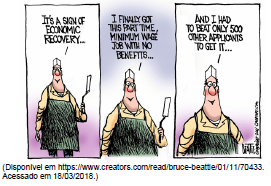
Leia a charge.


Imagem associada para resolução da questão

<https://tinyurl.com/y3lrke6a> Acesso em: 08.10.2019. Original colorido.


A ironia da charge se constrói no fato de

Alternativas
Ano: 2019 Banca: FATEC Órgão: FATEC Prova: FATEC - 2019 - FATEC - Vestibular |
Q1266037 Inglês

Imagem associada para resolução da questão

<https://tinyurl.com/y6fbtptu> Acesso em: 15.03.2019. Original colorido


Nos quadrinhos, pode-se observar que Alice se sente um tanto quanto decepcionada com a formação do novo líder porque ele

Alternativas
Ano: 2019 Banca: FUVEST Órgão: USP Prova: FUVEST - 2019 - USP - Vestibular |
Q1169894 Inglês
Harlem
What happens to a dream deferred?
Does it dry up like a raisin in the sun? Or fester like a sore — And then run? Does it stink like rotten meat? Or crust and sugar over — like a syrupy sweet?
Maybe it just sags like a heavy load.
Or does it explode?
Langston Hughes, Selected Poems of Langston Hughes (1990). Disponível em http://www.poetryfoundation.org/.
As tentativas de resposta do poeta à pergunta “What happens to a dream deferred?” evocam imagens de
Alternativas
Ano: 2019 Banca: FUVEST Órgão: USP Prova: FUVEST - 2019 - USP - Vestibular |
Q1169893 Inglês
TEXTO PARA A QUESTÃO

    Scientists have long touted DNA’s potential as an ideal storage medium; it’s dense, easy to replicate, and stable over millennia. But in order to replace existing silicon‐chip or magnetic‐tape storage technologies, DNA will have to get a lot cheaper to predictably read, write, and package.
    That’s where scientists like Hyunjun Park come in. He and the other cofounders of Catalog, an MIT DNA‐storage spinoff emerging out of stealth on Tuesday, are building a machine that will write a terabyte of data a day, using 500 trillion molecules of DNA.  
    If successful, DNA storage could be the answer to a uniquely 21st‐century problem: information overload. Five years ago humans had produced 4.4 zettabytes of data; that's set to explode to 160 zettabytes (each year!) by 2025. Current infrastructure can handle only a fraction of the coming data deluge, which is expected to consume all the world's microchip‐grade silicon by 2040.
    “Today’s technology is already close to the physical limits of scaling,” says Victor Zhirnov, chief scientist of the Semiconductor Research Corporation. “DNA has an information‐storage density several orders of magnitude higher than any other known storage technology.”
    How dense exactly? Imagine formatting every movie ever made into DNA; it would be smaller than the size of a sugar cube. And it would last for 10,000 years.
Wired, June, 2018. Disponível em https://www.wired.com/. Adaptado.
Conforme o texto, cientistas preveem que, em pouco mais de 20 anos,
Alternativas
Ano: 2019 Banca: FUVEST Órgão: USP Prova: FUVEST - 2019 - USP - Vestibular |
Q1169892 Inglês
TEXTO PARA A QUESTÃO

    Scientists have long touted DNA’s potential as an ideal storage medium; it’s dense, easy to replicate, and stable over millennia. But in order to replace existing silicon‐chip or magnetic‐tape storage technologies, DNA will have to get a lot cheaper to predictably read, write, and package.
    That’s where scientists like Hyunjun Park come in. He and the other cofounders of Catalog, an MIT DNA‐storage spinoff emerging out of stealth on Tuesday, are building a machine that will write a terabyte of data a day, using 500 trillion molecules of DNA.  
    If successful, DNA storage could be the answer to a uniquely 21st‐century problem: information overload. Five years ago humans had produced 4.4 zettabytes of data; that's set to explode to 160 zettabytes (each year!) by 2025. Current infrastructure can handle only a fraction of the coming data deluge, which is expected to consume all the world's microchip‐grade silicon by 2040.
    “Today’s technology is already close to the physical limits of scaling,” says Victor Zhirnov, chief scientist of the Semiconductor Research Corporation. “DNA has an information‐storage density several orders of magnitude higher than any other known storage technology.”
    How dense exactly? Imagine formatting every movie ever made into DNA; it would be smaller than the size of a sugar cube. And it would last for 10,000 years.
Wired, June, 2018. Disponível em https://www.wired.com/. Adaptado.
Afirma‐se no texto que, no futuro, a tecnologia de gravação em moléculas de DNA
Alternativas
Ano: 2019 Banca: FUVEST Órgão: USP Prova: FUVEST - 2019 - USP - Vestibular |
Q1169891 Inglês
Imagem associada para resolução da questão Disponível em https://www.facebook.com/groups/englishmemes/.
O efeito de comicidade que se obtém do meme decorre, sobretudo, da
Alternativas
Ano: 2019 Banca: FUVEST Órgão: USP Prova: FUVEST - 2019 - USP - Vestibular |
Q1169890 Inglês
TEXTO PARA A QUESTÃO

    Assigning female genders to digital assistants such as Apple’s Siri and Amazon’s Alexa is helping entrench harmful gender biases, according to a UN agency.
    Research released by Unesco claims that the often submissive and flirty responses offered by the systemsto many queries – including outright abusive ones – reinforce ideas of women as subservient.
    “Because the speech of most voice assistants is female, it sends a signal that women are obliging, docile and eager‐to‐ please helpers, available at the touch of a button or with a blunt voice command like ‘hey’ or ‘OK’”, the report said.
    “The assistant holds no power of agency beyond what the commander asks of it. It honours commands and responds to queries regardless of their tone or hostility. In many communities, this reinforces commonly held gender biases that women are subservient and tolerant of poor treatment.”
    The Unesco publication was entitled “I’d Blush if I Could”; a reference to the response Apple’s Siri assistant offers to the phrase: “You’re a slut.” Amazon’s Alexa will respond: “Well, thanks for the feedback.”
    The paper said such firms were “staffed by overwhelmingly male engineering teams” and have built AI (Artificial Intelligence) systems that “cause their feminised digital assistants to greet verbal abuse with catch‐me‐if‐you‐can flirtation”.
    Saniye Gülser Corat, Unesco’s director for gender equality, said: “The world needs to pay much closer attention to how, when and whether AI technologies are gendered and, crucially, who is gendering them.”
The Guardian, May, 2019. Adaptado.
De acordo com o texto, na opinião de Saniye Gülser Corat, tecnologias que envolvem Inteligência Artificial, entre outros aspectos,
Alternativas
Ano: 2019 Banca: FUVEST Órgão: USP Prova: FUVEST - 2019 - USP - Vestibular |
Q1169889 Inglês
TEXTO PARA A QUESTÃO

    Assigning female genders to digital assistants such as Apple’s Siri and Amazon’s Alexa is helping entrench harmful gender biases, according to a UN agency.
    Research released by Unesco claims that the often submissive and flirty responses offered by the systemsto many queries – including outright abusive ones – reinforce ideas of women as subservient.
    “Because the speech of most voice assistants is female, it sends a signal that women are obliging, docile and eager‐to‐ please helpers, available at the touch of a button or with a blunt voice command like ‘hey’ or ‘OK’”, the report said.
    “The assistant holds no power of agency beyond what the commander asks of it. It honours commands and responds to queries regardless of their tone or hostility. In many communities, this reinforces commonly held gender biases that women are subservient and tolerant of poor treatment.”
    The Unesco publication was entitled “I’d Blush if I Could”; a reference to the response Apple’s Siri assistant offers to the phrase: “You’re a slut.” Amazon’s Alexa will respond: “Well, thanks for the feedback.”
    The paper said such firms were “staffed by overwhelmingly male engineering teams” and have built AI (Artificial Intelligence) systems that “cause their feminised digital assistants to greet verbal abuse with catch‐me‐if‐you‐can flirtation”.
    Saniye Gülser Corat, Unesco’s director for gender equality, said: “The world needs to pay much closer attention to how, when and whether AI technologies are gendered and, crucially, who is gendering them.”
The Guardian, May, 2019. Adaptado.
Segundo o texto, o título do relatório publicado pela Unesco ‐ “I´d Blush if I Could” ‐, no que diz respeito aos assistentes digitais, indica
Alternativas
Respostas
761: C
762: B
763: B
764: D
765: A
766: C
767: A
768: B
769: E
770: E
771: A
772: D
773: A
774: E
775: C
776: B
777: E
778: B
779: E
780: A