Questões de Vestibular Sobre inglês
Foram encontradas 6.365 questões


Q1396164
Inglês


In the sentence “In terms of pros and cons, it offers great convenience and access for populations who might not otherwise have it” one can find a/an
Q1396163
Inglês
To succeed in an online course, it is advisable to
Q1396162
Inglês
Besides setting aside specific time to studying, another relevant tip for success is
Q1396161
Inglês
Professor Jovita Ross-Gordon believes online students are able to learn
Q1396160
Inglês
According to the text, in terms of its advantages, it is correct to say that online education is
Q1396159
Inglês
Louis Soares highlights the fact that
Q1396158
Inglês
As to Mr. Haynes, studying online allows him to be
Q1396157
Inglês
Ms. Gibson prefers studying online because in a regular class
Q1396156
Inglês
Studying online is especially attractive to
Ano: 2019
Banca:
PUC - RJ
Órgão:
PUC - RJ
Prova:
PUC - RJ - 2019 - PUC - RJ - Vestibular - Inglês - 1º Dia - Manhã - Grupo 2 |
Q1395348
Inglês
Texto associado
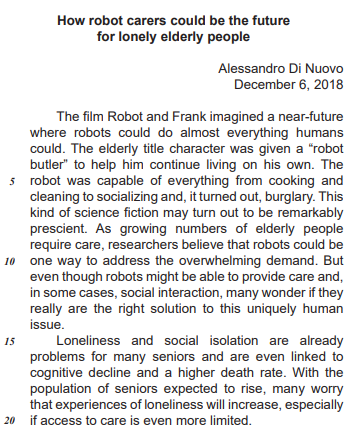
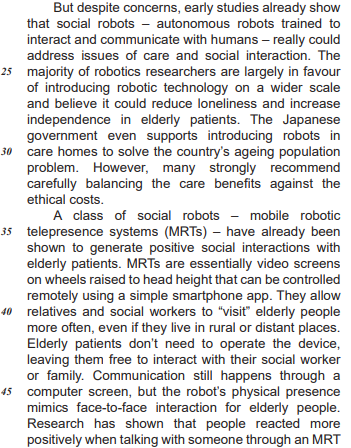
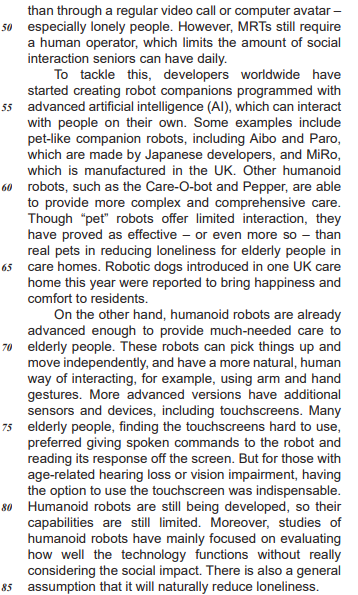
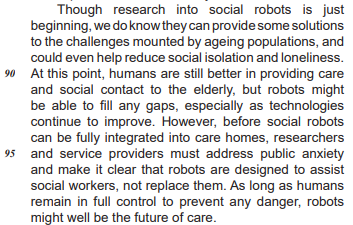
Available at:<https://www.independent.co.uk/life-style/gadgetsand-tech/features/robot-carer-elderly-people-lonelinessageing-population-care-homes-a8659801.html>. Retrieved on:
July 2, 2019. Adapted.
In the fragment “researchers and service providers must
address public anxiety and make it clear that robots are
designed to assist social workers, not replace them.” (lines
94-97), the verb form must conveys an idea of
Ano: 2019
Banca:
PUC - RJ
Órgão:
PUC - RJ
Prova:
PUC - RJ - 2019 - PUC - RJ - Vestibular - Inglês - 1º Dia - Tarde - Grupos 1, 3, 4 e 5 |
Q1391734
Inglês
Texto associado


The Arctic Ocean has lost 95 percent of its oldest ice
— a startling sign of what’s to come
By Chris Mooney
December 11, 2018
Available at: <https://www.washingtonpost.com/energyenvironment/2018/12/11/arctic-is-even-worse-shape-thanyou-realize/?noredirect=on&utm_term=.508085a17318>. Retrieved on: July 2, 2019. Adapted.
In the last paragraph, Walt Meier affirms that “The Arctic
is an indication of what’s coming to the rest of the globe”
(lines 86-87) because
Ano: 2019
Banca:
Cepros
Órgão:
CESMAC
Prova:
Cepros - 2019 - CESMAC - Prova de Medicina-2020.1- 1° DIA |
Q1391680
Inglês
Texto associado
Read the text below and answer the following question based on it.
How we learn things shapes our memory
Humans are constantly learning new things. This ability helps us to grow and adapt to new situations daily. But a new study suggests that different learning mechanisms actually shape how the brain stores memories.
As humans, we have not only survived, but thrived throughout time thanks to our ability to learn and adapt to new situations.
Learning itself is a complex process, and there are different types of learning mechanisms through which the brain stores new information and updates old information.
In general terms, there are two ways of learning that humans use to acquire new information in the long term.
One is by association, or through experience. This is when we learn new things incidentally, just because we happened to come across them, or because we are in a new environment that we are learning to navigate little by little.
The other one is learning by reinforcement. This is when we purposefully set out to learn new information — when we take a language course, for example.
A new study conducted by researchers from the Department of Experimental Psychology, the Wellcome Centre for Integrative Neuroimaging, and the Nuffield Department of Clinical Neurosciences — all in Oxford, United Kingdom — indicates that different learning mechanisms have links to memories stored in different parts of the brain.
The researchers add that not only do we store information differently depending on how we acquire it, but that it may be more or less easy for us to lose or change this information for the same reason.
The researchers also explain that the findings indicate that the brain can store information learned through reinforcement for a long time, while other types of information remain more available for updates.
"We also learned that some of this knowledge is very persistent, and the brain does not forget about it even when it becomes irrelevant, while knowledge acquired through an alternative learning mechanism is more flexible and can more easily be changed to new knowledge," notes KleinFlügge.
When it comes to unlearning or forgetting information, the researchers also note that information acquired incidentally through associations is easier to discard than information acquired through goal-oriented learning.
Adaptado de: < https://www.medicalnewstoday.com/articles/326826.php> Acessado em 29 de outubro de 2019.
Read the text below and answer the following question
based on it.
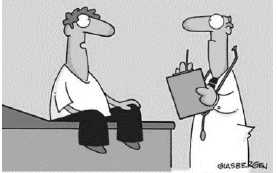
Disponivel em: <https://caveviews.blogs.com/cave_news/2010/08/webmdeffect.html>. Acessado em 19 de outubro de 2019.
The patient’s assertion
Disponivel em: <https://caveviews.blogs.com/cave_news/2010/08/webmdeffect.html>. Acessado em 19 de outubro de 2019.
The patient’s assertion
Ano: 2019
Banca:
Cepros
Órgão:
CESMAC
Prova:
Cepros - 2019 - CESMAC - Prova de Medicina-2020.1- 1° DIA |
Q1391679
Inglês
Texto associado
Read the text below and answer the following question based on it.
How we learn things shapes our memory
Humans are constantly learning new things. This ability helps us to grow and adapt to new situations daily. But a new study suggests that different learning mechanisms actually shape how the brain stores memories.
As humans, we have not only survived, but thrived throughout time thanks to our ability to learn and adapt to new situations.
Learning itself is a complex process, and there are different types of learning mechanisms through which the brain stores new information and updates old information.
In general terms, there are two ways of learning that humans use to acquire new information in the long term.
One is by association, or through experience. This is when we learn new things incidentally, just because we happened to come across them, or because we are in a new environment that we are learning to navigate little by little.
The other one is learning by reinforcement. This is when we purposefully set out to learn new information — when we take a language course, for example.
A new study conducted by researchers from the Department of Experimental Psychology, the Wellcome Centre for Integrative Neuroimaging, and the Nuffield Department of Clinical Neurosciences — all in Oxford, United Kingdom — indicates that different learning mechanisms have links to memories stored in different parts of the brain.
The researchers add that not only do we store information differently depending on how we acquire it, but that it may be more or less easy for us to lose or change this information for the same reason.
The researchers also explain that the findings indicate that the brain can store information learned through reinforcement for a long time, while other types of information remain more available for updates.
"We also learned that some of this knowledge is very persistent, and the brain does not forget about it even when it becomes irrelevant, while knowledge acquired through an alternative learning mechanism is more flexible and can more easily be changed to new knowledge," notes KleinFlügge.
When it comes to unlearning or forgetting information, the researchers also note that information acquired incidentally through associations is easier to discard than information acquired through goal-oriented learning.
Adaptado de: < https://www.medicalnewstoday.com/articles/326826.php> Acessado em 29 de outubro de 2019.
When it comes to storing, retrieving and forgetting
information
Ano: 2019
Banca:
Cepros
Órgão:
CESMAC
Prova:
Cepros - 2019 - CESMAC - Prova de Medicina-2020.1- 1° DIA |
Q1391678
Inglês
Texto associado
Read the text below and answer the following question based on it.
How we learn things shapes our memory
Humans are constantly learning new things. This ability helps us to grow and adapt to new situations daily. But a new study suggests that different learning mechanisms actually shape how the brain stores memories.
As humans, we have not only survived, but thrived throughout time thanks to our ability to learn and adapt to new situations.
Learning itself is a complex process, and there are different types of learning mechanisms through which the brain stores new information and updates old information.
In general terms, there are two ways of learning that humans use to acquire new information in the long term.
One is by association, or through experience. This is when we learn new things incidentally, just because we happened to come across them, or because we are in a new environment that we are learning to navigate little by little.
The other one is learning by reinforcement. This is when we purposefully set out to learn new information — when we take a language course, for example.
A new study conducted by researchers from the Department of Experimental Psychology, the Wellcome Centre for Integrative Neuroimaging, and the Nuffield Department of Clinical Neurosciences — all in Oxford, United Kingdom — indicates that different learning mechanisms have links to memories stored in different parts of the brain.
The researchers add that not only do we store information differently depending on how we acquire it, but that it may be more or less easy for us to lose or change this information for the same reason.
The researchers also explain that the findings indicate that the brain can store information learned through reinforcement for a long time, while other types of information remain more available for updates.
"We also learned that some of this knowledge is very persistent, and the brain does not forget about it even when it becomes irrelevant, while knowledge acquired through an alternative learning mechanism is more flexible and can more easily be changed to new knowledge," notes KleinFlügge.
When it comes to unlearning or forgetting information, the researchers also note that information acquired incidentally through associations is easier to discard than information acquired through goal-oriented learning.
Adaptado de: < https://www.medicalnewstoday.com/articles/326826.php> Acessado em 29 de outubro de 2019.
Generally speaking
Ano: 2019
Banca:
Cepros
Órgão:
CESMAC
Prova:
Cepros - 2019 - CESMAC - Prova de Medicina-2020.1- 1° DIA |
Q1391677
Inglês
Texto associado
Read the text below and answer the following question based on it.
How we learn things shapes our memory
Humans are constantly learning new things. This ability helps us to grow and adapt to new situations daily. But a new study suggests that different learning mechanisms actually shape how the brain stores memories.
As humans, we have not only survived, but thrived throughout time thanks to our ability to learn and adapt to new situations.
Learning itself is a complex process, and there are different types of learning mechanisms through which the brain stores new information and updates old information.
In general terms, there are two ways of learning that humans use to acquire new information in the long term.
One is by association, or through experience. This is when we learn new things incidentally, just because we happened to come across them, or because we are in a new environment that we are learning to navigate little by little.
The other one is learning by reinforcement. This is when we purposefully set out to learn new information — when we take a language course, for example.
A new study conducted by researchers from the Department of Experimental Psychology, the Wellcome Centre for Integrative Neuroimaging, and the Nuffield Department of Clinical Neurosciences — all in Oxford, United Kingdom — indicates that different learning mechanisms have links to memories stored in different parts of the brain.
The researchers add that not only do we store information differently depending on how we acquire it, but that it may be more or less easy for us to lose or change this information for the same reason.
The researchers also explain that the findings indicate that the brain can store information learned through reinforcement for a long time, while other types of information remain more available for updates.
"We also learned that some of this knowledge is very persistent, and the brain does not forget about it even when it becomes irrelevant, while knowledge acquired through an alternative learning mechanism is more flexible and can more easily be changed to new knowledge," notes KleinFlügge.
When it comes to unlearning or forgetting information, the researchers also note that information acquired incidentally through associations is easier to discard than information acquired through goal-oriented learning.
Adaptado de: < https://www.medicalnewstoday.com/articles/326826.php> Acessado em 29 de outubro de 2019.
According to the text
Ano: 2019
Banca:
Cepros
Órgão:
CESMAC
Prova:
Cepros - 2019 - CESMAC - Prova de Medicina-2020.1- 1° DIA |
Q1391676
Inglês
Texto associado
In a prospective, randomised, controlled trial to determine
whether comprehensive lifestyle changes affect coronary
atherosclerosis after 1 year, 28 patients were assigned to an
experimental group (low-fat vegetarian diet, stopping
smoking, stress management training, and moderate
exercise) and 20 to a usual-care control group. 195
coronary artery lesions were analysed by quantitative
coronary angiography. The average percentage diameter
stenosis regressed from 40.0 (SD 16.9)% to 37.8 (16.5)% in
the experimental group yet progressed from 42.7 (15.5)% to
46.1 (18.5)% in the control group. When only lesions greater
than 50% stenosed were analysed, the average percentage
diameter stenosis regressed from 61.1 (8.8)% to 55.8
(11.0)% in the experimental group and progressed from
61.7 (9.5)% to 64.4 (16.3)% in the control group. Overall,
82% of experimental-group patients had an average change
towards regression. Comprehensive lifestyle changes may
be able to bring about regression of even severe coronary
atherosclerosis after only 1 year, without use of lipidlowering drugs
Read the text below and answer the following question based on it.
Can lifestyle changes reverse coronary
heart disease? The Lifestyle Heart Trial.
Abstract
Adaptado de:
<https://www.ncbi.nlm.nih.gov/pubmed/1973470> Acessado
em 27 de outubro de 2017.
In “Comprehensive lifestyle changes may be able to
bring about regression…” may expresses:
Ano: 2019
Banca:
Cepros
Órgão:
CESMAC
Prova:
Cepros - 2019 - CESMAC - Prova de Medicina-2020.1- 1° DIA |
Q1391675
Inglês
Texto associado
In a prospective, randomised, controlled trial to determine
whether comprehensive lifestyle changes affect coronary
atherosclerosis after 1 year, 28 patients were assigned to an
experimental group (low-fat vegetarian diet, stopping
smoking, stress management training, and moderate
exercise) and 20 to a usual-care control group. 195
coronary artery lesions were analysed by quantitative
coronary angiography. The average percentage diameter
stenosis regressed from 40.0 (SD 16.9)% to 37.8 (16.5)% in
the experimental group yet progressed from 42.7 (15.5)% to
46.1 (18.5)% in the control group. When only lesions greater
than 50% stenosed were analysed, the average percentage
diameter stenosis regressed from 61.1 (8.8)% to 55.8
(11.0)% in the experimental group and progressed from
61.7 (9.5)% to 64.4 (16.3)% in the control group. Overall,
82% of experimental-group patients had an average change
towards regression. Comprehensive lifestyle changes may
be able to bring about regression of even severe coronary
atherosclerosis after only 1 year, without use of lipidlowering drugs
Read the text below and answer the following question based on it.
Can lifestyle changes reverse coronary
heart disease? The Lifestyle Heart Trial.
Abstract
Adaptado de:
<https://www.ncbi.nlm.nih.gov/pubmed/1973470> Acessado
em 27 de outubro de 2017.
The research conducted showed that
Ano: 2019
Banca:
Cepros
Órgão:
CESMAC
Prova:
Cepros - 2019 - CESMAC - Prova de Medicina-2020.1- 1° DIA |
Q1391674
Inglês
Texto associado
Read the text below and answer the following question based on it

Disponível em: < https://www.wikihow.com/Write-a-Prescription> Acessado em 11 de outubro de 2017
Jane Michelle Smith has been instructed to
Ano: 2019
Banca:
Cepros
Órgão:
CESMAC
Prova:
Cepros - 2019 - CESMAC - Prova de Medicina-2020.1- 1° DIA |
Q1391673
Inglês
Texto associado
Read the text below and answer the following question based on it
Disponível em: < https://www.wikihow.com/Write-a-Prescription> Acessado em 11 de outubro de 2017
Jane has been told to
Q1391458
Inglês
Observe o infográfico a seguir para responder à questão .
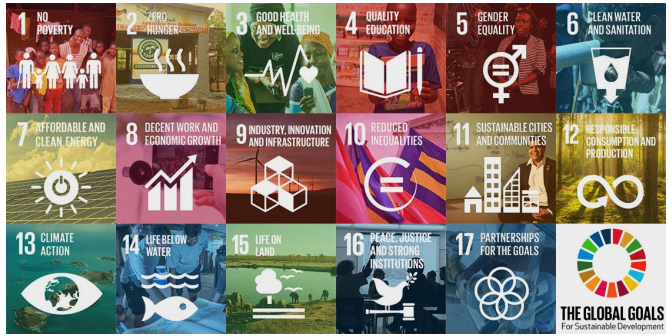
According to the information expressed in the image and the data, The Global Goals, we verify that the

 Conheça nossos planos