Questões de Vestibular Sobre inglês
Foram encontradas 6.365 questões


Q4162964
Inglês
Texto associado
Instrução: A questão está relacionadas ao texto abaixo.
Adapted from: PINKER, S. The better angels of our
nature: why violence has declined.
London: Viking Penguin, 2011.
Consider the statements below.
I - According to Peter Singer, literacy has enlarged the empathy circle, which means that today more people care about individuals very much unlike themselves.
II - The author argues that literature forces readers to adopt alternative points of view, which may contribute to increasing empathy and compassion.
III- Phenomena such as that of adult men crying over melodramatic novels in the 18th century are proof of literature’s power to trigger emotional responses which make readers oppose human right abuses.
Which ones are correct according to the text?
I - According to Peter Singer, literacy has enlarged the empathy circle, which means that today more people care about individuals very much unlike themselves.
II - The author argues that literature forces readers to adopt alternative points of view, which may contribute to increasing empathy and compassion.
III- Phenomena such as that of adult men crying over melodramatic novels in the 18th century are proof of literature’s power to trigger emotional responses which make readers oppose human right abuses.
Which ones are correct according to the text?
Q4162963
Inglês
Texto associado
Instrução: A questão está relacionadas ao texto abaixo.
Adapted from: PINKER, S. The better angels of our
nature: why violence has declined.
London: Viking Penguin, 2011.
Select the alternative that adequately fills in
the blanks in lines 10, 32 and 58.
Q4162962
Inglês
Texto associado

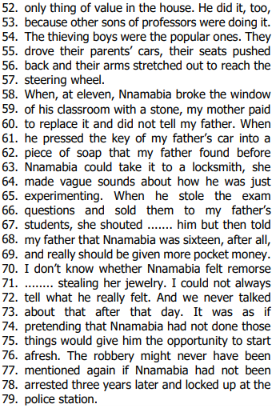
Instrução: A questão está relacionadas ao texto abaixo.
Adaptado de: ADICHIE, C. N.
Cell One. In: The thing around your neck.
New York / Toronto: Harper Collins, 2009.
A expressão start afresh (l. 75-76) pode ser substituída, sem prejuízo do sentido que tem no texto,
por
Q4162961
Inglês
Texto associado
Instrução: A questão está relacionadas ao texto abaixo.
Adaptado de: ADICHIE, C. N.
Cell One. In: The thing around your neck.
New York / Toronto: Harper Collins, 2009.
Associe as palavras da coluna da esquerda às suas respectivas traduções, na coluna da direita, de
acordo com o sentido que têm no texto.
( ) gaunt (l. 37)
( ) mutter (l. 49)
( ) pretending (l. 74)
1. resmungo
2. magro
3. pretender
4. queixa
5. fingir
6. altivo
A sequência correta de preenchimento dos parênteses, de cima para baixo, é
( ) gaunt (l. 37)
( ) mutter (l. 49)
( ) pretending (l. 74)
1. resmungo
2. magro
3. pretender
4. queixa
5. fingir
6. altivo
A sequência correta de preenchimento dos parênteses, de cima para baixo, é
Q4162960
Inglês
Texto associado
Instrução: A questão está relacionadas ao texto abaixo.
Adaptado de: ADICHIE, C. N.
Cell One. In: The thing around your neck.
New York / Toronto: Harper Collins, 2009.
Assinale a alternativa que apresenta versão de
sentido equivalente, em discurso indireto, e
gramaticalmente correta, do segmento de
frase “I know I have caused you both
terrible pain in the past, but I would
never violate your trust like this “ (l. 31-
33).
Q4162959
Inglês
Texto associado
Instrução: A questão está relacionadas ao texto abaixo.
Adaptado de: ADICHIE, C. N.
Cell One. In: The thing around your neck.
New York / Toronto: Harper Collins, 2009.
Considere as seguintes propostas de alteração
de segmentos do texto.
I - Substituição da palavra since (l. 14) por once.
II - Substituição da forma verbal pawned (l. 38) por lost.
III- Substituição de with whom he had spent it (l. 42-43) por who he had spent it with.
Quais resultariam gramaticalmente corretas e não alterariam o sentido literal, se aplicadas ao texto?
I - Substituição da palavra since (l. 14) por once.
II - Substituição da forma verbal pawned (l. 38) por lost.
III- Substituição de with whom he had spent it (l. 42-43) por who he had spent it with.
Quais resultariam gramaticalmente corretas e não alterariam o sentido literal, se aplicadas ao texto?
Q4162958
Inglês
Texto associado
Instrução: A questão está relacionadas ao texto abaixo.
Adaptado de: ADICHIE, C. N.
Cell One. In: The thing around your neck.
New York / Toronto: Harper Collins, 2009.
Considere as seguintes afirmações acerca do
texto.
I - A substituição do pronome he (l. 13) por they implicaria a modificação de duas outras palavras na frase que o contém.
II - O uso da voz passiva na oração the window had been opened from the inside (l. 26-27) indica que existe certeza quanto a quem executou a ação descrita.
III- As ocorrências do pronome it, nas linhas 51, 52 e 53, têm como referente o roubo das joias da mãe de Nnamabia.
Quais estão corretas?
I - A substituição do pronome he (l. 13) por they implicaria a modificação de duas outras palavras na frase que o contém.
II - O uso da voz passiva na oração the window had been opened from the inside (l. 26-27) indica que existe certeza quanto a quem executou a ação descrita.
III- As ocorrências do pronome it, nas linhas 51, 52 e 53, têm como referente o roubo das joias da mãe de Nnamabia.
Quais estão corretas?
Q4162955
Inglês
Texto associado
Instrução: A questão está relacionadas ao texto abaixo.
Adaptado de: ADICHIE, C. N.
Cell One. In: The thing around your neck.
New York / Toronto: Harper Collins, 2009.
Assinale a alternativa que preenche
adequadamente as lacunas das linhas 02, 36,
67 e 71, nesta ordem.
Q4149994
Inglês
Texto associado
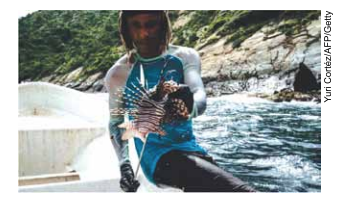
Aarav Chavda has been diving off the coast of Florida
for years. Each time he became increasingly depressed by
the ever-growing empty spaces, as colourful species of fish
and coral reefs continued to disappear. A significant reason
for that disappearance is the lionfish, an invasive species that
has boomed in Atlantic waters from Florida to the Caribbean
in recent decades, and in numerous other places from Brazil
and Mexico to the Mediterranean.
Lionfish have no natural predators outside their native
range — in the Indian and Pacific Oceans and the Red Sea —
and are all-consuming, devouring an estimated 79% of young
marine life within five weeks of entering a coral reef system.
“You can see the impacts on the reefs when you dive now
— it’s less vibrant, it’s less noisy,” Chavda said. “We know
there are solutions for some of the problems — such as coral-
-friendly sunscreens to help protect the reefs — but nobody’s
been able to do anything about the lionfish.”
So Chavda and a team of ecologically aware fellow
scuba enthusiasts decided to act by establishing a company
called Inversa, which turns lionfish into a new product: fish
leather. Chavda, 27, and his childhood friend from Texas,
Roland Salatino, set up the Florida-based company to make
the leather. They process the fish hides1
by tanning them
with drying agents and dye them before selling the leather to
partner companies to fashion into high-end products including
wallets, belts and handbags. Fish skin is thin but, because
the fibre structure runs crossways, it is stronger than many
other types of leather. Each hide, Chavda says, can save up
to 70,000 native reef fish.
The hides are also more sustainable than traditional
animal leathers, which generally require grazing on huge
amounts of pasture — degrading soils and producing high
carbon emissions. Inversa does not hunt the lionfish itself.
Instead, it relies on educating and encouraging largely poor
fishermen and women in often remote places to catch them.
“We’re really sort of empowering the consumer and fashion
by doing something for the planet — then we empower dive
communities in fishing cooperatives to do something for
themselves,” Chavda said.
(Richard Luscombe. www.theguardian.com, 12.06.2022. Adaptado.)
1
hide: an animal’s skin used to make leather
No trecho do quarto parágrafo “‘We’re really sort of
empowering the consumer and fashion’”, a expressão
sublinhada significa, no contexto em questão,
Q4149993
Inglês
Texto associado
Aarav Chavda has been diving off the coast of Florida
for years. Each time he became increasingly depressed by
the ever-growing empty spaces, as colourful species of fish
and coral reefs continued to disappear. A significant reason
for that disappearance is the lionfish, an invasive species that
has boomed in Atlantic waters from Florida to the Caribbean
in recent decades, and in numerous other places from Brazil
and Mexico to the Mediterranean.
Lionfish have no natural predators outside their native
range — in the Indian and Pacific Oceans and the Red Sea —
and are all-consuming, devouring an estimated 79% of young
marine life within five weeks of entering a coral reef system.
“You can see the impacts on the reefs when you dive now
— it’s less vibrant, it’s less noisy,” Chavda said. “We know
there are solutions for some of the problems — such as coral-
-friendly sunscreens to help protect the reefs — but nobody’s
been able to do anything about the lionfish.”
So Chavda and a team of ecologically aware fellow
scuba enthusiasts decided to act by establishing a company
called Inversa, which turns lionfish into a new product: fish
leather. Chavda, 27, and his childhood friend from Texas,
Roland Salatino, set up the Florida-based company to make
the leather. They process the fish hides1
by tanning them
with drying agents and dye them before selling the leather to
partner companies to fashion into high-end products including
wallets, belts and handbags. Fish skin is thin but, because
the fibre structure runs crossways, it is stronger than many
other types of leather. Each hide, Chavda says, can save up
to 70,000 native reef fish.
The hides are also more sustainable than traditional
animal leathers, which generally require grazing on huge
amounts of pasture — degrading soils and producing high
carbon emissions. Inversa does not hunt the lionfish itself.
Instead, it relies on educating and encouraging largely poor
fishermen and women in often remote places to catch them.
“We’re really sort of empowering the consumer and fashion
by doing something for the planet — then we empower dive
communities in fishing cooperatives to do something for
themselves,” Chavda said.
(Richard Luscombe. www.theguardian.com, 12.06.2022. Adaptado.)
1
hide: an animal’s skin used to make leather
No trecho do quarto parágrafo “Instead, it relies on educating
and encouraging largely poor fishermen and women”, o termo
“instead” equivale, em português, a
Q4149992
Inglês
Texto associado
Aarav Chavda has been diving off the coast of Florida
for years. Each time he became increasingly depressed by
the ever-growing empty spaces, as colourful species of fish
and coral reefs continued to disappear. A significant reason
for that disappearance is the lionfish, an invasive species that
has boomed in Atlantic waters from Florida to the Caribbean
in recent decades, and in numerous other places from Brazil
and Mexico to the Mediterranean.
Lionfish have no natural predators outside their native
range — in the Indian and Pacific Oceans and the Red Sea —
and are all-consuming, devouring an estimated 79% of young
marine life within five weeks of entering a coral reef system.
“You can see the impacts on the reefs when you dive now
— it’s less vibrant, it’s less noisy,” Chavda said. “We know
there are solutions for some of the problems — such as coral-
-friendly sunscreens to help protect the reefs — but nobody’s
been able to do anything about the lionfish.”
So Chavda and a team of ecologically aware fellow
scuba enthusiasts decided to act by establishing a company
called Inversa, which turns lionfish into a new product: fish
leather. Chavda, 27, and his childhood friend from Texas,
Roland Salatino, set up the Florida-based company to make
the leather. They process the fish hides1
by tanning them
with drying agents and dye them before selling the leather to
partner companies to fashion into high-end products including
wallets, belts and handbags. Fish skin is thin but, because
the fibre structure runs crossways, it is stronger than many
other types of leather. Each hide, Chavda says, can save up
to 70,000 native reef fish.
The hides are also more sustainable than traditional
animal leathers, which generally require grazing on huge
amounts of pasture — degrading soils and producing high
carbon emissions. Inversa does not hunt the lionfish itself.
Instead, it relies on educating and encouraging largely poor
fishermen and women in often remote places to catch them.
“We’re really sort of empowering the consumer and fashion
by doing something for the planet — then we empower dive
communities in fishing cooperatives to do something for
themselves,” Chavda said.
(Richard Luscombe. www.theguardian.com, 12.06.2022. Adaptado.)
1
hide: an animal’s skin used to make leather
No trecho do terceiro parágrafo “and dye them before selling the
leather to partner companies”, o termo sublinhado refere-se a
Q4149991
Inglês
Texto associado
Aarav Chavda has been diving off the coast of Florida
for years. Each time he became increasingly depressed by
the ever-growing empty spaces, as colourful species of fish
and coral reefs continued to disappear. A significant reason
for that disappearance is the lionfish, an invasive species that
has boomed in Atlantic waters from Florida to the Caribbean
in recent decades, and in numerous other places from Brazil
and Mexico to the Mediterranean.
Lionfish have no natural predators outside their native
range — in the Indian and Pacific Oceans and the Red Sea —
and are all-consuming, devouring an estimated 79% of young
marine life within five weeks of entering a coral reef system.
“You can see the impacts on the reefs when you dive now
— it’s less vibrant, it’s less noisy,” Chavda said. “We know
there are solutions for some of the problems — such as coral-
-friendly sunscreens to help protect the reefs — but nobody’s
been able to do anything about the lionfish.”
So Chavda and a team of ecologically aware fellow
scuba enthusiasts decided to act by establishing a company
called Inversa, which turns lionfish into a new product: fish
leather. Chavda, 27, and his childhood friend from Texas,
Roland Salatino, set up the Florida-based company to make
the leather. They process the fish hides1
by tanning them
with drying agents and dye them before selling the leather to
partner companies to fashion into high-end products including
wallets, belts and handbags. Fish skin is thin but, because
the fibre structure runs crossways, it is stronger than many
other types of leather. Each hide, Chavda says, can save up
to 70,000 native reef fish.
The hides are also more sustainable than traditional
animal leathers, which generally require grazing on huge
amounts of pasture — degrading soils and producing high
carbon emissions. Inversa does not hunt the lionfish itself.
Instead, it relies on educating and encouraging largely poor
fishermen and women in often remote places to catch them.
“We’re really sort of empowering the consumer and fashion
by doing something for the planet — then we empower dive
communities in fishing cooperatives to do something for
themselves,” Chavda said.
(Richard Luscombe. www.theguardian.com, 12.06.2022. Adaptado.)
1
hide: an animal’s skin used to make leather
De acordo com o texto,
Q4149990
Inglês
Texto associado
Aarav Chavda has been diving off the coast of Florida
for years. Each time he became increasingly depressed by
the ever-growing empty spaces, as colourful species of fish
and coral reefs continued to disappear. A significant reason
for that disappearance is the lionfish, an invasive species that
has boomed in Atlantic waters from Florida to the Caribbean
in recent decades, and in numerous other places from Brazil
and Mexico to the Mediterranean.
Lionfish have no natural predators outside their native
range — in the Indian and Pacific Oceans and the Red Sea —
and are all-consuming, devouring an estimated 79% of young
marine life within five weeks of entering a coral reef system.
“You can see the impacts on the reefs when you dive now
— it’s less vibrant, it’s less noisy,” Chavda said. “We know
there are solutions for some of the problems — such as coral-
-friendly sunscreens to help protect the reefs — but nobody’s
been able to do anything about the lionfish.”
So Chavda and a team of ecologically aware fellow
scuba enthusiasts decided to act by establishing a company
called Inversa, which turns lionfish into a new product: fish
leather. Chavda, 27, and his childhood friend from Texas,
Roland Salatino, set up the Florida-based company to make
the leather. They process the fish hides1
by tanning them
with drying agents and dye them before selling the leather to
partner companies to fashion into high-end products including
wallets, belts and handbags. Fish skin is thin but, because
the fibre structure runs crossways, it is stronger than many
other types of leather. Each hide, Chavda says, can save up
to 70,000 native reef fish.
The hides are also more sustainable than traditional
animal leathers, which generally require grazing on huge
amounts of pasture — degrading soils and producing high
carbon emissions. Inversa does not hunt the lionfish itself.
Instead, it relies on educating and encouraging largely poor
fishermen and women in often remote places to catch them.
“We’re really sort of empowering the consumer and fashion
by doing something for the planet — then we empower dive
communities in fishing cooperatives to do something for
themselves,” Chavda said.
(Richard Luscombe. www.theguardian.com, 12.06.2022. Adaptado.)
1
hide: an animal’s skin used to make leather
A expressão “such as”, no trecho do segundo parágrafo “such
as coral-friendly sunscreens”, foi utilizada para introduzir
Q4149989
Inglês
Texto associado
Aarav Chavda has been diving off the coast of Florida
for years. Each time he became increasingly depressed by
the ever-growing empty spaces, as colourful species of fish
and coral reefs continued to disappear. A significant reason
for that disappearance is the lionfish, an invasive species that
has boomed in Atlantic waters from Florida to the Caribbean
in recent decades, and in numerous other places from Brazil
and Mexico to the Mediterranean.
Lionfish have no natural predators outside their native
range — in the Indian and Pacific Oceans and the Red Sea —
and are all-consuming, devouring an estimated 79% of young
marine life within five weeks of entering a coral reef system.
“You can see the impacts on the reefs when you dive now
— it’s less vibrant, it’s less noisy,” Chavda said. “We know
there are solutions for some of the problems — such as coral-
-friendly sunscreens to help protect the reefs — but nobody’s
been able to do anything about the lionfish.”
So Chavda and a team of ecologically aware fellow
scuba enthusiasts decided to act by establishing a company
called Inversa, which turns lionfish into a new product: fish
leather. Chavda, 27, and his childhood friend from Texas,
Roland Salatino, set up the Florida-based company to make
the leather. They process the fish hides1
by tanning them
with drying agents and dye them before selling the leather to
partner companies to fashion into high-end products including
wallets, belts and handbags. Fish skin is thin but, because
the fibre structure runs crossways, it is stronger than many
other types of leather. Each hide, Chavda says, can save up
to 70,000 native reef fish.
The hides are also more sustainable than traditional
animal leathers, which generally require grazing on huge
amounts of pasture — degrading soils and producing high
carbon emissions. Inversa does not hunt the lionfish itself.
Instead, it relies on educating and encouraging largely poor
fishermen and women in often remote places to catch them.
“We’re really sort of empowering the consumer and fashion
by doing something for the planet — then we empower dive
communities in fishing cooperatives to do something for
themselves,” Chavda said.
(Richard Luscombe. www.theguardian.com, 12.06.2022. Adaptado.)
1
hide: an animal’s skin used to make leather
The text is mainly about
Ano: 2022
Banca:
VUNESP
Órgão:
FAMERP
Prova:
VUNESP - 2022 - FAMERP - Vestibular - Conhecimentos Gerais |
Q4146222
Inglês
Leia a tirinha.

(www.socmedsean.com)
A reflexão provocada pela tirinha é comprovada pela seguinte definição de Big Data:
Ano: 2022
Banca:
VUNESP
Órgão:
FAMERP
Prova:
VUNESP - 2022 - FAMERP - Vestibular - Conhecimentos Gerais |
Q4146221
Inglês
Texto associado

Leia o pôster de uma campanha do grupo “Dementia Together
Northern Ireland” para responder à questão.
(www.publichealth.hscni.net, 20.01.2017.)
In the excerpt “you can help to support them”, the underlined
word can be replaced, without meaning change, by
Ano: 2022
Banca:
VUNESP
Órgão:
FAMERP
Prova:
VUNESP - 2022 - FAMERP - Vestibular - Conhecimentos Gerais |
Q4146220
Inglês
Texto associado
Leia o pôster de uma campanha do grupo “Dementia Together
Northern Ireland” para responder à questão.
(www.publichealth.hscni.net, 20.01.2017.)
No título do pôster “I have dementia but I’m still me”, o termo
sublinhado foi empregado com o mesmo sentido em:
Ano: 2022
Banca:
VUNESP
Órgão:
FAMERP
Prova:
VUNESP - 2022 - FAMERP - Vestibular - Conhecimentos Gerais |
Q4146219
Inglês
Texto associado
Leia o pôster de uma campanha do grupo “Dementia Together
Northern Ireland” para responder à questão.
(www.publichealth.hscni.net, 20.01.2017.)
According to the poster, the #stillme campaign intends to
Ano: 2022
Banca:
VUNESP
Órgão:
FAMERP
Prova:
VUNESP - 2022 - FAMERP - Vestibular - Conhecimentos Gerais |
Q4146218
Inglês
Texto associado
Leia o texto para responder à questão.
Daters are astonished by the high prices of wining and
dining a romantic interest with inflation at its highest rate
in over 40 years. The consumer price index category for
food away from home rose 7.7% in June 2022 from a year
earlier, while full-service restaurants climbed 8.9%. For those
testing the waters with a cocktail or two, prices for alcoholic
beverages rose by 4%.
Those searching for love say they’re feeling the pain.
Among 3,000 users on the popular dating app Hinge, almost
41% said they were more concerned with the cost of dates
now versus a year ago, with Generation Z respondents more
likely to feel the pressure. Emily Derby, a 27-year-old in Tulsa,
Oklahoma, said her dating costs have doubled from $200 to
$400 a month.
As costs escalate, some singles are scaling back and
being more selective about the dates they’re going on, while
others are pausing their search for “the one” entirely. On dating
site OKCupid, 34% of 70,000 users reported that inflation was
impacting their love life.
“In the fall of 2020, I was going on dates left and right
not really thinking about the costs,” said Seth Rosenberg, a
25-year-old in Philadelphia. “Now, it’s harder to be excited
because if a date goes bad, you’re out anywhere from $50
to $100.”
Those still in the dating game have both love and money
on the mind. New York City-based dating coach Amy Nobile
said even her wealthy clients, many of whom pay $15,000 for
a four-month program, are trying to cut their dating costs in
half. Clients who would typically spend as much as $150 on a
date are seeing if they can get away with $75 or less.
“People are feeling rising prices,” she said. “For those in
the long game to find a partner, they feel like they really need
to monitor their money flow in the dating world.” As a result,
people are on the hunt for less expensive options, said Logan
Ury, director of relationship science at Hinge.
(Paulina Cachero. www.bloomberg.com, 21.07.2022. Adaptado.)
No contexto em que se encontra, o trecho que expressa ideia
de consequência é:
Ano: 2022
Banca:
VUNESP
Órgão:
FAMERP
Prova:
VUNESP - 2022 - FAMERP - Vestibular - Conhecimentos Gerais |
Q4146217
Inglês
Texto associado
Leia o texto para responder à questão.
Daters are astonished by the high prices of wining and
dining a romantic interest with inflation at its highest rate
in over 40 years. The consumer price index category for
food away from home rose 7.7% in June 2022 from a year
earlier, while full-service restaurants climbed 8.9%. For those
testing the waters with a cocktail or two, prices for alcoholic
beverages rose by 4%.
Those searching for love say they’re feeling the pain.
Among 3,000 users on the popular dating app Hinge, almost
41% said they were more concerned with the cost of dates
now versus a year ago, with Generation Z respondents more
likely to feel the pressure. Emily Derby, a 27-year-old in Tulsa,
Oklahoma, said her dating costs have doubled from $200 to
$400 a month.
As costs escalate, some singles are scaling back and
being more selective about the dates they’re going on, while
others are pausing their search for “the one” entirely. On dating
site OKCupid, 34% of 70,000 users reported that inflation was
impacting their love life.
“In the fall of 2020, I was going on dates left and right
not really thinking about the costs,” said Seth Rosenberg, a
25-year-old in Philadelphia. “Now, it’s harder to be excited
because if a date goes bad, you’re out anywhere from $50
to $100.”
Those still in the dating game have both love and money
on the mind. New York City-based dating coach Amy Nobile
said even her wealthy clients, many of whom pay $15,000 for
a four-month program, are trying to cut their dating costs in
half. Clients who would typically spend as much as $150 on a
date are seeing if they can get away with $75 or less.
“People are feeling rising prices,” she said. “For those in
the long game to find a partner, they feel like they really need
to monitor their money flow in the dating world.” As a result,
people are on the hunt for less expensive options, said Logan
Ury, director of relationship science at Hinge.
(Paulina Cachero. www.bloomberg.com, 21.07.2022. Adaptado.)
De acordo com o quarto parágrafo, no outono de 2020, Seth
Rosenberg

 Conheça nossos planos