Questões de Vestibular Sobre inglês
Foram encontradas 6.365 questões


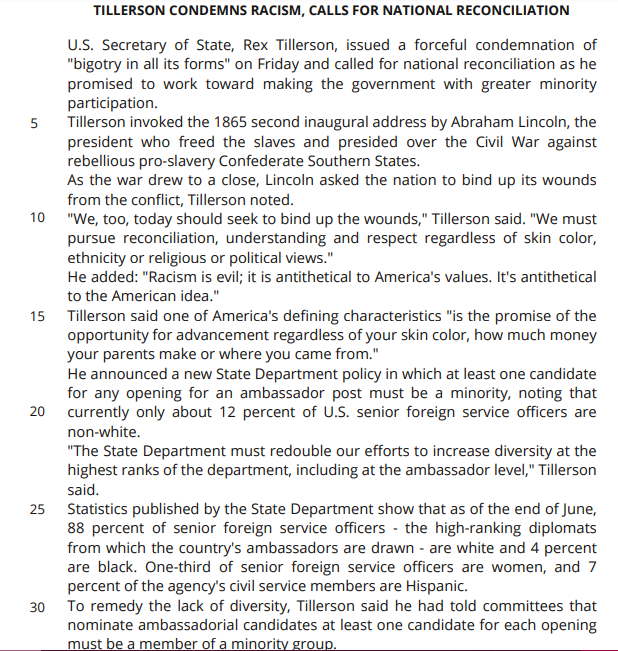
I – O texto é uma notícia veiculada no jornal online The New York Times. II – O texto apresenta que o racismo é um mal que vai contra os valores americanos. III – No texto, o Secretário de Estado Americano, Rex Tillerson, afirma que o racismo não tem remédio.
“And yet and yet. Whatever accommodation he reached with his first wife in life hasn't survived her death. Diana haunts Charles”.
Uma tradução para o termo grifado “Whatever” no context da frase seria:
Observe a frase retirada do texto e escolha a opção CORRETA:
“It’s a horizon that was once obscured by the War of the Waleses”
WAR PHOTOGRAPHER WHO SURVIVED LEUKAEMIA EXPOSED AS A FAKE
Eduardo Martins passed off photos of British surfer as himself and some of his war zone pictures were stolen.


WAR PHOTOGRAPHER WHO SURVIVED LEUKAEMIA EXPOSED AS A FAKE
Eduardo Martins passed off photos of British surfer as himself and some of his war zone pictures were stolen.
WAR PHOTOGRAPHER WHO SURVIVED LEUKAEMIA EXPOSED AS A FAKE
Eduardo Martins passed off photos of British surfer as himself and some of his war zone pictures were stolen.
WAR PHOTOGRAPHER WHO SURVIVED LEUKAEMIA EXPOSED AS A FAKE
Eduardo Martins passed off photos of British surfer as himself and some of his war zone pictures were stolen.
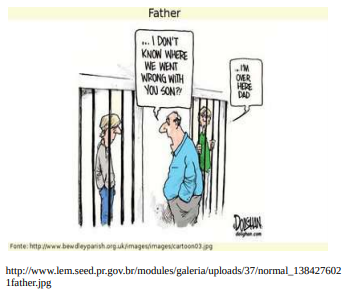
Charges são produzidas com o intuito de satirizar comportamentos humanos e assim oportunizarem a reflexão sobre nossos próprios comportamentos e atitudes. Nessa charge, a linguagem utilizada pelas personagens em uma conversa em inglês evidencia:
I - a confusão mental do pai ao visitar o filho na cadeia e confundi-lo com outro presidiário.
II - o diálogo entre dois presidiários e um carcereiro
a respeito do sistema carcerário no Brasil.
III - a ausência de comunicação no sistema
carcerário.
IV - a distração do pai ao visitar o sobrinho preso na cadeia e confundi-lo com outro presidiário.
V - a ausência de comunicação entre pais e filhos.
Assinale a alternativa correta.
How English evolved into a global language
As the British Library charts the evolution of English in a new major exhibition, author Michael Rosen gives a brief history of a language that has grown to world domination with phrases such as "cool" and "go to it".
The need for an international language has always existed. In the past it was about religion and intellectual debate. With the technologies of today, it's about communicating with others anywhere in the world in a matter of moments.
Two events, separated by nearly 400 years, show how this need has always been present.
Firstly, sitting in front of me I have a copy of the celebrated book Utopia, by Sir Thomas More. This particular edition is published in 1629 in Amsterdam, not in English, not in Dutch, but in Latin.
The second event was a talk I recently had with a German scientist. He said that he knew of scientific conferences taking place in Germany, where all the people attending were German and yet the conference was conducted in English.
Source: <http://www.bbc.com/news/magazine-12017753>
How English evolved into a global language
As the British Library charts the evolution of English in a new major exhibition, author Michael Rosen gives a brief history of a language that has grown to world domination with phrases such as "cool" and "go to it".
The need for an international language has always existed. In the past it was about religion and intellectual debate. With the technologies of today, it's about communicating with others anywhere in the world in a matter of moments.
Two events, separated by nearly 400 years, show how this need has always been present.
Firstly, sitting in front of me I have a copy of the celebrated book Utopia, by Sir Thomas More. This particular edition is published in 1629 in Amsterdam, not in English, not in Dutch, but in Latin.
The second event was a talk I recently had with a German scientist. He said that he knew of scientific conferences taking place in Germany, where all the people attending were German and yet the conference was conducted in English.
Source: <http://www.bbc.com/news/magazine-12017753>

 Conheça nossos planos