Questões de Vestibular Sobre inglês
Foram encontradas 6.365 questões


According to the text, answer true (T) or false (F):
( ) The referendum was held only in some parts of Turkey
( ) The referendum has reduced Recip Erdogan’s presidential powers.
( ) With the new constitution, the Turkish president will not be able to appoint his own ministers.
( ) The European Union that the referendum is not going to help Turkey become a member of the
The correct sequence, from top to bottom is:
Re-Planting a Forest, One Drone at a Time
That funny little buzz you hear in the forest may not just be the hum of summer insects. In the near future it could be a small fleet of drones, coming to replant and restore forests that have been stripped of trees by industrial-scale deforestation. It’s all part of an ambitious plan by BioCarbon Engineering, a U.K.-based startup on a global mission to battle widespread clear-cutting, which strips more than 26 billion trees off the planet each year. CEO Lauren Fletcher, who spent 20 years as an engineer with NASA, says the only way to fight industrial-scale deforestation is with industrial-scale reforestation. Their idea: plant 1 billion trees a year. The first targets are in South Africa and the Amazonian jungles, both of which have suffered from widespread forest eradication.
BioCarbon’s reforestation scheme is simple and efficient. Here’s a quick look at how it plans to deploy its drone fleet:
1 Do a 3-D aerial survey. First, drones are sent to fly over a potential planting zone, snapping photos that create 3-D maps of the area to be reforested. The number of drones will vary depending up on the size of the seeding.
2 Create a seeding plan. Once all that terrain data has been analyzed, it then generates a seeding pattern that best suits the terrain.
3 Load the seed pods. The drones, which are equipped with guidance and control software, carry pressurized canisters of seed pods with germinated seeds immersed in a nutrient-rich gel.
4 Hover and plant. Flying at a height of 1 or 2 meters, the drones follow the planting patterns, firing the biodegradable seed pods down to the ground. The pods break open upon impact, allowing the germinated seed a chance to take root.
5 Monitor growth. After planting, the drones do low-level flights to assess the health of the sprouts and saplings.
Such “precision forestry,” as BioCarbon calls it, is extremely efficient. A farmer might hand plant as many as 3,000 seeds a day; Fletcher says his drones can drop up to 36,000 seed pods daily, often in areas where a human can’t reach. Working with local ecologists, BioCarbon will use the drones to spread a variety of tree species, as well as microorganisms and fungi designed to improve the soil quality. “The central focus is ecosystem restoration,” Fletcher says.
On a planetary climatological scale, Morton notes that “tropical deforestation plays a big role in global climate cycles,” claiming the accelerated pace of cutting and burning of forests accounted for 20 percent of greenhouse gas emissions in the 1990s. Fletcher and his team want to help reverse that trend. “By planting at the scale we’re looking at,” he says, “we can make a real longterm impact. We hope to do a lot of good in the world.”
(Adapted from https://www.wired.com/brandlab/2015/07/re-planting-forest-one-drone-time/. Access on 22/8/2017)
Re-Planting a Forest, One Drone at a Time
That funny little buzz you hear in the forest may not just be the hum of summer insects. In the near future it could be a small fleet of drones, coming to replant and restore forests that have been stripped of trees by industrial-scale deforestation. It’s all part of an ambitious plan by BioCarbon Engineering, a U.K.-based startup on a global mission to battle widespread clear-cutting, which strips more than 26 billion trees off the planet each year. CEO Lauren Fletcher, who spent 20 years as an engineer with NASA, says the only way to fight industrial-scale deforestation is with industrial-scale reforestation. Their idea: plant 1 billion trees a year. The first targets are in South Africa and the Amazonian jungles, both of which have suffered from widespread forest eradication.
BioCarbon’s reforestation scheme is simple and efficient. Here’s a quick look at how it plans to deploy its drone fleet:
1 Do a 3-D aerial survey. First, drones are sent to fly over a potential planting zone, snapping photos that create 3-D maps of the area to be reforested. The number of drones will vary depending up on the size of the seeding.
2 Create a seeding plan. Once all that terrain data has been analyzed, it then generates a seeding pattern that best suits the terrain.
3 Load the seed pods. The drones, which are equipped with guidance and control software, carry pressurized canisters of seed pods with germinated seeds immersed in a nutrient-rich gel.
4 Hover and plant. Flying at a height of 1 or 2 meters, the drones follow the planting patterns, firing the biodegradable seed pods down to the ground. The pods break open upon impact, allowing the germinated seed a chance to take root.
5 Monitor growth. After planting, the drones do low-level flights to assess the health of the sprouts and saplings.
Such “precision forestry,” as BioCarbon calls it, is extremely efficient. A farmer might hand plant as many as 3,000 seeds a day; Fletcher says his drones can drop up to 36,000 seed pods daily, often in areas where a human can’t reach. Working with local ecologists, BioCarbon will use the drones to spread a variety of tree species, as well as microorganisms and fungi designed to improve the soil quality. “The central focus is ecosystem restoration,” Fletcher says.
On a planetary climatological scale, Morton notes that “tropical deforestation plays a big role in global climate cycles,” claiming the accelerated pace of cutting and burning of forests accounted for 20 percent of greenhouse gas emissions in the 1990s. Fletcher and his team want to help reverse that trend. “By planting at the scale we’re looking at,” he says, “we can make a real longterm impact. We hope to do a lot of good in the world.”
(Adapted from https://www.wired.com/brandlab/2015/07/re-planting-forest-one-drone-time/. Access on 22/8/2017)
Re-Planting a Forest, One Drone at a Time
That funny little buzz you hear in the forest may not just be the hum of summer insects. In the near future it could be a small fleet of drones, coming to replant and restore forests that have been stripped of trees by industrial-scale deforestation. It’s all part of an ambitious plan by BioCarbon Engineering, a U.K.-based startup on a global mission to battle widespread clear-cutting, which strips more than 26 billion trees off the planet each year. CEO Lauren Fletcher, who spent 20 years as an engineer with NASA, says the only way to fight industrial-scale deforestation is with industrial-scale reforestation. Their idea: plant 1 billion trees a year. The first targets are in South Africa and the Amazonian jungles, both of which have suffered from widespread forest eradication.
BioCarbon’s reforestation scheme is simple and efficient. Here’s a quick look at how it plans to deploy its drone fleet:
1 Do a 3-D aerial survey. First, drones are sent to fly over a potential planting zone, snapping photos that create 3-D maps of the area to be reforested. The number of drones will vary depending up on the size of the seeding.
2 Create a seeding plan. Once all that terrain data has been analyzed, it then generates a seeding pattern that best suits the terrain.
3 Load the seed pods. The drones, which are equipped with guidance and control software, carry pressurized canisters of seed pods with germinated seeds immersed in a nutrient-rich gel.
4 Hover and plant. Flying at a height of 1 or 2 meters, the drones follow the planting patterns, firing the biodegradable seed pods down to the ground. The pods break open upon impact, allowing the germinated seed a chance to take root.
5 Monitor growth. After planting, the drones do low-level flights to assess the health of the sprouts and saplings.
Such “precision forestry,” as BioCarbon calls it, is extremely efficient. A farmer might hand plant as many as 3,000 seeds a day; Fletcher says his drones can drop up to 36,000 seed pods daily, often in areas where a human can’t reach. Working with local ecologists, BioCarbon will use the drones to spread a variety of tree species, as well as microorganisms and fungi designed to improve the soil quality. “The central focus is ecosystem restoration,” Fletcher says.
On a planetary climatological scale, Morton notes that “tropical deforestation plays a big role in global climate cycles,” claiming the accelerated pace of cutting and burning of forests accounted for 20 percent of greenhouse gas emissions in the 1990s. Fletcher and his team want to help reverse that trend. “By planting at the scale we’re looking at,” he says, “we can make a real longterm impact. We hope to do a lot of good in the world.”
(Adapted from https://www.wired.com/brandlab/2015/07/re-planting-forest-one-drone-time/. Access on 22/8/2017)
Re-Planting a Forest, One Drone at a Time
That funny little buzz you hear in the forest may not just be the hum of summer insects. In the near future it could be a small fleet of drones, coming to replant and restore forests that have been stripped of trees by industrial-scale deforestation. It’s all part of an ambitious plan by BioCarbon Engineering, a U.K.-based startup on a global mission to battle widespread clear-cutting, which strips more than 26 billion trees off the planet each year. CEO Lauren Fletcher, who spent 20 years as an engineer with NASA, says the only way to fight industrial-scale deforestation is with industrial-scale reforestation. Their idea: plant 1 billion trees a year. The first targets are in South Africa and the Amazonian jungles, both of which have suffered from widespread forest eradication.
BioCarbon’s reforestation scheme is simple and efficient. Here’s a quick look at how it plans to deploy its drone fleet:
1 Do a 3-D aerial survey. First, drones are sent to fly over a potential planting zone, snapping photos that create 3-D maps of the area to be reforested. The number of drones will vary depending up on the size of the seeding.
2 Create a seeding plan. Once all that terrain data has been analyzed, it then generates a seeding pattern that best suits the terrain.
3 Load the seed pods. The drones, which are equipped with guidance and control software, carry pressurized canisters of seed pods with germinated seeds immersed in a nutrient-rich gel.
4 Hover and plant. Flying at a height of 1 or 2 meters, the drones follow the planting patterns, firing the biodegradable seed pods down to the ground. The pods break open upon impact, allowing the germinated seed a chance to take root.
5 Monitor growth. After planting, the drones do low-level flights to assess the health of the sprouts and saplings.
Such “precision forestry,” as BioCarbon calls it, is extremely efficient. A farmer might hand plant as many as 3,000 seeds a day; Fletcher says his drones can drop up to 36,000 seed pods daily, often in areas where a human can’t reach. Working with local ecologists, BioCarbon will use the drones to spread a variety of tree species, as well as microorganisms and fungi designed to improve the soil quality. “The central focus is ecosystem restoration,” Fletcher says.
On a planetary climatological scale, Morton notes that “tropical deforestation plays a big role in global climate cycles,” claiming the accelerated pace of cutting and burning of forests accounted for 20 percent of greenhouse gas emissions in the 1990s. Fletcher and his team want to help reverse that trend. “By planting at the scale we’re looking at,” he says, “we can make a real longterm impact. We hope to do a lot of good in the world.”
(Adapted from https://www.wired.com/brandlab/2015/07/re-planting-forest-one-drone-time/. Access on 22/8/2017)
( ) The drones can drop seeds in places which are hard to access. ( ) The drones will make a lot of noise, which can pose a risk to nature. ( ) Fletcher and his team expect that the drones will have a positive impact in the long run ( ) The drones can only help spread tree species. ( ) Despite being simple, BioCarbon’s reforestation scheme is efficient.
The correct sequence, from top to bottom is:
Re-Planting a Forest, One Drone at a Time
That funny little buzz you hear in the forest may not just be the hum of summer insects. In the near future it could be a small fleet of drones, coming to replant and restore forests that have been stripped of trees by industrial-scale deforestation. It’s all part of an ambitious plan by BioCarbon Engineering, a U.K.-based startup on a global mission to battle widespread clear-cutting, which strips more than 26 billion trees off the planet each year. CEO Lauren Fletcher, who spent 20 years as an engineer with NASA, says the only way to fight industrial-scale deforestation is with industrial-scale reforestation. Their idea: plant 1 billion trees a year. The first targets are in South Africa and the Amazonian jungles, both of which have suffered from widespread forest eradication.
BioCarbon’s reforestation scheme is simple and efficient. Here’s a quick look at how it plans to deploy its drone fleet:
1 Do a 3-D aerial survey. First, drones are sent to fly over a potential planting zone, snapping photos that create 3-D maps of the area to be reforested. The number of drones will vary depending up on the size of the seeding.
2 Create a seeding plan. Once all that terrain data has been analyzed, it then generates a seeding pattern that best suits the terrain.
3 Load the seed pods. The drones, which are equipped with guidance and control software, carry pressurized canisters of seed pods with germinated seeds immersed in a nutrient-rich gel.
4 Hover and plant. Flying at a height of 1 or 2 meters, the drones follow the planting patterns, firing the biodegradable seed pods down to the ground. The pods break open upon impact, allowing the germinated seed a chance to take root.
5 Monitor growth. After planting, the drones do low-level flights to assess the health of the sprouts and saplings.
Such “precision forestry,” as BioCarbon calls it, is extremely efficient. A farmer might hand plant as many as 3,000 seeds a day; Fletcher says his drones can drop up to 36,000 seed pods daily, often in areas where a human can’t reach. Working with local ecologists, BioCarbon will use the drones to spread a variety of tree species, as well as microorganisms and fungi designed to improve the soil quality. “The central focus is ecosystem restoration,” Fletcher says.
On a planetary climatological scale, Morton notes that “tropical deforestation plays a big role in global climate cycles,” claiming the accelerated pace of cutting and burning of forests accounted for 20 percent of greenhouse gas emissions in the 1990s. Fletcher and his team want to help reverse that trend. “By planting at the scale we’re looking at,” he says, “we can make a real longterm impact. We hope to do a lot of good in the world.”
(Adapted from https://www.wired.com/brandlab/2015/07/re-planting-forest-one-drone-time/. Access on 22/8/2017)
( ) The author agrees with the presence of the Brazilian army in the streets. ( ) The #Movimentos movement was created to include the input of the population in the issue of drug violence. ( ) The author thinks it’s important to talk about the relationship between violence and drugs. ( ) The author knows what motivates people in the midst of fear. ( ) Brazil is investing in research and prevention mechanisms in public health services.
The correct sequence, from top to bottom is:
INSTRUÇÃO: Responder à questão com base no texto, que apresenta comentários de especialistas sobre o gráfico.
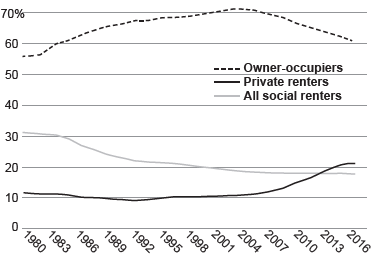
Comment 1 – (…) the proportion of the population living in their own home has gone into decline. It peaked around the middle of the last decade, at just over 70 per cent.
Comment 2 – Owner occupiers spend an average of 18 per cent on their mortgage. That average may be misleading – those who’ve paid off their mortgage will be zilch. At least they’re building up an asset.
Comment 3 – The proportion in council homes has fallen too, thanks largely to Right to Buy. As a result, the proportion renting their own home has more than doubled in the last two decades, from under 10 per cent to over 20.
Comment 4 – (…) housing which costs more than 30 per cent of your income should count as unaffordable. This is a problem faced overwhelmingly by young renters.
Comment 5 – Soon, the rates of the population living in their own home will be back under 60 per cent, for the first time since the mid 1980s.
Adapted from: http://www.citymetric.com/politics/british-housing-crisis-five-charts
Read these assertions.
I. The word “living”, in the context of comment 1, plays the same grammatical function as in How do young people make a living in London?
II. If the grammatical structure “may be misleading” (comment 2) were in reported speech, it would be: The expert said that average might mislead.
III. By reading comment 3, one can say that some people who had the opportunity to buy their houses from the council are now renting them to others.
IV. “(…) should count as unaffordable”. (comment 4) means are to be considered financially unfeasible.
V. By reading comment 5, one can say that the population living in their own home did not reach 60 per cent in the mid 1980s.
The correct assertions are only
INSTRUÇÃO: Responder à questão com base no texto , que apresenta comentários de especialistas sobre o gráfico.
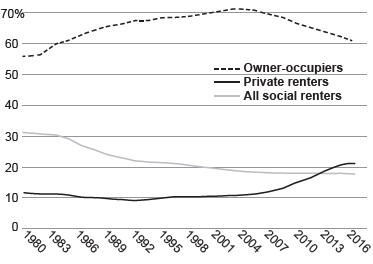
Comment 1 – (…) the proportion of the population living in their own home has gone into decline. It peaked around the middle of the last decade, at just over 70 per cent.
Comment 2 – Owner occupiers spend an average of 18 per cent on their mortgage. That average may be misleading – those who’ve paid off their mortgage will be zilch. At least they’re building up an asset.
Comment 3 – The proportion in council homes has fallen too, thanks largely to Right to Buy. As a result, the proportion renting their own home has more than doubled in the last two decades, from under 10 per cent to over 20.
Comment 4 – (…) housing which costs more than 30 per cent of your income should count as unaffordable. This is a problem faced overwhelmingly by young renters.
Comment 5 – Soon, the rates of the population living in their own home will be back under 60 per cent, for the first time since the mid 1980s.
Adapted from: http://www.citymetric.com/politics/british-housing-crisis-five-charts
The comments conveying ideas that have a representation on the graph are only
INSTRUÇÃO: Responder à questão com base no texto.


Adapted from: https://www.theguardian.com/uk-news/2015/
jun/28/london-the-city-that-ate-itself-rowan-moore
Read paragraph 6 and mark the following sentences T (true) or F (false).
( ) Scots used to see Middlesbrough and Ipswich as Tony Travers did.
( ) The SNP and Ukip despise London’s decision power.
( ) Alex Salmond and Tony Travers do not share the same opinion.
( ) The author thinks that not all views are concerned about how much London is eating itself.
Choose the alternative that presents the correct answers, from top to bottom, for the sentences above.
INSTRUÇÃO: Responder à questão com base no texto.
Adapted from: https://www.theguardian.com/uk-news/2015/
jun/28/london-the-city-that-ate-itself-rowan-moore
INSTRUÇÃO: Responder à questão com base no texto.
Adapted from: https://www.theguardian.com/uk-news/2015/
jun/28/london-the-city-that-ate-itself-rowan-moore
INSTRUÇÃO: Responder à questão com base no texto.
Adapted from: https://www.theguardian.com/uk-news/2015/
jun/28/london-the-city-that-ate-itself-rowan-moore

 Conheça nossos planos