Questões de Vestibular
Sobre pronome objetivo | objective pronoun em inglês
Foram encontradas 10 questões


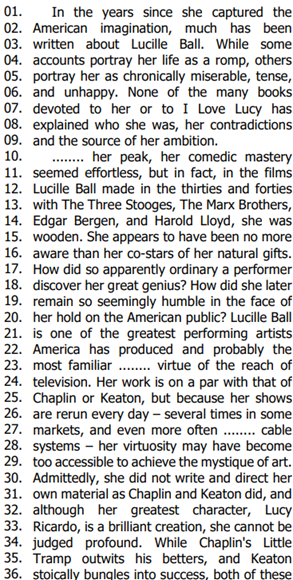
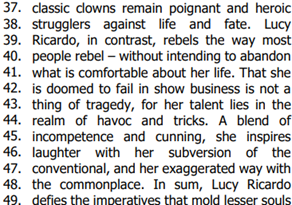
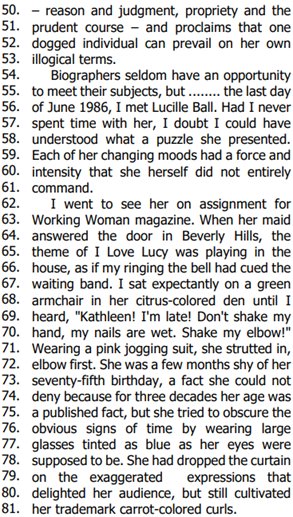
( ) As palavras she (l. 01), she (l. 45), her (l. 57) e herself (l. 60) têm o mesmo referente.
( ) A palavra did (l. 30) substitui o segmento direct her own material (l. 30-31), evitando portanto a repetição desse segmento.
( ) O pronome his (l. 35) refere-se a Chaplin’s Little Tramp (l. 34-35).
( ) O segmento reason and judgment, propriety and the prudent course (l. 50-51) é um aposto que se refere à palavra imperatives (l. 49).
A sequência correta de preenchimento dos parênteses, de cima para baixo, é
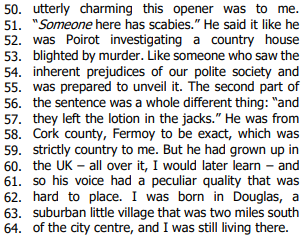
Adaptado de: O’DONOGHUE, C. The Rachel Incident. New York: Knopf Publishing Group, 2023. p. 10-11.
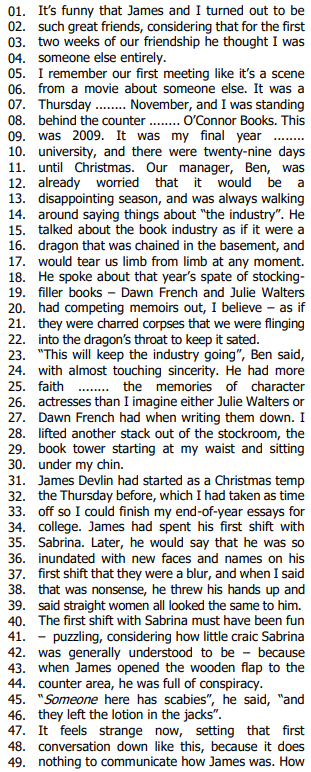
I - Substituição de like it’s (l. 05) por as if it were.
II - Substituição de he would say (l. 35) por he used to saying.
III- Substituição de it (l. 55) por them.
Quais resultariam gramaticalmente corretas, se aplicadas ao texto?
TEXT II
Avicenna, Arabic Ibn Sīnā, (born 980, near Bukhara, Iran [now in Uzbekistan]—died 1037, Hamadan, Iran), Muslim physician, the most famous and influential of the philosopher-scientists of the medieval Islamic world. He was particularly noted for his contributions in the fields of Aristotelian philosophy and medicine. He composed the Book of the Cure, a vast philosophical and scientific encyclopaedia, and The Canon of Medicine, which is among the most famous books in the history of medicine.
Avicenna did not burst upon an empty Islamic intellectual stage. It is believed that Muslim writer Ibn al-Muqaffaʿ, or possibly his son, had introduced Aristotelian logic to the Islamic world more than two centuries before Avicenna. Al-Kindī, the first Islamic Peripatetic (Aristotelian) philosopher, and Turkish polymath al-Fārābī, from whose book Avicenna would learn Aristotle’s metaphysics, preceded him. Of these luminaries, however, Avicenna remains by far the greatest.
Adapted from https://www.britannica.com/biography/Avicenna
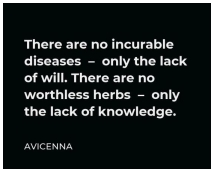
Here is one of his sayings:
Text 1
What is Distance Learning and Why Is It So Important?


A TOOL FOR SPIES
When Iran’s opposition protesters used Twitter and other forms of social media last year to let the world know about their regime’s brutal post election crackdown, activists praised Twitter as the tool of revolution and freedom. But now Venezuelan President Hugo Chávez has figured out how to twist this tool into one of repression. Though as recently as this past January Chávez was decrying Twitter as a weapon of terrorists, he’s since turned into an avid Twitterer himself ( his account, the country’s most popular, boasted more than half a million followers at press time ), as well as a devoted Facebook user and blogger.
Far from embracing the democratic spirit of the Web, though, the Venezuelan strongman is using his accounts and blog to exhort people to spy on each other. At the launch of his Twitter account, Chávez enjoined the Boliviarian faithful to use it to keep an eye on state enemies, namely the wealthy. My Twitter account is open for you to denounce them, “ Chávez announced on his television program. El Presidente has hired a staff of 200 to deal with tweeted “requests, denunciations, and other problems,” which have resulted in actions against allegedly credit-stingy banks and currency speculators. He’s now considering going a step further and ruling that all Venezuelan Web sites must move from U.S.- based servers to domestic ones - which would, of course, make them far easier to control. Big Brother would be proud.
(Newsweek – June 14, 2010. By Mac Margolis and Alex Marin)

 Conheça nossos planos