Questões de Vestibular Sobre presente simples | simple present em inglês

Foram encontradas 33 questões

Ano: 2015 Banca: PUC - RS Órgão: PUC - RS Prova: PUC - RS - 2015 - PUC - RS - Vestibular - Segundo Semestre 2º dia |
Q535526 Inglês

INSTRUCTION: Answer question  according to text 2.


Fill in the gaps with the suitable sequence of verbs.
Alternativas
Ano: 2014 Banca: UniCEUB Órgão: UniCEUB Prova: UniCEUB - 2014 - UniCEUB - Vestibular - 1º Vestibular |
Q515706 Inglês
A rise in temperature in the semi-arid region of Brazil has left rivers dry and cattle dying of thirst. The search is on for initiatives to combat desertification.

                                                                                                                                          Guardian Professional

The underlined words in the passage represent the
Alternativas
Ano: 2014 Banca: UniCEUB Órgão: UniCEUB Prova: UniCEUB - 2014 - UniCEUB - Vestibular - 1º Vestibular |
Q515705 Inglês
President Obama has outlined a slimmer version of the NSA program that ................... data from millions of Americans’ phone calls in a proposal that ................... phone companies to hold the records, but mandates law enforcement to win a secretive court’s approval to search them.

                                                                                                                                                                              TIME
Alternativas
Ano: 2014 Banca: UniCEUB Órgão: UniCEUB Prova: UniCEUB - 2014 - UniCEUB - Vestibular - 1º Vestibular |
Q515702 Inglês
On the hunt for a good read? Try a new romance

Dark Deeds by Anne Marie Becker. Book 4, Mindhunters. Walking away from sexy Detective Diego Sandoval ................... one of ................... things security specialist Becca Haney ever had to do, but when he’s assigned to help keep her safe from a human trafficking ring and an admirer ................... only as “the Fan,”, he’s determined to stay by her side and learn about the woman behind the passion – scars and all.

                                                                                                                                    USA TODAY
Alternativas
Ano: 2014 Banca: VUNESP Órgão: UEA Prova: VUNESP - 2014 - UEA - Vestibular |
Q466660 Inglês
Leia o texto para responder à questão.

       Mr. Day was a teacher at a school in a big city in the north of England. He usually went to France or Germany for a few weeks during his summer holidays, and he spoke French and German quite well.
       But one year Mr. Day said to one of his friends, “I’m going to have a holiday in Athens. But I don’t speak Greek, so I’ll go to evening classes and have Greek lessons for a
month before I go.”
       He studied very hard for a month, and then 10 holidays began and he went to Greece.
       When he came back a few weeks later, his friend said to him, “Did you have any trouble with your Greek when you were in Athens, Dick?”
       “No, I didn’t have any trouble with it,” answered Mr. Day. “But the Greeks did!”

                                          (L. A. Hill. Elementary Stories for Reproduction, 1977.)

A primeira frase do texto poderia ser expressa no presente, sem alterar o sentido do texto, como
Alternativas
Ano: 2013 Banca: UECE-CEV Órgão: UECE Prova: UECE-CEV - 2013 - UECE - Vestibular - Inglês - 1º Dia |
Q1261831 Inglês
TEXT
   
   HARVARD BUSINESS REVIEW calls data science “the sexiest job in the 21st century,” and by most accounts this hot new field promises to revolutionize industries from business to government, health care to academia. 
   The field has been spawned by the enormous amounts of data that modern technologies create — be it the online behavior of Facebook users, tissue samples of cancer patients, purchasing habits of grocery shoppers or crime statistics of cities. Data scientists are the magicians of the Big Data era. They crunch the data, use mathematical models to analyze it and create narratives or visualizations to explain it, then suggest how to use the information to make decisions. 
     In the last few years, dozens of programs under a variety of names have sprung up in response to the excitement about Big Data, not to mention the six-figure salaries for some recent graduates. In the fall, Columbia will offer new master’s and certificate programs heavy on data. The University of San Francisco will soon graduate its charter class of students with a master’s in analytics.
      Rachel Schutt, a senior research scientist at Johnson Research Labs, taught “Introduction to Data Science” last semester at Columbia (its first course with “data science” in the title). She described the data scientist this way: “a hybrid computer scientist software engineer statistician.” And added: “The best tend to be really curious people, thinkers who ask good questions and are O.K. dealing with unstructured situations and trying to find structure in them.”
      Eurry Kim, a 30-year-old “wannabe data scientist,” is studying at Columbia for a master’s in quantitative methods in the social sciences and plans to use her degree for government service. She discovered the possibilities while working as a corporate tax analyst at the Internal Revenue Service. She might, for example, analyze tax return data to develop algorithms that flag fraudulent filings, or cull national security databases to spot suspicious activity.
     Some of her classmates are hoping to apply their skills to e-commerce, where data about users’ browsing history is gold.
     “This is a generation of kids that grew up with data science around them — Netflix telling them what movies they should watch, Amazon telling them what books they should read — so this is an academic interest with real-world applications,” said Chris Wiggins, a professor of applied mathematics at Columbia who is involved in its new Institute for Data Sciences and Engineering. “And,” he added, “they know it will make them employable.”
  Universities can hardly turn out data scientists fast enough. To meet demand from employers, the United States will need to increase the number of graduates with skills handling large amounts of data by as much as 60 percent, according to a report by McKinsey Global Institute. There will be almost half a million jobs in five years, and a shortage of up to 190,000 qualified data scientists, plus a need for 1.5 million executives and support staff who have an understanding of data.
      Because data science is so new, universities are scrambling to define it and develop curriculums. As an academic field, it cuts across disciplines, with courses in statistics, analytics, computer science and math, coupled with the specialty a student wants to analyze, from patterns in marine life to historical texts.
    With the sheer volume, variety and speed of data today, as well as developing technologies, programs are more than a repackaging of existing courses. “Data science is emerging as an academic discipline, defined not by a mere amalgamation of interdisciplinary fields but as a body of knowledge, a set of professional practices, a professional organization and a set of ethical responsibilities,” said Christopher Starr, chairman of the computer science department at the College of Charleston, one of a few institutions offering data science at the undergraduate level.
     Most master’s degree programs in data science require basic programming skills. They start with what Ms. Schutt describes as the “boring” part — scraping and cleaning raw data and “getting it into a nice table where you can actually analyze it.” Many use data sets provided by businesses or government, and pass back their results. Some host competitions to see which student can come up with the best solution to a company’s problem.
     Studying a Web user’s data has privacy implications. Using data to decide someone’s eligibility for a line of credit or health insurance, or even recommending who they friend on Facebook, can affect their lives. “We’re building these models that have impact on human life,” Ms. Schutt said. “How can we do that carefully?” Ethics classes address these questions.
       Finally, students have to learn to communicate their findings, visually and orally, and they need business know-how, perhaps to develop new products.

From: www.nytimes.com
In terms of verb tense, the sentences “Rachel Schutt, a senior research scientist at Johnson Research Labs, taught ‘Introduction to Data Science’ last semester at Columbia.”, “In the last few years, dozens of programs under a variety of names have sprung up in response to the excitement about Big Data.” and “Most master’s degree programs in data science require basic programming skills.” are, respectively, in the
Alternativas
Ano: 2012 Banca: UEM Órgão: UEM Prova: UEM - 2012 - UEM - Vestibular - PAS - Etapa 1 - Inglês |
Q1364280 Inglês

Texto

Human Rights

BBC Learning English News Word
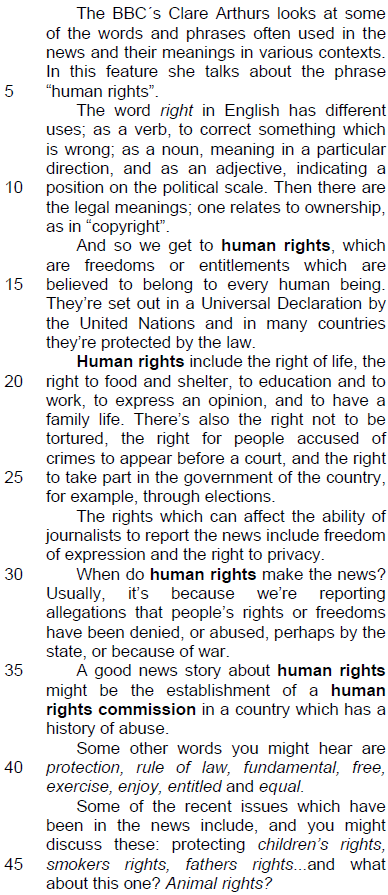

(Texto adaptado. Disponível em: http://downloads.bbc.co.uk/worldservice/learningenglish/n ewswords/100211_nw_human_rights_text.pdf Acessado em: 16/05/2012) 

Concerning the vocabulary in the text, it is correct to affirm that


the words, “relates” (line 11), “include” (line 19) and “issues” (line 42) are verbs in the present tense.

Alternativas
Ano: 2012 Banca: UECE-CEV Órgão: UECE Prova: UECE-CEV - 2012 - UECE - Vestibular - Língua Inglesa - 1º Dia - 2ª fase |
Q1278816 Inglês
T E X T 

    SPEAKING two languages rather than just one has obvious practical benefits in an increasingly globalized world. But in recent years, scientists have begun to show that the advantages of bilingualism are even more fundamental than being able to converse with a wider range of people. Being bilingual, it turns out, makes you smarter. It can have a profound effect on your brain, improving cognitive skills not related to language and even shielding against dementia in old age. 

     This view of bilingualism is remarkably different from the understanding of bilingualism through much of the 20th century. Researchers, educators and policy makers long considered a second language to be an interference, cognitively speaking, that hindered a child’s academic and intellectual development. 
    They were not wrong about the interference: there is ample evidence that in a bilingual’s brain both language systems are active even when he is using only one language, thus creating situations in which one system obstructs the other. But this interference, researchers are finding out, isn’t so much a handicap as a blessing in disguise. It forces the brain to resolve internal conflict, giving the mind a workout that strengthens its cognitive muscles. 
    Bilinguals, for instance, seem to be more adept than monolinguals at solving certain kinds of mental puzzles. In a 2004 study by the psychologists Ellen Bialystok and Michelle MartinRhee, bilingual and monolingual preschoolers were asked to sort blue circles and red squares presented on a computer screen into two digital bins — one marked with a blue square and the other marked with a red circle. 
    In the first task, the children had to sort the shapes by color, placing blue circles in the bin marked with the blue square and red squares in the bin marked with the red circle. Both groups did this with comparable ease. Next, the children were asked to sort by shape, which was more challenging because it required placing the images in a bin marked with a conflicting color. The bilinguals were quicker at performing this task. 
    The collective evidence from a number of such studies suggests that the bilingual experience improves the brain’s so-called executive function — a command system that directs the attention processes that we use for planning, solving problems and performing various other mentally demanding tasks. These processes include ignoring distractions to stay focused, switching attention willfully from one thing to another and holding information in mind — like remembering a sequence of directions while driving.
    Why does the tussle between two simultaneously active language systems improve these aspects of cognition? Until recently, researchers thought the bilingual advantage stemmed primarily from an ability for inhibition that was honed by the exercise of suppressing one language system: this suppression, it was thought, would help train the bilingual mind to ignore distractions in other contexts. But that explanation increasingly appears to be inadequate, since studies have shown that bilinguals perform better than monolinguals even at tasks that do not require inhibition, like threading a line through an ascending series of numbers scattered randomly on a page.
    The key difference between bilinguals and monolinguals may be more basic: a heightened ability to monitor the environment. “Bilinguals have to switch languages quite often — you may talk to your father in one language and to your mother in another language,” says Albert Costa, a researcher at the University of PompeuFabra in Spain. “It requires keeping track of changes around you in the same way that we monitor our surroundings when driving.” In a study comparing German-Italian bilinguals with Italian monolinguals on monitoring tasks, Mr. Costa and his colleagues found that the bilingual subjects not only performed better, but they also did so with less activity in parts of the brain involved in monitoring, indicating that they were more efficient at it. 
    The bilingual experience appears to influence the brain from infancy to old age (and there is reason to believe that it may also apply to those who learn a second language later in life). 
    In a 2009 study led by Agnes Kovacs of the International School for Advanced Studies in Trieste, Italy, 7-month-old babies exposed to two languages from birth were compared with peers raised with one language. In an initial set of trials, the infants were presented with an audio cue and then shown a puppet on one side of a screen. Both infant groups learned to look at that side of the screen in anticipation of the puppet. But in a later set of trials, when the puppet began appearing on the opposite side of the screen, the babies exposed to a bilingual environment quickly learned to switch their anticipatory gaze in the new direction while the other babies did not. 
    Bilingualism’s effects also extend into the twilight years. In a recent study of 44 elderly Spanish-English bilinguals, scientists led by the neuropsychologist Tamar Gollan of the University of California, San Diego, found that individuals with a higher degree of bilingualism — measured through a comparative evaluation of proficiency in each language — were more resistant than others to the onset of dementia and other symptoms of Alzheimer’s disease: the higher the degree of bilingualism, the later the age of onset.
    Nobody ever doubted the power of language. But who would have imagined that the words we hear and the sentences we speak might be leaving such a deep imprint? 

Source: www.nytimes.com

In the following question, some sentences from the text have been modified to fit certain grammatical structures. 
The verbs of the sentences “In the first task, the children sorted the shapes by color.”, “…since studies have shown that bilinguals…” and “Why does the tussle between two simultaneously active language systems improve these aspects of cognition?” are respectively in the
Alternativas
Ano: 2012 Banca: UERJ Órgão: UERJ Prova: UERJ - 2012 - UERJ - Vestibular - Segundo Exame |
Q828948 Inglês

The ideas expressed in a text might be perceived as true because of the choice and repetition of a specific tense.

The verb tense that makes the ideas in the text seem true is:

Alternativas
Ano: 2012 Banca: CEV-URCA Órgão: URCA Prova: CEV-URCA - 2012 - URCA - Vestibular - Prova 2 |
Q265534 Inglês
The sentences “…when he’s gone.”, “His edge lies in tempting the population…” and “his departure will leave a scar on the national psyche.” are, respectively in:

Alternativas
Ano: 2010 Banca: UECE-CEV Órgão: UECE Prova: UECE-CEV - 2010 - UECE - Vestibular - Inglês |
Q238886 Inglês
The extract “A community without a written literature expresses itself with less precision, with less richness of nuance, and with less clarity than a community whose principal instrument of communication, the word, has been cultivated and perfected by means of literary texts. … A person who does not read, or reads little, or reads only trash, is a person with an impediment: he can speak much but he will say little, because his vocabulary is deficient in the means for self-expression.” contains verbs in the following tenses (irrespective of the sequence)
Alternativas
Ano: 2010 Banca: UFAC Órgão: UFAC Prova: UFAC - 2010 - UFAC - Vestibular - Prova 1 |
Q222330 Inglês
Choose the alternative that best completes the sentence:

Charles normally ________ water, but now he ________ coke.
Alternativas
Ano: 2008 Banca: UNIR Órgão: UNIR Prova: UNIR - 2008 - UNIR - Vestibular - Primeira Fase |
Q1353993 Inglês
Strategic Spending on Organic Foods


Sweet bell peppers are among the vegetables high in pesticides. (Richard Drew/Associated Press)


(Extraído de http://well.blogs.nytimes.com/2008/04/18/strategic-spending-on-organic-foods. Acesso em 14/09/2008.)

A coluna da esquerda apresenta formas verbais utilizadas no texto e a da direita, os tempos correspondentes. Numere a coluna da direita de acordo com a da esquerda.


1 – was reading (linha 1)

2 – reminded me of (linha 1)

3 – is going to be (linha 12)

4 – there is (linha 4)


( ) Immediate Future

( ) Present Simple

( ) Past Continuous
( ) Past Simple


Assinale a seqüência correta.

Alternativas
Respostas
14: C
15: B
16: E
17: A
18: A
19: C
20: E
21: A
22: B
23: D
24: A
25: A
26: C
