Questões de Vestibular
Comentadas sobre aspectos linguísticos | linguistic aspects em inglês
Foram encontradas 77 questões


Except it’s neither: the billboard pictured here is real, it’s located in Lima, Peru, and it produces around 100 liters of water a day (about 26 gallons) from nothing more than humidity, a basic fltration system and a little gravitational ingenuity3 .
Let’s talk about Lima for a moment, the largest city in Peru and the ffth largest in all of the Americas, with some 7.6 million people (closer to 9 million when you factor in the surrounding metro area). Because it sits along the southern Pacifc Ocean, the humidity in the city averages 83% (it’s actually closer to 100% in the mornings). But Lima is also part of what’s called a coastal desert: it lies at the northern edge of the Atacama, the driest desert in the world, meaning the city sees perhaps half an inch of precipitation annually (Lima is the second largest desert city in the world after Cairo). Lima thus depends on drainage from the Andes as well as runof from glacier melt - both sources on the decline because of climate change. (...)
1Five Man Electrical Band: nome de um grupo de rock canadense.
2gimmick: algo que não é sério, usado para atrair a atenção das pessoas temporariamente, especialmente para fazê-las comprar algo.
3ingenuity: habilidade de pensar em novos meios inteligentes de se fazer algo.
A forma verbal gotta, presente ao fnal do primeiro parágrafo, é


As mensagens passadas nos cartuns visam satirizar comportamentos humanos e proporcionar uma reflexão sobre nossas atitudes. No cartum acima, a professora emite a frase Nw lts bgn, pls trn t pg 122, que está sem algumas letras, a fim de ganhar tempo. Tal frase, que se assemelha às expressões usadas em mensagens de texto, seria grafada em sua maneira completa da seguinte forma:
Read text 2 to answer question.
Text 2
For Obama, Big Rise in Poll Numbers After Bin Laden Raid
Support for President Obama has risen sharply following the killing of Osama bin Laden by American military forces in Pakistan. Support for the president rose significantly among both Republicans and independents.
Among independents, his approval rating increased 11 points from last month, to 52 percent, while among Republicans it rose 15 points, to 24 percent. Among Democrats, 86 percent supported his job performance, compared with 79 percent in April.
In all, 57 percent said they now approved of the president’s job performance, up from 46 percent last month. More than six in 10 Americans said that killing Bin Laden was likely to increase the threat of terrorism against the United States in the short term. Nearly half said the nation should decrease troop levels in Afghanistan, but more than six in 10 also said the United States had not completed its mission in Afghanistan.
Adapted from: The New York Times. Available in http://www.nytimes.com/2011/05/05/us/politics/05poll.html ?hp. Access on: May 04, 2011.
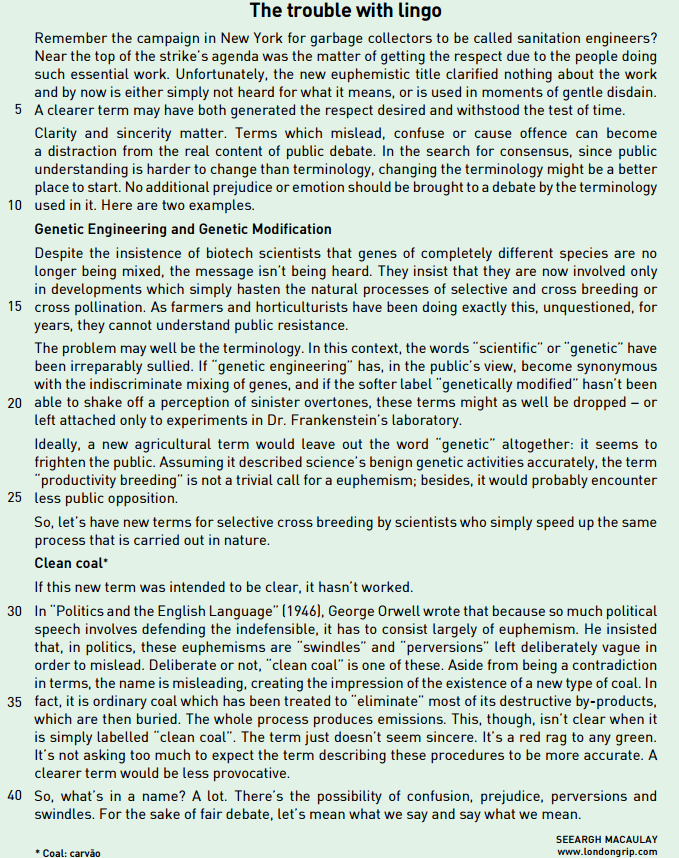
The fragments below share the question “What’s in a name?”:
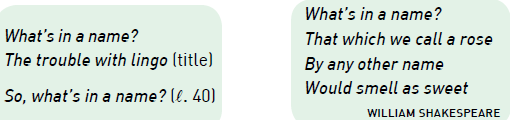
The author of the text uses a resource that consists of borrowing from another text, published beforehand.
This resource is called:
Text 3
What is a Computer?
Nowadays, in most modern societies, almost everybody has idea about what a computer is. We depend on computers in every aspect of our lives whether we know how to use one or not. But does everyone really know how a computer works inside?
A computer is an electronic machine which processes data and provides the results of the processing as information. There are three basic steps in the computing process. The first one is input, which consists of feeding data into the computer’s memory. Then comes the processing: the program is run and the computer processes the data by performing a set of instructions. The third and final step is the output furnished by the computer, which allows the user to see the results either in printed form or on the screen.
The world of computers has created a specific language of its own. English words such as software and hardware are used worldwide and have been borrowed by many different languages. Software is information in the form of data and programs, and hardware refers to the electronic and mechanical parts that make up a computer system.
Despite the constant presence of computers in most modern societies, it is a great mistake to believe that everybody in the world is computerliterate, i.e., is familiar with computers and knows how to use them properly. In some contemporary societies, many people still have no idea about the existence of computers, and even in the so-called developed countries, there are lots of people who do not know or do not care about what a computer is.
Inglês.com.textos para informática, p. 25, 2001
Text 2
Because of the bright lights of the modern cities, when we look up at the sky we can see no more than 100 stars. But from dark parts of the Earth, the naked eye can see more than 5,000! And modern telescopes tell a very different story.
With the help of some of the world’s most powerful instruments to measure the brightness of all the galaxies in one sector of the cosmos, Australian astronomers say it is probable that there are 70 sextillion stars in the visible Universe. In other words and numbers, seven followed by 22 zeroes, a really astronomical figure.
That is more than the total number of grains of sand in all the world’s beaches and deserts, and that is only the visible Universe within range of our telescopes.
Dr. Simon Driver, of the Australian National University, has a theory that some of them probably have life. Dr. Driver’s theory is not exactly new, and those planets are so distant, he says, that there is no real possibility for us to see or contact anyone living on them.
Retirado do livro “Inglês série Brasil”, p. 8, 2008
Text 1
NEWSWEEK Remembers Paul the Octopus
Less than six months ago, Paul the Octopus catapulted from a life of obscurity to worldwide fame. Now, Paul has died, at the ripe old octopus age of two.
A common octopus living at the Sea Life Center in Oberhausen, Germany, Paul was able to correctly predict the winner of all Germany's World Cup matches. Prior to the matches, Paul was given two boxes of food, identical except for the flags of the competing teams. The team represented on the box Paul chose to eat from inevitably won the match. His picking prowess made him an international star.
Here at NEWSWEEK, we were just as taken with Paul as was the rest of the news media, and in an attempt to get inside his cephalopodial head, we sought out prestigious pet psychic Catherine Ferguson. In honor of Paul, we present that video yet again. Rest in peace, Paul the Octopus.
Newsweek, October 28th, 2010
Analyze the following statements:
I. “Catapulted from” (line 2) can be understood as “saiu de”.
II. The sentence “Paul has died” (line 3) is in the simple past.
III. In the expressions “Sea Life Center” (line 5 and 6) and “Germany's World Cup matches” (lines 7 and 8), the expressions “Sea Life” and “Germany’s World Cup” are modifiers.
IV. The words “inevitably” and “correctly” are formed by the suffix –ly, and are adjectives.
Mark the correct alternative:
You Can Blame the Bugs
The West epitomizes individualistic, do-your-own-thing cultures, ones where the rights of the individual equal and often trump those of the group and where differences are valued. East Asian societies exalt the larger society; behavior is constrained by social roles, conformity is prized, outsiders shunned. […] But the reason a society falls where it does on the individualism-collectivism spectrum has been pretty much a mystery. Now a team of researchers has come up with a surprising explanation: disease-causing microbes. Societies that evolved in places with an abundance of pathogens, they argue, had to adopt behaviors that add up to collectivism, for reasons of sheer preservation. Societies that arose in places with fewer pathogens had the luxury of individualism, which is less effective at limiting the spread of disease but brings with it other social benefits, such as innovation. […]
Written in March
The cock is crowing,
TEXTO I
Little Boy: What does your Daddy do?
Little Girl: Whatever my Momma tells him.
(JANSSEN, Arlo T. International Stories.
New Jersey: Prentice-Hall, 1981.)
TEXTO II
George: Which candidate is your wife going to vote for?
Herman: Oh, she’ll vote for the same one I do.
George: Which one is that? Herman: I don’t know yet. She’s going to tell me
tomorrow.
(JANSSEN, Arlo T. International Stories.
New Jersey: Prentice-Hall, 1981.)

 Conheça nossos planos