Questões de Vestibular
Sobre análise sintática | syntax parsing em inglês
Foram encontradas 143 questões


An increasing body of evidence suggests that the time we spend on our smartphones is interfering with our sleep, self-esteem, relationships, memory, attention spans, creativity, productivity and problem-solving and decision-making skills. But there is another reason for us to rethink our relationships with our devices. By chronically raising levels of cortisol, the body’s main stress hormone, our phones may be threatening our health and shortening our lives.
If they happened only occasionally, phone-induced cortisol spikes might not matter. But the average American spends four hours a day staring at their smartphone and keeps it within arm’s reach nearly all the time, according to a tracking app called Moment.
“Your cortisol levels are elevated when your phone is in sight or nearby, or when you hear it or even think you hear it,” says David Greenfield, professor of clinical psychiatry at the University of Connecticut School of Medicine and founder of the Center for Internet and Technology Addiction. “It’s a stress response, and it feels unpleasant, and the body’s natural response is to want to check the phone to make the stress go away.”
But while doing so might soothe you for a second, it probably will make things worse in the long run. Any time you check your phone, you’re likely to find something else stressful waiting for you, leading to another spike in cortisol and another craving to check your phone to make your anxiety go away. This cycle, when continuously reinforced, leads to chronically elevated cortisol levels. And chronically elevated cortisol levels have been tied to an increased risk of serious health problems, including depression, obesity, metabolic syndrome, Type 2 diabetes, fertility issues, high blood pressure, heart attack, dementia and stroke.
(Catherine Price. www.nytimes.com, 24.04.2019. Adaptado.)
No trecho do primeiro parágrafo “But there is another reason for us to rethink our relationships with our devices”, o termo sublinhado introduz uma
TEXTO
The Future Of Work: 5 Important Ways Jobs
Will Change In The 4th Industrial Revolution


Fonte:
https://www.forbes.com/2019/07/15
TEXTO
The Future Of Work: 5 Important Ways Jobs
Will Change In The 4th Industrial Revolution
Fonte:
https://www.forbes.com/2019/07/15
TEXTO
The Future Of Work: 5 Important Ways Jobs
Will Change In The 4th Industrial Revolution
Fonte:
https://www.forbes.com/2019/07/15
TEXTO
The Future Of Work: 5 Important Ways Jobs
Will Change In The 4th Industrial Revolution
Fonte:
https://www.forbes.com/2019/07/15
TEXTO
The Future Of Work: 5 Important Ways Jobs
Will Change In The 4th Industrial Revolution
Fonte:
https://www.forbes.com/2019/07/15
TEXTO
The Future Of Work: 5 Important Ways Jobs
Will Change In The 4th Industrial Revolution
Fonte:
https://www.forbes.com/2019/07/15
TEXTO
The Future Of Work: 5 Important Ways Jobs
Will Change In The 4th Industrial Revolution
Fonte:
https://www.forbes.com/2019/07/15
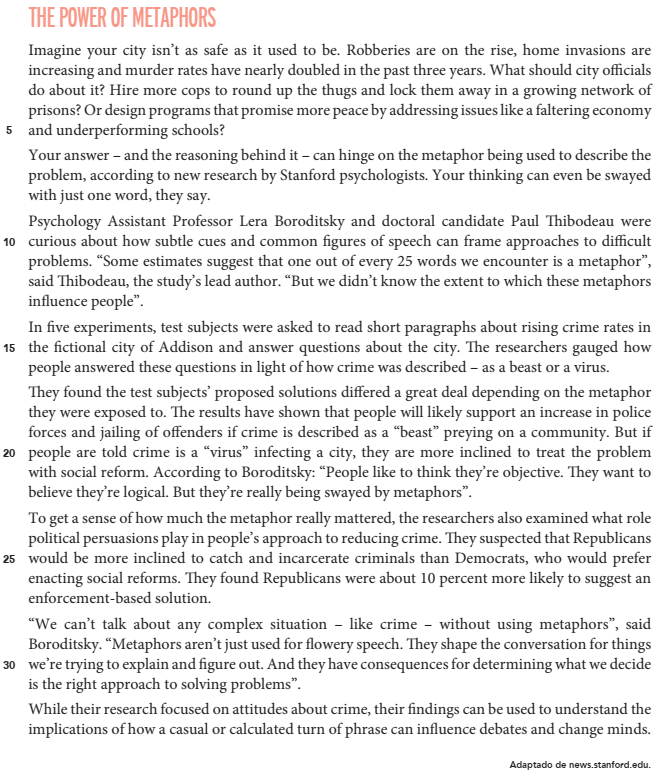
test subjects were asked to read short paragraphs (ℓ. 14)
The reason for the omission of the agent in the sentence above is:


How World Leaders Reacted to Trump at the U.N.
By SOMINI SENGUPTA and MEGAN SPECIA SEPT. 23, 2017
He was called a “giant gold Goliath” and a “rogue newcomer.” But in a few corners the remarks made by President Trump at the United Nations were described as “courageous” and “gratifying.”
Throughout the week, Mr. Trump’s first address to the General Assembly drew many direct and indirect swipes, from allies and rivals alike, and sparse support.
While the North Korean leader, Kim Jong-un, attacked Mr. Trump from afar — calling him a “dotard” in a statement on North Korean national television — others used their platforms at the United Nations to respond.
Some leaders were more subtle than others.
Robert Mugabe, Zimbabwe’s 93-year-old president, took aim at Mr. Trump during his own speech on Thursday. Mr. Mugabe mocked Mr. Trump as a “giant gold Goliath” and said other nations were “embarrassed if not frightened” by his statements about North Korea.
“Are we having a return of Goliath to our midst, who threatens the extinction of other countries?” Mr. Mugabe asked. Some responded with applause to his reference to the biblical character who threatened the Israelites before being slain by the young shepherd David, who would become king.
Mr. Mugabe then went on to address Mr. Trump directly, telling him to “blow your trumpet in a musical way towards the values of unity, peace, cooperation, togetherness and dialogue which we have always stood for.”
During his speech, Mr. Trump notably omitted any talk of climate change, seen as one of the most pressing issues for many world leaders.
Prime Minister Justin Trudeau of Canada received the longest applause during his General Assembly speech on Thursday after an implicit dig at Mr. Trump.
“There is no country on the planet that can walk away from the challenge and reality of climate change,” Mr. Trudeau said, referring to Mr. Trump’s plans to pull out of the Paris climate accord.
(Adapted from https://www.nytimes.com/2017/09/23/world/americas/world-leaders-trump-un.html?mcubz=0)
Texto 3

Dinner and a movie. A walk in a park after a picnic for two. They might not be original, but these are classic date ideas.
Do people your age go out on dates? Or are you more likely to hang out with a big group of people that includes people who are seeing each other exclusively?
In "The End of Courtship?" Alex Williams writes about Shani Silver, who recently waited to hear from the guy who had asked her on a "date" that evening: at 10 p.m., he texted to ask if she wanted to join him and "a bunch of friends from college" at the place where they were hanging out:
Turned off, she fired back a text message, politely declining. But in retrospect, she might have adjusted her expectations. "The word 'date‘ should almost be stricken from the dictionary," Ms. Silver said. "Dating culture has evolved to a cycle of text messages, each one requiring the code-breaking skills of a cold war spy to interpret."
"It‘s one step below a date, and one step above a high-five," she added. Dinner at a romantic new bistro? Forget it. Women in their 20s these days are lucky to get a last-minute text to tag along. Raised in the age of so-called "hookup culture," millennials — who are reaching an age where they are starting to think about settling down — are subverting the rules of courtship.
Instead of dinner and a movie, which seems as obsolete as a rotary phone, they rendezvous over phone texts, Facebook posts, instant messages and other "non-dates" that are leaving a generation confused about how to land a boyfriend or girlfriend.
"The new date is 'hanging out,' " said Denise Hewett, 24, an associate television producer in Manhattan, who is currently developing a show about this frustrating new romantic landscape. As one male friend recently told her: "I don‘t like to take girls out. I like to have them join in on what I‘m doing — going to an event, a concert."
(…) Relationship experts point to technology as another factor in the upending of dating culture.
Traditional courtship — picking up the telephone and asking someone on a date — required courage, strategic planning and a considerable investment of ego (by telephone, rejection stings). Not so with texting, e-mail, Twitter or other forms of "asynchronous communication," as techies call it. In the context of dating, it removes much of the need for charm; it‘s more like dropping a line in the water and hoping for a nibble.
"I‘ve seen men put more effort into finding a movie to watch on Netflix Instant than composing a coherent message to ask a woman out," said Anna Goldfarb, 34, an author and blogger in Moorestown, N.J. A typical, annoying query is the last-minute: "Is anything fun going on tonight?" (…)
BY SHANNON DOYNE Disponível em: https://mobile.nytimes.com/blogs/learning/2013/01/14/ is-the-date-a-thing-of-the-past/? Adaptado.
Observe o parágrafo 4: “Instead of dinner and a movie, which seems as obsolete as a rotary phone, they rendezvous over phone texts, Facebook posts, instant messages and other “non-dates” that are leaving a generation confused about how to land a boyfriend or girlfriend.”
As partes sublinhadas contêm, respectivamente,

 Conheça nossos planos