Questões de Vestibular
Comentadas sobre análise sintática | syntax parsing em inglês
Foram encontradas 61 questões


Leia o texto a seguir para responder à questão.
The voluminous literature dealing with the idea of human progress is decidedly a mixed bag. While some of these writings are impressive and even inspiring, many of them are superficial, perhaps even ridiculous, in their reiteration (especially during the nineteenth century) of the comforting prospect that every day in every way we are growing better and better.
This kind of foolishness is manifested especially in discussions of such matters as economic, political, and moral progress, and of progress in art. [...]
From time to time, there seems to be real and measurable improvement in these areas. At other times the opposite seems equally to be the case. Thus the fervent belief of writers like the French sociophilosopher Auguste Comte in the inevitability of progress in all fields of human endeavor must be viewed as insupportable. We cannot accept it any longer, even if we once thought it was true.
Progress in human knowledge is another matter. Here it is possible to argue cogently that progress is in the nature of things. “Not only does each individual progress from day to day”, wrote French philosopher, mathematician, and mystic Blaise Pascal, “but mankind as a whole constantly progresses... in proportion as the universe grows older.” The essence of man as a rational being, as a later historian would put it, is that he develops his potential capacities by accumulating the experience of past generations.
Just as in our individual lives we learn more and more from day to day and from year to year because we remember some at least of what we have learned and add our new knowledge to it, so in the history of the race the collective memory retains at least some knowledge from the past to which is added every new discovery.
The memories of individuals fail and the persons die, but the memory of the race is eternal, or at least it can be expected to endure as long as human beings continue to write books and read them, or — which becomes more and more common — store up their knowledge in other mediums for the use of future generations.
Fonte: VAN DOREN, Charles. A History of Knowledge: Past, Present and Future. New York: The Random House Publishing Group, 1991, p. XV–XVI.
This text refers to question
How to Stop Eating Sugar
By David Leonhardt
If you’re like most Americans, you eat more sugar than is good for you. But it’s entirely possible to eat less sugar without sacrificing much — if any — of the pleasures of eating. Surprising as it may sound, many people who have cut back on sugar say they find their new eating habits more pleasurable than their old ones. This guide will walk you through why sugar matters, how you can make smart food choices to reduce sugar consumption, and how you can keep your life sweet, even without so many sweets.
Here's why you eat more sugar than you realize, and why it's a problem. The first thing to know: Added sugars, of one kind or another, are almost everywhere in the modern diet. They’re in sandwich bread, chicken stock, pickles, salad dressing, crackers, yogurt and cereal, as well as in the obvious foods and drinks, like soda and desserts.
The biggest problem with added sweeteners is that they make it easy to overeat. They’re tasty and highly caloric but they often don’t make you feel full. Instead, they can trick you into wanting even more food. Because we’re surrounded by added sweeteners — in our kitchens, in restaurants, at schools and offices — most of us will eat too much of them unless we consciously set out to do otherwise.
It’s not an accident. The sugar industry has conducted an aggressive, decades-long campaign to blame the obesity epidemic on fats, not sugars. Fats, after all, seem as if they should cause obesity. Thanks partly to that campaign, sugar consumption soared in the United States even as people were trying to lose weight. But research increasingly indicates that an overabundance of simple carbohydrates, and sugar in particular, is the No. 1 problem in modern diets. Sugar is the driving force behind the diabetes and obesity epidemics. Fortunately, more people are realizing the harms of sugar and cutting back.
[...]
Changing your diet is hard. If your strategy involves thinking about sugar all the time — whenever you’re shopping or eating — you’ll likely fail. You’ll also be miserable in the process. It’s much more effective to come up with a few simple rules and habits that then become second nature. (One strategy to consider: Eliminate all added sugars for one month, and then add back only the ones you miss. It’s easier than it sounds.)
Above all, most people’s goal should be to find a few simple, lasting ways to cut back on sugar. Once you’re done reading this guide, we suggest you choose two or three of our ideas and try them for a few weeks.
https://www.nytimes.com/guides/smarterliving/how-to-stop-eating-sugar (text adapted)
The World Might Be Running Low on Americans
The world has been stricken by scarcity. Our post-pandemic pantry has run bare of gasoline, lumber, microchips, chicken wings, ketchup packets, cat food, used cars and Chickfil-A sauce. Like the Great Toilet Paper Scare of 2020, though, many of these shortages are the consequence of near-term, Covid-related disruptions. Soon enough there will again be a chicken wing in every pot and more than enough condiments to go with it.
But there is one recently announced potential shortage that should give Americans great reason for concern. It is a shortfall that the nation has rarely had to face, and nobody quite knows how things will work when we begin to run out.
I speak, of course, of all of us: The world may be running low on Americans — most crucially, tomorrow’s working-age, childbearing, idea-generating, community-building young Americans. Late last month, the Census Bureau released the first results from its 2020 count, and the numbers confirmed what demographers have been warning of for years: The United States is undergoing “demographic stagnation,” transitioning from a relatively fast-growing country of young people to a slow-growing, older nation.
Many Americans might consider slow growth a blessing. Your city could already be packed to the gills, the roads clogged with traffic and housing prices shooting through the roof. Why do we need more folks? And, anyway, aren’t we supposed to be conserving resources on a planet whose climate is changing? Yet demographic stagnation could bring its own high costs, among them a steady reduction in dynamism, productivity and a slowdown in national and individual prosperity, even a diminishment of global power.
And there is no real reason we have to endure such a transition, not even an environmental one. Even if your own city is packed like tinned fish, the U.S. overall can accommodate millions more people. Most of the counties in the U.S. are losing working-age adults; if these declines persist, local economies will falter, tax bases will dry up, and local governments will struggle to maintain services. Growth is not just an option but a necessity — it’s not just that we can afford to have more people, it may be that we can’t afford not to.
But how does a country get more people? There are two ways: Make them, and invite them in. Increasing the first is relatively difficult — birthrates are declining across the world, and while family-friendly policies may be beneficial for many reasons, they seem to do little to get people to have more babies. On the second method, though, the United States enjoys a significant advantage — people around the globe have long been clamoring to live here, notwithstanding our government’s recent hostility to foreigners. This fact presents a relatively simple policy solution to a vexing long-term issue: America needs more people, and the world has people to send us. All we have to do is let more of them in.
For decades, the United States has enjoyed a significant economic advantage over other industrialized nations — our population was growing faster, which suggested a more youthful and more prosperous future. But in the last decade, American fertility has gone down. At the same time, there has been a slowdown in immigration.
The Census Bureau’s latest numbers show that these trends are catching up with us. As of April 1, it reports that there were 331,449,281 residents in the United States, an increase of just 7.4 percent since 2010 — the second-smallest decade-long growth rate ever recorded, only slightly ahead of the 7.3 percent growth during the Depression-struck 1930s.
The bureau projects that sometime next decade — that is, in the 2030s — Americans over 65 will outnumber Americans younger than 18 for the first time in our history. The nation will cross the 400-million population mark sometime in the late 2050s, but by then we’ll be quite long in the tooth — about half of Americans will be over 45, and one fifth will be older than 85.
The idea that more people will lead to greater prosperity may sound counterintuitive — wouldn’t more people just consume more of our scarce resources? Human history generally refutes this simple intuition. Because more people usually make for more workers, more companies, and most fundamentally, more new ideas for pushing humanity forward, economic studies suggest that population growth is often an important catalyst of economic growth.
A declining global population might be beneficial in some ways; fewer people would most likely mean less carbon emission, for example — though less than you might think, since leading climate models already assume slowing population growth over the coming century. And a declining population could be catastrophic in other ways. In a recent paper, Chad Jones, an economist at Stanford, argues that a global population decline could reduce the fundamental innovativeness of humankind. The theory is simple: Without enough people, the font of new ideas dries up, Jones argues; without new ideas, progress could be imperiled.
There are more direct ways that slow growth can hurt us. As a country’s population grows heavy with retiring older people and light with working younger people, you get a problem of too many eaters and too few cooks. Programs for seniors like Social Security and Medicare may suffer as they become dependent on ever-fewer working taxpayers for funding. Another problem is the lack of people to do all the work. For instance, experts predict a major shortage of health care workers, especially home care workers, who will be needed to help the aging nation.
In a recent report, Ali Noorani, the chief executive of the National Immigration Forum, an immigration-advocacy group, and a co-author, Danilo Zak, say that increasing legal immigration by slightly more than a third each year would keep America’s ratio of working young people to retired old people stable over the next four decades.
As an immigrant myself, I have to confess I
find much of the demographic argument in favor
of greater immigration quite a bit too anodyne.
Immigrants bring a lot more to the United States
than simply working-age bodies for toiling in
pursuit of greater economic growth. I also believe
that the United States’ founding idea of universal
equality will never be fully realized until we
recognize that people outside our borders are as
worthy of our ideals as those here through an
accident of birth.
The World Might Be Running Low on Americans
The world has been stricken by scarcity. Our post-pandemic pantry has run bare of gasoline, lumber, microchips, chicken wings, ketchup packets, cat food, used cars and Chickfil-A sauce. Like the Great Toilet Paper Scare of 2020, though, many of these shortages are the consequence of near-term, Covid-related disruptions. Soon enough there will again be a chicken wing in every pot and more than enough condiments to go with it.
But there is one recently announced potential shortage that should give Americans great reason for concern. It is a shortfall that the nation has rarely had to face, and nobody quite knows how things will work when we begin to run out.
I speak, of course, of all of us: The world may be running low on Americans — most crucially, tomorrow’s working-age, childbearing, idea-generating, community-building young Americans. Late last month, the Census Bureau released the first results from its 2020 count, and the numbers confirmed what demographers have been warning of for years: The United States is undergoing “demographic stagnation,” transitioning from a relatively fast-growing country of young people to a slow-growing, older nation.
Many Americans might consider slow growth a blessing. Your city could already be packed to the gills, the roads clogged with traffic and housing prices shooting through the roof. Why do we need more folks? And, anyway, aren’t we supposed to be conserving resources on a planet whose climate is changing? Yet demographic stagnation could bring its own high costs, among them a steady reduction in dynamism, productivity and a slowdown in national and individual prosperity, even a diminishment of global power.
And there is no real reason we have to endure such a transition, not even an environmental one. Even if your own city is packed like tinned fish, the U.S. overall can accommodate millions more people. Most of the counties in the U.S. are losing working-age adults; if these declines persist, local economies will falter, tax bases will dry up, and local governments will struggle to maintain services. Growth is not just an option but a necessity — it’s not just that we can afford to have more people, it may be that we can’t afford not to.
But how does a country get more people? There are two ways: Make them, and invite them in. Increasing the first is relatively difficult — birthrates are declining across the world, and while family-friendly policies may be beneficial for many reasons, they seem to do little to get people to have more babies. On the second method, though, the United States enjoys a significant advantage — people around the globe have long been clamoring to live here, notwithstanding our government’s recent hostility to foreigners. This fact presents a relatively simple policy solution to a vexing long-term issue: America needs more people, and the world has people to send us. All we have to do is let more of them in.
For decades, the United States has enjoyed a significant economic advantage over other industrialized nations — our population was growing faster, which suggested a more youthful and more prosperous future. But in the last decade, American fertility has gone down. At the same time, there has been a slowdown in immigration.
The Census Bureau’s latest numbers show that these trends are catching up with us. As of April 1, it reports that there were 331,449,281 residents in the United States, an increase of just 7.4 percent since 2010 — the second-smallest decade-long growth rate ever recorded, only slightly ahead of the 7.3 percent growth during the Depression-struck 1930s.
The bureau projects that sometime next decade — that is, in the 2030s — Americans over 65 will outnumber Americans younger than 18 for the first time in our history. The nation will cross the 400-million population mark sometime in the late 2050s, but by then we’ll be quite long in the tooth — about half of Americans will be over 45, and one fifth will be older than 85.
The idea that more people will lead to greater prosperity may sound counterintuitive — wouldn’t more people just consume more of our scarce resources? Human history generally refutes this simple intuition. Because more people usually make for more workers, more companies, and most fundamentally, more new ideas for pushing humanity forward, economic studies suggest that population growth is often an important catalyst of economic growth.
A declining global population might be beneficial in some ways; fewer people would most likely mean less carbon emission, for example — though less than you might think, since leading climate models already assume slowing population growth over the coming century. And a declining population could be catastrophic in other ways. In a recent paper, Chad Jones, an economist at Stanford, argues that a global population decline could reduce the fundamental innovativeness of humankind. The theory is simple: Without enough people, the font of new ideas dries up, Jones argues; without new ideas, progress could be imperiled.
There are more direct ways that slow growth can hurt us. As a country’s population grows heavy with retiring older people and light with working younger people, you get a problem of too many eaters and too few cooks. Programs for seniors like Social Security and Medicare may suffer as they become dependent on ever-fewer working taxpayers for funding. Another problem is the lack of people to do all the work. For instance, experts predict a major shortage of health care workers, especially home care workers, who will be needed to help the aging nation.
In a recent report, Ali Noorani, the chief executive of the National Immigration Forum, an immigration-advocacy group, and a co-author, Danilo Zak, say that increasing legal immigration by slightly more than a third each year would keep America’s ratio of working young people to retired old people stable over the next four decades.
As an immigrant myself, I have to confess I
find much of the demographic argument in favor
of greater immigration quite a bit too anodyne.
Immigrants bring a lot more to the United States
than simply working-age bodies for toiling in
pursuit of greater economic growth. I also believe
that the United States’ founding idea of universal
equality will never be fully realized until we
recognize that people outside our borders are as
worthy of our ideals as those here through an
accident of birth.
The World Might Be Running Low on Americans
The world has been stricken by scarcity. Our post-pandemic pantry has run bare of gasoline, lumber, microchips, chicken wings, ketchup packets, cat food, used cars and Chickfil-A sauce. Like the Great Toilet Paper Scare of 2020, though, many of these shortages are the consequence of near-term, Covid-related disruptions. Soon enough there will again be a chicken wing in every pot and more than enough condiments to go with it.
But there is one recently announced potential shortage that should give Americans great reason for concern. It is a shortfall that the nation has rarely had to face, and nobody quite knows how things will work when we begin to run out.
I speak, of course, of all of us: The world may be running low on Americans — most crucially, tomorrow’s working-age, childbearing, idea-generating, community-building young Americans. Late last month, the Census Bureau released the first results from its 2020 count, and the numbers confirmed what demographers have been warning of for years: The United States is undergoing “demographic stagnation,” transitioning from a relatively fast-growing country of young people to a slow-growing, older nation.
Many Americans might consider slow growth a blessing. Your city could already be packed to the gills, the roads clogged with traffic and housing prices shooting through the roof. Why do we need more folks? And, anyway, aren’t we supposed to be conserving resources on a planet whose climate is changing? Yet demographic stagnation could bring its own high costs, among them a steady reduction in dynamism, productivity and a slowdown in national and individual prosperity, even a diminishment of global power.
And there is no real reason we have to endure such a transition, not even an environmental one. Even if your own city is packed like tinned fish, the U.S. overall can accommodate millions more people. Most of the counties in the U.S. are losing working-age adults; if these declines persist, local economies will falter, tax bases will dry up, and local governments will struggle to maintain services. Growth is not just an option but a necessity — it’s not just that we can afford to have more people, it may be that we can’t afford not to.
But how does a country get more people? There are two ways: Make them, and invite them in. Increasing the first is relatively difficult — birthrates are declining across the world, and while family-friendly policies may be beneficial for many reasons, they seem to do little to get people to have more babies. On the second method, though, the United States enjoys a significant advantage — people around the globe have long been clamoring to live here, notwithstanding our government’s recent hostility to foreigners. This fact presents a relatively simple policy solution to a vexing long-term issue: America needs more people, and the world has people to send us. All we have to do is let more of them in.
For decades, the United States has enjoyed a significant economic advantage over other industrialized nations — our population was growing faster, which suggested a more youthful and more prosperous future. But in the last decade, American fertility has gone down. At the same time, there has been a slowdown in immigration.
The Census Bureau’s latest numbers show that these trends are catching up with us. As of April 1, it reports that there were 331,449,281 residents in the United States, an increase of just 7.4 percent since 2010 — the second-smallest decade-long growth rate ever recorded, only slightly ahead of the 7.3 percent growth during the Depression-struck 1930s.
The bureau projects that sometime next decade — that is, in the 2030s — Americans over 65 will outnumber Americans younger than 18 for the first time in our history. The nation will cross the 400-million population mark sometime in the late 2050s, but by then we’ll be quite long in the tooth — about half of Americans will be over 45, and one fifth will be older than 85.
The idea that more people will lead to greater prosperity may sound counterintuitive — wouldn’t more people just consume more of our scarce resources? Human history generally refutes this simple intuition. Because more people usually make for more workers, more companies, and most fundamentally, more new ideas for pushing humanity forward, economic studies suggest that population growth is often an important catalyst of economic growth.
A declining global population might be beneficial in some ways; fewer people would most likely mean less carbon emission, for example — though less than you might think, since leading climate models already assume slowing population growth over the coming century. And a declining population could be catastrophic in other ways. In a recent paper, Chad Jones, an economist at Stanford, argues that a global population decline could reduce the fundamental innovativeness of humankind. The theory is simple: Without enough people, the font of new ideas dries up, Jones argues; without new ideas, progress could be imperiled.
There are more direct ways that slow growth can hurt us. As a country’s population grows heavy with retiring older people and light with working younger people, you get a problem of too many eaters and too few cooks. Programs for seniors like Social Security and Medicare may suffer as they become dependent on ever-fewer working taxpayers for funding. Another problem is the lack of people to do all the work. For instance, experts predict a major shortage of health care workers, especially home care workers, who will be needed to help the aging nation.
In a recent report, Ali Noorani, the chief executive of the National Immigration Forum, an immigration-advocacy group, and a co-author, Danilo Zak, say that increasing legal immigration by slightly more than a third each year would keep America’s ratio of working young people to retired old people stable over the next four decades.
As an immigrant myself, I have to confess I
find much of the demographic argument in favor
of greater immigration quite a bit too anodyne.
Immigrants bring a lot more to the United States
than simply working-age bodies for toiling in
pursuit of greater economic growth. I also believe
that the United States’ founding idea of universal
equality will never be fully realized until we
recognize that people outside our borders are as
worthy of our ideals as those here through an
accident of birth.
The World Might Be Running Low on Americans
The world has been stricken by scarcity. Our post-pandemic pantry has run bare of gasoline, lumber, microchips, chicken wings, ketchup packets, cat food, used cars and Chickfil-A sauce. Like the Great Toilet Paper Scare of 2020, though, many of these shortages are the consequence of near-term, Covid-related disruptions. Soon enough there will again be a chicken wing in every pot and more than enough condiments to go with it.
But there is one recently announced potential shortage that should give Americans great reason for concern. It is a shortfall that the nation has rarely had to face, and nobody quite knows how things will work when we begin to run out.
I speak, of course, of all of us: The world may be running low on Americans — most crucially, tomorrow’s working-age, childbearing, idea-generating, community-building young Americans. Late last month, the Census Bureau released the first results from its 2020 count, and the numbers confirmed what demographers have been warning of for years: The United States is undergoing “demographic stagnation,” transitioning from a relatively fast-growing country of young people to a slow-growing, older nation.
Many Americans might consider slow growth a blessing. Your city could already be packed to the gills, the roads clogged with traffic and housing prices shooting through the roof. Why do we need more folks? And, anyway, aren’t we supposed to be conserving resources on a planet whose climate is changing? Yet demographic stagnation could bring its own high costs, among them a steady reduction in dynamism, productivity and a slowdown in national and individual prosperity, even a diminishment of global power.
And there is no real reason we have to endure such a transition, not even an environmental one. Even if your own city is packed like tinned fish, the U.S. overall can accommodate millions more people. Most of the counties in the U.S. are losing working-age adults; if these declines persist, local economies will falter, tax bases will dry up, and local governments will struggle to maintain services. Growth is not just an option but a necessity — it’s not just that we can afford to have more people, it may be that we can’t afford not to.
But how does a country get more people? There are two ways: Make them, and invite them in. Increasing the first is relatively difficult — birthrates are declining across the world, and while family-friendly policies may be beneficial for many reasons, they seem to do little to get people to have more babies. On the second method, though, the United States enjoys a significant advantage — people around the globe have long been clamoring to live here, notwithstanding our government’s recent hostility to foreigners. This fact presents a relatively simple policy solution to a vexing long-term issue: America needs more people, and the world has people to send us. All we have to do is let more of them in.
For decades, the United States has enjoyed a significant economic advantage over other industrialized nations — our population was growing faster, which suggested a more youthful and more prosperous future. But in the last decade, American fertility has gone down. At the same time, there has been a slowdown in immigration.
The Census Bureau’s latest numbers show that these trends are catching up with us. As of April 1, it reports that there were 331,449,281 residents in the United States, an increase of just 7.4 percent since 2010 — the second-smallest decade-long growth rate ever recorded, only slightly ahead of the 7.3 percent growth during the Depression-struck 1930s.
The bureau projects that sometime next decade — that is, in the 2030s — Americans over 65 will outnumber Americans younger than 18 for the first time in our history. The nation will cross the 400-million population mark sometime in the late 2050s, but by then we’ll be quite long in the tooth — about half of Americans will be over 45, and one fifth will be older than 85.
The idea that more people will lead to greater prosperity may sound counterintuitive — wouldn’t more people just consume more of our scarce resources? Human history generally refutes this simple intuition. Because more people usually make for more workers, more companies, and most fundamentally, more new ideas for pushing humanity forward, economic studies suggest that population growth is often an important catalyst of economic growth.
A declining global population might be beneficial in some ways; fewer people would most likely mean less carbon emission, for example — though less than you might think, since leading climate models already assume slowing population growth over the coming century. And a declining population could be catastrophic in other ways. In a recent paper, Chad Jones, an economist at Stanford, argues that a global population decline could reduce the fundamental innovativeness of humankind. The theory is simple: Without enough people, the font of new ideas dries up, Jones argues; without new ideas, progress could be imperiled.
There are more direct ways that slow growth can hurt us. As a country’s population grows heavy with retiring older people and light with working younger people, you get a problem of too many eaters and too few cooks. Programs for seniors like Social Security and Medicare may suffer as they become dependent on ever-fewer working taxpayers for funding. Another problem is the lack of people to do all the work. For instance, experts predict a major shortage of health care workers, especially home care workers, who will be needed to help the aging nation.
In a recent report, Ali Noorani, the chief executive of the National Immigration Forum, an immigration-advocacy group, and a co-author, Danilo Zak, say that increasing legal immigration by slightly more than a third each year would keep America’s ratio of working young people to retired old people stable over the next four decades.
As an immigrant myself, I have to confess I
find much of the demographic argument in favor
of greater immigration quite a bit too anodyne.
Immigrants bring a lot more to the United States
than simply working-age bodies for toiling in
pursuit of greater economic growth. I also believe
that the United States’ founding idea of universal
equality will never be fully realized until we
recognize that people outside our borders are as
worthy of our ideals as those here through an
accident of birth.
The World Might Be Running Low on Americans
The world has been stricken by scarcity. Our post-pandemic pantry has run bare of gasoline, lumber, microchips, chicken wings, ketchup packets, cat food, used cars and Chickfil-A sauce. Like the Great Toilet Paper Scare of 2020, though, many of these shortages are the consequence of near-term, Covid-related disruptions. Soon enough there will again be a chicken wing in every pot and more than enough condiments to go with it.
But there is one recently announced potential shortage that should give Americans great reason for concern. It is a shortfall that the nation has rarely had to face, and nobody quite knows how things will work when we begin to run out.
I speak, of course, of all of us: The world may be running low on Americans — most crucially, tomorrow’s working-age, childbearing, idea-generating, community-building young Americans. Late last month, the Census Bureau released the first results from its 2020 count, and the numbers confirmed what demographers have been warning of for years: The United States is undergoing “demographic stagnation,” transitioning from a relatively fast-growing country of young people to a slow-growing, older nation.
Many Americans might consider slow growth a blessing. Your city could already be packed to the gills, the roads clogged with traffic and housing prices shooting through the roof. Why do we need more folks? And, anyway, aren’t we supposed to be conserving resources on a planet whose climate is changing? Yet demographic stagnation could bring its own high costs, among them a steady reduction in dynamism, productivity and a slowdown in national and individual prosperity, even a diminishment of global power.
And there is no real reason we have to endure such a transition, not even an environmental one. Even if your own city is packed like tinned fish, the U.S. overall can accommodate millions more people. Most of the counties in the U.S. are losing working-age adults; if these declines persist, local economies will falter, tax bases will dry up, and local governments will struggle to maintain services. Growth is not just an option but a necessity — it’s not just that we can afford to have more people, it may be that we can’t afford not to.
But how does a country get more people? There are two ways: Make them, and invite them in. Increasing the first is relatively difficult — birthrates are declining across the world, and while family-friendly policies may be beneficial for many reasons, they seem to do little to get people to have more babies. On the second method, though, the United States enjoys a significant advantage — people around the globe have long been clamoring to live here, notwithstanding our government’s recent hostility to foreigners. This fact presents a relatively simple policy solution to a vexing long-term issue: America needs more people, and the world has people to send us. All we have to do is let more of them in.
For decades, the United States has enjoyed a significant economic advantage over other industrialized nations — our population was growing faster, which suggested a more youthful and more prosperous future. But in the last decade, American fertility has gone down. At the same time, there has been a slowdown in immigration.
The Census Bureau’s latest numbers show that these trends are catching up with us. As of April 1, it reports that there were 331,449,281 residents in the United States, an increase of just 7.4 percent since 2010 — the second-smallest decade-long growth rate ever recorded, only slightly ahead of the 7.3 percent growth during the Depression-struck 1930s.
The bureau projects that sometime next decade — that is, in the 2030s — Americans over 65 will outnumber Americans younger than 18 for the first time in our history. The nation will cross the 400-million population mark sometime in the late 2050s, but by then we’ll be quite long in the tooth — about half of Americans will be over 45, and one fifth will be older than 85.
The idea that more people will lead to greater prosperity may sound counterintuitive — wouldn’t more people just consume more of our scarce resources? Human history generally refutes this simple intuition. Because more people usually make for more workers, more companies, and most fundamentally, more new ideas for pushing humanity forward, economic studies suggest that population growth is often an important catalyst of economic growth.
A declining global population might be beneficial in some ways; fewer people would most likely mean less carbon emission, for example — though less than you might think, since leading climate models already assume slowing population growth over the coming century. And a declining population could be catastrophic in other ways. In a recent paper, Chad Jones, an economist at Stanford, argues that a global population decline could reduce the fundamental innovativeness of humankind. The theory is simple: Without enough people, the font of new ideas dries up, Jones argues; without new ideas, progress could be imperiled.
There are more direct ways that slow growth can hurt us. As a country’s population grows heavy with retiring older people and light with working younger people, you get a problem of too many eaters and too few cooks. Programs for seniors like Social Security and Medicare may suffer as they become dependent on ever-fewer working taxpayers for funding. Another problem is the lack of people to do all the work. For instance, experts predict a major shortage of health care workers, especially home care workers, who will be needed to help the aging nation.
In a recent report, Ali Noorani, the chief executive of the National Immigration Forum, an immigration-advocacy group, and a co-author, Danilo Zak, say that increasing legal immigration by slightly more than a third each year would keep America’s ratio of working young people to retired old people stable over the next four decades.
As an immigrant myself, I have to confess I
find much of the demographic argument in favor
of greater immigration quite a bit too anodyne.
Immigrants bring a lot more to the United States
than simply working-age bodies for toiling in
pursuit of greater economic growth. I also believe
that the United States’ founding idea of universal
equality will never be fully realized until we
recognize that people outside our borders are as
worthy of our ideals as those here through an
accident of birth.
The World Might Be Running Low on Americans
The world has been stricken by scarcity. Our post-pandemic pantry has run bare of gasoline, lumber, microchips, chicken wings, ketchup packets, cat food, used cars and Chickfil-A sauce. Like the Great Toilet Paper Scare of 2020, though, many of these shortages are the consequence of near-term, Covid-related disruptions. Soon enough there will again be a chicken wing in every pot and more than enough condiments to go with it.
But there is one recently announced potential shortage that should give Americans great reason for concern. It is a shortfall that the nation has rarely had to face, and nobody quite knows how things will work when we begin to run out.
I speak, of course, of all of us: The world may be running low on Americans — most crucially, tomorrow’s working-age, childbearing, idea-generating, community-building young Americans. Late last month, the Census Bureau released the first results from its 2020 count, and the numbers confirmed what demographers have been warning of for years: The United States is undergoing “demographic stagnation,” transitioning from a relatively fast-growing country of young people to a slow-growing, older nation.
Many Americans might consider slow growth a blessing. Your city could already be packed to the gills, the roads clogged with traffic and housing prices shooting through the roof. Why do we need more folks? And, anyway, aren’t we supposed to be conserving resources on a planet whose climate is changing? Yet demographic stagnation could bring its own high costs, among them a steady reduction in dynamism, productivity and a slowdown in national and individual prosperity, even a diminishment of global power.
And there is no real reason we have to endure such a transition, not even an environmental one. Even if your own city is packed like tinned fish, the U.S. overall can accommodate millions more people. Most of the counties in the U.S. are losing working-age adults; if these declines persist, local economies will falter, tax bases will dry up, and local governments will struggle to maintain services. Growth is not just an option but a necessity — it’s not just that we can afford to have more people, it may be that we can’t afford not to.
But how does a country get more people? There are two ways: Make them, and invite them in. Increasing the first is relatively difficult — birthrates are declining across the world, and while family-friendly policies may be beneficial for many reasons, they seem to do little to get people to have more babies. On the second method, though, the United States enjoys a significant advantage — people around the globe have long been clamoring to live here, notwithstanding our government’s recent hostility to foreigners. This fact presents a relatively simple policy solution to a vexing long-term issue: America needs more people, and the world has people to send us. All we have to do is let more of them in.
For decades, the United States has enjoyed a significant economic advantage over other industrialized nations — our population was growing faster, which suggested a more youthful and more prosperous future. But in the last decade, American fertility has gone down. At the same time, there has been a slowdown in immigration.
The Census Bureau’s latest numbers show that these trends are catching up with us. As of April 1, it reports that there were 331,449,281 residents in the United States, an increase of just 7.4 percent since 2010 — the second-smallest decade-long growth rate ever recorded, only slightly ahead of the 7.3 percent growth during the Depression-struck 1930s.
The bureau projects that sometime next decade — that is, in the 2030s — Americans over 65 will outnumber Americans younger than 18 for the first time in our history. The nation will cross the 400-million population mark sometime in the late 2050s, but by then we’ll be quite long in the tooth — about half of Americans will be over 45, and one fifth will be older than 85.
The idea that more people will lead to greater prosperity may sound counterintuitive — wouldn’t more people just consume more of our scarce resources? Human history generally refutes this simple intuition. Because more people usually make for more workers, more companies, and most fundamentally, more new ideas for pushing humanity forward, economic studies suggest that population growth is often an important catalyst of economic growth.
A declining global population might be beneficial in some ways; fewer people would most likely mean less carbon emission, for example — though less than you might think, since leading climate models already assume slowing population growth over the coming century. And a declining population could be catastrophic in other ways. In a recent paper, Chad Jones, an economist at Stanford, argues that a global population decline could reduce the fundamental innovativeness of humankind. The theory is simple: Without enough people, the font of new ideas dries up, Jones argues; without new ideas, progress could be imperiled.
There are more direct ways that slow growth can hurt us. As a country’s population grows heavy with retiring older people and light with working younger people, you get a problem of too many eaters and too few cooks. Programs for seniors like Social Security and Medicare may suffer as they become dependent on ever-fewer working taxpayers for funding. Another problem is the lack of people to do all the work. For instance, experts predict a major shortage of health care workers, especially home care workers, who will be needed to help the aging nation.
In a recent report, Ali Noorani, the chief executive of the National Immigration Forum, an immigration-advocacy group, and a co-author, Danilo Zak, say that increasing legal immigration by slightly more than a third each year would keep America’s ratio of working young people to retired old people stable over the next four decades.
As an immigrant myself, I have to confess I
find much of the demographic argument in favor
of greater immigration quite a bit too anodyne.
Immigrants bring a lot more to the United States
than simply working-age bodies for toiling in
pursuit of greater economic growth. I also believe
that the United States’ founding idea of universal
equality will never be fully realized until we
recognize that people outside our borders are as
worthy of our ideals as those here through an
accident of birth.
The World Might Be Running Low on Americans
The world has been stricken by scarcity. Our post-pandemic pantry has run bare of gasoline, lumber, microchips, chicken wings, ketchup packets, cat food, used cars and Chickfil-A sauce. Like the Great Toilet Paper Scare of 2020, though, many of these shortages are the consequence of near-term, Covid-related disruptions. Soon enough there will again be a chicken wing in every pot and more than enough condiments to go with it.
But there is one recently announced potential shortage that should give Americans great reason for concern. It is a shortfall that the nation has rarely had to face, and nobody quite knows how things will work when we begin to run out.
I speak, of course, of all of us: The world may be running low on Americans — most crucially, tomorrow’s working-age, childbearing, idea-generating, community-building young Americans. Late last month, the Census Bureau released the first results from its 2020 count, and the numbers confirmed what demographers have been warning of for years: The United States is undergoing “demographic stagnation,” transitioning from a relatively fast-growing country of young people to a slow-growing, older nation.
Many Americans might consider slow growth a blessing. Your city could already be packed to the gills, the roads clogged with traffic and housing prices shooting through the roof. Why do we need more folks? And, anyway, aren’t we supposed to be conserving resources on a planet whose climate is changing? Yet demographic stagnation could bring its own high costs, among them a steady reduction in dynamism, productivity and a slowdown in national and individual prosperity, even a diminishment of global power.
And there is no real reason we have to endure such a transition, not even an environmental one. Even if your own city is packed like tinned fish, the U.S. overall can accommodate millions more people. Most of the counties in the U.S. are losing working-age adults; if these declines persist, local economies will falter, tax bases will dry up, and local governments will struggle to maintain services. Growth is not just an option but a necessity — it’s not just that we can afford to have more people, it may be that we can’t afford not to.
But how does a country get more people? There are two ways: Make them, and invite them in. Increasing the first is relatively difficult — birthrates are declining across the world, and while family-friendly policies may be beneficial for many reasons, they seem to do little to get people to have more babies. On the second method, though, the United States enjoys a significant advantage — people around the globe have long been clamoring to live here, notwithstanding our government’s recent hostility to foreigners. This fact presents a relatively simple policy solution to a vexing long-term issue: America needs more people, and the world has people to send us. All we have to do is let more of them in.
For decades, the United States has enjoyed a significant economic advantage over other industrialized nations — our population was growing faster, which suggested a more youthful and more prosperous future. But in the last decade, American fertility has gone down. At the same time, there has been a slowdown in immigration.
The Census Bureau’s latest numbers show that these trends are catching up with us. As of April 1, it reports that there were 331,449,281 residents in the United States, an increase of just 7.4 percent since 2010 — the second-smallest decade-long growth rate ever recorded, only slightly ahead of the 7.3 percent growth during the Depression-struck 1930s.
The bureau projects that sometime next decade — that is, in the 2030s — Americans over 65 will outnumber Americans younger than 18 for the first time in our history. The nation will cross the 400-million population mark sometime in the late 2050s, but by then we’ll be quite long in the tooth — about half of Americans will be over 45, and one fifth will be older than 85.
The idea that more people will lead to greater prosperity may sound counterintuitive — wouldn’t more people just consume more of our scarce resources? Human history generally refutes this simple intuition. Because more people usually make for more workers, more companies, and most fundamentally, more new ideas for pushing humanity forward, economic studies suggest that population growth is often an important catalyst of economic growth.
A declining global population might be beneficial in some ways; fewer people would most likely mean less carbon emission, for example — though less than you might think, since leading climate models already assume slowing population growth over the coming century. And a declining population could be catastrophic in other ways. In a recent paper, Chad Jones, an economist at Stanford, argues that a global population decline could reduce the fundamental innovativeness of humankind. The theory is simple: Without enough people, the font of new ideas dries up, Jones argues; without new ideas, progress could be imperiled.
There are more direct ways that slow growth can hurt us. As a country’s population grows heavy with retiring older people and light with working younger people, you get a problem of too many eaters and too few cooks. Programs for seniors like Social Security and Medicare may suffer as they become dependent on ever-fewer working taxpayers for funding. Another problem is the lack of people to do all the work. For instance, experts predict a major shortage of health care workers, especially home care workers, who will be needed to help the aging nation.
In a recent report, Ali Noorani, the chief executive of the National Immigration Forum, an immigration-advocacy group, and a co-author, Danilo Zak, say that increasing legal immigration by slightly more than a third each year would keep America’s ratio of working young people to retired old people stable over the next four decades.
As an immigrant myself, I have to confess I
find much of the demographic argument in favor
of greater immigration quite a bit too anodyne.
Immigrants bring a lot more to the United States
than simply working-age bodies for toiling in
pursuit of greater economic growth. I also believe
that the United States’ founding idea of universal
equality will never be fully realized until we
recognize that people outside our borders are as
worthy of our ideals as those here through an
accident of birth.
The World Might Be Running Low on Americans
The world has been stricken by scarcity. Our post-pandemic pantry has run bare of gasoline, lumber, microchips, chicken wings, ketchup packets, cat food, used cars and Chickfil-A sauce. Like the Great Toilet Paper Scare of 2020, though, many of these shortages are the consequence of near-term, Covid-related disruptions. Soon enough there will again be a chicken wing in every pot and more than enough condiments to go with it.
But there is one recently announced potential shortage that should give Americans great reason for concern. It is a shortfall that the nation has rarely had to face, and nobody quite knows how things will work when we begin to run out.
I speak, of course, of all of us: The world may be running low on Americans — most crucially, tomorrow’s working-age, childbearing, idea-generating, community-building young Americans. Late last month, the Census Bureau released the first results from its 2020 count, and the numbers confirmed what demographers have been warning of for years: The United States is undergoing “demographic stagnation,” transitioning from a relatively fast-growing country of young people to a slow-growing, older nation.
Many Americans might consider slow growth a blessing. Your city could already be packed to the gills, the roads clogged with traffic and housing prices shooting through the roof. Why do we need more folks? And, anyway, aren’t we supposed to be conserving resources on a planet whose climate is changing? Yet demographic stagnation could bring its own high costs, among them a steady reduction in dynamism, productivity and a slowdown in national and individual prosperity, even a diminishment of global power.
And there is no real reason we have to endure such a transition, not even an environmental one. Even if your own city is packed like tinned fish, the U.S. overall can accommodate millions more people. Most of the counties in the U.S. are losing working-age adults; if these declines persist, local economies will falter, tax bases will dry up, and local governments will struggle to maintain services. Growth is not just an option but a necessity — it’s not just that we can afford to have more people, it may be that we can’t afford not to.
But how does a country get more people? There are two ways: Make them, and invite them in. Increasing the first is relatively difficult — birthrates are declining across the world, and while family-friendly policies may be beneficial for many reasons, they seem to do little to get people to have more babies. On the second method, though, the United States enjoys a significant advantage — people around the globe have long been clamoring to live here, notwithstanding our government’s recent hostility to foreigners. This fact presents a relatively simple policy solution to a vexing long-term issue: America needs more people, and the world has people to send us. All we have to do is let more of them in.
For decades, the United States has enjoyed a significant economic advantage over other industrialized nations — our population was growing faster, which suggested a more youthful and more prosperous future. But in the last decade, American fertility has gone down. At the same time, there has been a slowdown in immigration.
The Census Bureau’s latest numbers show that these trends are catching up with us. As of April 1, it reports that there were 331,449,281 residents in the United States, an increase of just 7.4 percent since 2010 — the second-smallest decade-long growth rate ever recorded, only slightly ahead of the 7.3 percent growth during the Depression-struck 1930s.
The bureau projects that sometime next decade — that is, in the 2030s — Americans over 65 will outnumber Americans younger than 18 for the first time in our history. The nation will cross the 400-million population mark sometime in the late 2050s, but by then we’ll be quite long in the tooth — about half of Americans will be over 45, and one fifth will be older than 85.
The idea that more people will lead to greater prosperity may sound counterintuitive — wouldn’t more people just consume more of our scarce resources? Human history generally refutes this simple intuition. Because more people usually make for more workers, more companies, and most fundamentally, more new ideas for pushing humanity forward, economic studies suggest that population growth is often an important catalyst of economic growth.
A declining global population might be beneficial in some ways; fewer people would most likely mean less carbon emission, for example — though less than you might think, since leading climate models already assume slowing population growth over the coming century. And a declining population could be catastrophic in other ways. In a recent paper, Chad Jones, an economist at Stanford, argues that a global population decline could reduce the fundamental innovativeness of humankind. The theory is simple: Without enough people, the font of new ideas dries up, Jones argues; without new ideas, progress could be imperiled.
There are more direct ways that slow growth can hurt us. As a country’s population grows heavy with retiring older people and light with working younger people, you get a problem of too many eaters and too few cooks. Programs for seniors like Social Security and Medicare may suffer as they become dependent on ever-fewer working taxpayers for funding. Another problem is the lack of people to do all the work. For instance, experts predict a major shortage of health care workers, especially home care workers, who will be needed to help the aging nation.
In a recent report, Ali Noorani, the chief executive of the National Immigration Forum, an immigration-advocacy group, and a co-author, Danilo Zak, say that increasing legal immigration by slightly more than a third each year would keep America’s ratio of working young people to retired old people stable over the next four decades.
As an immigrant myself, I have to confess I
find much of the demographic argument in favor
of greater immigration quite a bit too anodyne.
Immigrants bring a lot more to the United States
than simply working-age bodies for toiling in
pursuit of greater economic growth. I also believe
that the United States’ founding idea of universal
equality will never be fully realized until we
recognize that people outside our borders are as
worthy of our ideals as those here through an
accident of birth.
An increasing body of evidence suggests that the time we spend on our smartphones is interfering with our sleep, self-esteem, relationships, memory, attention spans, creativity, productivity and problem-solving and decision-making skills. But there is another reason for us to rethink our relationships with our devices. By chronically raising levels of cortisol, the body’s main stress hormone, our phones may be threatening our health and shortening our lives.
If they happened only occasionally, phone-induced cortisol spikes might not matter. But the average American spends four hours a day staring at their smartphone and keeps it within arm’s reach nearly all the time, according to a tracking app called Moment.
“Your cortisol levels are elevated when your phone is in sight or nearby, or when you hear it or even think you hear it,” says David Greenfield, professor of clinical psychiatry at the University of Connecticut School of Medicine and founder of the Center for Internet and Technology Addiction. “It’s a stress response, and it feels unpleasant, and the body’s natural response is to want to check the phone to make the stress go away.”
But while doing so might soothe you for a second, it probably will make things worse in the long run. Any time you check your phone, you’re likely to find something else stressful waiting for you, leading to another spike in cortisol and another craving to check your phone to make your anxiety go away. This cycle, when continuously reinforced, leads to chronically elevated cortisol levels. And chronically elevated cortisol levels have been tied to an increased risk of serious health problems, including depression, obesity, metabolic syndrome, Type 2 diabetes, fertility issues, high blood pressure, heart attack, dementia and stroke.
(Catherine Price. www.nytimes.com, 24.04.2019. Adaptado.)
No trecho do primeiro parágrafo “But there is another reason for us to rethink our relationships with our devices”, o termo sublinhado introduz uma
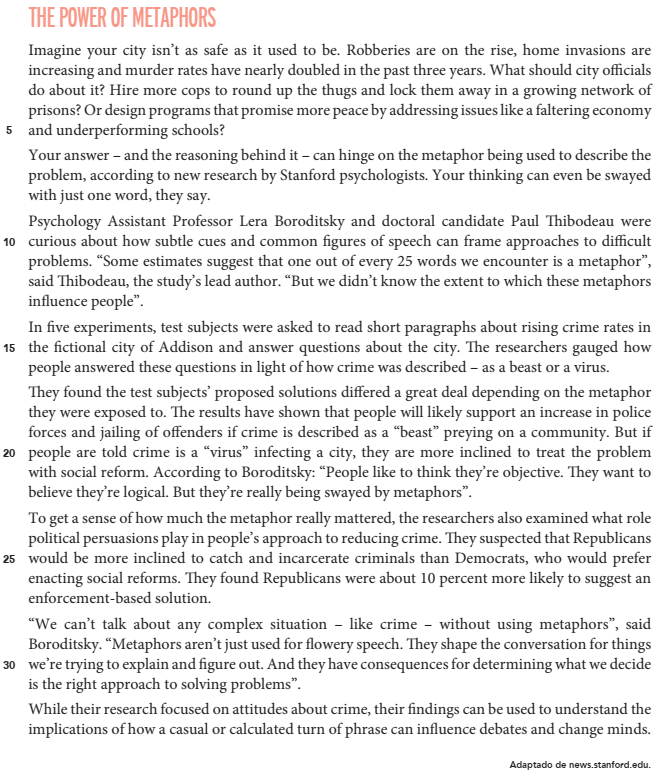
test subjects were asked to read short paragraphs (ℓ. 14)
The reason for the omission of the agent in the sentence above is:
How World Leaders Reacted to Trump at the U.N.
By SOMINI SENGUPTA and MEGAN SPECIA SEPT. 23, 2017
He was called a “giant gold Goliath” and a “rogue newcomer.” But in a few corners the remarks made by President Trump at the United Nations were described as “courageous” and “gratifying.”
Throughout the week, Mr. Trump’s first address to the General Assembly drew many direct and indirect swipes, from allies and rivals alike, and sparse support.
While the North Korean leader, Kim Jong-un, attacked Mr. Trump from afar — calling him a “dotard” in a statement on North Korean national television — others used their platforms at the United Nations to respond.
Some leaders were more subtle than others.
Robert Mugabe, Zimbabwe’s 93-year-old president, took aim at Mr. Trump during his own speech on Thursday. Mr. Mugabe mocked Mr. Trump as a “giant gold Goliath” and said other nations were “embarrassed if not frightened” by his statements about North Korea.
“Are we having a return of Goliath to our midst, who threatens the extinction of other countries?” Mr. Mugabe asked. Some responded with applause to his reference to the biblical character who threatened the Israelites before being slain by the young shepherd David, who would become king.
Mr. Mugabe then went on to address Mr. Trump directly, telling him to “blow your trumpet in a musical way towards the values of unity, peace, cooperation, togetherness and dialogue which we have always stood for.”
During his speech, Mr. Trump notably omitted any talk of climate change, seen as one of the most pressing issues for many world leaders.
Prime Minister Justin Trudeau of Canada received the longest applause during his General Assembly speech on Thursday after an implicit dig at Mr. Trump.
“There is no country on the planet that can walk away from the challenge and reality of climate change,” Mr. Trudeau said, referring to Mr. Trump’s plans to pull out of the Paris climate accord.
(Adapted from https://www.nytimes.com/2017/09/23/world/americas/world-leaders-trump-un.html?mcubz=0)

 Conheça nossos planos