Questões de Vestibular Comentadas sobre adjetivos | adjectives em inglês

Foram encontradas 47 questões

Q2092707 Inglês
TEXTO 1

Asylum-seeker smuggling is a
symptom, not a root cause

Robert Falconer/Craig D. Smith - Jan 31, 2022

1_- 7.png (369×777)
1_- 40.png (371×212)

Source: https://www.theglobeandmail.com/opinion/
article-asylum-seeker-smuggling-is-a-symptom-not-a-root-cause/
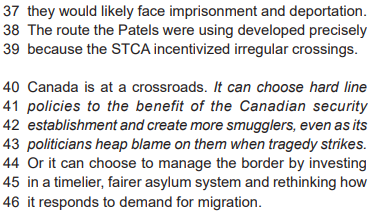
Consider the following sentences from text 1 and answer T (true) or F (false).
( ) The last sentence in Text 1 (lines 44 to 46) presents two examples of adjectives in the comparative degree. ( ) “avoid being returned” (line 36) is about an action that will/would happen while “remember being arrested” is about an action that has already happened. ( ) The two instances of the word “such” (lines 05 and 06) have the same idea as “such” in “I cannot imagine anyone living on such a small salary”.
The alternative that presents the correct top-down sequence of answers to the sentences above is
Alternativas
Q2030423 Inglês
Americans May Add Five Times More Plastic to the Oceans Than Thought

The United States is using more
plastic than ever, and waste exported for
recycling is often mishandled, according
to a new study.
The United States contribution
to coastal plastic pollution worldwide is
significantly larger than previously
thought, possibly by as much as five
times, according to a study published
Friday. The research, published in Science
Advances, is the sequel to a 2015 paper
by the same authors. Two factors
contributed to the sharp increase:
Americans are using more plastic than
ever and the current study included
pollution generated by United States
exports of plastic waste, while the earlier
one did not.
The United States, which does
not have sufficient infrastructure to
handle its recycling demands at home,
exports about half of its recyclable waste.
Of the total exported, about 88 percent
ends up in countries considered to have
inadequate waste management.
“When you consider how much
of our plastic waste isn’t actually
recyclable because it is low-value,
contaminated or difficult to process, it’s
not surprising that a lot of it ends up
polluting the environment,” said the
study’s lead author, Kara Lavender Law,
research professor of oceanography at
Sea Education Association, in a
statement.
The study estimates that in
2016, the United States contributed
between 1.1 and 2.2 million metric tons of
plastic waste to the oceans through a
combination of littering, dumping and 
mismanaged exports. At a minimum,
that’s almost double the total estimated
waste in the team’s previous study. At the
high end, it would be a fivefold increase
over the earlier estimate.
Nicholas Mallos, a senior
director at the Ocean Conservancy and an
author of the study, said the upper
estimate would be equal to a pile of
plastic covering the area of the White
House Lawn and reaching as high as the
Empire State Building.
The ranges are wide partly
because “there’s no real standard for
being able to provide good quality data on
collection and disposal of waste in
general,” said Ted Siegler, a resource
economist at DSM Environmental
Solutions, a consulting firm, and an
author of the study. Mr. Siegler said the
researchers had evaluated waste-disposal
practices in countries around the world
and used their “best professional
judgment” to determine the lowest and
highest amounts of plastic waste likely to
escape into the environment. They settled
on a range of 25 percent to 75 percent.
Tony Walker, an associate
professor at the Dalhousie University
School for Resource and Environmental
Studies in Halifax, Nova Scotia, said that
analyzing waste data can amount to a
“data minefield” because there are no
data standards across municipalities.
Moreover, once plastic waste is shipped
overseas, he said, data is often not
recorded at all.
Nonetheless, Dr. Walker, who
was not involved in the study, said it
could offer a more accurate accounting of
plastic pollution than the previous study,
which likely underestimated the United
States’ contribution. “They’ve put their
best estimate, as accurate as they can be
with this data,” he said, and used ranges,
which underscores that the figures are
estimates.
Of the plastics that go into the
United States recycling system, about 9
percent of the country’s total plastic
waste, there is no guarantee that they’ll
be remade into new consumer goods. New
plastic is so inexpensive to manufacture
that only certain expensive, high-grade
plastics are profitable to recycle within the
United States, which is why roughly half
of the country’s plastic waste was shipped
abroad in 2016, the most recent year for
which data is available.
Since 2016, however, the
recycling landscape has changed. China
and many countries in Southeast Asia
have stopped accepting plastic waste
imports. And lower oil prices have further
reduced the market for recycled plastic.
“What the new study really underscores is
we have to get a handle on source
reduction at home,” Mr. Mallos said. “That
starts with eliminating unnecessary and
problematic single-use plastics.”

From: https://www.nytimes.com/2020/10/30/
The superlative forms of the adjectives accurate, large, and easy are, respectively,
Alternativas
Q1797670 Inglês
Leia o texto para responder à questão.

The fantastic appeal of fantasy


The fantasy genre starts where science ends

     Few things can brighten up a dark morning in a Scottish seaside resort during an Atlantic storm. Yet while sheltering in a bookshop from the rain, I had a moment of sunny revelation. Stacked almost as high as my 11-year-old self were copies of The Lord of the Rings, with a cover illustration that promised mystery and magic. That chance discovery started a lifelong love of the fantasy genre1 , both as reader and writer. 
   The fantasy genre has had more and more success, but today we’re in the middle of an unprecedented fantasy boom. Sales continue to rise and it is now the biggest genre in publishing. The more rational the world gets, with super-science all around us, the more we demand the irrational in our fiction.
     Fantasy is not simply a case of swords2 and sorcery3 . Yes, there is that by the shelf. But the genre is as broad as the imagination. The genre starts where science ends.
    “In these modern times, where most of us sit at computers, fantasy books offer a chance to break out of mundane moments,” says Mark Newton, an editor with the genre. “People like to explore themes that go beyond the limited palette that literary fiction claims to offer.” 
     A search for the origins of fantasy will usually have academics muttering about Beowulf or Homer’s The Iliad, but they come from a time when all stories were fantasy: gods and monsters and supernatural artefacts with humanity caught in the middle. The first modern fantasy writer is usually considered to be William Morris, in the late 19th Century. But it was the early 20th Century where fantasy really started to gain status.
     Fantasy fiction has always been about visionary ideas. You can get artful words in plenty of literary fiction, but being able to see beyond the boundaries4 of the world around us — now that’s a special skill.
     I don’t write fantasy fiction simply to provide a trapdoor5 from the real world. For me, the genre is about the reality. But instead of coming up against it, fantasy maps the unconscious aspirations of our modern society through allegory in story- -forms as old as humanity. It’s about turning off the mobile phone and the computer and remembering who we are in the deepest parts of ourselves.

(Mark Chadbourn. www.telegraph.co.uk, 12.04.2008. Adaptado.)

1genre: gênero. Categoria distintiva de composição literária, como romance, poesia etc.
2sword: espada.
3sorcery: feitiçaria.
4boundary: fronteira.
5trapdoor: alçapão
O trecho sublinhado em “the genre is as broad as the imagination” (3° parágrafo) expressa uma
Alternativas
Ano: 2019 Banca: CÁSPER LÍBERO Órgão: CÁSPER LÍBERO Prova: CÁSPER LÍBERO - 2019 - CÁSPER LÍBERO - Vestibular |
Q1380988 Inglês
Quais expressões a seguir não configuram um oximoro?
Alternativas
Ano: 2019 Banca: UEG Órgão: UEG Prova: UEG - 2019 - UEG - Vestibular - Medicina - Inglês |
Q1300891 Inglês

Leia o texto a seguir para responder à questão. 

Artificial intelligence and the future of medicine

Washington University researchers are working to develop artificial intelligence (AI) systems for health care, which have the potential to transform the diagnosis and treatment of diseases, helping to ensure that patients get the right treatment at the right time.
In health care, artificial intelligence relies on the power of computers to sift through and make sense of reams of electronic data about patients—such as their ages, medical histories, health status, test results, medical images, DNA sequences, and many other sources of health information. AI excels at the complex identification of patterns in these reams of data, and it can do this at a scale and speed beyond human capacity. The hope is that this technology can be harnessed to help doctors and patients make better health-care decisions.


Where are the first places we will start to see AI entering medical practice?

One of the first applications of AI in patient care that we currently see is in imaging, to help improve the diagnosis of cancer or heart problems, for example. There are many types of imaging tests —X-rays, CT scans, MRIs and echocardiograms. But the underlying commonality in all those imaging methods is huge amounts of high-quality data. For AI to work well, it's best to have very complete data sets—no missing numbers, so to speak—and digital images provide that. Plus, the human eye is often blind to some of the patterns that could be present in these images—subtle changes in breast tissue over several years of mammograms, for example. There has been some interesting work done in recognizing early patterns of cancer or early patterns of heart failure that even a highly trained physician would not see.
In many ways, we already have very simple forms of AI in the clinic now. We've had tools for a long time that identify abnormal rhythms in an EKG, for example. An abnormal heartbeat pattern triggers an alert to draw a clinician's attention. This is a computer trying to replicate a human being understanding that data and saying, "This doesn't look normal, you may need to address this problem." Now, we have the capacity to analyze much larger and more complex sources of data, such as the entire electronic health record and perhaps even data pulled from daily life, as more people track their sleep patterns or pulse rates with wearable devices, for example.


What effect will this have on how doctors practice medicine?

It's important to emphasize that these tools are never going to replace clinicians. These technologies will provide assistance, helping care providers see important signals in massive amounts of data that would otherwise remain hidden. But at the same time, there are levels of understanding that computers still can't and may never replicate. To take a treatment recommendation from an AI, even an excellent recommendation, and decide if it's right for the patient is inherently a human decision-making process. What are the patient's preferences? What are the patient's values? What does this mean for the patient's life and for his or her family? That's never going to be an AI function. As these AI systems slowly emerge, we may start to see the roles of physicians changing—in my opinion, in better ways. Doctors' roles may shift from being data collectors and analyzers to being interpreters and councilors for patients as they try to navigate their health. 
Right now, the challenges we need to address as we try to bring AI into medical practice include improving the quality of the data that we feed into AI systems, developing ways to evaluate whether an AI system is actually better than standard of care, ensuring patient privacy and making sure not only that AI doesn't disrupt clinical work flow but in fact improves it. But if doctors do their jobs right and build these systems well, much of what we have described will become so ingrained in the system, people won't even refer to it separately as informatics or AI. It will just be medicine. 

Disponível em: https://medicalxpress.com/news/2018-12-artificial-intelligence-future-medicine.html. Acesso em: 02 maio 2019.
Analisando-se os aspectos linguísticos e estruturais do texto, constata-se que
Alternativas
Ano: 2019 Banca: UNIVESP Órgão: UNIVESP Prova: UNIVESP - 2019 - UNIVESP - Vestibular 1º semestre |
Q1280806 Inglês
Utilize o texto a seguir para responder a questão.

NO DIFFERENCE

Small as a peanut,
Big as a giant,
We’re all the same size
When we turn off the light.

Rich as a sultan,
Poor as a mite,
We’re all worth the same
When we turn off the light.

Red, black or orange,
Yellow or white,
We all look the same
When we turn off the light

So maybe the way
To make everything right
Is for God just reach out
And turn off the light!

(Where the Sidewalk Ends, the poems and drawings of Shel Silverstein. New York, Harper Collins Publishers, 1974)
De acordo com o texto, assinale a alternativa incorreta na oposição de adjetivos.
Alternativas
Ano: 2019 Banca: UEMG Órgão: UEMG Prova: UEMG - 2019 - UEMG - Vestibular |
Q970580 Inglês

               Fire Devastates Brazil's Oldest Science Museum

The overnight inferno likely claimed fossils, cultural artifacts, and more irreplaceable collections amassed over 200 years.

                                                                                    By Michael Greshko                                                   ______________________________________

                                                                   PUBLISHED September 6, 2018


Major pieces of Brazil's scientific and cultural heritage went up in smoke on September 2, as a devastating fire ripped through much of Rio de Janeiro's Museu Nacional, or National Museum. Founded in 1818, the museum is Brazil's oldest scientific institution and one of the largest and most renowned museums in Latin America, amassing a collection of some 20 million scientifically and culturally invaluable artifacts.

The Museu Nacional's holdings include Luzia, an 11,500-year-old skull considered one of South America's oldest human fossils, as well as the bones of uniquely Brazilian creatures such as the long-necked dinosaur Maxakalisaurus. Because of the auction tastes of Brazil's 19th-century emperors, the Museu Nacional also ended up with Latin America's oldest collection of Egyptian mummies and artifacts.

Even the building holds historical importance: It housed the exiled Portuguese royal family from 1808 to 1821, after they fled to Rio de Janeiro in 1807 to escape Napoleon. The complex also served as the palace for Brazil's post-independence emperors until 1889, before the museum collections were transferred there in 1902. In an September 5 email, Museu Nacional curator Débora Pires wrote that the entomology and arachnology collections were completely destroyed, as was most of the mollusk collection. However, technicians had braved the fire to save 80 percent of the mollusk holotypes—the specimens that formally serve as the global references for a given species. The museum's vertebrate specimens, herbarium, and library were housed separately and survived the fire.

(…)

An Irreplaceable Loss

It's not yet clear how the fire started, but it did begin after the museum was closed to the public, and no injuries have yet been reported. Firefighters worked through the night to douse the burnt-out shell of the main building, but it seems the blaze has already seared a gaping hole in many scientists' careers.

“The importance of the collections that were lost couldn't be overstated,” says Luiz Rocha, a Brazilian ichthyologist now at the California Academy of Sciences who has visited the Museu Nacional several times to study its collections. “They were unique as it gets: Many of them were irreplaceable, there's no way to put a monetary value on it.”

“In terms of [my] life-long research agenda, I'm pretty much lost,” says Marcus Guidoti, a Brazilian entomologist finishing up his Ph.D. in a program co-run by Brazil's Federal University of Rio Grande do Sul.

Guidoti studies lace bugs, an insect family with more than 2,000 species worldwide. The Museu Nacional held one of the world's largest lace bug collections, but the fire likely destroyed it and the rest of the museum's five million arthropod specimens. “Those type specimens can't be replaced, and they are crucial to understand the species,” he says by text message. “If I was willing to keep working on this family in this region of the globe, this was definitely a big hit.”

Paleontologist Dimila Mothé, a postdoctoral researcher at the Federal University of the State of Rio de Janeiro, adds that the blows to science extend beyond the collections themselves. “It's not only the cultural history, the natural history, but all the theses and research developed there,” she says. “Most of the laboratories there were lost, too, and the research of several professors. I'm not sure you can say the impact of what was lost.”

Brazil’s indigenous knowledge also has suffered. The Museu Nacional housed world-renowned collections of indigenous objects, as well as many audio recordings of indigenous languages from all over Brazil. Some of these recordings, now lost, were of languages that are no longer spoken.

“I have no words to say how horrible this is,” says Brazilian anthropologist Mariana Françozo, an expert on South American indigenous objects at Leiden University. “The indigenous collections are a tremendous loss … we can no longer study them, we can no longer understand what our ancestors did. It’s heartbreaking.” 

On Monday, The Brazilian publication G1 Rio reported that ashes of burned documents—some still flecked in notes or illustrations—have rained down from the sky more than a mile away from the Museu Nacional, thrown aloft by the inferno.

(…)

Editor's Note: This story was updated on September 6, 2018, with new details about which artifacts survived the fire. 

Taken from: https://www.nationalgeographic.com/science/2018/09/news-museu-nacional-fire-rio-de-janeiro-natural-history/. Access: 11 dez. 2018.

In the excerpt “Founded in 1818, the museum is Brazil's oldest scientific institution and one of the largest and most renowned museums in Latin America” we have 3 (three) occurrences of:
Alternativas
Ano: 2018 Banca: UDESC Órgão: UDESC Prova: UDESC - 2018 - UDESC - Vestibular - Segundo Semestre (Manhã) |
Q1264804 Inglês
The Invitation

It doesn’t interest me what you do for a living, I want to know what you ache for, and if you dare to dream of meeting your heart’s longing.

It doesn’t interest me how old you are. I want to know if you will risk looking like a fool for love, for your dreams, for the adventure of being alive.

It doesn’t interest me what planets are squaring with your moon. I want to know if you have touched the center of your own sorrow, if you have been opened by life’s betrayals or have become shriveled and closed from fear of further pain. I want to know if you can sit with pain, mine or your own, without moving to hide it, or fade it or fix it. I want to know if you can be with joy, mine or even your own; if you can dance with the wilderness and let the ecstasy fill you to the tips of your fingers and toes without cautioning us to be careful, be realistic, or to remember the limitations of being a human.

It doesn´t interest me if the story you´re telling me is true. I want to know if you can risk disappointing another to be true to yourself; if you can bear the accusation of betrayal and not betray your own soul. I want to know if you can be faithless and therefore be trustworthy. I want to know if you can see beauty even when it´s not pretty every day, and if you can source your life from its presence. I want to know if you can live with failure, yours and mine, and still stand on the edge of a lake and shout to the silver of the moon, “YES”.

It doesn´t interest me to know where you live or how much money you have. I want to know if you can get up after a night of grief and despair, weary and bruised to the bone, and do what needs to be done for the children. It doesn´t matter to me who you are, how you came to be here. I want to know if you will stand in the center of the fire with me and not shrink back. 

It doesn´t interest me where or what or with whom you have studied. I want to know what sustains you from the inside when all else falls away. I want to know if you can be alone with yourself; and if you truly like the company you keep in the empty moments.

(By Oriah Mountain Dreamer from the book THE INVITATION (c) 1999. Published by HarperONE, San Francisco. All rights reserved. Presented with permission of the author. www.oriah.org) (theunboundedspirit.com/start-living) Accessed on March 27th, 2018.
According to the meaning of the text, the underlined words are consecutively:
Alternativas
Ano: 2018 Banca: INSTITUTO AOCP Órgão: UEMG Prova: INSTITUTO AOCP - 2018 - UEMG - Vestibular |
Q924560 Inglês

            Brazil must legalise drugs – its existing policy just destroys lives


      For decades, guns and imprisonment have been the hallmarks of Brazil’s war against the drug trafficking. But the only way to beat the gangs is to stop creating criminals, says a top Brazilian judge

      “The war raging in Rocinha, Latin America’s largest favela, has already been lost. Rooted in a dispute between gangs for control of drug trafficking, it has disrupted the daily life of the community in Rio de Janeiro since mid-September. With the sound of shots coming from all sides, schools and shops are constantly forced to close. Recently, a stray bullet killed a Spanish tourist. The war is not the only thing being lost.

      For decades, Brazil has had the same drug policy approach. Police, weapons and numerous arrests. It does not take an expert to conclude the obvious: the strategy has failed. Drug trafficking and consumption have only increased. […]

      In a case still before the Brazilian supreme court, I voted for decriminalising the possession of marijuana for private consumption. […] 

      Drugs are an issue that has a profound impact on the criminal justice system, and it is legitimate for the supreme court to participate in the public debate. So here are the reasons for my views.

      First, drugs are bad and it is therefore the role of the state and society to discourage consumption, treat dependents and repress trafficking. The rationale behind legalisation is rooted in the belief that it will help in achieving these goals.

      Second, the war on drugs has failed. Since the 1970s, under the influence and leadership of the US, the world has tackled this problem with the use of police forces, armies, and armaments. The tragic reality is that 40 years, billions of dollars, hundreds of thousands of prisoners and thousands of deaths later, things are worse. At least in countries like Brazil.

      Third, as the American economist Milton Friedman argued, the only result of criminalisation is ensuring the trafficker’s monopoly. 

      With these points in mind, what would legalisation achieve?

      In most countries in North America and Europe, the greatest concern of the authorities is users and the impact drugs have on their lives and on society. These are all important considerations. In Brazil, however, the principal focus must be ending the dominance drug dealers exercise over poor communities. Gangs have become the main political and economic power in thousands of modest neighbourhoods in Brazil. This scenario prevents a family of honest and hard-working people from educating their children away from the influence of criminal factions, who intimidate, co-opt and exercise an unfair advantage over any lawful activity. Crucially, this power of trafficking comes from illegality.

       Another benefit of legalisation would be to prevent the mass incarceration of impoverished young people with no criminal record who are arrested for trafficking because they are caught in possession of negligible amounts of marijuana. A third of detainees in Brazil are imprisoned for drug trafficking. Once arrested, young prisoners will have to join one of the factions that control the penitentiaries – and on that day, they become dangerous.

      […]

      We cannot be certain that a progressive and cautious policy of decriminalisation and legalisation will be successful. What we can affirm is that the existing policy of criminalisation has failed. We must take chances; otherwise, we risk simply accepting a terrible situation. As the Brazilian navigator Amyr Klink said: “The worst shipwreck is not setting off at all.” 

Disponível em: <https://www.theguardian.com/global-development/2017/nov/15/brazil-must-legalise-drugs-existing-policy-destroys-lives-luis-roberto-barroso-supreme-court-judge> . Acesso em: 14 nov. 2017.

In the excerpt “Recently, a stray bullet killed a Spanish tourist”, the expression “stray bullet” is
Alternativas
Ano: 2018 Banca: INSTITUTO AOCP Órgão: UEMG Prova: INSTITUTO AOCP - 2018 - UEMG - Vestibular |
Q924559 Inglês

            Brazil must legalise drugs – its existing policy just destroys lives


      For decades, guns and imprisonment have been the hallmarks of Brazil’s war against the drug trafficking. But the only way to beat the gangs is to stop creating criminals, says a top Brazilian judge

      “The war raging in Rocinha, Latin America’s largest favela, has already been lost. Rooted in a dispute between gangs for control of drug trafficking, it has disrupted the daily life of the community in Rio de Janeiro since mid-September. With the sound of shots coming from all sides, schools and shops are constantly forced to close. Recently, a stray bullet killed a Spanish tourist. The war is not the only thing being lost.

      For decades, Brazil has had the same drug policy approach. Police, weapons and numerous arrests. It does not take an expert to conclude the obvious: the strategy has failed. Drug trafficking and consumption have only increased. […]

      In a case still before the Brazilian supreme court, I voted for decriminalising the possession of marijuana for private consumption. […] 

      Drugs are an issue that has a profound impact on the criminal justice system, and it is legitimate for the supreme court to participate in the public debate. So here are the reasons for my views.

      First, drugs are bad and it is therefore the role of the state and society to discourage consumption, treat dependents and repress trafficking. The rationale behind legalisation is rooted in the belief that it will help in achieving these goals.

      Second, the war on drugs has failed. Since the 1970s, under the influence and leadership of the US, the world has tackled this problem with the use of police forces, armies, and armaments. The tragic reality is that 40 years, billions of dollars, hundreds of thousands of prisoners and thousands of deaths later, things are worse. At least in countries like Brazil.

      Third, as the American economist Milton Friedman argued, the only result of criminalisation is ensuring the trafficker’s monopoly. 

      With these points in mind, what would legalisation achieve?

      In most countries in North America and Europe, the greatest concern of the authorities is users and the impact drugs have on their lives and on society. These are all important considerations. In Brazil, however, the principal focus must be ending the dominance drug dealers exercise over poor communities. Gangs have become the main political and economic power in thousands of modest neighbourhoods in Brazil. This scenario prevents a family of honest and hard-working people from educating their children away from the influence of criminal factions, who intimidate, co-opt and exercise an unfair advantage over any lawful activity. Crucially, this power of trafficking comes from illegality.

       Another benefit of legalisation would be to prevent the mass incarceration of impoverished young people with no criminal record who are arrested for trafficking because they are caught in possession of negligible amounts of marijuana. A third of detainees in Brazil are imprisoned for drug trafficking. Once arrested, young prisoners will have to join one of the factions that control the penitentiaries – and on that day, they become dangerous.

      […]

      We cannot be certain that a progressive and cautious policy of decriminalisation and legalisation will be successful. What we can affirm is that the existing policy of criminalisation has failed. We must take chances; otherwise, we risk simply accepting a terrible situation. As the Brazilian navigator Amyr Klink said: “The worst shipwreck is not setting off at all.” 

Disponível em: <https://www.theguardian.com/global-development/2017/nov/15/brazil-must-legalise-drugs-existing-policy-destroys-lives-luis-roberto-barroso-supreme-court-judge> . Acesso em: 14 nov. 2017.

Consider the following excerpt: “Since the 1970s, under the influence and leadership of the US, the world has tackled this problem with the use of police forces, armies, and armaments.” Mark the option which best describes the use of some words in the excerpt.
Alternativas
Ano: 2017 Banca: ACAFE Órgão: Univille Prova: ACAFE - 2017 - Univille - Vestibular - Segundo Semestre |
Q1396196 Inglês

TEXTO

Brazil has declared an end to its public health emergency over the Zika virus, 18 months after a surge in cases drew headlines around the world.

The mosquito-borne virus was not considered a major health threat until the 2015 outbreak revealed that Zika can lead to severe birth defects. One of those defects, microcephaly, causes babies to be born with skulls much smaller than expected.

Photos of babies with the defect spread panic around the globe as the virus was reported in dozens of countries. Many would-be travellers cancelled their trips to Zika-infected places. The concern spread even more widely when health officials said it could also be transmitted through sexual contact with an infected person.

The health scare came just as Brazil, the epicentre of the outbreak, was preparing to host the 2016 Olympics, fuelling concerns the Games could help spread the virus. One athlete, a Spanish wind surfer, said she got Zika while training in Brazil ahead of the Games.

In response to the outbreak, Brazil launched a mosquito-eradication campaign. The health ministry said those efforts have helped to dramatically reduce cases of Zika. Between January and mid-April, 95% fewer cases were recorded than during the same period last year. The incidence of microcephaly has fallen as well. 

The World Health Organization (WHO) lifted its own international emergency in November, even while saying the virus remained a threat. 

“The end of the emergency doesn’t mean the end of surveillance or assistance” to affected families, said Adeilson Cavalcante, the secretary for health surveillance at Brazil’s health ministry. “The health ministry and other organisations involved in this area will maintain a policy of fighting Zika, dengue and chikungunya.”

All three diseases are carried by the Aedes aegypti mosquito.

But the WHO has warned that Zika is “here to stay,” even when cases of it fall off, and that fighting the disease will be an ongoing battle.

(Fonte: Associated Press, Friday 12 May 2017 10.18 BST. Last modified on Friday 12 May 2017 22.00 BST) 

From the words in bold below, which is not adjective in the text:
Alternativas
Ano: 2017 Banca: VUNESP Órgão: FAMERP Prova: VUNESP - 2017 - FAMERP - Conhecimentos Gerais |
Q1335936 Inglês

Leia o texto para responder à questão.

Can plants hear?
Flora may be able to detect the sounds of flowing water or munching insects

    Pseudoscientific claims that music helps plants grow have been made for decades, despite evidence that is shaky at best. Yet new research suggests some flora may be capable of sensing sounds, such as the gurgle of water through a pipe or the buzzing of insects.
    In a recent study, Monica Gagliano, an evolutionary biologist at the University of Western Australia, and her colleagues placed pea seedlings in pots shaped like an upside-down Y. One arm of each pot was placed in either a tray of water or a coiled plastic tube through which water flowed; the other arm had dry soil. The roots grew toward the arm of the pipe with the fluid, regardless of whether it was easily accessible or hidden inside the tubing. “They just knew the water was there, even if the only thing to detect was the sound of it flowing inside the pipe,” Gagliano says. Yet when the seedlings were given a choice between the water tube and some moistened soil, their roots favored the latter. She hypothesizes that these plants use sound waves to detect water at a distance but follow moisture gradients to home in on their target when it is closer.
    The research, reported earlier this year in Oecologia, is not the first to suggest flora can detect and interpret sounds. A 2014 study showed the rock cress Arabidopsis can distinguish between caterpillar chewing sounds and wind vibrations – the plant produced more chemical toxins after “hearing” a recording of feeding insects. “We tend to underestimate plants because their responses are usually less visible to us. But leaves turn out to be extremely sensitive vibration detectors,” says lead study author Heidi M. Appel, an environmental scientist now at the University of Toledo.
(Marta Zaraska. www.scientificamerican.com, 17.05.2017.)
No trecho do terceiro parágrafo “The research, reported earlier”, o termo em destaque indica
Alternativas
Ano: 2017 Banca: VUNESP Órgão: UNESP Prova: VUNESP - 2017 - UNESP - Vestibular - Segundo Semestre |
Q815356 Inglês

                            “One never builds something finished”:

                   the brilliance of architect Paulo Mendes da Rocha

Oliver Wainwright

February 4, 2017

   “All space is public,” says Paulo Mendes da Rocha. “The only private space that you can imagine is in the human mind.” It is an optimistic statement from the 88-year-old Brazilian architect, given he is a resident of São Paulo, a city where the triumph of the private realm over the public could not be more stark. The sprawling megalopolis is a place of such marked inequality that its superrich hop between their rooftop helipads because they are too scared of street crime to come down from the clouds.

   But for Mendes da Rocha, who received the 2017 gold medal from the Royal Institute of British Architects this week – an accolade previously bestowed on such luminaries as Le Corbusier and Frank Lloyd Wright – the ground is everything. He has spent his 60-year career lifting his massive concrete buildings up, in gravity-defying balancing acts, or else burying them below ground in an attempt to liberate the Earth’s surface as a continuous democratic public realm. “The city has to be for everybody,” he says, “not just for the very few.”

                                                                                    (www.theguardian.com. Adaptado.)

No trecho do primeiro parágrafo “The sprawling megalopolis is a place of such marked inequality”, o termo em destaque indica
Alternativas
Ano: 2016 Banca: IF-RR Órgão: IF-RR Prova: IF-RR - 2016 - IF-RR - Vestibular - Primeiro Semestre |
Q1274278 Inglês
Facebook and Google Are Going To War Against Hate Speech
Offending posts will be deleted within 24 hours

   Facebook, Twitter, Google, and Microsoft have agreed to work with European officials to crack down on hateful speech published on their respective platforms. Each company has agreed to review potentially problematic posts and remove offending content within 24 hours. 
   “The recent terror attacks have reminded us of the urgent need to address illegal online hate speech,” Vĕra Jourová, EU Commissioner for Justice, Consumers and Gender Equality, said in a joint statement from the European Commission and the participating companies. “Social media is unfortunately one of the tools that terrorist groups use to radicalize young people and racist use to spread violence and hatred.”
     The new partnership comes after Facebook, Twitter, and Google agreed to erase hate speech from their platforms within 24 hours in Germany, an attempt to address racism following the refugee crisis. That agreement, which Reuters reported last year, also made it easier for individual users to report hateful speech.
     Under the new code of conduct, technology companies will have clear rules in place for reviewing content that may be deemed malicious or hateful. The document also says the companies should be responsible for educating their users on the types of content that are disallowed.
      Tech companies assure that the recently announced code of conduct won’t interfere with freedom of speech. “We remain committed to letting the Tweets flow,” Karen White, Twitter’s head of public policy for Europe, said in the statement. “However, there is a clear distinction between freedom of expression and conduct that incites violence and hate.”
(Time Magazine, May 31, 2016)

Glossary: hate speech – discurso de ódio; to agree: concordar; to erase: apagar; partnership – parceria. 
As palavras “potentially” e “offending”, ambas na quinta e sexta linhas do texto, são, respectivamente:
Alternativas
Ano: 2016 Banca: FCM Órgão: UEMG Prova: FCM - 2016 - UEMG - Vestibular |
Q924612 Inglês
How a young student’s innovative idea hopes to boost response times for EMTs

By Woody Brown on June 1, 2015

    Drones have been at the forefront of the national conversation for years now. As the components needed to create them grow smaller and more affordable, many companies and organizations have started exploring the potential that drones could have to improve our daily lives. Whether by delivering a product with unprecedented speed or taking photographs and video from new heights, drones have many capabilities, most of which we have yet to discover. One young man, however, has envisioned a new way to use drones that could save thousands of lives.
    One of the greatest obstacles facing first responders and emergency medical technicians [EMTs] when it comes to the difficult business of saving lives is time. Think of your daily commute: people in the United States spend an average of 25.5 minutes traveling one-way to work every day. In bumperto-bumper traffic, blaring sirens and flashing lights are often not enough to clear a fast path for an ambulance to reach someone in need. During cardiac arrest, there are, at most, a few minutes to save a person’s life. After that, the mortality rate rises steeply. With stakes this high, every second counts.
    Alec Momont, a graduate student in engineering at Delft University of Technology in the Netherlands, recognized this problem and saw a way to significantly reduce deaths that result from delayed emergency care. What if ambulances could fly? Or rather, what if we could make a drone that functioned like a stripped-down, lightweight automatic external defibrillator [AED]? AEDs, which can be found in schools, sports arenas and many government buildings, are significantly more effective than cardiopulmonary resuscitation [CPR] at preventing fatalities resulting from cardiac arrest. CPR can be helpful, but an AED is better, and very few people have AEDs in their cars or homes.
    As his master’s degree project, Momont built a prototype of this lifesaving drone. It contained an AED, a microphone and speakers. The average travel time, according to him, could be cut by 90 percent. Here’s how it works: In the event of cardiac arrest, a paramedic would respond to a call by flying the drone at a speed of 60 mph to the scene of the emergency. The paramedic would then give instructions to someone near the victim, who would position the AED. Once in place, the AED would operate automatically. The paramedic would be able to see through the camera whether or not the pads on the AED have been correctly positioned, and how the victim responds.
    A dramatized video released by Momont’s university demonstrates all of this functionality. In it, a young woman calls emergency services in a panic because her father has had a heart attack. A calm-voiced EMT answers and guides her through the surprisingly simple process of finding and using the drone. Fewer than two minutes after she makes the call, her father sits up and hugs her.
    The ambulance drone can increase the chances of surviving cardiac arrest from eight percent to 80 percent, Momont says in the video. The drone’s ability to travel as the crow flies frees it from infrastructural limitations that currently impede road-bound ambulances. “Using advanced production techniques such as 3D printed microstructures and carbon fiber frame construction, we were able to achieve a very lightweight design,” Momont says. “The result is an integrated solution that is clear in its orientation and friendly in appearance.”
    Momont’s aim is to rapidly expand the existing framework of emergency services by constructing many of these drones over the next five years. Expenses are low: each drone is relatively cheap to make, about $18,600. By comparison, a typical ambulance costs more than $100,000, and a ride in one usually costs more than $1,000.
    The ambulance drones can even fly autonomously (though legislation in many countries does not permit this yet). Several emergency service providers have already expressed interest. If the technology continues to receive financial support from other parties in the healthcare industry, Momont’s dream could very easily become a reality.
    We live in a world where drones have, so far, been used mostly in armed conflict. Momont, however, has a different vision. In the near future that he describes, tens of thousands of needless deaths will be prevented with his ingenious invention. That is certainly welcome news, especially in the United States, which deals with skyrocketing numbers of heart-related ailments and disabilities. “Let’s use drones for a good purpose,” Momont says. “Let us use drones to save lives.”

Adapted from: <http://www.verizonwireless.com/news/article/2015/05/ambulance-dronescould-save-thousands-of-lives.html>. Access on: 03 Oct. 2016.
The word that functions as an adjective in the text is
Alternativas
Ano: 2016 Banca: VUNESP Órgão: UNESP Prova: VUNESP - 2016 - UNESP - Vestibular - Primeiro Semestre |
Q809334 Inglês

Question: Is there anything I can do to train my body to need less sleep?

Karen Weintraub

June 17, 2016


   Many people think they can teach themselves to need less sleep, but they’re wrong, said Dr. Sigrid Veasey, a professor at the Center for Sleep and Circadian Neurobiology at the University of Pennsylvania’s Perelman School of Medicine. We might feel that we’re getting by fine on less sleep, but we’re deluding ourselves, Dr. Veasey said, largely because lack of sleep skews our self-awareness. “The more you deprive yourself of sleep over long periods of time, the less accurate you are of judging your own sleep perception,” she said.

   Multiple studies have shown that people don’t functionally adapt to less sleep than their bodies need. There is a range of normal sleep times, with most healthy adults naturally needing seven to nine hours of sleep per night, according to the National Sleep Foundation. Those over 65 need about seven to eight hours, on average, while teenagers need eight to 10 hours, and school-age children nine to 11 hours. People’s performance continues to be poor while they are sleep deprived, Dr. Veasey said.

   Health issues like pain, sleep apnea or autoimmune disease can increase people’s need for sleep, said Andrea Meredith, a neuroscientist at the University of Maryland School of Medicine. A misalignment of the clock that governs our sleep-wake cycle can also drive up the need for sleep, Dr. Meredith said. The brain’s clock can get misaligned by being stimulated at the wrong time of day, she said, such as from caffeine in the afternoon or evening, digital screen use too close to bedtime, or even exercise at a time of day when the body wants to be winding down.

(http://well.blogs.nytimes.com. Adaptado.)

No trecho do primeiro parágrafo “The more you deprive yourself of sleep over long periods of time, the less accurate you are of judging your own sleep perception”, os termos em destaque indicam
Alternativas
Ano: 2015 Banca: Esamc Órgão: Esamc Prova: Esamc - 2015 - Esamc - Vestibular |
Q1353105 Inglês

Considere o excerto a seguir, retirado do site do jornal britânico The Guardian, para responder à questão.


    Homeopaths believe that illness-causing substances can, in minute doses, treat people who are unwell. By diluting these substances in water or alcohol, homeopaths claim the resulting mixture retains a “memory” of the original substance that triggers a healing response in the body.

    These claims have been widely disproven by multiple studies, but the National Health and Medical Research Council (NHMRC) has for the first time thoroughly reviewed 225 research papers on homeopathy to come up with its position statement, released on Wednesday: Homeopathy is not effective for treating any health condition.

(Adaptado de www.theguardian.com - acesso em 12/03/2015)

Considere o segundo parágrafo do texto. As palavras claims, studies, thoroughly, effective são classificadas, respectivamente, como
Alternativas
Ano: 2015 Banca: PUC-PR Órgão: PUC - PR Prova: PUC-PR - 2015 - PUC - PR - Vestibular - Medicina |
Q809839 Inglês

Read the text and answer the question.


                  Life stress may lead to cognitive developmental delays in children


According to a new study, children living in harsh or unstable environments are more likely to experience learning and cognitive delays by age 4.

Researchers examined the cortisol levels and cognitive delays of 201 children from low-income families in the northeastern United States. It was found that those kids with higher levels of cortisol experienced harsh or insensitive caregiving.

"We discovered that exposure to specific forms of family adversity when children were 2 years old predicted their cortisol profile, which in turn was linked with notable differences in children´s cognitive functioning at age 4," the researchers say.

Disponível em: <http://www.shortnews.com/start.cfm?id=100733> . Acesso em: 16/06/15.


According to the research, we can state that:


I. Children who are more stressed may have cognitive delay.

II. Children who are stresser may have developmental delays.

III. Children from more rich families were evaluated in this research.

IV. Children from richer families were evaluated in this research.

V. Children from poorer families were evaluated in this research. 

Alternativas
Q1357100 Inglês
Cycling


What's the furthest you have ever cycled?


Perhaps you cycle to school or to work, or maybe at most a short cycling trip with friends? How would you feel about spending months on the road travelling solo from the UK to China, by bike?
For British cyclist Pete Jones, camping rough and cycling long distances through inhospitable terrain are second nature. Mr Jones is currently undertaking a mammoth trip across the Eurasian continent from Britain to China.
Pete Jones is no stranger to China. But he says many people there are puzzled by his passion for cycling, asking why he would choose to cycle when he can afford a car. Indeed, while there are an estimated 400 million bicycles in China, where it has long been the preferred form of transport, rapid economic growth has fuelled an explosive expansion in car ownership.
Edward Genochio, another British cyclist who completed a 41,000km trip to China and back, said one of his aims was to "promote cycling as a safe, sustainable and environmentally benign means of getting about".
In the UK, the last few years have seen a rise in the number of people choosing two wheels over four, with some estimates saying the number of people cycling to work has almost doubled in the last five years.
Politicians also see cycling as a way to boost their eco-credentials, with people such as London mayor Boris Johnson often riding to work under his own steam. But we may have to wait some time before we see him emulating Pete Jones in attempting to cycle all the way to China!
Fonte: www.bbc.co.uk/worldservice/... 
According to the text, the underlined word “rough” is:
Alternativas
Ano: 2014 Banca: Esamc Órgão: Esamc Prova: Esamc - 2014 - Esamc - Vestibular |
Q1352444 Inglês
Considere o texto abaixo para responder à questão.


    Can Audio or Digital Books Improve Learning Outcomes?

    Children with learning disabilities (LD), like dyslexia, have trouble understanding words they read. Causes are unclear, but we now know that LD is not due to a lack of intelligence or a desire to learn.

     While dyslexia is a life-long condition, early identification, support from a parent or teacher, and access to digital or audio books and other learning materials may help your child to improve their learning outcomes and be better prepared to successfully work around their LD.

    Research now demonstrates that when children with LD are given accessible instructional materials (often referred to as AIM) — textbooks or learning materials that are delivered in audio and/or digital formats — they can excel in school and also learn to enjoy reading.
    Reading with digital (or e-books) and audio books can enrich a user's learning experience by engaging them in the content in multi-sensory ways.
(National Center for Learning Disabilities. . p. 23. - acesso em 08/04/2014 The Dyslexia Toolkit )
Considere o primeiro parágrafo do texto. As palavras learning, like, read e desire aparecem no trecho, respectivamente, como
Alternativas
Respostas
1: B
2: A
3: C
4: C
5: A
6: D
7: B
8: B
9: B
10: A
11: D
12: D
13: C
14: E
15: B
16: C
17: E
18: B
19: B
20: C