Questões de Vestibular Sobre adjetivos | adjectives em inglês

Foram encontradas 107 questões

Ano: 2025 Banca: FGV Órgão: FEMPAR Prova: FGV - 2025 - FEMPAR - Vestibular - Medicina |
Q3840973 Inglês
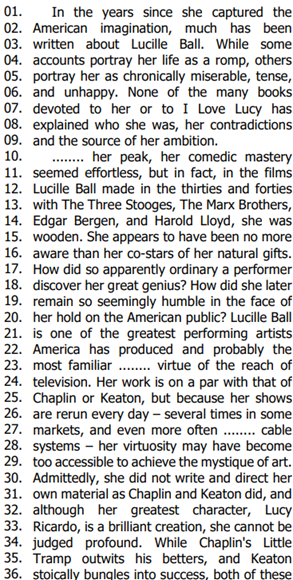
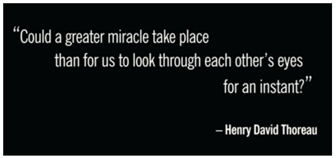
Read Text II below and answer the question that follow it.

Text II


Q20_23.png (336×158)

From: https://cdn.quotesgram.com/img/31/9/1932969763-Thoreau-empathyquote.jpg
The opposite of “greater” in this context is
Alternativas
Ano: 2025 Banca: Ibest Órgão: UCB Prova: Ibest - 2025 - UCB - Vestibular - Medicina |
Q3664578 Inglês

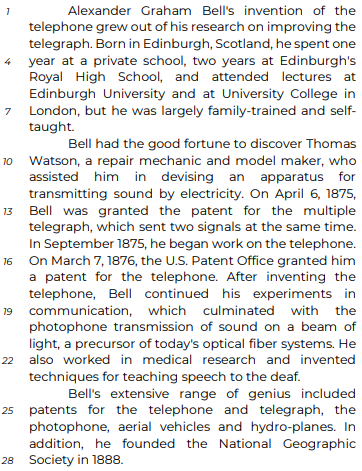
Text for question


Internet: <https://www.invent.org/inductees/alexander-grahambell> (adapted).
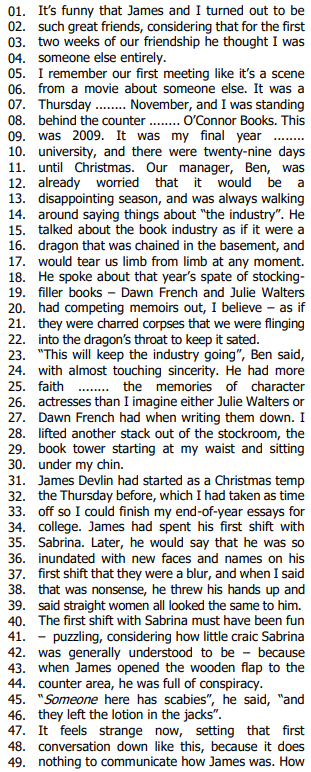
Regarding the use of pronouns and adjectives in the second paragraph, choose the correct alternative.
Alternativas
Ano: 2023 Banca: UEMA Órgão: UEMA Prova: UEMA - 2023 - UEMA - Vestibular |
Q3728689 Inglês
This text refers to question.


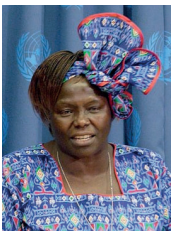
Wangari Maathai

TEXTO_18-19.png (176×233)

        Wangari Maathai, in full Wangari Muta Maathai, (born April 1, 1940, Nyeri, Kenya—died September 25, 2011, Nairobi), Kenyan politician and environmental activist who was awarded the 2004 Nobel Prize for Peace, becoming the first Black African woman to win a Nobel Prize.

        Maathai was educated in the United States at Mount St. Scholastica College (1964) and at the University of Pittsburgh (M.S., 1966). In 1971 she received a Ph.D. at the University of Nairobi, effectively becoming the first woman in either East or Central Africa to earn a doctorate.

        Maathai developed the idea that village women could improve the environment by planting trees to provide a fuel source and to slow the processes of deforestation and desertification. The Green Belt Movement, an organization she founded in 1977, had by the early 21st century planted some 30 million trees. Leaders of the Green Belt Movement established the Pan African Green Belt Network in 1986 in order to educate world leaders about conservation and environmental improvement.

        In addition to her conservation work, Maathai was elected to Kenya’s National Assembly in 2002 with 98 percent of the vote, and in 2003 she was appointed assistant minister of environment, natural resources, and wildlife. When she won the Nobel Prize in 2004, the committee commended her “holistic approach to sustainable development that embraces democracy, human rights, and women’s rights in particular.” She published an autobiography, Unbowed, in 2007. Another volume, The Challenge for Africa (2009), criticized Africa’s leadership as ineffectual and urged Africans to try to solve their problems without Western assistance. Maathai was a frequent contributor to international publications such as the Los Angeles Times and the Guardian.

Wangari Maathai | Extract taken from Biography, Nobel Peace Prize, Books, Green Belt Movement, & Facts | Britannica
The underlined words environmental (3rd par.), National (4th par.), and natural (4th par.), according to the english morphology, are respectively
Alternativas
Ano: 2023 Banca: UFGD Órgão: UFGD Prova: UFGD - 2023 - UFGD - Vestibular - Ingresso em 2024 |
Q3249044 Inglês
What is mindful eating?
Mindfulness is the practice of being present in the moment, and observing the inputs flooding your senses. At meal time: "Think about how the food looks, how it tastes and smells. What's the texture? What memories does it bring up? How does it make you feel?" Burton Murray asks. By being mindful at meals, you'll slow the eating process, pay more attention to your body's hunger and fullness cues, and perhaps avoid overeating. "It makes you take a step back and make decisions about what you're eating, rather than just going through the automatic process of see food, take food, eat food," Burton Murray says.
Set yourself up for success in being mindful when you eat by: Removing distractions. Turn off phones, TVs, and computers. Eat in a peaceful, uncluttered space.
Pacing yourself for a 20-minute meal. Chew your food slowly and put your fork down between bites.

Captura_de tela 2025-03-18 113239.png (491×250)

Disponible in: https://www.health.harvard.edu/blog/overeating-mindfulness-exercises-may-help-202203282714. Access in: May, 15 2023 (adapted).

Choose the correct alternative.
Alternativas
Ano: 2023 Banca: CESPE / CEBRASPE Órgão: UNB Prova: CESPE / CEBRASPE - 2023 - UNB - Prova de Conhecimentos I - 1° dia - Inglês |
Q3108572 Inglês
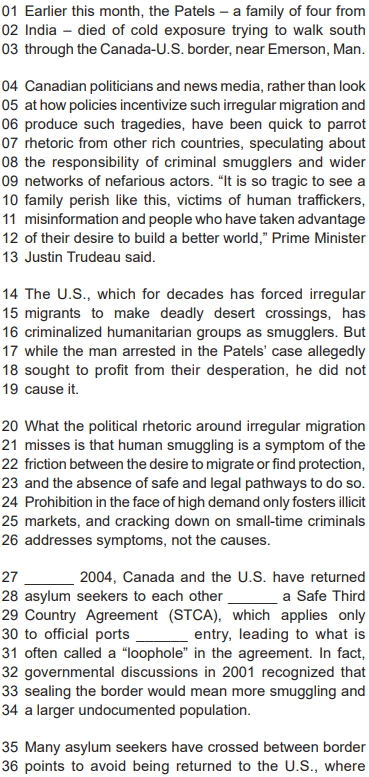
Regarding the preceding comic strip and the conversation between the rabbit and the kid, judge the following item.

The passage “to make it free for kids to go to the movies” (third box) can be correctly rewritten as to make kids free to go to the cinema.
Alternativas
Q2092707 Inglês
TEXTO 1

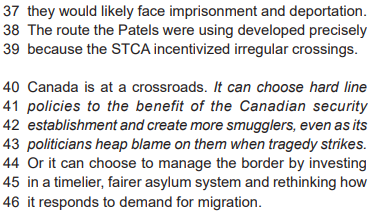
Asylum-seeker smuggling is a
symptom, not a root cause

Robert Falconer/Craig D. Smith - Jan 31, 2022

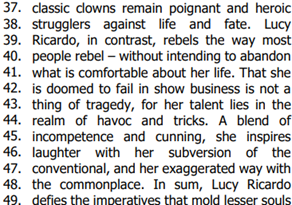
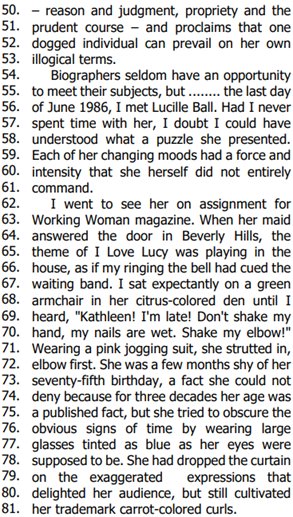
1_- 7.png (369×777)
1_- 40.png (371×212)

Source: https://www.theglobeandmail.com/opinion/
article-asylum-seeker-smuggling-is-a-symptom-not-a-root-cause/
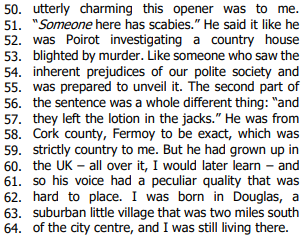
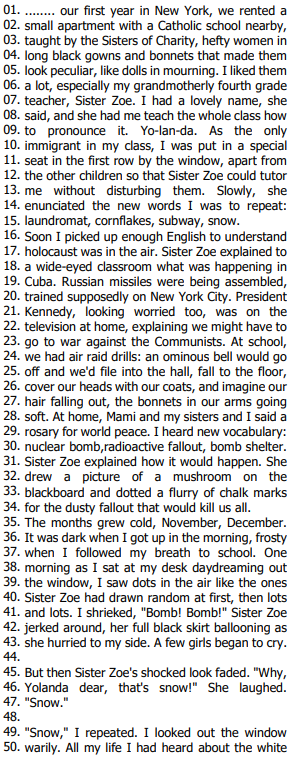
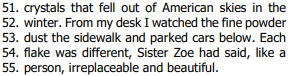
Consider the following sentences from text 1 and answer T (true) or F (false).
( ) The last sentence in Text 1 (lines 44 to 46) presents two examples of adjectives in the comparative degree. ( ) “avoid being returned” (line 36) is about an action that will/would happen while “remember being arrested” is about an action that has already happened. ( ) The two instances of the word “such” (lines 05 and 06) have the same idea as “such” in “I cannot imagine anyone living on such a small salary”.
The alternative that presents the correct top-down sequence of answers to the sentences above is
Alternativas
Q1860176 Inglês

https://www.theguardian.com/environment/ 2021/sep/27/

The underlined words in “extreme heatwaves” (line 13), “current pledges” (lines 14- 15), “polluting countries” (line 32) function respectively as
Alternativas
Q2030423 Inglês
Americans May Add Five Times More Plastic to the Oceans Than Thought

The United States is using more
plastic than ever, and waste exported for
recycling is often mishandled, according
to a new study.
The United States contribution
to coastal plastic pollution worldwide is
significantly larger than previously
thought, possibly by as much as five
times, according to a study published
Friday. The research, published in Science
Advances, is the sequel to a 2015 paper
by the same authors. Two factors
contributed to the sharp increase:
Americans are using more plastic than
ever and the current study included
pollution generated by United States
exports of plastic waste, while the earlier
one did not.
The United States, which does
not have sufficient infrastructure to
handle its recycling demands at home,
exports about half of its recyclable waste.
Of the total exported, about 88 percent
ends up in countries considered to have
inadequate waste management.
“When you consider how much
of our plastic waste isn’t actually
recyclable because it is low-value,
contaminated or difficult to process, it’s
not surprising that a lot of it ends up
polluting the environment,” said the
study’s lead author, Kara Lavender Law,
research professor of oceanography at
Sea Education Association, in a
statement.
The study estimates that in
2016, the United States contributed
between 1.1 and 2.2 million metric tons of
plastic waste to the oceans through a
combination of littering, dumping and 
mismanaged exports. At a minimum,
that’s almost double the total estimated
waste in the team’s previous study. At the
high end, it would be a fivefold increase
over the earlier estimate.
Nicholas Mallos, a senior
director at the Ocean Conservancy and an
author of the study, said the upper
estimate would be equal to a pile of
plastic covering the area of the White
House Lawn and reaching as high as the
Empire State Building.
The ranges are wide partly
because “there’s no real standard for
being able to provide good quality data on
collection and disposal of waste in
general,” said Ted Siegler, a resource
economist at DSM Environmental
Solutions, a consulting firm, and an
author of the study. Mr. Siegler said the
researchers had evaluated waste-disposal
practices in countries around the world
and used their “best professional
judgment” to determine the lowest and
highest amounts of plastic waste likely to
escape into the environment. They settled
on a range of 25 percent to 75 percent.
Tony Walker, an associate
professor at the Dalhousie University
School for Resource and Environmental
Studies in Halifax, Nova Scotia, said that
analyzing waste data can amount to a
“data minefield” because there are no
data standards across municipalities.
Moreover, once plastic waste is shipped
overseas, he said, data is often not
recorded at all.
Nonetheless, Dr. Walker, who
was not involved in the study, said it
could offer a more accurate accounting of
plastic pollution than the previous study,
which likely underestimated the United
States’ contribution. “They’ve put their
best estimate, as accurate as they can be
with this data,” he said, and used ranges,
which underscores that the figures are
estimates.
Of the plastics that go into the
United States recycling system, about 9
percent of the country’s total plastic
waste, there is no guarantee that they’ll
be remade into new consumer goods. New
plastic is so inexpensive to manufacture
that only certain expensive, high-grade
plastics are profitable to recycle within the
United States, which is why roughly half
of the country’s plastic waste was shipped
abroad in 2016, the most recent year for
which data is available.
Since 2016, however, the
recycling landscape has changed. China
and many countries in Southeast Asia
have stopped accepting plastic waste
imports. And lower oil prices have further
reduced the market for recycled plastic.
“What the new study really underscores is
we have to get a handle on source
reduction at home,” Mr. Mallos said. “That
starts with eliminating unnecessary and
problematic single-use plastics.”

From: https://www.nytimes.com/2020/10/30/
The superlative forms of the adjectives accurate, large, and easy are, respectively,
Alternativas
Q1797670 Inglês
Leia o texto para responder à questão.

The fantastic appeal of fantasy


The fantasy genre starts where science ends

     Few things can brighten up a dark morning in a Scottish seaside resort during an Atlantic storm. Yet while sheltering in a bookshop from the rain, I had a moment of sunny revelation. Stacked almost as high as my 11-year-old self were copies of The Lord of the Rings, with a cover illustration that promised mystery and magic. That chance discovery started a lifelong love of the fantasy genre1 , both as reader and writer. 
   The fantasy genre has had more and more success, but today we’re in the middle of an unprecedented fantasy boom. Sales continue to rise and it is now the biggest genre in publishing. The more rational the world gets, with super-science all around us, the more we demand the irrational in our fiction.
     Fantasy is not simply a case of swords2 and sorcery3 . Yes, there is that by the shelf. But the genre is as broad as the imagination. The genre starts where science ends.
    “In these modern times, where most of us sit at computers, fantasy books offer a chance to break out of mundane moments,” says Mark Newton, an editor with the genre. “People like to explore themes that go beyond the limited palette that literary fiction claims to offer.” 
     A search for the origins of fantasy will usually have academics muttering about Beowulf or Homer’s The Iliad, but they come from a time when all stories were fantasy: gods and monsters and supernatural artefacts with humanity caught in the middle. The first modern fantasy writer is usually considered to be William Morris, in the late 19th Century. But it was the early 20th Century where fantasy really started to gain status.
     Fantasy fiction has always been about visionary ideas. You can get artful words in plenty of literary fiction, but being able to see beyond the boundaries4 of the world around us — now that’s a special skill.
     I don’t write fantasy fiction simply to provide a trapdoor5 from the real world. For me, the genre is about the reality. But instead of coming up against it, fantasy maps the unconscious aspirations of our modern society through allegory in story- -forms as old as humanity. It’s about turning off the mobile phone and the computer and remembering who we are in the deepest parts of ourselves.

(Mark Chadbourn. www.telegraph.co.uk, 12.04.2008. Adaptado.)

1genre: gênero. Categoria distintiva de composição literária, como romance, poesia etc.
2sword: espada.
3sorcery: feitiçaria.
4boundary: fronteira.
5trapdoor: alçapão
O trecho sublinhado em “the genre is as broad as the imagination” (3° parágrafo) expressa uma
Alternativas
Ano: 2019 Banca: UNICENTRO Órgão: UNICENTRO Prova: UNICENTRO - 2019 - UNICENTRO - Vestibular - Língua Inglesa |
Q1403982 Inglês


Backpacs” (title) - a large bag carried on the back.

“strap” (l. 2) - a strip of leather, cloth or other flexible material.

“lugging” (l. 5) - carrying something with great effort. “prof” (l. 8) - professor.

“sprains” (l. 18) - injuries.

“strains” (l. 18) - severe demands on physical strengh.

The adjective that is in the superlative form is
Alternativas
Ano: 2019 Banca: UNICENTRO Órgão: UNICENTRO Prova: UNICENTRO - 2019 - UNICENTRO - Vestibular - Língua Inglesa |
Q1403980 Inglês


Backpacs” (title) - a large bag carried on the back.

“strap” (l. 2) - a strip of leather, cloth or other flexible material.

“lugging” (l. 5) - carrying something with great effort. “prof” (l. 8) - professor.

“sprains” (l. 18) - injuries.

“strains” (l. 18) - severe demands on physical strengh.

Based on the language aspects in the text, it is correct to say that
Alternativas
Ano: 2019 Banca: UNICENTRO Órgão: UNICENTRO Prova: UNICENTRO - 2019 - UNICENTRO - Vestibular - PAC - 1ª Etapa |
Q1402784 Inglês
The adjective that best describes the author’s attitude toward the Internet is
Alternativas
Ano: 2019 Banca: UNICENTRO Órgão: UNICENTRO Prova: UNICENTRO - 2019 - UNICENTRO - Vestibular - PAC - 1ª Etapa |
Q1402783 Inglês
Concerning vocabulary, the alternative containing a wrong piece of information is
Alternativas
Ano: 2019 Banca: UECE-CEV Órgão: UECE Prova: UECE-CEV - 2019 - UECE - Vestibular - Inglês 2° Fase |
Q1396174 Inglês
The underlined words in “learning experience”(line 26) and “can be isolating(line 38) are respectively an
Alternativas
Ano: 2019 Banca: CÁSPER LÍBERO Órgão: CÁSPER LÍBERO Prova: CÁSPER LÍBERO - 2019 - CÁSPER LÍBERO - Vestibular |
Q1380988 Inglês
Quais expressões a seguir não configuram um oximoro?
Alternativas
Ano: 2019 Banca: FAINOR Órgão: FAINOR Prova: FAINOR - 2019 - FAINOR - Vestibular - 2019.1 |
Q1369462 Inglês
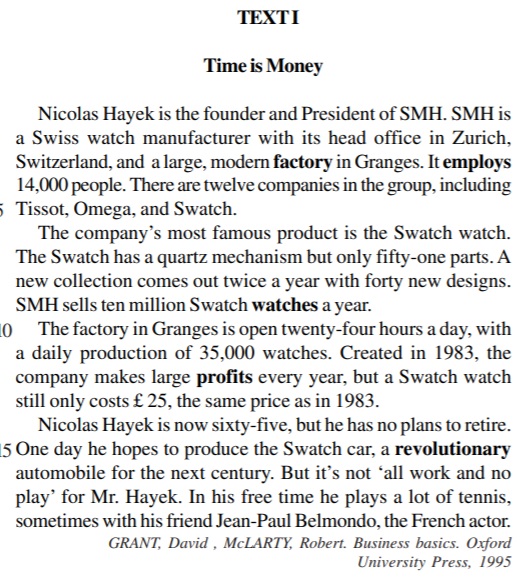
Identifique a classe gramatical das palavras que estão em negrito no texto:
I- “factory”   II- “employs”   III- “watches”   IV- “profit”   V- “revolutionary”

Marque a alternativa que possui a seqüência correta das respostas:

Alternativas
Ano: 2019 Banca: Inatel Órgão: Inatel Prova: Inatel - 2019 - Inatel - Vestibular - Junho |
Q1369374 Inglês
How alcohol damages stem cell DNA and increases cancer risk.


LONDON (Reuters) - Drinking alcohol produces a harmful chemical in the body which can lead to permanent genetic damage in the DNA of stem cells, increasing the risk of cancer developing, according to research published on Wednesday.

Working with mice in a laboratory, British scientists used chromosome analysis and DNA sequencing to examine the genetic damage caused by acetaldehyde, a harmful chemical produced when the body processes alcohol.

Their findings offered more detail about how alcohol increases the risk of developing 7 types of cancer, including common forms such as breast and bowel cancer. It also showed how the body seeks to defend against the damage alcohol can do.“Some cancers develop due to DNA damage in stem cells. While some damage occurs by chance, our findings suggest that drinking alcohol can increase the risk of this damage,” said Ketan Patel, a professor at the Medical Research Council Laboratory of Molecular Biology, who co-led the study. The World Health Organization’s International Agency for Research on Cancer classifies alcohol as a Group 1 carcinogen, citing “convincing evidence” it causes cancer in humans.

In Wednesday’s study, published in the journal Nature, Patel’s team gave diluted alcohol to mice and then analyzed the effect on the animals’ DNA. They found that acetaldehyde can break and damage DNA within blood stem cells, permanently altering the DNA sequences within these cells.

This is important, Patel said, because when healthy stem cells become faulty, they can give rise to cancerous cells.

Source: www.reuters.com/article/us-health-cancer-alcohol/how alcohol-damages-stem-celldna-and-increases-cancer-risk-idUSKB1ES1N2 
Pate said: “When healthy stem cells become faulty, they can rise to cancerous cells.” (Opposite)
Alternativas
Ano: 2019 Banca: UNIOESTE Órgão: UNIOESTE Prova: UNIOESTE - 2019 - UNIOESTE - Vestibular - Inglês |
Q1303659 Inglês

Leia o texto e responda à questão.


Adapted from: https://www.dailymail.co.uk/sciencetech/article-7399879/European-capital-cities-dominate-list-worlds-FASTEST-public-transport-systems.html Last access: August, 29, 2019.

Qual alternativa abaixo contém um exemplo do uso do superlativo?
Alternativas
Ano: 2019 Banca: UEG Órgão: UEG Prova: UEG - 2019 - UEG - Vestibular - Medicina - Inglês |
Q1300891 Inglês

Leia o texto a seguir para responder à questão. 

Artificial intelligence and the future of medicine

Washington University researchers are working to develop artificial intelligence (AI) systems for health care, which have the potential to transform the diagnosis and treatment of diseases, helping to ensure that patients get the right treatment at the right time.
In health care, artificial intelligence relies on the power of computers to sift through and make sense of reams of electronic data about patients—such as their ages, medical histories, health status, test results, medical images, DNA sequences, and many other sources of health information. AI excels at the complex identification of patterns in these reams of data, and it can do this at a scale and speed beyond human capacity. The hope is that this technology can be harnessed to help doctors and patients make better health-care decisions.


Where are the first places we will start to see AI entering medical practice?

One of the first applications of AI in patient care that we currently see is in imaging, to help improve the diagnosis of cancer or heart problems, for example. There are many types of imaging tests —X-rays, CT scans, MRIs and echocardiograms. But the underlying commonality in all those imaging methods is huge amounts of high-quality data. For AI to work well, it's best to have very complete data sets—no missing numbers, so to speak—and digital images provide that. Plus, the human eye is often blind to some of the patterns that could be present in these images—subtle changes in breast tissue over several years of mammograms, for example. There has been some interesting work done in recognizing early patterns of cancer or early patterns of heart failure that even a highly trained physician would not see.
In many ways, we already have very simple forms of AI in the clinic now. We've had tools for a long time that identify abnormal rhythms in an EKG, for example. An abnormal heartbeat pattern triggers an alert to draw a clinician's attention. This is a computer trying to replicate a human being understanding that data and saying, "This doesn't look normal, you may need to address this problem." Now, we have the capacity to analyze much larger and more complex sources of data, such as the entire electronic health record and perhaps even data pulled from daily life, as more people track their sleep patterns or pulse rates with wearable devices, for example.


What effect will this have on how doctors practice medicine?

It's important to emphasize that these tools are never going to replace clinicians. These technologies will provide assistance, helping care providers see important signals in massive amounts of data that would otherwise remain hidden. But at the same time, there are levels of understanding that computers still can't and may never replicate. To take a treatment recommendation from an AI, even an excellent recommendation, and decide if it's right for the patient is inherently a human decision-making process. What are the patient's preferences? What are the patient's values? What does this mean for the patient's life and for his or her family? That's never going to be an AI function. As these AI systems slowly emerge, we may start to see the roles of physicians changing—in my opinion, in better ways. Doctors' roles may shift from being data collectors and analyzers to being interpreters and councilors for patients as they try to navigate their health. 
Right now, the challenges we need to address as we try to bring AI into medical practice include improving the quality of the data that we feed into AI systems, developing ways to evaluate whether an AI system is actually better than standard of care, ensuring patient privacy and making sure not only that AI doesn't disrupt clinical work flow but in fact improves it. But if doctors do their jobs right and build these systems well, much of what we have described will become so ingrained in the system, people won't even refer to it separately as informatics or AI. It will just be medicine. 

Disponível em: https://medicalxpress.com/news/2018-12-artificial-intelligence-future-medicine.html. Acesso em: 02 maio 2019.
Analisando-se os aspectos linguísticos e estruturais do texto, constata-se que
Alternativas
Ano: 2019 Banca: UNIVESP Órgão: UNIVESP Prova: UNIVESP - 2019 - UNIVESP - Vestibular 1º semestre |
Q1280806 Inglês
Utilize o texto a seguir para responder a questão.

NO DIFFERENCE

Small as a peanut,
Big as a giant,
We’re all the same size
When we turn off the light.

Rich as a sultan,
Poor as a mite,
We’re all worth the same
When we turn off the light.

Red, black or orange,
Yellow or white,
We all look the same
When we turn off the light

So maybe the way
To make everything right
Is for God just reach out
And turn off the light!

(Where the Sidewalk Ends, the poems and drawings of Shel Silverstein. New York, Harper Collins Publishers, 1974)
De acordo com o texto, assinale a alternativa incorreta na oposição de adjetivos.
Alternativas
Respostas
1: E
2: D
3: A
4: C
5: E
6: B
7: A
8: A
9: C
10: E
11: E
12: D
13: D
14: C
15: C
16: B
17: C
18: B
19: A
20: D