Questões de Concurso
Para pesquisador tecnologista em metrologia e qualidade - informática aplicada à metrologia legal
Foram encontradas 70 questões
Resolva questões gratuitamente!
Junte-se a mais de 4 milhões de concurseiros!


Ano: 2010
Banca:
CESPE / CEBRASPE
Órgão:
INMETRO
Provas:
CESPE - 2010 - INMETRO - Cargos de Nível Superior
|
CESPE - 2010 - INMETRO - Analista Executivo em Metrologia e Qualidade - Avaliação da Conformidade |
CESPE - 2010 - INMETRO - Pesquisador Tecnologista em Metrologia e Qualidade - Informática Aplicada à Metrologia Legal |
CESPE - 2010 - INMETRO - Pesquisador Tecnologista - Acreditação |
Q109430
Atualidades
Em fins de agosto de 2010, setenta e dois imigrantes latino- americanos que se dirigiam ao México foram brutalmente assassinados. Eram 58 homens e 14 mulheres. As vítimas estavam vendadas e amarradas, algumas com os braços entrelaçados por baixo das pernas para eliminar as chances de fuga.
Veja, 1.o/9/2010, p. 145-6 (com adaptações).
Com relação ao massacre de que trata o fragmento de texto acima, assinale a opção correta.
Veja, 1.o/9/2010, p. 145-6 (com adaptações).
Com relação ao massacre de que trata o fragmento de texto acima, assinale a opção correta.
Ano: 2010
Banca:
CESPE / CEBRASPE
Órgão:
INMETRO
Provas:
CESPE - 2010 - INMETRO - Cargos de Nível Superior
|
CESPE - 2010 - INMETRO - Analista Executivo em Metrologia e Qualidade - Avaliação da Conformidade |
CESPE - 2010 - INMETRO - Pesquisador Tecnologista em Metrologia e Qualidade - Informática Aplicada à Metrologia Legal |
CESPE - 2010 - INMETRO - Pesquisador Tecnologista - Acreditação |
Q109429
Atualidades
Nos últimos 35 anos, o Brasil passou por uma impressionante transformação. Completou a transição de país rural para sociedade urbana e industrial. Isso resultou em uma impressionante mudança no padrão físico do brasileiro. Desde 1974, quando foi feita a primeira pesquisa familiar que registrou peso e altura dos entrevistados, a população tornou-se mais alta. O deficit de altura entre crianças declinou da faixa dos 30% para menos de 10%. Infelizmente, nesse mesmo período, o brasileiro ganhou peso. Muito peso.
Internet: <www.veja.abril.com.br> (com adaptações).
Considerando as informações do texto, assinale a opção correta acerca das mudanças no padrão físico do brasileiro.
Internet: <www.veja.abril.com.br> (com adaptações).
Considerando as informações do texto, assinale a opção correta acerca das mudanças no padrão físico do brasileiro.
Ano: 2010
Banca:
CESPE / CEBRASPE
Órgão:
INMETRO
Provas:
CESPE - 2010 - INMETRO - Cargos de Nível Superior
|
CESPE - 2010 - INMETRO - Analista Executivo em Metrologia e Qualidade - Avaliação da Conformidade |
CESPE - 2010 - INMETRO - Pesquisador Tecnologista em Metrologia e Qualidade - Informática Aplicada à Metrologia Legal |
CESPE - 2010 - INMETRO - Pesquisador Tecnologista - Acreditação |
Q109428
Atualidades
Em junho de 2010, a Agência Nacional de Vigilância Sanitária (ANVISA) publicou a Resolução n.º 24/2010, com mudanças substanciais no que diz respeito, entre outros aspectos, a oferta, propaganda, publicidade e informação de determinados tipos de alimentos, o que levou a inúmeros questionamentos, inclusive judiciais. Assinale a opção correta no que se refere às novidades propostas por essa resolução.
Ano: 2010
Banca:
CESPE / CEBRASPE
Órgão:
INMETRO
Provas:
CESPE - 2010 - INMETRO - Cargos de Nível Superior
|
CESPE - 2010 - INMETRO - Analista Executivo em Metrologia e Qualidade - Avaliação da Conformidade |
CESPE - 2010 - INMETRO - Pesquisador Tecnologista em Metrologia e Qualidade - Informática Aplicada à Metrologia Legal |
CESPE - 2010 - INMETRO - Pesquisador Tecnologista - Acreditação |
Q109427
Atualidades
Cuba tem sido frequentemente questionada sobre a maneira como trata seus presos políticos, fato que recebeu grande repercussão na imprensa brasileira e mundial em 2010. A respeito desse aspecto da vida política cubana, assinale a opção correta.
Ano: 2010
Banca:
CESPE / CEBRASPE
Órgão:
INMETRO
Provas:
CESPE - 2010 - INMETRO - Cargos de Nível Superior
|
CESPE - 2010 - INMETRO - Analista Executivo em Metrologia e Qualidade - Avaliação da Conformidade |
CESPE - 2010 - INMETRO - Pesquisador Tecnologista em Metrologia e Qualidade - Informática Aplicada à Metrologia Legal |
CESPE - 2010 - INMETRO - Pesquisador Tecnologista - Acreditação |
Q109426
Atualidades
As eleições brasileiras de 2010 foram mobilizadas em torno da questão da Lei da Ficha Limpa e de quais candidatos se adequariam ou não às regras dessa nova lei. Acerca da Lei da Ficha Limpa, assinale a opção correta.
Ano: 2010
Banca:
CESPE / CEBRASPE
Órgão:
INMETRO
Provas:
CESPE - 2010 - INMETRO - Cargos de Nível Superior
|
CESPE - 2010 - INMETRO - Analista Executivo em Metrologia e Qualidade - Avaliação da Conformidade |
CESPE - 2010 - INMETRO - Pesquisador Tecnologista em Metrologia e Qualidade - Informática Aplicada à Metrologia Legal |
CESPE - 2010 - INMETRO - Pesquisador Tecnologista - Acreditação |
Q109425
Atualidades
O Irã, desde a revolução que derrubou o xá Reza Pahlevi, tem exercido papel atuante nas relações internacionais, estando com frequência em destaque devido a conflitos com outros países. Assinale a opção correta acerca do relacionamento do Irã com o restante do mundo.
Ano: 2010
Banca:
CESPE / CEBRASPE
Órgão:
INMETRO
Provas:
CESPE - 2010 - INMETRO - Cargos de Nível Superior
|
CESPE - 2010 - INMETRO - Analista Executivo em Metrologia e Qualidade - Avaliação da Conformidade |
CESPE - 2010 - INMETRO - Pesquisador Tecnologista em Metrologia e Qualidade - Informática Aplicada à Metrologia Legal |
CESPE - 2010 - INMETRO - Pesquisador Tecnologista - Acreditação |
Q109424
Atualidades
Incomoda os pecuaristas brasileiros a imagem que o mundo faz deles — cada vez pior à medida que os negócios prosperam. Não se conformam com as críticas pesadas de ambientalistas, autoridades da saúde, procuradores de justiça, grupos vegetarianos e até mesmo de outros produtores rurais, que os consideram a parte mais retrógrada do agronegócio.
CartaCapital, set./2010 (com adaptações).
Tendo o texto acima como referência inicial, assinale a opção correta a respeito da agropecuária brasileira e de seus impactos sobre o meio ambiente.
CartaCapital, set./2010 (com adaptações).
Tendo o texto acima como referência inicial, assinale a opção correta a respeito da agropecuária brasileira e de seus impactos sobre o meio ambiente.
Ano: 2010
Banca:
CESPE / CEBRASPE
Órgão:
INMETRO
Provas:
CESPE - 2010 - INMETRO - Cargos de Nível Superior
|
CESPE - 2010 - INMETRO - Analista Executivo em Metrologia e Qualidade - Avaliação da Conformidade |
CESPE - 2010 - INMETRO - Pesquisador Tecnologista em Metrologia e Qualidade - Informática Aplicada à Metrologia Legal |
CESPE - 2010 - INMETRO - Pesquisador Tecnologista - Acreditação |
Q109423
Inglês


In the fragment “OIML members cover in total an astounding 86% of the world’s population” (L.13-15), the term “astounding” is synonymous with
Ano: 2010
Banca:
CESPE / CEBRASPE
Órgão:
INMETRO
Provas:
CESPE - 2010 - INMETRO - Cargos de Nível Superior
|
CESPE - 2010 - INMETRO - Analista Executivo em Metrologia e Qualidade - Avaliação da Conformidade |
CESPE - 2010 - INMETRO - Pesquisador Tecnologista em Metrologia e Qualidade - Informática Aplicada à Metrologia Legal |
CESPE - 2010 - INMETRO - Pesquisador Tecnologista - Acreditação |
Q109422
Inglês
From the text, it can be concluded that
Ano: 2010
Banca:
CESPE / CEBRASPE
Órgão:
INMETRO
Provas:
CESPE - 2010 - INMETRO - Cargos de Nível Superior
|
CESPE - 2010 - INMETRO - Analista Executivo em Metrologia e Qualidade - Avaliação da Conformidade |
CESPE - 2010 - INMETRO - Pesquisador Tecnologista em Metrologia e Qualidade - Informática Aplicada à Metrologia Legal |
CESPE - 2010 - INMETRO - Pesquisador Tecnologista - Acreditação |
Q109421
Inglês
It is correct to conclude from the text that
Ano: 2010
Banca:
CESPE / CEBRASPE
Órgão:
INMETRO
Provas:
CESPE - 2010 - INMETRO - Cargos de Nível Superior
|
CESPE - 2010 - INMETRO - Analista Executivo em Metrologia e Qualidade - Avaliação da Conformidade |
CESPE - 2010 - INMETRO - Pesquisador Tecnologista em Metrologia e Qualidade - Informática Aplicada à Metrologia Legal |
CESPE - 2010 - INMETRO - Pesquisador Tecnologista - Acreditação |
Q109420
Inglês
According to what is stated in the text, choose the correct option.
Ano: 2010
Banca:
CESPE / CEBRASPE
Órgão:
INMETRO
Provas:
CESPE - 2010 - INMETRO - Cargos de Nível Superior
|
CESPE - 2010 - INMETRO - Analista Executivo em Metrologia e Qualidade - Avaliação da Conformidade |
CESPE - 2010 - INMETRO - Pesquisador Tecnologista em Metrologia e Qualidade - Informática Aplicada à Metrologia Legal |
CESPE - 2010 - INMETRO - Pesquisador Tecnologista - Acreditação |
Q109419
Inglês
Texto associado
This text refers to questions from 16 through 19.
In today’s society, measurements are used for many applications not only in industry and science but also in our daily life. There are measurements involved such as when buying petrol or foodstuff from the shop or energy from utilities; when trying to keep within the speed limits when driving your car; in health analyses when doctors diagnose and treat on the basis of blood pressure measurements; or when authorities make measurements to control the pollution in the air that we all breathe. Common to all these situations is that the measurement results need to be accepted (with confidence) by society. If not, the result is repeated measurements, disputes and legal actions. In most cases, the consumer or even the user of the measuring instrument does not personally have either the knowledge, the opportunity or the equipment to check whether the measurement that is so important for us is correct or not. In most countries, the legislature therefore has decided to set accuracy requirements for these types of measurements; most commonly, measurements in trade are regulated, but increasingly, also those within the health and environmental sectors.
Ongoing harmonization in Europe has become more and more the first reference point for authorities in the establishment of requirements for measurements, as requirements for new
measuring instruments are stated in directives; the most important of these directives being the Measuring Instrument Directive (MID) and the directive on Non-Automatic Weighing Instruments
(NAWI). For many of the instrument categories covered by the directives, there is a national possibility to select the prescription of different accuracy classes for different applications, and furthermore, to decide on what maximum permissible errors (MPEs) to apply in-service.

In today’s society, measurements are used for many applications not only in industry and science but also in our daily life. There are measurements involved such as when buying petrol or foodstuff from the shop or energy from utilities; when trying to keep within the speed limits when driving your car; in health analyses when doctors diagnose and treat on the basis of blood pressure measurements; or when authorities make measurements to control the pollution in the air that we all breathe. Common to all these situations is that the measurement results need to be accepted (with confidence) by society. If not, the result is repeated measurements, disputes and legal actions. In most cases, the consumer or even the user of the measuring instrument does not personally have either the knowledge, the opportunity or the equipment to check whether the measurement that is so important for us is correct or not. In most countries, the legislature therefore has decided to set accuracy requirements for these types of measurements; most commonly, measurements in trade are regulated, but increasingly, also those within the health and environmental sectors.
Ongoing harmonization in Europe has become more and more the first reference point for authorities in the establishment of requirements for measurements, as requirements for new
measuring instruments are stated in directives; the most important of these directives being the Measuring Instrument Directive (MID) and the directive on Non-Automatic Weighing Instruments
(NAWI). For many of the instrument categories covered by the directives, there is a national possibility to select the prescription of different accuracy classes for different applications, and furthermore, to decide on what maximum permissible errors (MPEs) to apply in-service.
Based on the text, one can infer that
Ano: 2010
Banca:
CESPE / CEBRASPE
Órgão:
INMETRO
Provas:
CESPE - 2010 - INMETRO - Cargos de Nível Superior
|
CESPE - 2010 - INMETRO - Analista Executivo em Metrologia e Qualidade - Avaliação da Conformidade |
CESPE - 2010 - INMETRO - Pesquisador Tecnologista em Metrologia e Qualidade - Informática Aplicada à Metrologia Legal |
CESPE - 2010 - INMETRO - Pesquisador Tecnologista - Acreditação |
Q109418
Inglês
Texto associado
This text refers to questions from 16 through 19.
In today’s society, measurements are used for many applications not only in industry and science but also in our daily life. There are measurements involved such as when buying petrol or foodstuff from the shop or energy from utilities; when trying to keep within the speed limits when driving your car; in health analyses when doctors diagnose and treat on the basis of blood pressure measurements; or when authorities make measurements to control the pollution in the air that we all breathe. Common to all these situations is that the measurement results need to be accepted (with confidence) by society. If not, the result is repeated measurements, disputes and legal actions. In most cases, the consumer or even the user of the measuring instrument does not personally have either the knowledge, the opportunity or the equipment to check whether the measurement that is so important for us is correct or not. In most countries, the legislature therefore has decided to set accuracy requirements for these types of measurements; most commonly, measurements in trade are regulated, but increasingly, also those within the health and environmental sectors.
Ongoing harmonization in Europe has become more and more the first reference point for authorities in the establishment of requirements for measurements, as requirements for new
measuring instruments are stated in directives; the most important of these directives being the Measuring Instrument Directive (MID) and the directive on Non-Automatic Weighing Instruments
(NAWI). For many of the instrument categories covered by the directives, there is a national possibility to select the prescription of different accuracy classes for different applications, and furthermore, to decide on what maximum permissible errors (MPEs) to apply in-service.
In today’s society, measurements are used for many applications not only in industry and science but also in our daily life. There are measurements involved such as when buying petrol or foodstuff from the shop or energy from utilities; when trying to keep within the speed limits when driving your car; in health analyses when doctors diagnose and treat on the basis of blood pressure measurements; or when authorities make measurements to control the pollution in the air that we all breathe. Common to all these situations is that the measurement results need to be accepted (with confidence) by society. If not, the result is repeated measurements, disputes and legal actions. In most cases, the consumer or even the user of the measuring instrument does not personally have either the knowledge, the opportunity or the equipment to check whether the measurement that is so important for us is correct or not. In most countries, the legislature therefore has decided to set accuracy requirements for these types of measurements; most commonly, measurements in trade are regulated, but increasingly, also those within the health and environmental sectors.
Ongoing harmonization in Europe has become more and more the first reference point for authorities in the establishment of requirements for measurements, as requirements for new
measuring instruments are stated in directives; the most important of these directives being the Measuring Instrument Directive (MID) and the directive on Non-Automatic Weighing Instruments
(NAWI). For many of the instrument categories covered by the directives, there is a national possibility to select the prescription of different accuracy classes for different applications, and furthermore, to decide on what maximum permissible errors (MPEs) to apply in-service.
According to the text, it can be deduced that
Ano: 2010
Banca:
CESPE / CEBRASPE
Órgão:
INMETRO
Provas:
CESPE - 2010 - INMETRO - Cargos de Nível Superior
|
CESPE - 2010 - INMETRO - Analista Executivo em Metrologia e Qualidade - Avaliação da Conformidade |
CESPE - 2010 - INMETRO - Pesquisador Tecnologista em Metrologia e Qualidade - Informática Aplicada à Metrologia Legal |
CESPE - 2010 - INMETRO - Pesquisador Tecnologista - Acreditação |
Q109417
Inglês
Texto associado
This text refers to questions from 16 through 19.
In today’s society, measurements are used for many applications not only in industry and science but also in our daily life. There are measurements involved such as when buying petrol or foodstuff from the shop or energy from utilities; when trying to keep within the speed limits when driving your car; in health analyses when doctors diagnose and treat on the basis of blood pressure measurements; or when authorities make measurements to control the pollution in the air that we all breathe. Common to all these situations is that the measurement results need to be accepted (with confidence) by society. If not, the result is repeated measurements, disputes and legal actions. In most cases, the consumer or even the user of the measuring instrument does not personally have either the knowledge, the opportunity or the equipment to check whether the measurement that is so important for us is correct or not. In most countries, the legislature therefore has decided to set accuracy requirements for these types of measurements; most commonly, measurements in trade are regulated, but increasingly, also those within the health and environmental sectors.
Ongoing harmonization in Europe has become more and more the first reference point for authorities in the establishment of requirements for measurements, as requirements for new
measuring instruments are stated in directives; the most important of these directives being the Measuring Instrument Directive (MID) and the directive on Non-Automatic Weighing Instruments
(NAWI). For many of the instrument categories covered by the directives, there is a national possibility to select the prescription of different accuracy classes for different applications, and furthermore, to decide on what maximum permissible errors (MPEs) to apply in-service.
In today’s society, measurements are used for many applications not only in industry and science but also in our daily life. There are measurements involved such as when buying petrol or foodstuff from the shop or energy from utilities; when trying to keep within the speed limits when driving your car; in health analyses when doctors diagnose and treat on the basis of blood pressure measurements; or when authorities make measurements to control the pollution in the air that we all breathe. Common to all these situations is that the measurement results need to be accepted (with confidence) by society. If not, the result is repeated measurements, disputes and legal actions. In most cases, the consumer or even the user of the measuring instrument does not personally have either the knowledge, the opportunity or the equipment to check whether the measurement that is so important for us is correct or not. In most countries, the legislature therefore has decided to set accuracy requirements for these types of measurements; most commonly, measurements in trade are regulated, but increasingly, also those within the health and environmental sectors.
Ongoing harmonization in Europe has become more and more the first reference point for authorities in the establishment of requirements for measurements, as requirements for new
measuring instruments are stated in directives; the most important of these directives being the Measuring Instrument Directive (MID) and the directive on Non-Automatic Weighing Instruments
(NAWI). For many of the instrument categories covered by the directives, there is a national possibility to select the prescription of different accuracy classes for different applications, and furthermore, to decide on what maximum permissible errors (MPEs) to apply in-service.
It can be concluded from the text that
Ano: 2010
Banca:
CESPE / CEBRASPE
Órgão:
INMETRO
Provas:
CESPE - 2010 - INMETRO - Cargos de Nível Superior
|
CESPE - 2010 - INMETRO - Analista Executivo em Metrologia e Qualidade - Avaliação da Conformidade |
CESPE - 2010 - INMETRO - Pesquisador Tecnologista em Metrologia e Qualidade - Informática Aplicada à Metrologia Legal |
CESPE - 2010 - INMETRO - Pesquisador Tecnologista - Acreditação |
Q109416
Inglês
Texto associado
This text refers to questions from 16 through 19.
In today’s society, measurements are used for many applications not only in industry and science but also in our daily life. There are measurements involved such as when buying petrol or foodstuff from the shop or energy from utilities; when trying to keep within the speed limits when driving your car; in health analyses when doctors diagnose and treat on the basis of blood pressure measurements; or when authorities make measurements to control the pollution in the air that we all breathe. Common to all these situations is that the measurement results need to be accepted (with confidence) by society. If not, the result is repeated measurements, disputes and legal actions. In most cases, the consumer or even the user of the measuring instrument does not personally have either the knowledge, the opportunity or the equipment to check whether the measurement that is so important for us is correct or not. In most countries, the legislature therefore has decided to set accuracy requirements for these types of measurements; most commonly, measurements in trade are regulated, but increasingly, also those within the health and environmental sectors.
Ongoing harmonization in Europe has become more and more the first reference point for authorities in the establishment of requirements for measurements, as requirements for new
measuring instruments are stated in directives; the most important of these directives being the Measuring Instrument Directive (MID) and the directive on Non-Automatic Weighing Instruments
(NAWI). For many of the instrument categories covered by the directives, there is a national possibility to select the prescription of different accuracy classes for different applications, and furthermore, to decide on what maximum permissible errors (MPEs) to apply in-service.
In today’s society, measurements are used for many applications not only in industry and science but also in our daily life. There are measurements involved such as when buying petrol or foodstuff from the shop or energy from utilities; when trying to keep within the speed limits when driving your car; in health analyses when doctors diagnose and treat on the basis of blood pressure measurements; or when authorities make measurements to control the pollution in the air that we all breathe. Common to all these situations is that the measurement results need to be accepted (with confidence) by society. If not, the result is repeated measurements, disputes and legal actions. In most cases, the consumer or even the user of the measuring instrument does not personally have either the knowledge, the opportunity or the equipment to check whether the measurement that is so important for us is correct or not. In most countries, the legislature therefore has decided to set accuracy requirements for these types of measurements; most commonly, measurements in trade are regulated, but increasingly, also those within the health and environmental sectors.
Ongoing harmonization in Europe has become more and more the first reference point for authorities in the establishment of requirements for measurements, as requirements for new
measuring instruments are stated in directives; the most important of these directives being the Measuring Instrument Directive (MID) and the directive on Non-Automatic Weighing Instruments
(NAWI). For many of the instrument categories covered by the directives, there is a national possibility to select the prescription of different accuracy classes for different applications, and furthermore, to decide on what maximum permissible errors (MPEs) to apply in-service.
Based on the text, choose de correct option.
Ano: 2010
Banca:
CESPE / CEBRASPE
Órgão:
INMETRO
Provas:
CESPE - 2010 - INMETRO - Cargos de Nível Superior
|
CESPE - 2010 - INMETRO - Analista Executivo em Metrologia e Qualidade - Avaliação da Conformidade |
CESPE - 2010 - INMETRO - Pesquisador Tecnologista em Metrologia e Qualidade - Informática Aplicada à Metrologia Legal |
CESPE - 2010 - INMETRO - Pesquisador Tecnologista - Acreditação |
Q109415
Redação Oficial
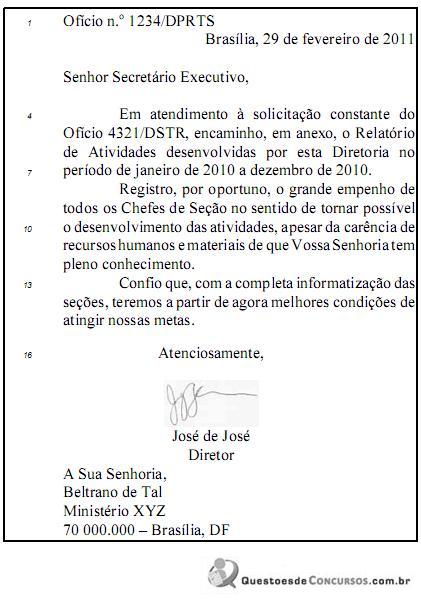
Para que o exemplo fictício de documento apresentado acima respeite as normas de elaboração de documentos oficiais, é necessário
Ano: 2010
Banca:
CESPE / CEBRASPE
Órgão:
INMETRO
Provas:
CESPE - 2010 - INMETRO - Cargos de Nível Superior
|
CESPE - 2010 - INMETRO - Analista Executivo em Metrologia e Qualidade - Avaliação da Conformidade |
CESPE - 2010 - INMETRO - Pesquisador Tecnologista em Metrologia e Qualidade - Informática Aplicada à Metrologia Legal |
CESPE - 2010 - INMETRO - Pesquisador Tecnologista - Acreditação |
Q109414
Redação Oficial
Assinale a opção que apresenta associação correta entre o documento indicado e o fechamento apresentado.
Ano: 2010
Banca:
CESPE / CEBRASPE
Órgão:
INMETRO
Provas:
CESPE - 2010 - INMETRO - Cargos de Nível Superior
|
CESPE - 2010 - INMETRO - Analista Executivo em Metrologia e Qualidade - Avaliação da Conformidade |
CESPE - 2010 - INMETRO - Pesquisador Tecnologista em Metrologia e Qualidade - Informática Aplicada à Metrologia Legal |
CESPE - 2010 - INMETRO - Pesquisador Tecnologista - Acreditação |
Q109413
Português


Depreende-se da argumentação do texto que
Ano: 2010
Banca:
CESPE / CEBRASPE
Órgão:
INMETRO
Provas:
CESPE - 2010 - INMETRO - Cargos de Nível Superior
|
CESPE - 2010 - INMETRO - Analista Executivo em Metrologia e Qualidade - Avaliação da Conformidade |
CESPE - 2010 - INMETRO - Pesquisador Tecnologista em Metrologia e Qualidade - Informática Aplicada à Metrologia Legal |
CESPE - 2010 - INMETRO - Pesquisador Tecnologista - Acreditação |
Q109412
Português
Assinale a opção que apresenta reescrita textualmente coerente e gramaticalmente correta do trecho “se conseguirmos afinal (...) escrevendo, editando.” (L.21-25).
Ano: 2010
Banca:
CESPE / CEBRASPE
Órgão:
INMETRO
Provas:
CESPE - 2010 - INMETRO - Cargos de Nível Superior
|
CESPE - 2010 - INMETRO - Analista Executivo em Metrologia e Qualidade - Avaliação da Conformidade |
CESPE - 2010 - INMETRO - Pesquisador Tecnologista em Metrologia e Qualidade - Informática Aplicada à Metrologia Legal |
CESPE - 2010 - INMETRO - Pesquisador Tecnologista - Acreditação |
Q109411
Português
Preservam-se a correção gramatical e a coerência textual ao se fazer a substituição

 Conheça nossos planos