Selecionar segmento
Estude com questões de diferentes segmentos
Atenção: Isso limpará todos os campos já preenchidos no filtro!
Foram encontradas 1.276 questões
Resolva questões gratuitamente!
Junte-se a mais de 4 milhões de concurseiros!


Ano: 2025
Banca:
IDCAP
Órgão:
PPSA
Prova:
IDCAP - 2025 - PPSA - Especialista em Petróleo e Gás - Engenharia Submarina |
Q3843194
Engenharia de Petróleo
Com relação a utilização do PIPESIM, quais itens abaixo podemos afirmar que são corretos?
I.O simulador PIPESIM se aplica apenas a situações de fluxo transiente.
II.O simulador PIPESIM permite avaliar a influência na produção do poço, segundo a variação do diâmetro da flowline.
III.O simulador PIPESIM permite análise de eventuais obstruções nos dutos.
IV.O simulador PIPESIM NÃO se aplica a poços com alto BSW.
É correto o que se afirma em:
I.O simulador PIPESIM se aplica apenas a situações de fluxo transiente.
II.O simulador PIPESIM permite avaliar a influência na produção do poço, segundo a variação do diâmetro da flowline.
III.O simulador PIPESIM permite análise de eventuais obstruções nos dutos.
IV.O simulador PIPESIM NÃO se aplica a poços com alto BSW.
É correto o que se afirma em:
Ano: 2025
Banca:
IDCAP
Órgão:
PPSA
Prova:
IDCAP - 2025 - PPSA - Especialista em Petróleo e Gás - Engenharia Submarina |
Q3843193
Engenharia de Petróleo
Considerando o desenvolvimento tecnológico para viabilizar a produção do pré-sal, podemos citar as seguintes relevantes contribuições tecnológicas, mas umas das opções abaixo não é correta, qual seria?
Ano: 2025
Banca:
IDCAP
Órgão:
PPSA
Prova:
IDCAP - 2025 - PPSA - Especialista em Petróleo e Gás - Engenharia Submarina |
Q3843192
Engenharia de Petróleo
Observe as afirmativas a seguir:
I.Um PLET (Pipeline End Termination) é um equipamento submarino, de uma única saída, a ser conectada a uma instalação, normalmente, a jusante.
II.Um PLEM (Pipeline End Manifold) é um manifold submarino simplificado que permite a instalação de ANM também simplificada.
III.Manifolds podem também ser usados para permitir que um grupo de poços compartilhe sistemas de gas lift.
É correto o que se afirma em:
I.Um PLET (Pipeline End Termination) é um equipamento submarino, de uma única saída, a ser conectada a uma instalação, normalmente, a jusante.
II.Um PLEM (Pipeline End Manifold) é um manifold submarino simplificado que permite a instalação de ANM também simplificada.
III.Manifolds podem também ser usados para permitir que um grupo de poços compartilhe sistemas de gas lift.
É correto o que se afirma em:
Ano: 2025
Banca:
IDCAP
Órgão:
PPSA
Prova:
IDCAP - 2025 - PPSA - Especialista em Petróleo e Gás - Engenharia Submarina |
Q3843191
Inglês
Texto associado
O texto seguinte servirá de base para responder às questão.
Texto 2
Driven by pre-salt, oil becomes Brazil's top export
Revenues
The discovery of the pre-salt was so significant for Brazil's oil production potential that it led the government to change the regime that authorized companies to explore the submerged resources.
As a result, the pre-salt areas are governed by the sharing regime. Under this model, surplus oil production—the balance after covering costs—is divided between the company and the Brazilian government. During the auction that authorizes exploration, the company offering the highest share of profits to the federal government is granted the right to explore.
This is distinct from the concession model, which applies to the post-salt period. In this system, the risk of investment and exploration lies with the concessionaire, who becomes the owner of all the oil and gas that may be discovered. In return, the company pays royalties and special participation fees, particularly for large production fields, in addition to a signature bonus upon winning the auction.
New frontiers
With the pre-salt expected to reach its peak in the 2030s, Brazil's oil industry, led by Petrobras, is shifting its focus to new oil frontiers that are believed to hold significant production potential.
One such frontier is the so-called equatorial margin, located off Brazil's northern coast, where exploration is pending a favorable decision from the Brazilian Institute for the Environment and Renewable Natural Resources (Ibama), an agency under the Ministry of the Environment and Climate Change.
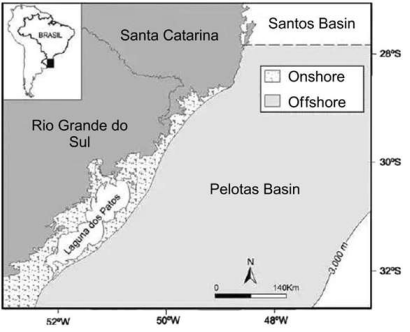
Another promising region is the Pelotas Basin, located off Brazil's southern coast. The growing interest in this area is fueled by the discovery of oil wells in Uruguay and off the coasts of Namibia and South Africa. Experts suggest that the geological conditions in these regions are similar, as the continents were once joined tens of millions of years ago.
According to Petrobras, the company plans to invest $79 billion in exploring new oil and gas frontiers by 2029. Of this amount, 40 percent will be allocated to the South and Southeast regions, 38 percent to the equatorial margin, with the remainder directed towards other countries.
From MOURA, Bruno de Freitas. Driven by pre-salt, oil becomes Brazil's top export. Rio de Janeiro, Agência Brasil, Jan 18th,2025. Accessed on February 21st, 2025
From the sentence The growing interest in this area is fueled by the discovery of oil wells in Uruguay and off the coasts of Namibia and South Africa one can infer that:
Ano: 2025
Banca:
IDCAP
Órgão:
PPSA
Prova:
IDCAP - 2025 - PPSA - Especialista em Petróleo e Gás - Engenharia Submarina |
Q3843187
Inglês
Texto associado
O texto seguinte servirá de base para responder às questão.
Texto 2
Driven by pre-salt, oil becomes Brazil's top export
Revenues
The discovery of the pre-salt was so significant for Brazil's oil production potential that it led the government to change the regime that authorized companies to explore the submerged resources.
As a result, the pre-salt areas are governed by the sharing regime. Under this model, surplus oil production—the balance after covering costs—is divided between the company and the Brazilian government. During the auction that authorizes exploration, the company offering the highest share of profits to the federal government is granted the right to explore.
This is distinct from the concession model, which applies to the post-salt period. In this system, the risk of investment and exploration lies with the concessionaire, who becomes the owner of all the oil and gas that may be discovered. In return, the company pays royalties and special participation fees, particularly for large production fields, in addition to a signature bonus upon winning the auction.
New frontiers
With the pre-salt expected to reach its peak in the 2030s, Brazil's oil industry, led by Petrobras, is shifting its focus to new oil frontiers that are believed to hold significant production potential.
One such frontier is the so-called equatorial margin, located off Brazil's northern coast, where exploration is pending a favorable decision from the Brazilian Institute for the Environment and Renewable Natural Resources (Ibama), an agency under the Ministry of the Environment and Climate Change.
Another promising region is the Pelotas Basin, located off Brazil's southern coast. The growing interest in this area is fueled by the discovery of oil wells in Uruguay and off the coasts of Namibia and South Africa. Experts suggest that the geological conditions in these regions are similar, as the continents were once joined tens of millions of years ago.
According to Petrobras, the company plans to invest $79 billion in exploring new oil and gas frontiers by 2029. Of this amount, 40 percent will be allocated to the South and Southeast regions, 38 percent to the equatorial margin, with the remainder directed towards other countries.
From MOURA, Bruno de Freitas. Driven by pre-salt, oil becomes Brazil's top export. Rio de Janeiro, Agência Brasil, Jan 18th,2025. Accessed on February 21st, 2025
The author of text 2 concludes the text with:
Ano: 2025
Banca:
IDCAP
Órgão:
PPSA
Prova:
IDCAP - 2025 - PPSA - Especialista em Petróleo e Gás - Engenharia Submarina |
Q3843185
Inglês
Texto associado
O texto seguinte servirá de base para responder à questão.
Downstream: Refining and Marketing
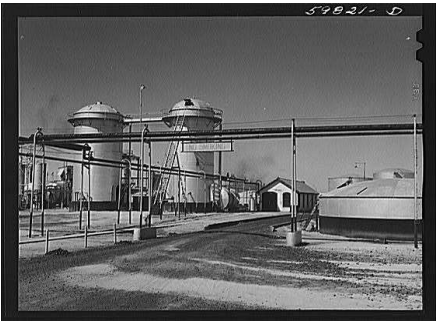
While refining is a complex process, the goal is straightforward: to take crude oil, which is virtually unusable in its natural state, and transform it into petroleum products used for a variety of purposes such as heating homes, fueling vehicles and making petrochemical plastics. Wolcott, Marion Post. Barnsdall oil refinery. Kansas, 1941.
Wolcott, Marion Post. Barnsdall oil refinery. Kansas, 1941.
A number of processes are involved in refining depending on the wanted end product. Hydrotreating is used to remove unwanted elements, such as sulphur and nitrogen from hydrocarbons; cracking breaks molecules into smaller fragments to produce gasoline and other lighter hydrocarbons. The gases produced by cracking are used to create other products like synthetic rubber and plastics. When making gasoline, refiners need high octane numbers to prevent engine knocking. Despite knowing the dangers of lead, tetraethyl lead was added to gasoline in the United States in the 1920s in order to increase the octane. Since the U.S. government banned lead in vehicle gasoline in 1996 as part of the U.S. Clean Air Act, refineries use alkylation and reforming to develop high-octane gasoline.
(From Oil and Gas Industry: A Research Guide, Library of Congress https://guides.loc.gov/oil-and-gas-industry/downstream, accessed on February 19th, 2025)
"By 1996, with the establishment of new federal standards of air pollutants, tetraethyl ______________ to gasoline in the U.S." is suitably filled in with:
Ano: 2025
Banca:
IDCAP
Órgão:
PPSA
Prova:
IDCAP - 2025 - PPSA - Especialista em Petróleo e Gás - Engenharia de Reservatórios |
Q3842726
Engenharia de Petróleo
Os testes de formação executados após a perfuração
dos poços (DST) são fundamentais para a
caracterização do reservatório, ajudando a definir numa
escala macro a produtividade e a permeabilidade. No
caso de poços de gás, qual é a afirmação verdadeira em
relação à AOF (Absolute Open Flow)?
Ano: 2025
Banca:
IDCAP
Órgão:
PPSA
Prova:
IDCAP - 2025 - PPSA - Especialista em Petróleo e Gás - Engenharia de Reservatórios |
Q3842725
Engenharia de Petróleo
Algumas hipóteses simplificadoras são assumidas na
formulação da equação da difusividade. Qual dos
seguintes fatores não é diretamente considerado na
formulação da equação de difusividade para o fluxo
radial?
Ano: 2025
Banca:
IDCAP
Órgão:
PPSA
Prova:
IDCAP - 2025 - PPSA - Especialista em Petróleo e Gás - Engenharia de Reservatórios |
Q3842724
Engenharia de Petróleo
A perfilagem dos poços após a perfuração fornecem
informações das mais importantes para a caracterização
dos reservatórios, tanto da rocha quanto dos fluidos
presentes na rocha. O perfil de resistividade faz parte do
combo básico de perfilagem. Entre as afirmações abaixo,
qual é a que define a principal aplicação deste perfil?
Ano: 2025
Banca:
IDCAP
Órgão:
PPSA
Prova:
IDCAP - 2025 - PPSA - Especialista em Petróleo e Gás - Engenharia de Reservatórios |
Q3842723
Engenharia de Petróleo
Os mecanismos naturais de produção de um reservatório
são determinantes no comportamento e performance da
produção. No caso de reservatórios do tipo gás em
solução, qual dos seguintes comportamentos não é
usual durante a fase de produção?
Ano: 2025
Banca:
IDCAP
Órgão:
PPSA
Prova:
IDCAP - 2025 - PPSA - Especialista em Petróleo e Gás - Engenharia de Reservatórios |
Q3842722
Engenharia de Petróleo
Ainda sobre as curvas de performance de poço
discutidas na questão anterior, entre as seguintes
afirmativas qual é a que descreve corretamente o
impacto da redução da abertura do choke no ponto de
operação de um poço nas curvas IPR e TPR?
Ano: 2025
Banca:
IDCAP
Órgão:
PPSA
Prova:
IDCAP - 2025 - PPSA - Especialista em Petróleo e Gás - Engenharia de Reservatórios |
Q3842721
Engenharia de Petróleo
Em um poço produtor vertical, o fluxo multifásico (óleo,
gás e água) pode apresentar vários padrões de
escoamento. Entre as alternativas abaixo, qual aquela
que corretamente descreve o regime de fluxo no interior
do poço?
Ano: 2025
Banca:
IDCAP
Órgão:
PPSA
Prova:
IDCAP - 2025 - PPSA - Especialista em Petróleo e Gás - Engenharia de Reservatórios |
Q3842720
Engenharia de Petróleo
A pressão de poro é a pressão que os fluidos exercem
nos espaços porosos da rocha, cujo conhecimento é
importante tanto para a fase de perfuração dos poços
quanto para a fase de produção, e é influenciada por
vários fatores. Qual das propriedades abaixo não é um
fator determinante na pressão de poro?
Ano: 2025
Banca:
IDCAP
Órgão:
PPSA
Prova:
IDCAP - 2025 - PPSA - Especialista em Petróleo e Gás - Engenharia de Reservatórios |
Q3842719
Engenharia de Petróleo
A modelagem de fácies é uma etapa importante na
modelagem geológica de reservatórios pois as fácies
controlam a distribuição das propriedades petrofísicas.
Qual das seguintes técnicas é menos adequada para a
modelagem de fácies?
Ano: 2025
Banca:
IDCAP
Órgão:
PPSA
Prova:
IDCAP - 2025 - PPSA - Especialista em Petróleo e Gás - Engenharia de Reservatórios |
Q3842718
Engenharia de Petróleo
Em uma análise PVT, os processos de liberação
diferencial e liberação flash são realizados pois cada um
é mais representativo dos processos desde o fluxo no
reservatório até as instalações de superfície. Sendo
assim, qual das seguintes afirmativas é verdadeira em
relação às aplicações da liberação diferencial e da
liberação flash?
Ano: 2025
Banca:
IDCAP
Órgão:
PPSA
Prova:
IDCAP - 2025 - PPSA - Especialista em Petróleo e Gás - Engenharia de Reservatórios |
Q3842717
Engenharia de Petróleo
Numa modelagem geostatística de um reservatório de
petróleo através da técnica da krigagem, se um
variograma apresenta um pequeno range (alcance) e um
sill (patamar) elevado, o que isso indica sobre a
variabilidade espacial da propriedade sendo modelada?
Ano: 2025
Banca:
IDCAP
Órgão:
PPSA
Prova:
IDCAP - 2025 - PPSA - Especialista em Petróleo e Gás - Engenharia de Reservatórios |
Q3842716
Engenharia de Petróleo
Na medição de propriedades da rocha em laboratório, a
relação entre o volume total de vazios interconectados
de uma rocha e o volume total da rocha, é chamada de:
Ano: 2025
Banca:
IDCAP
Órgão:
PPSA
Prova:
IDCAP - 2025 - PPSA - Especialista em Petróleo e Gás - Engenharia de Reservatórios |
Q3842715
Engenharia de Petróleo
Entre as afirmações abaixo, selecione aquela que não é
correta.
Ano: 2025
Banca:
IDCAP
Órgão:
PPSA
Prova:
IDCAP - 2025 - PPSA - Especialista em Petróleo e Gás - Engenharia de Reservatórios |
Q3842714
Engenharia de Petróleo
A fase de ajuste de histórico numa simulação numérica
de reservatórios é determinante para a adequação do
modelo geológico e dinâmico. Entre as afirmações
abaixo, selecione a alternativa falsa.
Ano: 2025
Banca:
IDCAP
Órgão:
PPSA
Prova:
IDCAP - 2025 - PPSA - Especialista em Petróleo e Gás - Engenharia de Reservatórios |
Q3842713
Engenharia de Petróleo
Processos relacionados aos ambientes deposicionais e
processos diagenéticos são responsáveis pela
determinação das características das rochas
reservatório. Entre as alternativas abaixo, selecione
aquela que não está correta.

 Conheça nossos planos