Questões de Concurso
Para analista de planejamento e orçamento
Foram encontradas 1.446 questões
Resolva questões gratuitamente!
Junte-se a mais de 4 milhões de concurseiros!


Text 1
The good oil boys club
It should have been a day of high excitement. A public auction on July 15th marked the end of a 77-year monopoly on oil exploration and production by Pemex, Mexico`s state-owned oil company, and ushered in a new era of foreign investment in Mexican oil that until a few years ago was considered unimaginable.
The Mexican government had hoped that its firstever auction of shallow-water exploration blocks in the Gulf of Mexico would successfully launch the modernisation of its energy industry. In the run-up to the bidding, Mexico had sought to be as accommodating as its historic dislike for foreign oil companies allowed it to be. Juan Carlos Zepeda, head of the National Hydrocarbons Commission, the regulator, had put a premium on transparency, saying there was “zero room” for favouritism.
When prices of Mexican crude were above $100 a barrel last year (now they are around $50), the government had spoken optimistically of a bonanza. It had predicted that four to six blocks would be sold, based on international norms.
It did not turn out that way. The results fell well short of the government’s hopes and underscore how residual resource nationalism continues to plague the Latin American oil industry. Only two of 14 exploration blocks were awarded, both going to the same Mexican-led trio of energy fi rms. Offi cials blamed the disappointing outcome on the sagging international oil market, but their own insecurity about appearing to sell the country’s oil too cheap may also have been to blame, according to industry experts. On the day of the auction, the fi nance ministry set minimum-bid requirements that some considered onerously high; bids for four blocks were disqualifi ed because they failed to reach the offi cial fl oor.
(Source: http://www.economist.com/news/business/21657827-
latinamericas-oil-fi
rms-need-more-foreign-capital-historic-auctionmexico-shows)
Text 1
The good oil boys club
It should have been a day of high excitement. A public auction on July 15th marked the end of a 77-year monopoly on oil exploration and production by Pemex, Mexico`s state-owned oil company, and ushered in a new era of foreign investment in Mexican oil that until a few years ago was considered unimaginable.
The Mexican government had hoped that its firstever auction of shallow-water exploration blocks in the Gulf of Mexico would successfully launch the modernisation of its energy industry. In the run-up to the bidding, Mexico had sought to be as accommodating as its historic dislike for foreign oil companies allowed it to be. Juan Carlos Zepeda, head of the National Hydrocarbons Commission, the regulator, had put a premium on transparency, saying there was “zero room” for favouritism.
When prices of Mexican crude were above $100 a barrel last year (now they are around $50), the government had spoken optimistically of a bonanza. It had predicted that four to six blocks would be sold, based on international norms.
It did not turn out that way. The results fell well short of the government’s hopes and underscore how residual resource nationalism continues to plague the Latin American oil industry. Only two of 14 exploration blocks were awarded, both going to the same Mexican-led trio of energy fi rms. Offi cials blamed the disappointing outcome on the sagging international oil market, but their own insecurity about appearing to sell the country’s oil too cheap may also have been to blame, according to industry experts. On the day of the auction, the fi nance ministry set minimum-bid requirements that some considered onerously high; bids for four blocks were disqualifi ed because they failed to reach the offi cial fl oor.
(Source: http://www.economist.com/news/business/21657827-
latinamericas-oil-fi
rms-need-more-foreign-capital-historic-auctionmexico-shows)
Text 1
The good oil boys club
It should have been a day of high excitement. A public auction on July 15th marked the end of a 77-year monopoly on oil exploration and production by Pemex, Mexico`s state-owned oil company, and ushered in a new era of foreign investment in Mexican oil that until a few years ago was considered unimaginable.
The Mexican government had hoped that its firstever auction of shallow-water exploration blocks in the Gulf of Mexico would successfully launch the modernisation of its energy industry. In the run-up to the bidding, Mexico had sought to be as accommodating as its historic dislike for foreign oil companies allowed it to be. Juan Carlos Zepeda, head of the National Hydrocarbons Commission, the regulator, had put a premium on transparency, saying there was “zero room” for favouritism.
When prices of Mexican crude were above $100 a barrel last year (now they are around $50), the government had spoken optimistically of a bonanza. It had predicted that four to six blocks would be sold, based on international norms.
It did not turn out that way. The results fell well short of the government’s hopes and underscore how residual resource nationalism continues to plague the Latin American oil industry. Only two of 14 exploration blocks were awarded, both going to the same Mexican-led trio of energy fi rms. Offi cials blamed the disappointing outcome on the sagging international oil market, but their own insecurity about appearing to sell the country’s oil too cheap may also have been to blame, according to industry experts. On the day of the auction, the fi nance ministry set minimum-bid requirements that some considered onerously high; bids for four blocks were disqualifi ed because they failed to reach the offi cial fl oor.
(Source: http://www.economist.com/news/business/21657827-
latinamericas-oil-fi
rms-need-more-foreign-capital-historic-auctionmexico-shows)
Text 1
The good oil boys club
It should have been a day of high excitement. A public auction on July 15th marked the end of a 77-year monopoly on oil exploration and production by Pemex, Mexico`s state-owned oil company, and ushered in a new era of foreign investment in Mexican oil that until a few years ago was considered unimaginable.
The Mexican government had hoped that its firstever auction of shallow-water exploration blocks in the Gulf of Mexico would successfully launch the modernisation of its energy industry. In the run-up to the bidding, Mexico had sought to be as accommodating as its historic dislike for foreign oil companies allowed it to be. Juan Carlos Zepeda, head of the National Hydrocarbons Commission, the regulator, had put a premium on transparency, saying there was “zero room” for favouritism.
When prices of Mexican crude were above $100 a barrel last year (now they are around $50), the government had spoken optimistically of a bonanza. It had predicted that four to six blocks would be sold, based on international norms.
It did not turn out that way. The results fell well short of the government’s hopes and underscore how residual resource nationalism continues to plague the Latin American oil industry. Only two of 14 exploration blocks were awarded, both going to the same Mexican-led trio of energy fi rms. Offi cials blamed the disappointing outcome on the sagging international oil market, but their own insecurity about appearing to sell the country’s oil too cheap may also have been to blame, according to industry experts. On the day of the auction, the fi nance ministry set minimum-bid requirements that some considered onerously high; bids for four blocks were disqualifi ed because they failed to reach the offi cial fl oor.
(Source: http://www.economist.com/news/business/21657827-
latinamericas-oil-fi
rms-need-more-foreign-capital-historic-auctionmexico-shows)
( ) Este parece ser um problema para um país que, a partir de 1992, quer-se dentro de um mundo globalizado.
( ) Um dos pontos dominantes é o grande número de resenhas de livros “clássicos" traduzidos pela primeira vez no Brasil.
( ) É verdade que o número de editoras citadas no Mais! é maior, mas o espaço é regionalizado, com a hegemonia dos lançamentos das editoras do eixo Rio-São Paulo.
( ) Aqui há o rebaixamento de um procedimento modernista: sabemos que o intelectual modernista pode ser pensado como um tradutor, como um pedagogo, e o que acontece agora é que o suplemento retoma esse procedimento, porém “deslumbrado".
( ) O Mais! parece oferecer uma compensação para este “atraso', traduzindo e publicando grande quantidade de textos de autores estrangeiros de renome na cena intelectual, como Darton, Kurz, Bloom, Derrida e, ao mesmo tempo, oferecendo regularmente espaço para as traduções literárias dos Irmãos Campos.
(Adaptado de Valdir Prigol, Leituras do presente: narrativas
de comemoração no Mais! da Folha de São Paulo, p. 31)
A sequência correta da ordem dos fragmentos de texto é
Leia atentamente o texto abaixo para responder a questão.

Leia atentamente o texto abaixo para responder a questão.
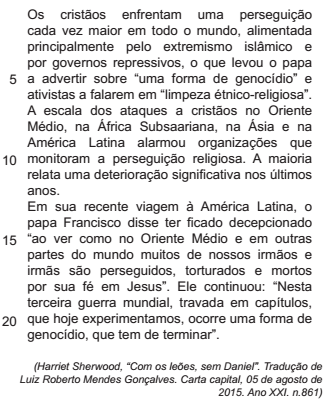
No que diz respeito às estruturas linguísticas do texto, assinale a opção correta.
.
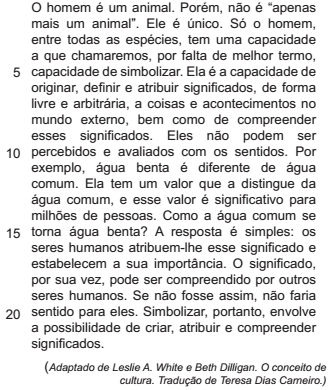
Sobre o uso da pontuação, assinale a opção incorreta.
( ) No plano geográfico, é notória a unidade da América Latina como fruto de sua continuidade continental.
( ) Ainda hoje, nós, latino-americanos, vivemos como se fôssemos um arquipélago de ilhas que se comunicam por mar e pelo ar e que com mais frequência se voltam para fora, para os grandes centros econômicos mundiais, do que para dentro.
( ) Efetivamente, a unidade geográfica jamais funcionou aqui como fator de unificação porque as distintas implantações coloniais das quais nasceram as sociedades latino-americanas coexistiram sem conviver, ao longo dos séculos. Cada uma delas se relacionava diretamente com a metrópole colonial.
( ) Toda a vastidão continental se rompe em nacionalidades singulares.
( ) A essa base física, porém, não corresponde uma estrutura sociopolítica unificada, nem mesmo uma coexistência ativa e interaturante.
(Adaptação de Darcy Ribeiro, América Latina: a pátria grande, p. 3)
A sequência correta é:
Nem muros, nem cercas, nem mares. Muito menos passaportes: quando uma pessoa decide abandonar seu próprio país para tentar uma vida melhor em outro lugar, nenhuma dessas barreiras é suficiente para dissuadi-la. As fronteiras europeias nunca estiveram tão fechadas e, ao mesmo tempo, nunca tantos imigrantes ilegais entraram no continente. Um estudo da Frontex, agência europeia de vigilância das fronteiras, aponta que, entre julho e setembro de 2014, cerca de 110 mil pessoas chegaram à Europa clandestinamente por terra e sobretudo por mar. Este número é quase três vezes maior do que o pico da Primavera Árabe, em 2011.
__________________________________________________________________________________________________________________________________________________________________
Até então, a maior catástrofe do tipo havia sido o naufrágio próximo à ilha de Lampedusa, que fez 366 vítimas fatais em 2013. Na época houve uma grande mobilização para o caso, chamando a atenção para a realidade dos imigrantes clandestinos. Logo após o ocorrido, a marinha italiana lançou uma operação humanitária e militar batizada Mare Nostrum, que tinha como objetivo socorrer pessoas à deriva.
(Adaptação da reportagem “Por um porto seguro", de Amanda
Lourenço (revista Caros amigos, ano XIX, nº 220, julho 2015)
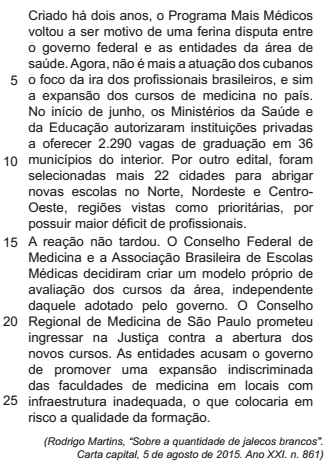
Indique a opção incorreta com relação às estruturas linguísticas do texto e à compreensão textual.
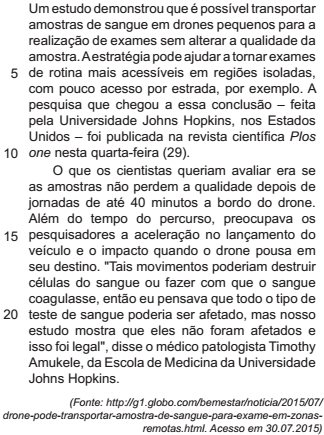
Indique a opção incorreta no que diz respeito às estruturas linguísticas do texto.
Este livro pretende demarcar uma área de pesquisa e reflexão dentro da antropologia contemporânea. Esta tem hoje tantas possibilidades, tornando-se um campo de conhecimento de tal forma rico e complexo, que não é mais possível a figura do generalista capaz de dominá-la em seus vários ramos e tendências. A própria antropologia social, aparentemente uma subárea, já abriu tantos espaços e produziu uma bibliografia tão vasta que é incomum encontrar profissionais que, por exemplo, se movam com familiaridade do estudo de sociedades indígenas sul-americanas para a problemática do meio urbano com toda a sua diversidade ou mesmo para as discussões sobre campesinato, trabalhadores rurais etc. No entanto, permanece, como ponto aglutinador e condensador, uma problemática teórica, às vezes deixada de lado ou marginalizada. Os nomes podem variar, assim como as ênfases, mas a questão da unidade e continuidade dos sistemas sociais permanece sendo referência central da disciplina. Quer se privilegie o consenso ou o conflito, quer se parta do indivíduo ou da sociedade e/ou cultura, estamos sempre lidando com o dilema da estabilidade e da descontinuidade. Como se estabelecem pactos? Como se efetiva a dominação? De que forma são socializados e incorporados os indivíduos? Como é possível exercer o poder e que padrões de reciprocidade sustentam redes de relações sociais?
(Adaptado de Gilberto Velho, Individualismo e cultura: notas para
uma Antropologia da Sociedade Contemporânea, 2004, p. 7).
A partir das ideias do texto, julgue como verdadeiras (V) ou falsas (F) as inferências a seguir.
( ) A antropologia social é um ramo recente da antropologia.
( ) A antropologia social ainda não definiu com clareza seu objeto.
( ) São poucos os pesquisadores familiarizados com todos os temas da antropologia social.
( ) A relação entre estabilidade e descontinuidade dos sistemas sociais é um problema teórico central da antropologia social.
( ) A antropologia social estuda, sobretudo, as relações de poder.
A sequência correta é:
( ) Desde então, Bruna nunca mais deixou de usar o Avonex, nome comercial da betainterferona 1, medicamento de alto custo fornecido pelo Sistema Único de Saúde (SUS).
( ) Com esclerose múltipla, a publicitária Bruna Rocha Silveira foi aprovada para doutorado em educação na Universidade Federal do Rio Grande do Sul (UFRGS).
( ) A ponto de desistir do curso, passou a experimentar uma medicação.
( ) A doença forçava-a a andar com uma bengala e provocava tremores nas mãos, o que dificultava a locomoção e a impedia de fazer anotações em aula.
( ) Então, os tremores desapareceram e ela pôde passar a andar sem a bengala.
(Adaptado da reportagem “Luta para tratar a esclerose múltipla", de Warner
Bento Filho (Correio Braziliense de 1° de agosto de 2015)
A sequência correta obtida é
Leia com atenção o texto abaixo.

Sobre o uso das estruturas linguísticas do texto,
assinale a opção incorreta.
Leia com atenção o texto abaixo.
Assinale a opção incorreta a respeito do uso das estruturas linguísticas do texto.

 Conheça nossos planos