Questões de Concurso
Para engenheiro júnior - análise de projetos de inverstimentos
Foram encontradas 66 questões
Resolva questões gratuitamente!
Junte-se a mais de 4 milhões de concurseiros!


Ano: 2011
Banca:
CESGRANRIO
Órgão:
Transpetro
Prova:
CESGRANRIO - 2011 - Transpetro - Engenheiro Júnior - Análise de Projetos de Inverstimentos |
Q179968
Administração Geral
Uma empresa decide adotar uma estratégia mercadológica baseada em pioneirismo, oferecendo produtos novos, descobrindo demandas e atraindo novos clientes.
Tal escolha estratégica pode ser mais adequada se a(o)
Tal escolha estratégica pode ser mais adequada se a(o)
Ano: 2011
Banca:
CESGRANRIO
Órgão:
Transpetro
Prova:
CESGRANRIO - 2011 - Transpetro - Engenheiro Júnior - Análise de Projetos de Inverstimentos |
Q179967
Engenharia Mecânica
A atividade de manutenção preventiva em uma empresa
Ano: 2011
Banca:
CESGRANRIO
Órgão:
Transpetro
Prova:
CESGRANRIO - 2011 - Transpetro - Engenheiro Júnior - Análise de Projetos de Inverstimentos |
Q179966
Economia
Uma empresa industrial processa minério para obter um determinado metal. De cada tonelada de minério processado ela extrai 30 kg do metal para venda a seus clientes.
Essa característica de processo produtivo tende a fazer com que a empresa se localize
Essa característica de processo produtivo tende a fazer com que a empresa se localize
Ano: 2011
Banca:
CESGRANRIO
Órgão:
Transpetro
Prova:
CESGRANRIO - 2011 - Transpetro - Engenheiro Júnior - Análise de Projetos de Inverstimentos |
Q179965
Administração Geral
Ao formular sua estratégia mercadológica, a empresa X precisa identificar os potenciais concorrentes e não considerar apenas os existentes.
As características relacionadas abaixo identificam os potenciais concorrentes, EXCETO a
As características relacionadas abaixo identificam os potenciais concorrentes, EXCETO a
Ano: 2011
Banca:
CESGRANRIO
Órgão:
Transpetro
Prova:
CESGRANRIO - 2011 - Transpetro - Engenheiro Júnior - Análise de Projetos de Inverstimentos |
Q179964
Economia
Alguns fatores externos às empresas são importantes na determinação de seu ambiente de negócios.
Dentre os fatores abaixo relacionados, aquele que NÃO é considerado fator externo é a(o)
Dentre os fatores abaixo relacionados, aquele que NÃO é considerado fator externo é a(o)
Ano: 2011
Banca:
CESGRANRIO
Órgão:
Transpetro
Prova:
CESGRANRIO - 2011 - Transpetro - Engenheiro Júnior - Análise de Projetos de Inverstimentos |
Q179963
Matemática Financeira
Todos os gastos e recebimentos, presentes e futuros, do fluxo financeiro de certo projeto de investimento, aumentam 40% no caso de se considerar um cenário externo alternativo. Logo, nesse cenário, o projeto terá
Ano: 2011
Banca:
CESGRANRIO
Órgão:
Transpetro
Prova:
CESGRANRIO - 2011 - Transpetro - Engenheiro Júnior - Análise de Projetos de Inverstimentos |
Q179962
Matemática Financeira
O Valor Presente Líquido de um projeto de investimento da empresa X, avaliado à taxa mínima de atratividade, é negativo. Logo, o projeto
Ano: 2011
Banca:
CESGRANRIO
Órgão:
Transpetro
Prova:
CESGRANRIO - 2011 - Transpetro - Engenheiro Júnior - Análise de Projetos de Inverstimentos |
Q179961
Economia
Na escolha e avaliação social de projetos, a aplicação do conceito de “preço-sombra"
Ano: 2011
Banca:
CESGRANRIO
Órgão:
Transpetro
Prova:
CESGRANRIO - 2011 - Transpetro - Engenheiro Júnior - Análise de Projetos de Inverstimentos |
Q179960
Matemática Financeira
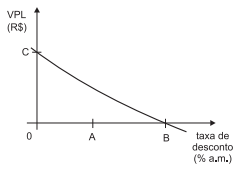
A figura acima mostra como o Valor Presente Líquido (VPL) de um projeto de investimento varia com a taxa de desconto usada para calcular o próprio VPL.
Nessa situação, verifica-se que o(a)
Ano: 2011
Banca:
CESGRANRIO
Órgão:
Transpetro
Prova:
CESGRANRIO - 2011 - Transpetro - Engenheiro Júnior - Análise de Projetos de Inverstimentos |
Q179959
Economia
Dois projetos de investimento diferentes são mutuamente exclusivos. Em consequência,
Ano: 2011
Banca:
CESGRANRIO
Órgão:
Transpetro
Provas:
CESGRANRIO - 2011 - Transpetro - Administrador Júnior
|
CESGRANRIO - 2011 - Transpetro - Analista de Sistemas Júnior |
CESGRANRIO - 2011 - Transpetro - Contador Júnior - Contábil |
CESGRANRIO - 2011 - Transpetro - Contador Júnior - Auditoria Interna |
CESGRANRIO - 2011 - Transpetro - Economista Júnior |
CESGRANRIO - 2011 - Transpetro - Engenheiro Júnior - Engenharia de Produção |
CESGRANRIO - 2011 - Transpetro - Médico do trabalho |
CESGRANRIO - 2011 - Transpetro - Engenheiro Júnior - Análise de Projetos de Inverstimentos |
CESGRANRIO - 2011 - Transpetro - Engenheiro Júnior - Geotécnica |
CESGRANRIO - 2011 - Transpetro - Engenheiro Júnior - Elétrica |
CESGRANRIO - 2011 - Transpetro - Engenheiro Júnior - Mecânica |
CESGRANRIO - 2011 - Transpetro - Profissional de Meio Ambiente Júnior |
CESGRANRIO - 2011 - Transpetro - Engenheiro Júnior - Processamento |
CESGRANRIO - 2011 - Transpetro - Engenheiro Júnior - Segurança |
CESGRANRIO - 2011 - Transpetro - Engenheiro Júnior - Naval |
CESGRANRIO - 2011 - Transpetro - Químico de Petróleo Júnior |
CESGRANRIO - 2011 - Transpetro - Engenheiro Júnior - Automação |
Q154636
Inglês
Texto associado
Model copes with chaos to deliver relief
Computer program helps responders transport
supplies in tough conditions
By Rachel Ehrenberg Science News, Web edition: Monday, February 21st, 2011
WASHINGTON — Getting blood or other perishable supplies to an area that’s been struck by an earthquake or hurricane isn’t as simple as asking what brown can do for you. But a new model quickly determines the best routes and means for delivering humanitarian aid, even in situations where bridges are out or airport tarmacs are clogged with planes.
The research, presented February 18 at the annual meeting of the American Association for the Advancement of Science, could help get supplies to areas which have experienced natural disasters or help prepare for efficient distribution of vaccines when the flu hits.
Efficient supply chains have long been a goal of manufacturers, but transport in fragile networks — where supply, demand and delivery routes may be in extremely rapid flux — requires a different approach, said Anna Nagurney of the University of Massachusetts Amherst, who presented the new work. Rather than considering the shortest path from one place to another to maximize profit, her system aims for the cleanest path at minimum cost, while capturing factors such as the perishability of the product and the uncertainty of supply routes. ‘You don’t know where demand is, so it’s tricky,’ said Nagurney. ‘It’s a multicriteria decision-making problem.’
By calculating the total cost associated with each link in a network, accounting for congestion and incorporating penalties for time and products that are lost, the computer model calculates the best supply chain in situations where standard routes may be disrupted.
‘Mathematical tools are essential to develop formal means to predict, and to respond to, such critical perturbations,’ said Iain Couzin of Princeton University, who uses similar computational tools to study collective animal behavior. ‘This is particularly important where response must be rapid and effective, such as during disaster scenarios … or during epidemics or breaches of national security.
’ The work can be applied to immediate, pressing situations, such as getting blood, food or medication to a disaster site, or to longer-term problems such as determining the best locations for manufacturing flu vaccines. . Retrieved April 7th, 2011.
By Rachel Ehrenberg Science News, Web edition: Monday, February 21st, 2011
WASHINGTON — Getting blood or other perishable supplies to an area that’s been struck by an earthquake or hurricane isn’t as simple as asking what brown can do for you. But a new model quickly determines the best routes and means for delivering humanitarian aid, even in situations where bridges are out or airport tarmacs are clogged with planes.
The research, presented February 18 at the annual meeting of the American Association for the Advancement of Science, could help get supplies to areas which have experienced natural disasters or help prepare for efficient distribution of vaccines when the flu hits.
Efficient supply chains have long been a goal of manufacturers, but transport in fragile networks — where supply, demand and delivery routes may be in extremely rapid flux — requires a different approach, said Anna Nagurney of the University of Massachusetts Amherst, who presented the new work. Rather than considering the shortest path from one place to another to maximize profit, her system aims for the cleanest path at minimum cost, while capturing factors such as the perishability of the product and the uncertainty of supply routes. ‘You don’t know where demand is, so it’s tricky,’ said Nagurney. ‘It’s a multicriteria decision-making problem.’
By calculating the total cost associated with each link in a network, accounting for congestion and incorporating penalties for time and products that are lost, the computer model calculates the best supply chain in situations where standard routes may be disrupted.
‘Mathematical tools are essential to develop formal means to predict, and to respond to, such critical perturbations,’ said Iain Couzin of Princeton University, who uses similar computational tools to study collective animal behavior. ‘This is particularly important where response must be rapid and effective, such as during disaster scenarios … or during epidemics or breaches of national security.
’ The work can be applied to immediate, pressing situations, such as getting blood, food or medication to a disaster site, or to longer-term problems such as determining the best locations for manufacturing flu vaccines. . Retrieved April 7th, 2011.
The computer model discussed in the text “…copes with chaos to deliver relief" (title) and analyzes different factors. The only factor
NOT taken in consideration in the model is the
Ano: 2011
Banca:
CESGRANRIO
Órgão:
Transpetro
Provas:
CESGRANRIO - 2011 - Transpetro - Administrador Júnior
|
CESGRANRIO - 2011 - Transpetro - Analista de Sistemas Júnior |
CESGRANRIO - 2011 - Transpetro - Contador Júnior - Contábil |
CESGRANRIO - 2011 - Transpetro - Contador Júnior - Auditoria Interna |
CESGRANRIO - 2011 - Transpetro - Economista Júnior |
CESGRANRIO - 2011 - Transpetro - Engenheiro Júnior - Engenharia de Produção |
CESGRANRIO - 2011 - Transpetro - Médico do trabalho |
CESGRANRIO - 2011 - Transpetro - Engenheiro Júnior - Análise de Projetos de Inverstimentos |
CESGRANRIO - 2011 - Transpetro - Engenheiro Júnior - Geotécnica |
CESGRANRIO - 2011 - Transpetro - Engenheiro Júnior - Elétrica |
CESGRANRIO - 2011 - Transpetro - Engenheiro Júnior - Mecânica |
CESGRANRIO - 2011 - Transpetro - Profissional de Meio Ambiente Júnior |
CESGRANRIO - 2011 - Transpetro - Engenheiro Júnior - Processamento |
CESGRANRIO - 2011 - Transpetro - Engenheiro Júnior - Segurança |
CESGRANRIO - 2011 - Transpetro - Engenheiro Júnior - Naval |
CESGRANRIO - 2011 - Transpetro - Químico de Petróleo Júnior |
CESGRANRIO - 2011 - Transpetro - Engenheiro Júnior - Automação |
Q154635
Inglês
Texto associado
Model copes with chaos to deliver relief
Computer program helps responders transport
supplies in tough conditions
By Rachel Ehrenberg Science News, Web edition: Monday, February 21st, 2011
WASHINGTON — Getting blood or other perishable supplies to an area that’s been struck by an earthquake or hurricane isn’t as simple as asking what brown can do for you. But a new model quickly determines the best routes and means for delivering humanitarian aid, even in situations where bridges are out or airport tarmacs are clogged with planes.
The research, presented February 18 at the annual meeting of the American Association for the Advancement of Science, could help get supplies to areas which have experienced natural disasters or help prepare for efficient distribution of vaccines when the flu hits.
Efficient supply chains have long been a goal of manufacturers, but transport in fragile networks — where supply, demand and delivery routes may be in extremely rapid flux — requires a different approach, said Anna Nagurney of the University of Massachusetts Amherst, who presented the new work. Rather than considering the shortest path from one place to another to maximize profit, her system aims for the cleanest path at minimum cost, while capturing factors such as the perishability of the product and the uncertainty of supply routes. ‘You don’t know where demand is, so it’s tricky,’ said Nagurney. ‘It’s a multicriteria decision-making problem.’
By calculating the total cost associated with each link in a network, accounting for congestion and incorporating penalties for time and products that are lost, the computer model calculates the best supply chain in situations where standard routes may be disrupted.
‘Mathematical tools are essential to develop formal means to predict, and to respond to, such critical perturbations,’ said Iain Couzin of Princeton University, who uses similar computational tools to study collective animal behavior. ‘This is particularly important where response must be rapid and effective, such as during disaster scenarios … or during epidemics or breaches of national security.
’ The work can be applied to immediate, pressing situations, such as getting blood, food or medication to a disaster site, or to longer-term problems such as determining the best locations for manufacturing flu vaccines. . Retrieved April 7th, 2011.
By Rachel Ehrenberg Science News, Web edition: Monday, February 21st, 2011
WASHINGTON — Getting blood or other perishable supplies to an area that’s been struck by an earthquake or hurricane isn’t as simple as asking what brown can do for you. But a new model quickly determines the best routes and means for delivering humanitarian aid, even in situations where bridges are out or airport tarmacs are clogged with planes.
The research, presented February 18 at the annual meeting of the American Association for the Advancement of Science, could help get supplies to areas which have experienced natural disasters or help prepare for efficient distribution of vaccines when the flu hits.
Efficient supply chains have long been a goal of manufacturers, but transport in fragile networks — where supply, demand and delivery routes may be in extremely rapid flux — requires a different approach, said Anna Nagurney of the University of Massachusetts Amherst, who presented the new work. Rather than considering the shortest path from one place to another to maximize profit, her system aims for the cleanest path at minimum cost, while capturing factors such as the perishability of the product and the uncertainty of supply routes. ‘You don’t know where demand is, so it’s tricky,’ said Nagurney. ‘It’s a multicriteria decision-making problem.’
By calculating the total cost associated with each link in a network, accounting for congestion and incorporating penalties for time and products that are lost, the computer model calculates the best supply chain in situations where standard routes may be disrupted.
‘Mathematical tools are essential to develop formal means to predict, and to respond to, such critical perturbations,’ said Iain Couzin of Princeton University, who uses similar computational tools to study collective animal behavior. ‘This is particularly important where response must be rapid and effective, such as during disaster scenarios … or during epidemics or breaches of national security.
’ The work can be applied to immediate, pressing situations, such as getting blood, food or medication to a disaster site, or to longer-term problems such as determining the best locations for manufacturing flu vaccines. . Retrieved April 7th, 2011.
In “The work can be applied to immediate, pressing situations," (lines 41-42), the fragment “can be applied" is replaced, without change in meaning, by
Ano: 2011
Banca:
CESGRANRIO
Órgão:
Transpetro
Provas:
CESGRANRIO - 2011 - Transpetro - Administrador Júnior
|
CESGRANRIO - 2011 - Transpetro - Analista de Sistemas Júnior |
CESGRANRIO - 2011 - Transpetro - Contador Júnior - Contábil |
CESGRANRIO - 2011 - Transpetro - Contador Júnior - Auditoria Interna |
CESGRANRIO - 2011 - Transpetro - Economista Júnior |
CESGRANRIO - 2011 - Transpetro - Engenheiro Júnior - Engenharia de Produção |
CESGRANRIO - 2011 - Transpetro - Médico do trabalho |
CESGRANRIO - 2011 - Transpetro - Engenheiro Júnior - Análise de Projetos de Inverstimentos |
CESGRANRIO - 2011 - Transpetro - Engenheiro Júnior - Geotécnica |
CESGRANRIO - 2011 - Transpetro - Engenheiro Júnior - Elétrica |
CESGRANRIO - 2011 - Transpetro - Engenheiro Júnior - Mecânica |
CESGRANRIO - 2011 - Transpetro - Profissional de Meio Ambiente Júnior |
CESGRANRIO - 2011 - Transpetro - Engenheiro Júnior - Processamento |
CESGRANRIO - 2011 - Transpetro - Engenheiro Júnior - Segurança |
CESGRANRIO - 2011 - Transpetro - Engenheiro Júnior - Naval |
CESGRANRIO - 2011 - Transpetro - Químico de Petróleo Júnior |
CESGRANRIO - 2011 - Transpetro - Engenheiro Júnior - Automação |
Q154634
Inglês
Texto associado
Model copes with chaos to deliver relief
Computer program helps responders transport
supplies in tough conditions
By Rachel Ehrenberg Science News, Web edition: Monday, February 21st, 2011
WASHINGTON — Getting blood or other perishable supplies to an area that’s been struck by an earthquake or hurricane isn’t as simple as asking what brown can do for you. But a new model quickly determines the best routes and means for delivering humanitarian aid, even in situations where bridges are out or airport tarmacs are clogged with planes.
The research, presented February 18 at the annual meeting of the American Association for the Advancement of Science, could help get supplies to areas which have experienced natural disasters or help prepare for efficient distribution of vaccines when the flu hits.
Efficient supply chains have long been a goal of manufacturers, but transport in fragile networks — where supply, demand and delivery routes may be in extremely rapid flux — requires a different approach, said Anna Nagurney of the University of Massachusetts Amherst, who presented the new work. Rather than considering the shortest path from one place to another to maximize profit, her system aims for the cleanest path at minimum cost, while capturing factors such as the perishability of the product and the uncertainty of supply routes. ‘You don’t know where demand is, so it’s tricky,’ said Nagurney. ‘It’s a multicriteria decision-making problem.’
By calculating the total cost associated with each link in a network, accounting for congestion and incorporating penalties for time and products that are lost, the computer model calculates the best supply chain in situations where standard routes may be disrupted.
‘Mathematical tools are essential to develop formal means to predict, and to respond to, such critical perturbations,’ said Iain Couzin of Princeton University, who uses similar computational tools to study collective animal behavior. ‘This is particularly important where response must be rapid and effective, such as during disaster scenarios … or during epidemics or breaches of national security.
’ The work can be applied to immediate, pressing situations, such as getting blood, food or medication to a disaster site, or to longer-term problems such as determining the best locations for manufacturing flu vaccines. . Retrieved April 7th, 2011.
By Rachel Ehrenberg Science News, Web edition: Monday, February 21st, 2011
WASHINGTON — Getting blood or other perishable supplies to an area that’s been struck by an earthquake or hurricane isn’t as simple as asking what brown can do for you. But a new model quickly determines the best routes and means for delivering humanitarian aid, even in situations where bridges are out or airport tarmacs are clogged with planes.
The research, presented February 18 at the annual meeting of the American Association for the Advancement of Science, could help get supplies to areas which have experienced natural disasters or help prepare for efficient distribution of vaccines when the flu hits.
Efficient supply chains have long been a goal of manufacturers, but transport in fragile networks — where supply, demand and delivery routes may be in extremely rapid flux — requires a different approach, said Anna Nagurney of the University of Massachusetts Amherst, who presented the new work. Rather than considering the shortest path from one place to another to maximize profit, her system aims for the cleanest path at minimum cost, while capturing factors such as the perishability of the product and the uncertainty of supply routes. ‘You don’t know where demand is, so it’s tricky,’ said Nagurney. ‘It’s a multicriteria decision-making problem.’
By calculating the total cost associated with each link in a network, accounting for congestion and incorporating penalties for time and products that are lost, the computer model calculates the best supply chain in situations where standard routes may be disrupted.
‘Mathematical tools are essential to develop formal means to predict, and to respond to, such critical perturbations,’ said Iain Couzin of Princeton University, who uses similar computational tools to study collective animal behavior. ‘This is particularly important where response must be rapid and effective, such as during disaster scenarios … or during epidemics or breaches of national security.
’ The work can be applied to immediate, pressing situations, such as getting blood, food or medication to a disaster site, or to longer-term problems such as determining the best locations for manufacturing flu vaccines. . Retrieved April 7th, 2011.
Based on the meanings in the text, the two items are antonymous in
Ano: 2011
Banca:
CESGRANRIO
Órgão:
Transpetro
Provas:
CESGRANRIO - 2011 - Transpetro - Administrador Júnior
|
CESGRANRIO - 2011 - Transpetro - Analista de Sistemas Júnior |
CESGRANRIO - 2011 - Transpetro - Contador Júnior - Contábil |
CESGRANRIO - 2011 - Transpetro - Contador Júnior - Auditoria Interna |
CESGRANRIO - 2011 - Transpetro - Economista Júnior |
CESGRANRIO - 2011 - Transpetro - Engenheiro Júnior - Engenharia de Produção |
CESGRANRIO - 2011 - Transpetro - Médico do trabalho |
CESGRANRIO - 2011 - Transpetro - Engenheiro Júnior - Análise de Projetos de Inverstimentos |
CESGRANRIO - 2011 - Transpetro - Engenheiro Júnior - Geotécnica |
CESGRANRIO - 2011 - Transpetro - Engenheiro Júnior - Elétrica |
CESGRANRIO - 2011 - Transpetro - Engenheiro Júnior - Mecânica |
CESGRANRIO - 2011 - Transpetro - Profissional de Meio Ambiente Júnior |
CESGRANRIO - 2011 - Transpetro - Engenheiro Júnior - Processamento |
CESGRANRIO - 2011 - Transpetro - Engenheiro Júnior - Segurança |
CESGRANRIO - 2011 - Transpetro - Engenheiro Júnior - Naval |
CESGRANRIO - 2011 - Transpetro - Químico de Petróleo Júnior |
CESGRANRIO - 2011 - Transpetro - Engenheiro Júnior - Automação |
Q154633
Inglês
Texto associado
Model copes with chaos to deliver relief
Computer program helps responders transport
supplies in tough conditions
By Rachel Ehrenberg Science News, Web edition: Monday, February 21st, 2011
WASHINGTON — Getting blood or other perishable supplies to an area that’s been struck by an earthquake or hurricane isn’t as simple as asking what brown can do for you. But a new model quickly determines the best routes and means for delivering humanitarian aid, even in situations where bridges are out or airport tarmacs are clogged with planes.
The research, presented February 18 at the annual meeting of the American Association for the Advancement of Science, could help get supplies to areas which have experienced natural disasters or help prepare for efficient distribution of vaccines when the flu hits.
Efficient supply chains have long been a goal of manufacturers, but transport in fragile networks — where supply, demand and delivery routes may be in extremely rapid flux — requires a different approach, said Anna Nagurney of the University of Massachusetts Amherst, who presented the new work. Rather than considering the shortest path from one place to another to maximize profit, her system aims for the cleanest path at minimum cost, while capturing factors such as the perishability of the product and the uncertainty of supply routes. ‘You don’t know where demand is, so it’s tricky,’ said Nagurney. ‘It’s a multicriteria decision-making problem.’
By calculating the total cost associated with each link in a network, accounting for congestion and incorporating penalties for time and products that are lost, the computer model calculates the best supply chain in situations where standard routes may be disrupted.
‘Mathematical tools are essential to develop formal means to predict, and to respond to, such critical perturbations,’ said Iain Couzin of Princeton University, who uses similar computational tools to study collective animal behavior. ‘This is particularly important where response must be rapid and effective, such as during disaster scenarios … or during epidemics or breaches of national security.
’ The work can be applied to immediate, pressing situations, such as getting blood, food or medication to a disaster site, or to longer-term problems such as determining the best locations for manufacturing flu vaccines. . Retrieved April 7th, 2011.
By Rachel Ehrenberg Science News, Web edition: Monday, February 21st, 2011
WASHINGTON — Getting blood or other perishable supplies to an area that’s been struck by an earthquake or hurricane isn’t as simple as asking what brown can do for you. But a new model quickly determines the best routes and means for delivering humanitarian aid, even in situations where bridges are out or airport tarmacs are clogged with planes.
The research, presented February 18 at the annual meeting of the American Association for the Advancement of Science, could help get supplies to areas which have experienced natural disasters or help prepare for efficient distribution of vaccines when the flu hits.
Efficient supply chains have long been a goal of manufacturers, but transport in fragile networks — where supply, demand and delivery routes may be in extremely rapid flux — requires a different approach, said Anna Nagurney of the University of Massachusetts Amherst, who presented the new work. Rather than considering the shortest path from one place to another to maximize profit, her system aims for the cleanest path at minimum cost, while capturing factors such as the perishability of the product and the uncertainty of supply routes. ‘You don’t know where demand is, so it’s tricky,’ said Nagurney. ‘It’s a multicriteria decision-making problem.’
By calculating the total cost associated with each link in a network, accounting for congestion and incorporating penalties for time and products that are lost, the computer model calculates the best supply chain in situations where standard routes may be disrupted.
‘Mathematical tools are essential to develop formal means to predict, and to respond to, such critical perturbations,’ said Iain Couzin of Princeton University, who uses similar computational tools to study collective animal behavior. ‘This is particularly important where response must be rapid and effective, such as during disaster scenarios … or during epidemics or breaches of national security.
’ The work can be applied to immediate, pressing situations, such as getting blood, food or medication to a disaster site, or to longer-term problems such as determining the best locations for manufacturing flu vaccines. . Retrieved April 7th, 2011.
In terms of pronominal reference,
Ano: 2011
Banca:
CESGRANRIO
Órgão:
Transpetro
Provas:
CESGRANRIO - 2011 - Transpetro - Administrador Júnior
|
CESGRANRIO - 2011 - Transpetro - Analista de Sistemas Júnior |
CESGRANRIO - 2011 - Transpetro - Contador Júnior - Contábil |
CESGRANRIO - 2011 - Transpetro - Economista Júnior |
CESGRANRIO - 2011 - Transpetro - Engenheiro Júnior - Engenharia de Produção |
CESGRANRIO - 2011 - Transpetro - Médico do trabalho |
CESGRANRIO - 2011 - Transpetro - Engenheiro Júnior - Análise de Projetos de Inverstimentos |
CESGRANRIO - 2011 - Transpetro - Engenheiro Júnior - Geotécnica |
CESGRANRIO - 2011 - Transpetro - Engenheiro Júnior - Elétrica |
CESGRANRIO - 2011 - Transpetro - Engenheiro Júnior - Mecânica |
CESGRANRIO - 2011 - Transpetro - Profissional de Meio Ambiente Júnior |
CESGRANRIO - 2011 - Transpetro - Engenheiro Júnior - Processamento |
CESGRANRIO - 2011 - Transpetro - Engenheiro Júnior - Segurança |
CESGRANRIO - 2011 - Transpetro - Engenheiro Júnior - Naval |
CESGRANRIO - 2011 - Transpetro - Químico de Petróleo Júnior |
CESGRANRIO - 2011 - Transpetro - Engenheiro Júnior - Automação |
Q154632
Inglês
Texto associado
Model copes with chaos to deliver relief
Computer program helps responders transport
supplies in tough conditions
By Rachel Ehrenberg Science News, Web edition: Monday, February 21st, 2011
WASHINGTON — Getting blood or other perishable supplies to an area that’s been struck by an earthquake or hurricane isn’t as simple as asking what brown can do for you. But a new model quickly determines the best routes and means for delivering humanitarian aid, even in situations where bridges are out or airport tarmacs are clogged with planes.
The research, presented February 18 at the annual meeting of the American Association for the Advancement of Science, could help get supplies to areas which have experienced natural disasters or help prepare for efficient distribution of vaccines when the flu hits.
Efficient supply chains have long been a goal of manufacturers, but transport in fragile networks — where supply, demand and delivery routes may be in extremely rapid flux — requires a different approach, said Anna Nagurney of the University of Massachusetts Amherst, who presented the new work. Rather than considering the shortest path from one place to another to maximize profit, her system aims for the cleanest path at minimum cost, while capturing factors such as the perishability of the product and the uncertainty of supply routes. ‘You don’t know where demand is, so it’s tricky,’ said Nagurney. ‘It’s a multicriteria decision-making problem.’
By calculating the total cost associated with each link in a network, accounting for congestion and incorporating penalties for time and products that are lost, the computer model calculates the best supply chain in situations where standard routes may be disrupted.
‘Mathematical tools are essential to develop formal means to predict, and to respond to, such critical perturbations,’ said Iain Couzin of Princeton University, who uses similar computational tools to study collective animal behavior. ‘This is particularly important where response must be rapid and effective, such as during disaster scenarios … or during epidemics or breaches of national security.
’ The work can be applied to immediate, pressing situations, such as getting blood, food or medication to a disaster site, or to longer-term problems such as determining the best locations for manufacturing flu vaccines. . Retrieved April 7th, 2011.
By Rachel Ehrenberg Science News, Web edition: Monday, February 21st, 2011
WASHINGTON — Getting blood or other perishable supplies to an area that’s been struck by an earthquake or hurricane isn’t as simple as asking what brown can do for you. But a new model quickly determines the best routes and means for delivering humanitarian aid, even in situations where bridges are out or airport tarmacs are clogged with planes.
The research, presented February 18 at the annual meeting of the American Association for the Advancement of Science, could help get supplies to areas which have experienced natural disasters or help prepare for efficient distribution of vaccines when the flu hits.
Efficient supply chains have long been a goal of manufacturers, but transport in fragile networks — where supply, demand and delivery routes may be in extremely rapid flux — requires a different approach, said Anna Nagurney of the University of Massachusetts Amherst, who presented the new work. Rather than considering the shortest path from one place to another to maximize profit, her system aims for the cleanest path at minimum cost, while capturing factors such as the perishability of the product and the uncertainty of supply routes. ‘You don’t know where demand is, so it’s tricky,’ said Nagurney. ‘It’s a multicriteria decision-making problem.’
By calculating the total cost associated with each link in a network, accounting for congestion and incorporating penalties for time and products that are lost, the computer model calculates the best supply chain in situations where standard routes may be disrupted.
‘Mathematical tools are essential to develop formal means to predict, and to respond to, such critical perturbations,’ said Iain Couzin of Princeton University, who uses similar computational tools to study collective animal behavior. ‘This is particularly important where response must be rapid and effective, such as during disaster scenarios … or during epidemics or breaches of national security.
’ The work can be applied to immediate, pressing situations, such as getting blood, food or medication to a disaster site, or to longer-term problems such as determining the best locations for manufacturing flu vaccines. . Retrieved April 7th, 2011.
The expression in boldface introduces the idea of conclusion in
Ano: 2011
Banca:
CESGRANRIO
Órgão:
Transpetro
Provas:
CESGRANRIO - 2011 - Transpetro - Administrador Júnior
|
CESGRANRIO - 2011 - Transpetro - Analista de Sistemas Júnior |
CESGRANRIO - 2011 - Transpetro - Contador Júnior - Contábil |
CESGRANRIO - 2011 - Transpetro - Contador Júnior - Auditoria Interna |
CESGRANRIO - 2011 - Transpetro - Economista Júnior |
CESGRANRIO - 2011 - Transpetro - Engenheiro Júnior - Engenharia de Produção |
CESGRANRIO - 2011 - Transpetro - Médico do trabalho |
CESGRANRIO - 2011 - Transpetro - Engenheiro Júnior - Análise de Projetos de Inverstimentos |
CESGRANRIO - 2011 - Transpetro - Engenheiro Júnior - Geotécnica |
CESGRANRIO - 2011 - Transpetro - Engenheiro Júnior - Elétrica |
CESGRANRIO - 2011 - Transpetro - Engenheiro Júnior - Mecânica |
CESGRANRIO - 2011 - Transpetro - Profissional de Meio Ambiente Júnior |
CESGRANRIO - 2011 - Transpetro - Engenheiro Júnior - Processamento |
CESGRANRIO - 2011 - Transpetro - Engenheiro Júnior - Segurança |
CESGRANRIO - 2011 - Transpetro - Engenheiro Júnior - Naval |
CESGRANRIO - 2011 - Transpetro - Químico de Petróleo Júnior |
CESGRANRIO - 2011 - Transpetro - Engenheiro Júnior - Automação |
Q154631
Inglês
Texto associado
Model copes with chaos to deliver relief
Computer program helps responders transport
supplies in tough conditions
By Rachel Ehrenberg Science News, Web edition: Monday, February 21st, 2011
WASHINGTON — Getting blood or other perishable supplies to an area that’s been struck by an earthquake or hurricane isn’t as simple as asking what brown can do for you. But a new model quickly determines the best routes and means for delivering humanitarian aid, even in situations where bridges are out or airport tarmacs are clogged with planes.
The research, presented February 18 at the annual meeting of the American Association for the Advancement of Science, could help get supplies to areas which have experienced natural disasters or help prepare for efficient distribution of vaccines when the flu hits.
Efficient supply chains have long been a goal of manufacturers, but transport in fragile networks — where supply, demand and delivery routes may be in extremely rapid flux — requires a different approach, said Anna Nagurney of the University of Massachusetts Amherst, who presented the new work. Rather than considering the shortest path from one place to another to maximize profit, her system aims for the cleanest path at minimum cost, while capturing factors such as the perishability of the product and the uncertainty of supply routes. ‘You don’t know where demand is, so it’s tricky,’ said Nagurney. ‘It’s a multicriteria decision-making problem.’
By calculating the total cost associated with each link in a network, accounting for congestion and incorporating penalties for time and products that are lost, the computer model calculates the best supply chain in situations where standard routes may be disrupted.
‘Mathematical tools are essential to develop formal means to predict, and to respond to, such critical perturbations,’ said Iain Couzin of Princeton University, who uses similar computational tools to study collective animal behavior. ‘This is particularly important where response must be rapid and effective, such as during disaster scenarios … or during epidemics or breaches of national security.
’ The work can be applied to immediate, pressing situations, such as getting blood, food or medication to a disaster site, or to longer-term problems such as determining the best locations for manufacturing flu vaccines. . Retrieved April 7th, 2011.
By Rachel Ehrenberg Science News, Web edition: Monday, February 21st, 2011
WASHINGTON — Getting blood or other perishable supplies to an area that’s been struck by an earthquake or hurricane isn’t as simple as asking what brown can do for you. But a new model quickly determines the best routes and means for delivering humanitarian aid, even in situations where bridges are out or airport tarmacs are clogged with planes.
The research, presented February 18 at the annual meeting of the American Association for the Advancement of Science, could help get supplies to areas which have experienced natural disasters or help prepare for efficient distribution of vaccines when the flu hits.
Efficient supply chains have long been a goal of manufacturers, but transport in fragile networks — where supply, demand and delivery routes may be in extremely rapid flux — requires a different approach, said Anna Nagurney of the University of Massachusetts Amherst, who presented the new work. Rather than considering the shortest path from one place to another to maximize profit, her system aims for the cleanest path at minimum cost, while capturing factors such as the perishability of the product and the uncertainty of supply routes. ‘You don’t know where demand is, so it’s tricky,’ said Nagurney. ‘It’s a multicriteria decision-making problem.’
By calculating the total cost associated with each link in a network, accounting for congestion and incorporating penalties for time and products that are lost, the computer model calculates the best supply chain in situations where standard routes may be disrupted.
‘Mathematical tools are essential to develop formal means to predict, and to respond to, such critical perturbations,’ said Iain Couzin of Princeton University, who uses similar computational tools to study collective animal behavior. ‘This is particularly important where response must be rapid and effective, such as during disaster scenarios … or during epidemics or breaches of national security.
’ The work can be applied to immediate, pressing situations, such as getting blood, food or medication to a disaster site, or to longer-term problems such as determining the best locations for manufacturing flu vaccines. . Retrieved April 7th, 2011.
“such critical perturbations," (lines 34-35) refers to all the items below, EXCEPT
Ano: 2011
Banca:
CESGRANRIO
Órgão:
Transpetro
Provas:
CESGRANRIO - 2011 - Transpetro - Administrador Júnior
|
CESGRANRIO - 2011 - Transpetro - Analista de Sistemas Júnior |
CESGRANRIO - 2011 - Transpetro - Contador Júnior - Contábil |
CESGRANRIO - 2011 - Transpetro - Contador Júnior - Auditoria Interna |
CESGRANRIO - 2011 - Transpetro - Economista Júnior |
CESGRANRIO - 2011 - Transpetro - Engenheiro Júnior - Engenharia de Produção |
CESGRANRIO - 2011 - Transpetro - Médico do trabalho |
CESGRANRIO - 2011 - Transpetro - Engenheiro Júnior - Análise de Projetos de Inverstimentos |
CESGRANRIO - 2011 - Transpetro - Engenheiro Júnior - Geotécnica |
CESGRANRIO - 2011 - Transpetro - Engenheiro Júnior - Elétrica |
CESGRANRIO - 2011 - Transpetro - Engenheiro Júnior - Mecânica |
CESGRANRIO - 2011 - Transpetro - Profissional de Meio Ambiente Júnior |
CESGRANRIO - 2011 - Transpetro - Engenheiro Júnior - Processamento |
CESGRANRIO - 2011 - Transpetro - Engenheiro Júnior - Segurança |
CESGRANRIO - 2011 - Transpetro - Engenheiro Júnior - Naval |
CESGRANRIO - 2011 - Transpetro - Químico de Petróleo Júnior |
CESGRANRIO - 2011 - Transpetro - Engenheiro Júnior - Automação |
Q154630
Inglês
Texto associado
Model copes with chaos to deliver relief
Computer program helps responders transport
supplies in tough conditions
By Rachel Ehrenberg Science News, Web edition: Monday, February 21st, 2011
WASHINGTON — Getting blood or other perishable supplies to an area that’s been struck by an earthquake or hurricane isn’t as simple as asking what brown can do for you. But a new model quickly determines the best routes and means for delivering humanitarian aid, even in situations where bridges are out or airport tarmacs are clogged with planes.
The research, presented February 18 at the annual meeting of the American Association for the Advancement of Science, could help get supplies to areas which have experienced natural disasters or help prepare for efficient distribution of vaccines when the flu hits.
Efficient supply chains have long been a goal of manufacturers, but transport in fragile networks — where supply, demand and delivery routes may be in extremely rapid flux — requires a different approach, said Anna Nagurney of the University of Massachusetts Amherst, who presented the new work. Rather than considering the shortest path from one place to another to maximize profit, her system aims for the cleanest path at minimum cost, while capturing factors such as the perishability of the product and the uncertainty of supply routes. ‘You don’t know where demand is, so it’s tricky,’ said Nagurney. ‘It’s a multicriteria decision-making problem.’
By calculating the total cost associated with each link in a network, accounting for congestion and incorporating penalties for time and products that are lost, the computer model calculates the best supply chain in situations where standard routes may be disrupted.
‘Mathematical tools are essential to develop formal means to predict, and to respond to, such critical perturbations,’ said Iain Couzin of Princeton University, who uses similar computational tools to study collective animal behavior. ‘This is particularly important where response must be rapid and effective, such as during disaster scenarios … or during epidemics or breaches of national security.
’ The work can be applied to immediate, pressing situations, such as getting blood, food or medication to a disaster site, or to longer-term problems such as determining the best locations for manufacturing flu vaccines. . Retrieved April 7th, 2011.
By Rachel Ehrenberg Science News, Web edition: Monday, February 21st, 2011
WASHINGTON — Getting blood or other perishable supplies to an area that’s been struck by an earthquake or hurricane isn’t as simple as asking what brown can do for you. But a new model quickly determines the best routes and means for delivering humanitarian aid, even in situations where bridges are out or airport tarmacs are clogged with planes.
The research, presented February 18 at the annual meeting of the American Association for the Advancement of Science, could help get supplies to areas which have experienced natural disasters or help prepare for efficient distribution of vaccines when the flu hits.
Efficient supply chains have long been a goal of manufacturers, but transport in fragile networks — where supply, demand and delivery routes may be in extremely rapid flux — requires a different approach, said Anna Nagurney of the University of Massachusetts Amherst, who presented the new work. Rather than considering the shortest path from one place to another to maximize profit, her system aims for the cleanest path at minimum cost, while capturing factors such as the perishability of the product and the uncertainty of supply routes. ‘You don’t know where demand is, so it’s tricky,’ said Nagurney. ‘It’s a multicriteria decision-making problem.’
By calculating the total cost associated with each link in a network, accounting for congestion and incorporating penalties for time and products that are lost, the computer model calculates the best supply chain in situations where standard routes may be disrupted.
‘Mathematical tools are essential to develop formal means to predict, and to respond to, such critical perturbations,’ said Iain Couzin of Princeton University, who uses similar computational tools to study collective animal behavior. ‘This is particularly important where response must be rapid and effective, such as during disaster scenarios … or during epidemics or breaches of national security.
’ The work can be applied to immediate, pressing situations, such as getting blood, food or medication to a disaster site, or to longer-term problems such as determining the best locations for manufacturing flu vaccines. . Retrieved April 7th, 2011.
Iain Couzin is mentioned in paragraph 5 (lines 33-40) because he
Ano: 2011
Banca:
CESGRANRIO
Órgão:
Transpetro
Provas:
CESGRANRIO - 2011 - Transpetro - Administrador Júnior
|
CESGRANRIO - 2011 - Transpetro - Analista de Sistemas Júnior |
CESGRANRIO - 2011 - Transpetro - Contador Júnior - Contábil |
CESGRANRIO - 2011 - Transpetro - Contador Júnior - Auditoria Interna |
CESGRANRIO - 2011 - Transpetro - Economista Júnior |
CESGRANRIO - 2011 - Transpetro - Engenheiro Júnior - Engenharia de Produção |
CESGRANRIO - 2011 - Transpetro - Médico do trabalho |
CESGRANRIO - 2011 - Transpetro - Engenheiro Júnior - Análise de Projetos de Inverstimentos |
CESGRANRIO - 2011 - Transpetro - Engenheiro Júnior - Geotécnica |
CESGRANRIO - 2011 - Transpetro - Engenheiro Júnior - Elétrica |
CESGRANRIO - 2011 - Transpetro - Engenheiro Júnior - Mecânica |
CESGRANRIO - 2011 - Transpetro - Profissional de Meio Ambiente Júnior |
CESGRANRIO - 2011 - Transpetro - Engenheiro Júnior - Processamento |
CESGRANRIO - 2011 - Transpetro - Engenheiro Júnior - Segurança |
CESGRANRIO - 2011 - Transpetro - Engenheiro Júnior - Naval |
CESGRANRIO - 2011 - Transpetro - Químico de Petróleo Júnior |
CESGRANRIO - 2011 - Transpetro - Engenheiro Júnior - Automação |
Q154629
Inglês
Texto associado
Model copes with chaos to deliver relief
Computer program helps responders transport
supplies in tough conditions
By Rachel Ehrenberg Science News, Web edition: Monday, February 21st, 2011
WASHINGTON — Getting blood or other perishable supplies to an area that’s been struck by an earthquake or hurricane isn’t as simple as asking what brown can do for you. But a new model quickly determines the best routes and means for delivering humanitarian aid, even in situations where bridges are out or airport tarmacs are clogged with planes.
The research, presented February 18 at the annual meeting of the American Association for the Advancement of Science, could help get supplies to areas which have experienced natural disasters or help prepare for efficient distribution of vaccines when the flu hits.
Efficient supply chains have long been a goal of manufacturers, but transport in fragile networks — where supply, demand and delivery routes may be in extremely rapid flux — requires a different approach, said Anna Nagurney of the University of Massachusetts Amherst, who presented the new work. Rather than considering the shortest path from one place to another to maximize profit, her system aims for the cleanest path at minimum cost, while capturing factors such as the perishability of the product and the uncertainty of supply routes. ‘You don’t know where demand is, so it’s tricky,’ said Nagurney. ‘It’s a multicriteria decision-making problem.’
By calculating the total cost associated with each link in a network, accounting for congestion and incorporating penalties for time and products that are lost, the computer model calculates the best supply chain in situations where standard routes may be disrupted.
‘Mathematical tools are essential to develop formal means to predict, and to respond to, such critical perturbations,’ said Iain Couzin of Princeton University, who uses similar computational tools to study collective animal behavior. ‘This is particularly important where response must be rapid and effective, such as during disaster scenarios … or during epidemics or breaches of national security.
’ The work can be applied to immediate, pressing situations, such as getting blood, food or medication to a disaster site, or to longer-term problems such as determining the best locations for manufacturing flu vaccines. . Retrieved April 7th, 2011.
By Rachel Ehrenberg Science News, Web edition: Monday, February 21st, 2011
WASHINGTON — Getting blood or other perishable supplies to an area that’s been struck by an earthquake or hurricane isn’t as simple as asking what brown can do for you. But a new model quickly determines the best routes and means for delivering humanitarian aid, even in situations where bridges are out or airport tarmacs are clogged with planes.
The research, presented February 18 at the annual meeting of the American Association for the Advancement of Science, could help get supplies to areas which have experienced natural disasters or help prepare for efficient distribution of vaccines when the flu hits.
Efficient supply chains have long been a goal of manufacturers, but transport in fragile networks — where supply, demand and delivery routes may be in extremely rapid flux — requires a different approach, said Anna Nagurney of the University of Massachusetts Amherst, who presented the new work. Rather than considering the shortest path from one place to another to maximize profit, her system aims for the cleanest path at minimum cost, while capturing factors such as the perishability of the product and the uncertainty of supply routes. ‘You don’t know where demand is, so it’s tricky,’ said Nagurney. ‘It’s a multicriteria decision-making problem.’
By calculating the total cost associated with each link in a network, accounting for congestion and incorporating penalties for time and products that are lost, the computer model calculates the best supply chain in situations where standard routes may be disrupted.
‘Mathematical tools are essential to develop formal means to predict, and to respond to, such critical perturbations,’ said Iain Couzin of Princeton University, who uses similar computational tools to study collective animal behavior. ‘This is particularly important where response must be rapid and effective, such as during disaster scenarios … or during epidemics or breaches of national security.
’ The work can be applied to immediate, pressing situations, such as getting blood, food or medication to a disaster site, or to longer-term problems such as determining the best locations for manufacturing flu vaccines. . Retrieved April 7th, 2011.
Nagurney's comment “'It's a multicriteria decision-making problem.'" (lines 25-26) refers to the fact that
Ano: 2011
Banca:
CESGRANRIO
Órgão:
Transpetro
Provas:
CESGRANRIO - 2011 - Transpetro - Administrador Júnior
|
CESGRANRIO - 2011 - Transpetro - Analista de Sistemas Júnior |
CESGRANRIO - 2011 - Transpetro - Contador Júnior - Contábil |
CESGRANRIO - 2011 - Transpetro - Contador Júnior - Auditoria Interna |
CESGRANRIO - 2011 - Transpetro - Economista Júnior |
CESGRANRIO - 2011 - Transpetro - Engenheiro Júnior - Engenharia de Produção |
CESGRANRIO - 2011 - Transpetro - Médico do trabalho |
CESGRANRIO - 2011 - Transpetro - Engenheiro Júnior - Análise de Projetos de Inverstimentos |
CESGRANRIO - 2011 - Transpetro - Engenheiro Júnior - Geotécnica |
CESGRANRIO - 2011 - Transpetro - Engenheiro Júnior - Elétrica |
CESGRANRIO - 2011 - Transpetro - Engenheiro Júnior - Mecânica |
CESGRANRIO - 2011 - Transpetro - Profissional de Meio Ambiente Júnior |
CESGRANRIO - 2011 - Transpetro - Engenheiro Júnior - Processamento |
CESGRANRIO - 2011 - Transpetro - Engenheiro Júnior - Segurança |
CESGRANRIO - 2011 - Transpetro - Engenheiro Júnior - Naval |
CESGRANRIO - 2011 - Transpetro - Químico de Petróleo Júnior |
CESGRANRIO - 2011 - Transpetro - Engenheiro Júnior - Automação |
Q154628
Inglês
Texto associado
Model copes with chaos to deliver relief
Computer program helps responders transport
supplies in tough conditions
By Rachel Ehrenberg Science News, Web edition: Monday, February 21st, 2011
WASHINGTON — Getting blood or other perishable supplies to an area that’s been struck by an earthquake or hurricane isn’t as simple as asking what brown can do for you. But a new model quickly determines the best routes and means for delivering humanitarian aid, even in situations where bridges are out or airport tarmacs are clogged with planes.
The research, presented February 18 at the annual meeting of the American Association for the Advancement of Science, could help get supplies to areas which have experienced natural disasters or help prepare for efficient distribution of vaccines when the flu hits.
Efficient supply chains have long been a goal of manufacturers, but transport in fragile networks — where supply, demand and delivery routes may be in extremely rapid flux — requires a different approach, said Anna Nagurney of the University of Massachusetts Amherst, who presented the new work. Rather than considering the shortest path from one place to another to maximize profit, her system aims for the cleanest path at minimum cost, while capturing factors such as the perishability of the product and the uncertainty of supply routes. ‘You don’t know where demand is, so it’s tricky,’ said Nagurney. ‘It’s a multicriteria decision-making problem.’
By calculating the total cost associated with each link in a network, accounting for congestion and incorporating penalties for time and products that are lost, the computer model calculates the best supply chain in situations where standard routes may be disrupted.
‘Mathematical tools are essential to develop formal means to predict, and to respond to, such critical perturbations,’ said Iain Couzin of Princeton University, who uses similar computational tools to study collective animal behavior. ‘This is particularly important where response must be rapid and effective, such as during disaster scenarios … or during epidemics or breaches of national security.
’ The work can be applied to immediate, pressing situations, such as getting blood, food or medication to a disaster site, or to longer-term problems such as determining the best locations for manufacturing flu vaccines. . Retrieved April 7th, 2011.
By Rachel Ehrenberg Science News, Web edition: Monday, February 21st, 2011
WASHINGTON — Getting blood or other perishable supplies to an area that’s been struck by an earthquake or hurricane isn’t as simple as asking what brown can do for you. But a new model quickly determines the best routes and means for delivering humanitarian aid, even in situations where bridges are out or airport tarmacs are clogged with planes.
The research, presented February 18 at the annual meeting of the American Association for the Advancement of Science, could help get supplies to areas which have experienced natural disasters or help prepare for efficient distribution of vaccines when the flu hits.
Efficient supply chains have long been a goal of manufacturers, but transport in fragile networks — where supply, demand and delivery routes may be in extremely rapid flux — requires a different approach, said Anna Nagurney of the University of Massachusetts Amherst, who presented the new work. Rather than considering the shortest path from one place to another to maximize profit, her system aims for the cleanest path at minimum cost, while capturing factors such as the perishability of the product and the uncertainty of supply routes. ‘You don’t know where demand is, so it’s tricky,’ said Nagurney. ‘It’s a multicriteria decision-making problem.’
By calculating the total cost associated with each link in a network, accounting for congestion and incorporating penalties for time and products that are lost, the computer model calculates the best supply chain in situations where standard routes may be disrupted.
‘Mathematical tools are essential to develop formal means to predict, and to respond to, such critical perturbations,’ said Iain Couzin of Princeton University, who uses similar computational tools to study collective animal behavior. ‘This is particularly important where response must be rapid and effective, such as during disaster scenarios … or during epidemics or breaches of national security.
’ The work can be applied to immediate, pressing situations, such as getting blood, food or medication to a disaster site, or to longer-term problems such as determining the best locations for manufacturing flu vaccines. . Retrieved April 7th, 2011.
According to Anna Nagurney, in paragraph 3 (lines 14-26), an efficient logistics system must consider the
Ano: 2011
Banca:
CESGRANRIO
Órgão:
Transpetro
Provas:
CESGRANRIO - 2011 - Transpetro - Administrador Júnior
|
CESGRANRIO - 2011 - Transpetro - Analista de Sistemas Júnior |
CESGRANRIO - 2011 - Transpetro - Contador Júnior - Contábil |
CESGRANRIO - 2011 - Transpetro - Contador Júnior - Auditoria Interna |
CESGRANRIO - 2011 - Transpetro - Economista Júnior |
CESGRANRIO - 2011 - Transpetro - Engenheiro Júnior - Engenharia de Produção |
CESGRANRIO - 2011 - Transpetro - Médico do trabalho |
CESGRANRIO - 2011 - Transpetro - Engenheiro Júnior - Análise de Projetos de Inverstimentos |
CESGRANRIO - 2011 - Transpetro - Engenheiro Júnior - Geotécnica |
CESGRANRIO - 2011 - Transpetro - Engenheiro Júnior - Elétrica |
CESGRANRIO - 2011 - Transpetro - Engenheiro Júnior - Mecânica |
CESGRANRIO - 2011 - Transpetro - Profissional de Meio Ambiente Júnior |
CESGRANRIO - 2011 - Transpetro - Engenheiro Júnior - Processamento |
CESGRANRIO - 2011 - Transpetro - Engenheiro Júnior - Segurança |
CESGRANRIO - 2011 - Transpetro - Engenheiro Júnior - Naval |
CESGRANRIO - 2011 - Transpetro - Químico de Petróleo Júnior |
CESGRANRIO - 2011 - Transpetro - Engenheiro Júnior - Automação |
Q154627
Inglês
Texto associado
Model copes with chaos to deliver relief
Computer program helps responders transport
supplies in tough conditions
By Rachel Ehrenberg Science News, Web edition: Monday, February 21st, 2011
WASHINGTON — Getting blood or other perishable supplies to an area that’s been struck by an earthquake or hurricane isn’t as simple as asking what brown can do for you. But a new model quickly determines the best routes and means for delivering humanitarian aid, even in situations where bridges are out or airport tarmacs are clogged with planes.
The research, presented February 18 at the annual meeting of the American Association for the Advancement of Science, could help get supplies to areas which have experienced natural disasters or help prepare for efficient distribution of vaccines when the flu hits.
Efficient supply chains have long been a goal of manufacturers, but transport in fragile networks — where supply, demand and delivery routes may be in extremely rapid flux — requires a different approach, said Anna Nagurney of the University of Massachusetts Amherst, who presented the new work. Rather than considering the shortest path from one place to another to maximize profit, her system aims for the cleanest path at minimum cost, while capturing factors such as the perishability of the product and the uncertainty of supply routes. ‘You don’t know where demand is, so it’s tricky,’ said Nagurney. ‘It’s a multicriteria decision-making problem.’
By calculating the total cost associated with each link in a network, accounting for congestion and incorporating penalties for time and products that are lost, the computer model calculates the best supply chain in situations where standard routes may be disrupted.
‘Mathematical tools are essential to develop formal means to predict, and to respond to, such critical perturbations,’ said Iain Couzin of Princeton University, who uses similar computational tools to study collective animal behavior. ‘This is particularly important where response must be rapid and effective, such as during disaster scenarios … or during epidemics or breaches of national security.
’ The work can be applied to immediate, pressing situations, such as getting blood, food or medication to a disaster site, or to longer-term problems such as determining the best locations for manufacturing flu vaccines. . Retrieved April 7th, 2011.
By Rachel Ehrenberg Science News, Web edition: Monday, February 21st, 2011
WASHINGTON — Getting blood or other perishable supplies to an area that’s been struck by an earthquake or hurricane isn’t as simple as asking what brown can do for you. But a new model quickly determines the best routes and means for delivering humanitarian aid, even in situations where bridges are out or airport tarmacs are clogged with planes.
The research, presented February 18 at the annual meeting of the American Association for the Advancement of Science, could help get supplies to areas which have experienced natural disasters or help prepare for efficient distribution of vaccines when the flu hits.
Efficient supply chains have long been a goal of manufacturers, but transport in fragile networks — where supply, demand and delivery routes may be in extremely rapid flux — requires a different approach, said Anna Nagurney of the University of Massachusetts Amherst, who presented the new work. Rather than considering the shortest path from one place to another to maximize profit, her system aims for the cleanest path at minimum cost, while capturing factors such as the perishability of the product and the uncertainty of supply routes. ‘You don’t know where demand is, so it’s tricky,’ said Nagurney. ‘It’s a multicriteria decision-making problem.’
By calculating the total cost associated with each link in a network, accounting for congestion and incorporating penalties for time and products that are lost, the computer model calculates the best supply chain in situations where standard routes may be disrupted.
‘Mathematical tools are essential to develop formal means to predict, and to respond to, such critical perturbations,’ said Iain Couzin of Princeton University, who uses similar computational tools to study collective animal behavior. ‘This is particularly important where response must be rapid and effective, such as during disaster scenarios … or during epidemics or breaches of national security.
’ The work can be applied to immediate, pressing situations, such as getting blood, food or medication to a disaster site, or to longer-term problems such as determining the best locations for manufacturing flu vaccines. . Retrieved April 7th, 2011.
The communicative intention of the article is to

 Conheça nossos planos