Questões de Concurso
Para economista júnior
Foram encontradas 136 questões
Resolva questões gratuitamente!
Junte-se a mais de 4 milhões de concurseiros!


Ano: 2011
Banca:
CESGRANRIO
Órgão:
Transpetro
Prova:
CESGRANRIO - 2011 - Transpetro - Economista Júnior |
Q156780
Economia
Considerando as estimativas iniciais do fluxo de caixa, o Valor Presente Líquido (VPL) de um projeto de investimento varia com a taxa de desconto usada, conforme a linha cheia no gráfico abaixo.
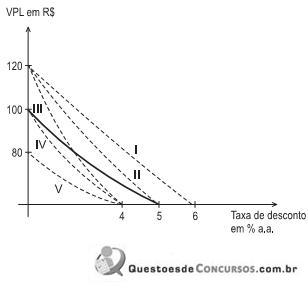
No estudo de sensibilidade do projeto, um analista considera um cenário em que todos os gastos e receitas sejam 20% maiores que os estimados inicialmente.
No gráfico, a linha tracejada que reflete este cenário será como
No estudo de sensibilidade do projeto, um analista considera um cenário em que todos os gastos e receitas sejam 20% maiores que os estimados inicialmente.
No gráfico, a linha tracejada que reflete este cenário será como
Ano: 2011
Banca:
CESGRANRIO
Órgão:
Transpetro
Prova:
CESGRANRIO - 2011 - Transpetro - Economista Júnior |
Q156779
Economia
Um projeto de investimento envolve um gasto inicial certo de R$ 1.200,00 e três receitas incertas, sucessivas, de R$ 500,00, conforme o diagrama de fluxo de caixa abaixo.
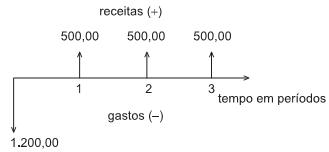
Ajustadas pelo risco, as receitas de R$ 500,00 no primeiro e no segundo períodos têm valores equivalentes de certeza de R$ 450,00 e R$ 350,00, respectivamente. Para que o projeto tenha uma taxa interna de retorno positiva, após o ajuste de risco pelo método de equivalentes de certeza, é necessário e suficiente que a receita do último período tenha um equivalente de certeza, em reais, maior que
Ajustadas pelo risco, as receitas de R$ 500,00 no primeiro e no segundo períodos têm valores equivalentes de certeza de R$ 450,00 e R$ 350,00, respectivamente. Para que o projeto tenha uma taxa interna de retorno positiva, após o ajuste de risco pelo método de equivalentes de certeza, é necessário e suficiente que a receita do último período tenha um equivalente de certeza, em reais, maior que
Ano: 2011
Banca:
CESGRANRIO
Órgão:
Transpetro
Prova:
CESGRANRIO - 2011 - Transpetro - Economista Júnior |
Q156778
Economia
Observe os gráficos abaixo que mostram, supostamente, quatro estruturas a termo da taxa de juros em diferentes economias.
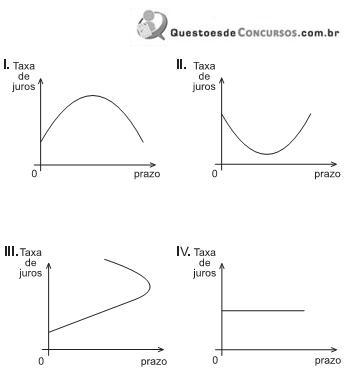
São possíveis as estruturas APENAS em
São possíveis as estruturas APENAS em
Ano: 2011
Banca:
CESGRANRIO
Órgão:
Transpetro
Prova:
CESGRANRIO - 2011 - Transpetro - Economista Júnior |
Q156777
Economia
Considere as afirmações abaixo sobre os critérios de avaliação e escolha entre dois projetos de investimento, X e Y.
I – É possível que a taxa interna de retorno de X seja maior que a de Y, mas o valor presente líquido de Y seja maior que o de X.
II – É possível que as taxas mínimas de atratividade usadas nas avaliações de X e de Y sejam diferentes.
III – É possível que o período de retorno do investimento de X seja igual ao de Y, mas a taxa interna de retorno de X seja maior que a de Y.
Está correto o que se afirma em
I – É possível que a taxa interna de retorno de X seja maior que a de Y, mas o valor presente líquido de Y seja maior que o de X.
II – É possível que as taxas mínimas de atratividade usadas nas avaliações de X e de Y sejam diferentes.
III – É possível que o período de retorno do investimento de X seja igual ao de Y, mas a taxa interna de retorno de X seja maior que a de Y.
Está correto o que se afirma em
Ano: 2011
Banca:
CESGRANRIO
Órgão:
Transpetro
Provas:
CESGRANRIO - 2011 - Transpetro - Administrador Júnior
|
CESGRANRIO - 2011 - Transpetro - Analista de Sistemas Júnior |
CESGRANRIO - 2011 - Transpetro - Contador Júnior - Contábil |
CESGRANRIO - 2011 - Transpetro - Contador Júnior - Auditoria Interna |
CESGRANRIO - 2011 - Transpetro - Economista Júnior |
CESGRANRIO - 2011 - Transpetro - Engenheiro Júnior - Engenharia de Produção |
CESGRANRIO - 2011 - Transpetro - Médico do trabalho |
CESGRANRIO - 2011 - Transpetro - Engenheiro Júnior - Análise de Projetos de Inverstimentos |
CESGRANRIO - 2011 - Transpetro - Engenheiro Júnior - Geotécnica |
CESGRANRIO - 2011 - Transpetro - Engenheiro Júnior - Elétrica |
CESGRANRIO - 2011 - Transpetro - Engenheiro Júnior - Mecânica |
CESGRANRIO - 2011 - Transpetro - Profissional de Meio Ambiente Júnior |
CESGRANRIO - 2011 - Transpetro - Engenheiro Júnior - Processamento |
CESGRANRIO - 2011 - Transpetro - Engenheiro Júnior - Segurança |
CESGRANRIO - 2011 - Transpetro - Engenheiro Júnior - Naval |
CESGRANRIO - 2011 - Transpetro - Químico de Petróleo Júnior |
CESGRANRIO - 2011 - Transpetro - Engenheiro Júnior - Automação |
Q154636
Inglês
Texto associado
Model copes with chaos to deliver relief
Computer program helps responders transport
supplies in tough conditions
By Rachel Ehrenberg Science News, Web edition: Monday, February 21st, 2011
WASHINGTON — Getting blood or other perishable supplies to an area that’s been struck by an earthquake or hurricane isn’t as simple as asking what brown can do for you. But a new model quickly determines the best routes and means for delivering humanitarian aid, even in situations where bridges are out or airport tarmacs are clogged with planes.
The research, presented February 18 at the annual meeting of the American Association for the Advancement of Science, could help get supplies to areas which have experienced natural disasters or help prepare for efficient distribution of vaccines when the flu hits.
Efficient supply chains have long been a goal of manufacturers, but transport in fragile networks — where supply, demand and delivery routes may be in extremely rapid flux — requires a different approach, said Anna Nagurney of the University of Massachusetts Amherst, who presented the new work. Rather than considering the shortest path from one place to another to maximize profit, her system aims for the cleanest path at minimum cost, while capturing factors such as the perishability of the product and the uncertainty of supply routes. ‘You don’t know where demand is, so it’s tricky,’ said Nagurney. ‘It’s a multicriteria decision-making problem.’
By calculating the total cost associated with each link in a network, accounting for congestion and incorporating penalties for time and products that are lost, the computer model calculates the best supply chain in situations where standard routes may be disrupted.
‘Mathematical tools are essential to develop formal means to predict, and to respond to, such critical perturbations,’ said Iain Couzin of Princeton University, who uses similar computational tools to study collective animal behavior. ‘This is particularly important where response must be rapid and effective, such as during disaster scenarios … or during epidemics or breaches of national security.
’ The work can be applied to immediate, pressing situations, such as getting blood, food or medication to a disaster site, or to longer-term problems such as determining the best locations for manufacturing flu vaccines. . Retrieved April 7th, 2011.
By Rachel Ehrenberg Science News, Web edition: Monday, February 21st, 2011
WASHINGTON — Getting blood or other perishable supplies to an area that’s been struck by an earthquake or hurricane isn’t as simple as asking what brown can do for you. But a new model quickly determines the best routes and means for delivering humanitarian aid, even in situations where bridges are out or airport tarmacs are clogged with planes.
The research, presented February 18 at the annual meeting of the American Association for the Advancement of Science, could help get supplies to areas which have experienced natural disasters or help prepare for efficient distribution of vaccines when the flu hits.
Efficient supply chains have long been a goal of manufacturers, but transport in fragile networks — where supply, demand and delivery routes may be in extremely rapid flux — requires a different approach, said Anna Nagurney of the University of Massachusetts Amherst, who presented the new work. Rather than considering the shortest path from one place to another to maximize profit, her system aims for the cleanest path at minimum cost, while capturing factors such as the perishability of the product and the uncertainty of supply routes. ‘You don’t know where demand is, so it’s tricky,’ said Nagurney. ‘It’s a multicriteria decision-making problem.’
By calculating the total cost associated with each link in a network, accounting for congestion and incorporating penalties for time and products that are lost, the computer model calculates the best supply chain in situations where standard routes may be disrupted.
‘Mathematical tools are essential to develop formal means to predict, and to respond to, such critical perturbations,’ said Iain Couzin of Princeton University, who uses similar computational tools to study collective animal behavior. ‘This is particularly important where response must be rapid and effective, such as during disaster scenarios … or during epidemics or breaches of national security.
’ The work can be applied to immediate, pressing situations, such as getting blood, food or medication to a disaster site, or to longer-term problems such as determining the best locations for manufacturing flu vaccines. . Retrieved April 7th, 2011.
The computer model discussed in the text “…copes with chaos to deliver relief" (title) and analyzes different factors. The only factor
NOT taken in consideration in the model is the
Ano: 2011
Banca:
CESGRANRIO
Órgão:
Transpetro
Provas:
CESGRANRIO - 2011 - Transpetro - Administrador Júnior
|
CESGRANRIO - 2011 - Transpetro - Analista de Sistemas Júnior |
CESGRANRIO - 2011 - Transpetro - Contador Júnior - Contábil |
CESGRANRIO - 2011 - Transpetro - Contador Júnior - Auditoria Interna |
CESGRANRIO - 2011 - Transpetro - Economista Júnior |
CESGRANRIO - 2011 - Transpetro - Engenheiro Júnior - Engenharia de Produção |
CESGRANRIO - 2011 - Transpetro - Médico do trabalho |
CESGRANRIO - 2011 - Transpetro - Engenheiro Júnior - Análise de Projetos de Inverstimentos |
CESGRANRIO - 2011 - Transpetro - Engenheiro Júnior - Geotécnica |
CESGRANRIO - 2011 - Transpetro - Engenheiro Júnior - Elétrica |
CESGRANRIO - 2011 - Transpetro - Engenheiro Júnior - Mecânica |
CESGRANRIO - 2011 - Transpetro - Profissional de Meio Ambiente Júnior |
CESGRANRIO - 2011 - Transpetro - Engenheiro Júnior - Processamento |
CESGRANRIO - 2011 - Transpetro - Engenheiro Júnior - Segurança |
CESGRANRIO - 2011 - Transpetro - Engenheiro Júnior - Naval |
CESGRANRIO - 2011 - Transpetro - Químico de Petróleo Júnior |
CESGRANRIO - 2011 - Transpetro - Engenheiro Júnior - Automação |
Q154635
Inglês
Texto associado
Model copes with chaos to deliver relief
Computer program helps responders transport
supplies in tough conditions
By Rachel Ehrenberg Science News, Web edition: Monday, February 21st, 2011
WASHINGTON — Getting blood or other perishable supplies to an area that’s been struck by an earthquake or hurricane isn’t as simple as asking what brown can do for you. But a new model quickly determines the best routes and means for delivering humanitarian aid, even in situations where bridges are out or airport tarmacs are clogged with planes.
The research, presented February 18 at the annual meeting of the American Association for the Advancement of Science, could help get supplies to areas which have experienced natural disasters or help prepare for efficient distribution of vaccines when the flu hits.
Efficient supply chains have long been a goal of manufacturers, but transport in fragile networks — where supply, demand and delivery routes may be in extremely rapid flux — requires a different approach, said Anna Nagurney of the University of Massachusetts Amherst, who presented the new work. Rather than considering the shortest path from one place to another to maximize profit, her system aims for the cleanest path at minimum cost, while capturing factors such as the perishability of the product and the uncertainty of supply routes. ‘You don’t know where demand is, so it’s tricky,’ said Nagurney. ‘It’s a multicriteria decision-making problem.’
By calculating the total cost associated with each link in a network, accounting for congestion and incorporating penalties for time and products that are lost, the computer model calculates the best supply chain in situations where standard routes may be disrupted.
‘Mathematical tools are essential to develop formal means to predict, and to respond to, such critical perturbations,’ said Iain Couzin of Princeton University, who uses similar computational tools to study collective animal behavior. ‘This is particularly important where response must be rapid and effective, such as during disaster scenarios … or during epidemics or breaches of national security.
’ The work can be applied to immediate, pressing situations, such as getting blood, food or medication to a disaster site, or to longer-term problems such as determining the best locations for manufacturing flu vaccines. . Retrieved April 7th, 2011.
By Rachel Ehrenberg Science News, Web edition: Monday, February 21st, 2011
WASHINGTON — Getting blood or other perishable supplies to an area that’s been struck by an earthquake or hurricane isn’t as simple as asking what brown can do for you. But a new model quickly determines the best routes and means for delivering humanitarian aid, even in situations where bridges are out or airport tarmacs are clogged with planes.
The research, presented February 18 at the annual meeting of the American Association for the Advancement of Science, could help get supplies to areas which have experienced natural disasters or help prepare for efficient distribution of vaccines when the flu hits.
Efficient supply chains have long been a goal of manufacturers, but transport in fragile networks — where supply, demand and delivery routes may be in extremely rapid flux — requires a different approach, said Anna Nagurney of the University of Massachusetts Amherst, who presented the new work. Rather than considering the shortest path from one place to another to maximize profit, her system aims for the cleanest path at minimum cost, while capturing factors such as the perishability of the product and the uncertainty of supply routes. ‘You don’t know where demand is, so it’s tricky,’ said Nagurney. ‘It’s a multicriteria decision-making problem.’
By calculating the total cost associated with each link in a network, accounting for congestion and incorporating penalties for time and products that are lost, the computer model calculates the best supply chain in situations where standard routes may be disrupted.
‘Mathematical tools are essential to develop formal means to predict, and to respond to, such critical perturbations,’ said Iain Couzin of Princeton University, who uses similar computational tools to study collective animal behavior. ‘This is particularly important where response must be rapid and effective, such as during disaster scenarios … or during epidemics or breaches of national security.
’ The work can be applied to immediate, pressing situations, such as getting blood, food or medication to a disaster site, or to longer-term problems such as determining the best locations for manufacturing flu vaccines. . Retrieved April 7th, 2011.
In “The work can be applied to immediate, pressing situations," (lines 41-42), the fragment “can be applied" is replaced, without change in meaning, by
Ano: 2011
Banca:
CESGRANRIO
Órgão:
Transpetro
Provas:
CESGRANRIO - 2011 - Transpetro - Administrador Júnior
|
CESGRANRIO - 2011 - Transpetro - Analista de Sistemas Júnior |
CESGRANRIO - 2011 - Transpetro - Contador Júnior - Contábil |
CESGRANRIO - 2011 - Transpetro - Contador Júnior - Auditoria Interna |
CESGRANRIO - 2011 - Transpetro - Economista Júnior |
CESGRANRIO - 2011 - Transpetro - Engenheiro Júnior - Engenharia de Produção |
CESGRANRIO - 2011 - Transpetro - Médico do trabalho |
CESGRANRIO - 2011 - Transpetro - Engenheiro Júnior - Análise de Projetos de Inverstimentos |
CESGRANRIO - 2011 - Transpetro - Engenheiro Júnior - Geotécnica |
CESGRANRIO - 2011 - Transpetro - Engenheiro Júnior - Elétrica |
CESGRANRIO - 2011 - Transpetro - Engenheiro Júnior - Mecânica |
CESGRANRIO - 2011 - Transpetro - Profissional de Meio Ambiente Júnior |
CESGRANRIO - 2011 - Transpetro - Engenheiro Júnior - Processamento |
CESGRANRIO - 2011 - Transpetro - Engenheiro Júnior - Segurança |
CESGRANRIO - 2011 - Transpetro - Engenheiro Júnior - Naval |
CESGRANRIO - 2011 - Transpetro - Químico de Petróleo Júnior |
CESGRANRIO - 2011 - Transpetro - Engenheiro Júnior - Automação |
Q154634
Inglês
Texto associado
Model copes with chaos to deliver relief
Computer program helps responders transport
supplies in tough conditions
By Rachel Ehrenberg Science News, Web edition: Monday, February 21st, 2011
WASHINGTON — Getting blood or other perishable supplies to an area that’s been struck by an earthquake or hurricane isn’t as simple as asking what brown can do for you. But a new model quickly determines the best routes and means for delivering humanitarian aid, even in situations where bridges are out or airport tarmacs are clogged with planes.
The research, presented February 18 at the annual meeting of the American Association for the Advancement of Science, could help get supplies to areas which have experienced natural disasters or help prepare for efficient distribution of vaccines when the flu hits.
Efficient supply chains have long been a goal of manufacturers, but transport in fragile networks — where supply, demand and delivery routes may be in extremely rapid flux — requires a different approach, said Anna Nagurney of the University of Massachusetts Amherst, who presented the new work. Rather than considering the shortest path from one place to another to maximize profit, her system aims for the cleanest path at minimum cost, while capturing factors such as the perishability of the product and the uncertainty of supply routes. ‘You don’t know where demand is, so it’s tricky,’ said Nagurney. ‘It’s a multicriteria decision-making problem.’
By calculating the total cost associated with each link in a network, accounting for congestion and incorporating penalties for time and products that are lost, the computer model calculates the best supply chain in situations where standard routes may be disrupted.
‘Mathematical tools are essential to develop formal means to predict, and to respond to, such critical perturbations,’ said Iain Couzin of Princeton University, who uses similar computational tools to study collective animal behavior. ‘This is particularly important where response must be rapid and effective, such as during disaster scenarios … or during epidemics or breaches of national security.
’ The work can be applied to immediate, pressing situations, such as getting blood, food or medication to a disaster site, or to longer-term problems such as determining the best locations for manufacturing flu vaccines. . Retrieved April 7th, 2011.
By Rachel Ehrenberg Science News, Web edition: Monday, February 21st, 2011
WASHINGTON — Getting blood or other perishable supplies to an area that’s been struck by an earthquake or hurricane isn’t as simple as asking what brown can do for you. But a new model quickly determines the best routes and means for delivering humanitarian aid, even in situations where bridges are out or airport tarmacs are clogged with planes.
The research, presented February 18 at the annual meeting of the American Association for the Advancement of Science, could help get supplies to areas which have experienced natural disasters or help prepare for efficient distribution of vaccines when the flu hits.
Efficient supply chains have long been a goal of manufacturers, but transport in fragile networks — where supply, demand and delivery routes may be in extremely rapid flux — requires a different approach, said Anna Nagurney of the University of Massachusetts Amherst, who presented the new work. Rather than considering the shortest path from one place to another to maximize profit, her system aims for the cleanest path at minimum cost, while capturing factors such as the perishability of the product and the uncertainty of supply routes. ‘You don’t know where demand is, so it’s tricky,’ said Nagurney. ‘It’s a multicriteria decision-making problem.’
By calculating the total cost associated with each link in a network, accounting for congestion and incorporating penalties for time and products that are lost, the computer model calculates the best supply chain in situations where standard routes may be disrupted.
‘Mathematical tools are essential to develop formal means to predict, and to respond to, such critical perturbations,’ said Iain Couzin of Princeton University, who uses similar computational tools to study collective animal behavior. ‘This is particularly important where response must be rapid and effective, such as during disaster scenarios … or during epidemics or breaches of national security.
’ The work can be applied to immediate, pressing situations, such as getting blood, food or medication to a disaster site, or to longer-term problems such as determining the best locations for manufacturing flu vaccines. . Retrieved April 7th, 2011.
Based on the meanings in the text, the two items are antonymous in
Ano: 2011
Banca:
CESGRANRIO
Órgão:
Transpetro
Provas:
CESGRANRIO - 2011 - Transpetro - Administrador Júnior
|
CESGRANRIO - 2011 - Transpetro - Analista de Sistemas Júnior |
CESGRANRIO - 2011 - Transpetro - Contador Júnior - Contábil |
CESGRANRIO - 2011 - Transpetro - Contador Júnior - Auditoria Interna |
CESGRANRIO - 2011 - Transpetro - Economista Júnior |
CESGRANRIO - 2011 - Transpetro - Engenheiro Júnior - Engenharia de Produção |
CESGRANRIO - 2011 - Transpetro - Médico do trabalho |
CESGRANRIO - 2011 - Transpetro - Engenheiro Júnior - Análise de Projetos de Inverstimentos |
CESGRANRIO - 2011 - Transpetro - Engenheiro Júnior - Geotécnica |
CESGRANRIO - 2011 - Transpetro - Engenheiro Júnior - Elétrica |
CESGRANRIO - 2011 - Transpetro - Engenheiro Júnior - Mecânica |
CESGRANRIO - 2011 - Transpetro - Profissional de Meio Ambiente Júnior |
CESGRANRIO - 2011 - Transpetro - Engenheiro Júnior - Processamento |
CESGRANRIO - 2011 - Transpetro - Engenheiro Júnior - Segurança |
CESGRANRIO - 2011 - Transpetro - Engenheiro Júnior - Naval |
CESGRANRIO - 2011 - Transpetro - Químico de Petróleo Júnior |
CESGRANRIO - 2011 - Transpetro - Engenheiro Júnior - Automação |
Q154633
Inglês
Texto associado
Model copes with chaos to deliver relief
Computer program helps responders transport
supplies in tough conditions
By Rachel Ehrenberg Science News, Web edition: Monday, February 21st, 2011
WASHINGTON — Getting blood or other perishable supplies to an area that’s been struck by an earthquake or hurricane isn’t as simple as asking what brown can do for you. But a new model quickly determines the best routes and means for delivering humanitarian aid, even in situations where bridges are out or airport tarmacs are clogged with planes.
The research, presented February 18 at the annual meeting of the American Association for the Advancement of Science, could help get supplies to areas which have experienced natural disasters or help prepare for efficient distribution of vaccines when the flu hits.
Efficient supply chains have long been a goal of manufacturers, but transport in fragile networks — where supply, demand and delivery routes may be in extremely rapid flux — requires a different approach, said Anna Nagurney of the University of Massachusetts Amherst, who presented the new work. Rather than considering the shortest path from one place to another to maximize profit, her system aims for the cleanest path at minimum cost, while capturing factors such as the perishability of the product and the uncertainty of supply routes. ‘You don’t know where demand is, so it’s tricky,’ said Nagurney. ‘It’s a multicriteria decision-making problem.’
By calculating the total cost associated with each link in a network, accounting for congestion and incorporating penalties for time and products that are lost, the computer model calculates the best supply chain in situations where standard routes may be disrupted.
‘Mathematical tools are essential to develop formal means to predict, and to respond to, such critical perturbations,’ said Iain Couzin of Princeton University, who uses similar computational tools to study collective animal behavior. ‘This is particularly important where response must be rapid and effective, such as during disaster scenarios … or during epidemics or breaches of national security.
’ The work can be applied to immediate, pressing situations, such as getting blood, food or medication to a disaster site, or to longer-term problems such as determining the best locations for manufacturing flu vaccines. . Retrieved April 7th, 2011.
By Rachel Ehrenberg Science News, Web edition: Monday, February 21st, 2011
WASHINGTON — Getting blood or other perishable supplies to an area that’s been struck by an earthquake or hurricane isn’t as simple as asking what brown can do for you. But a new model quickly determines the best routes and means for delivering humanitarian aid, even in situations where bridges are out or airport tarmacs are clogged with planes.
The research, presented February 18 at the annual meeting of the American Association for the Advancement of Science, could help get supplies to areas which have experienced natural disasters or help prepare for efficient distribution of vaccines when the flu hits.
Efficient supply chains have long been a goal of manufacturers, but transport in fragile networks — where supply, demand and delivery routes may be in extremely rapid flux — requires a different approach, said Anna Nagurney of the University of Massachusetts Amherst, who presented the new work. Rather than considering the shortest path from one place to another to maximize profit, her system aims for the cleanest path at minimum cost, while capturing factors such as the perishability of the product and the uncertainty of supply routes. ‘You don’t know where demand is, so it’s tricky,’ said Nagurney. ‘It’s a multicriteria decision-making problem.’
By calculating the total cost associated with each link in a network, accounting for congestion and incorporating penalties for time and products that are lost, the computer model calculates the best supply chain in situations where standard routes may be disrupted.
‘Mathematical tools are essential to develop formal means to predict, and to respond to, such critical perturbations,’ said Iain Couzin of Princeton University, who uses similar computational tools to study collective animal behavior. ‘This is particularly important where response must be rapid and effective, such as during disaster scenarios … or during epidemics or breaches of national security.
’ The work can be applied to immediate, pressing situations, such as getting blood, food or medication to a disaster site, or to longer-term problems such as determining the best locations for manufacturing flu vaccines. . Retrieved April 7th, 2011.
In terms of pronominal reference,
Ano: 2011
Banca:
CESGRANRIO
Órgão:
Transpetro
Provas:
CESGRANRIO - 2011 - Transpetro - Administrador Júnior
|
CESGRANRIO - 2011 - Transpetro - Analista de Sistemas Júnior |
CESGRANRIO - 2011 - Transpetro - Contador Júnior - Contábil |
CESGRANRIO - 2011 - Transpetro - Economista Júnior |
CESGRANRIO - 2011 - Transpetro - Engenheiro Júnior - Engenharia de Produção |
CESGRANRIO - 2011 - Transpetro - Médico do trabalho |
CESGRANRIO - 2011 - Transpetro - Engenheiro Júnior - Análise de Projetos de Inverstimentos |
CESGRANRIO - 2011 - Transpetro - Engenheiro Júnior - Geotécnica |
CESGRANRIO - 2011 - Transpetro - Engenheiro Júnior - Elétrica |
CESGRANRIO - 2011 - Transpetro - Engenheiro Júnior - Mecânica |
CESGRANRIO - 2011 - Transpetro - Profissional de Meio Ambiente Júnior |
CESGRANRIO - 2011 - Transpetro - Engenheiro Júnior - Processamento |
CESGRANRIO - 2011 - Transpetro - Engenheiro Júnior - Segurança |
CESGRANRIO - 2011 - Transpetro - Engenheiro Júnior - Naval |
CESGRANRIO - 2011 - Transpetro - Químico de Petróleo Júnior |
CESGRANRIO - 2011 - Transpetro - Engenheiro Júnior - Automação |
Q154632
Inglês
Texto associado
Model copes with chaos to deliver relief
Computer program helps responders transport
supplies in tough conditions
By Rachel Ehrenberg Science News, Web edition: Monday, February 21st, 2011
WASHINGTON — Getting blood or other perishable supplies to an area that’s been struck by an earthquake or hurricane isn’t as simple as asking what brown can do for you. But a new model quickly determines the best routes and means for delivering humanitarian aid, even in situations where bridges are out or airport tarmacs are clogged with planes.
The research, presented February 18 at the annual meeting of the American Association for the Advancement of Science, could help get supplies to areas which have experienced natural disasters or help prepare for efficient distribution of vaccines when the flu hits.
Efficient supply chains have long been a goal of manufacturers, but transport in fragile networks — where supply, demand and delivery routes may be in extremely rapid flux — requires a different approach, said Anna Nagurney of the University of Massachusetts Amherst, who presented the new work. Rather than considering the shortest path from one place to another to maximize profit, her system aims for the cleanest path at minimum cost, while capturing factors such as the perishability of the product and the uncertainty of supply routes. ‘You don’t know where demand is, so it’s tricky,’ said Nagurney. ‘It’s a multicriteria decision-making problem.’
By calculating the total cost associated with each link in a network, accounting for congestion and incorporating penalties for time and products that are lost, the computer model calculates the best supply chain in situations where standard routes may be disrupted.
‘Mathematical tools are essential to develop formal means to predict, and to respond to, such critical perturbations,’ said Iain Couzin of Princeton University, who uses similar computational tools to study collective animal behavior. ‘This is particularly important where response must be rapid and effective, such as during disaster scenarios … or during epidemics or breaches of national security.
’ The work can be applied to immediate, pressing situations, such as getting blood, food or medication to a disaster site, or to longer-term problems such as determining the best locations for manufacturing flu vaccines. . Retrieved April 7th, 2011.
By Rachel Ehrenberg Science News, Web edition: Monday, February 21st, 2011
WASHINGTON — Getting blood or other perishable supplies to an area that’s been struck by an earthquake or hurricane isn’t as simple as asking what brown can do for you. But a new model quickly determines the best routes and means for delivering humanitarian aid, even in situations where bridges are out or airport tarmacs are clogged with planes.
The research, presented February 18 at the annual meeting of the American Association for the Advancement of Science, could help get supplies to areas which have experienced natural disasters or help prepare for efficient distribution of vaccines when the flu hits.
Efficient supply chains have long been a goal of manufacturers, but transport in fragile networks — where supply, demand and delivery routes may be in extremely rapid flux — requires a different approach, said Anna Nagurney of the University of Massachusetts Amherst, who presented the new work. Rather than considering the shortest path from one place to another to maximize profit, her system aims for the cleanest path at minimum cost, while capturing factors such as the perishability of the product and the uncertainty of supply routes. ‘You don’t know where demand is, so it’s tricky,’ said Nagurney. ‘It’s a multicriteria decision-making problem.’
By calculating the total cost associated with each link in a network, accounting for congestion and incorporating penalties for time and products that are lost, the computer model calculates the best supply chain in situations where standard routes may be disrupted.
‘Mathematical tools are essential to develop formal means to predict, and to respond to, such critical perturbations,’ said Iain Couzin of Princeton University, who uses similar computational tools to study collective animal behavior. ‘This is particularly important where response must be rapid and effective, such as during disaster scenarios … or during epidemics or breaches of national security.
’ The work can be applied to immediate, pressing situations, such as getting blood, food or medication to a disaster site, or to longer-term problems such as determining the best locations for manufacturing flu vaccines. . Retrieved April 7th, 2011.
The expression in boldface introduces the idea of conclusion in
Ano: 2011
Banca:
CESGRANRIO
Órgão:
Transpetro
Provas:
CESGRANRIO - 2011 - Transpetro - Administrador Júnior
|
CESGRANRIO - 2011 - Transpetro - Analista de Sistemas Júnior |
CESGRANRIO - 2011 - Transpetro - Contador Júnior - Contábil |
CESGRANRIO - 2011 - Transpetro - Contador Júnior - Auditoria Interna |
CESGRANRIO - 2011 - Transpetro - Economista Júnior |
CESGRANRIO - 2011 - Transpetro - Engenheiro Júnior - Engenharia de Produção |
CESGRANRIO - 2011 - Transpetro - Médico do trabalho |
CESGRANRIO - 2011 - Transpetro - Engenheiro Júnior - Análise de Projetos de Inverstimentos |
CESGRANRIO - 2011 - Transpetro - Engenheiro Júnior - Geotécnica |
CESGRANRIO - 2011 - Transpetro - Engenheiro Júnior - Elétrica |
CESGRANRIO - 2011 - Transpetro - Engenheiro Júnior - Mecânica |
CESGRANRIO - 2011 - Transpetro - Profissional de Meio Ambiente Júnior |
CESGRANRIO - 2011 - Transpetro - Engenheiro Júnior - Processamento |
CESGRANRIO - 2011 - Transpetro - Engenheiro Júnior - Segurança |
CESGRANRIO - 2011 - Transpetro - Engenheiro Júnior - Naval |
CESGRANRIO - 2011 - Transpetro - Químico de Petróleo Júnior |
CESGRANRIO - 2011 - Transpetro - Engenheiro Júnior - Automação |
Q154631
Inglês
Texto associado
Model copes with chaos to deliver relief
Computer program helps responders transport
supplies in tough conditions
By Rachel Ehrenberg Science News, Web edition: Monday, February 21st, 2011
WASHINGTON — Getting blood or other perishable supplies to an area that’s been struck by an earthquake or hurricane isn’t as simple as asking what brown can do for you. But a new model quickly determines the best routes and means for delivering humanitarian aid, even in situations where bridges are out or airport tarmacs are clogged with planes.
The research, presented February 18 at the annual meeting of the American Association for the Advancement of Science, could help get supplies to areas which have experienced natural disasters or help prepare for efficient distribution of vaccines when the flu hits.
Efficient supply chains have long been a goal of manufacturers, but transport in fragile networks — where supply, demand and delivery routes may be in extremely rapid flux — requires a different approach, said Anna Nagurney of the University of Massachusetts Amherst, who presented the new work. Rather than considering the shortest path from one place to another to maximize profit, her system aims for the cleanest path at minimum cost, while capturing factors such as the perishability of the product and the uncertainty of supply routes. ‘You don’t know where demand is, so it’s tricky,’ said Nagurney. ‘It’s a multicriteria decision-making problem.’
By calculating the total cost associated with each link in a network, accounting for congestion and incorporating penalties for time and products that are lost, the computer model calculates the best supply chain in situations where standard routes may be disrupted.
‘Mathematical tools are essential to develop formal means to predict, and to respond to, such critical perturbations,’ said Iain Couzin of Princeton University, who uses similar computational tools to study collective animal behavior. ‘This is particularly important where response must be rapid and effective, such as during disaster scenarios … or during epidemics or breaches of national security.
’ The work can be applied to immediate, pressing situations, such as getting blood, food or medication to a disaster site, or to longer-term problems such as determining the best locations for manufacturing flu vaccines. . Retrieved April 7th, 2011.
By Rachel Ehrenberg Science News, Web edition: Monday, February 21st, 2011
WASHINGTON — Getting blood or other perishable supplies to an area that’s been struck by an earthquake or hurricane isn’t as simple as asking what brown can do for you. But a new model quickly determines the best routes and means for delivering humanitarian aid, even in situations where bridges are out or airport tarmacs are clogged with planes.
The research, presented February 18 at the annual meeting of the American Association for the Advancement of Science, could help get supplies to areas which have experienced natural disasters or help prepare for efficient distribution of vaccines when the flu hits.
Efficient supply chains have long been a goal of manufacturers, but transport in fragile networks — where supply, demand and delivery routes may be in extremely rapid flux — requires a different approach, said Anna Nagurney of the University of Massachusetts Amherst, who presented the new work. Rather than considering the shortest path from one place to another to maximize profit, her system aims for the cleanest path at minimum cost, while capturing factors such as the perishability of the product and the uncertainty of supply routes. ‘You don’t know where demand is, so it’s tricky,’ said Nagurney. ‘It’s a multicriteria decision-making problem.’
By calculating the total cost associated with each link in a network, accounting for congestion and incorporating penalties for time and products that are lost, the computer model calculates the best supply chain in situations where standard routes may be disrupted.
‘Mathematical tools are essential to develop formal means to predict, and to respond to, such critical perturbations,’ said Iain Couzin of Princeton University, who uses similar computational tools to study collective animal behavior. ‘This is particularly important where response must be rapid and effective, such as during disaster scenarios … or during epidemics or breaches of national security.
’ The work can be applied to immediate, pressing situations, such as getting blood, food or medication to a disaster site, or to longer-term problems such as determining the best locations for manufacturing flu vaccines. . Retrieved April 7th, 2011.
“such critical perturbations," (lines 34-35) refers to all the items below, EXCEPT
Ano: 2011
Banca:
CESGRANRIO
Órgão:
Transpetro
Provas:
CESGRANRIO - 2011 - Transpetro - Administrador Júnior
|
CESGRANRIO - 2011 - Transpetro - Analista de Sistemas Júnior |
CESGRANRIO - 2011 - Transpetro - Contador Júnior - Contábil |
CESGRANRIO - 2011 - Transpetro - Contador Júnior - Auditoria Interna |
CESGRANRIO - 2011 - Transpetro - Economista Júnior |
CESGRANRIO - 2011 - Transpetro - Engenheiro Júnior - Engenharia de Produção |
CESGRANRIO - 2011 - Transpetro - Médico do trabalho |
CESGRANRIO - 2011 - Transpetro - Engenheiro Júnior - Análise de Projetos de Inverstimentos |
CESGRANRIO - 2011 - Transpetro - Engenheiro Júnior - Geotécnica |
CESGRANRIO - 2011 - Transpetro - Engenheiro Júnior - Elétrica |
CESGRANRIO - 2011 - Transpetro - Engenheiro Júnior - Mecânica |
CESGRANRIO - 2011 - Transpetro - Profissional de Meio Ambiente Júnior |
CESGRANRIO - 2011 - Transpetro - Engenheiro Júnior - Processamento |
CESGRANRIO - 2011 - Transpetro - Engenheiro Júnior - Segurança |
CESGRANRIO - 2011 - Transpetro - Engenheiro Júnior - Naval |
CESGRANRIO - 2011 - Transpetro - Químico de Petróleo Júnior |
CESGRANRIO - 2011 - Transpetro - Engenheiro Júnior - Automação |
Q154630
Inglês
Texto associado
Model copes with chaos to deliver relief
Computer program helps responders transport
supplies in tough conditions
By Rachel Ehrenberg Science News, Web edition: Monday, February 21st, 2011
WASHINGTON — Getting blood or other perishable supplies to an area that’s been struck by an earthquake or hurricane isn’t as simple as asking what brown can do for you. But a new model quickly determines the best routes and means for delivering humanitarian aid, even in situations where bridges are out or airport tarmacs are clogged with planes.
The research, presented February 18 at the annual meeting of the American Association for the Advancement of Science, could help get supplies to areas which have experienced natural disasters or help prepare for efficient distribution of vaccines when the flu hits.
Efficient supply chains have long been a goal of manufacturers, but transport in fragile networks — where supply, demand and delivery routes may be in extremely rapid flux — requires a different approach, said Anna Nagurney of the University of Massachusetts Amherst, who presented the new work. Rather than considering the shortest path from one place to another to maximize profit, her system aims for the cleanest path at minimum cost, while capturing factors such as the perishability of the product and the uncertainty of supply routes. ‘You don’t know where demand is, so it’s tricky,’ said Nagurney. ‘It’s a multicriteria decision-making problem.’
By calculating the total cost associated with each link in a network, accounting for congestion and incorporating penalties for time and products that are lost, the computer model calculates the best supply chain in situations where standard routes may be disrupted.
‘Mathematical tools are essential to develop formal means to predict, and to respond to, such critical perturbations,’ said Iain Couzin of Princeton University, who uses similar computational tools to study collective animal behavior. ‘This is particularly important where response must be rapid and effective, such as during disaster scenarios … or during epidemics or breaches of national security.
’ The work can be applied to immediate, pressing situations, such as getting blood, food or medication to a disaster site, or to longer-term problems such as determining the best locations for manufacturing flu vaccines. . Retrieved April 7th, 2011.
By Rachel Ehrenberg Science News, Web edition: Monday, February 21st, 2011
WASHINGTON — Getting blood or other perishable supplies to an area that’s been struck by an earthquake or hurricane isn’t as simple as asking what brown can do for you. But a new model quickly determines the best routes and means for delivering humanitarian aid, even in situations where bridges are out or airport tarmacs are clogged with planes.
The research, presented February 18 at the annual meeting of the American Association for the Advancement of Science, could help get supplies to areas which have experienced natural disasters or help prepare for efficient distribution of vaccines when the flu hits.
Efficient supply chains have long been a goal of manufacturers, but transport in fragile networks — where supply, demand and delivery routes may be in extremely rapid flux — requires a different approach, said Anna Nagurney of the University of Massachusetts Amherst, who presented the new work. Rather than considering the shortest path from one place to another to maximize profit, her system aims for the cleanest path at minimum cost, while capturing factors such as the perishability of the product and the uncertainty of supply routes. ‘You don’t know where demand is, so it’s tricky,’ said Nagurney. ‘It’s a multicriteria decision-making problem.’
By calculating the total cost associated with each link in a network, accounting for congestion and incorporating penalties for time and products that are lost, the computer model calculates the best supply chain in situations where standard routes may be disrupted.
‘Mathematical tools are essential to develop formal means to predict, and to respond to, such critical perturbations,’ said Iain Couzin of Princeton University, who uses similar computational tools to study collective animal behavior. ‘This is particularly important where response must be rapid and effective, such as during disaster scenarios … or during epidemics or breaches of national security.
’ The work can be applied to immediate, pressing situations, such as getting blood, food or medication to a disaster site, or to longer-term problems such as determining the best locations for manufacturing flu vaccines. . Retrieved April 7th, 2011.
Iain Couzin is mentioned in paragraph 5 (lines 33-40) because he
Ano: 2011
Banca:
CESGRANRIO
Órgão:
Transpetro
Provas:
CESGRANRIO - 2011 - Transpetro - Administrador Júnior
|
CESGRANRIO - 2011 - Transpetro - Analista de Sistemas Júnior |
CESGRANRIO - 2011 - Transpetro - Contador Júnior - Contábil |
CESGRANRIO - 2011 - Transpetro - Contador Júnior - Auditoria Interna |
CESGRANRIO - 2011 - Transpetro - Economista Júnior |
CESGRANRIO - 2011 - Transpetro - Engenheiro Júnior - Engenharia de Produção |
CESGRANRIO - 2011 - Transpetro - Médico do trabalho |
CESGRANRIO - 2011 - Transpetro - Engenheiro Júnior - Análise de Projetos de Inverstimentos |
CESGRANRIO - 2011 - Transpetro - Engenheiro Júnior - Geotécnica |
CESGRANRIO - 2011 - Transpetro - Engenheiro Júnior - Elétrica |
CESGRANRIO - 2011 - Transpetro - Engenheiro Júnior - Mecânica |
CESGRANRIO - 2011 - Transpetro - Profissional de Meio Ambiente Júnior |
CESGRANRIO - 2011 - Transpetro - Engenheiro Júnior - Processamento |
CESGRANRIO - 2011 - Transpetro - Engenheiro Júnior - Segurança |
CESGRANRIO - 2011 - Transpetro - Engenheiro Júnior - Naval |
CESGRANRIO - 2011 - Transpetro - Químico de Petróleo Júnior |
CESGRANRIO - 2011 - Transpetro - Engenheiro Júnior - Automação |
Q154629
Inglês
Texto associado
Model copes with chaos to deliver relief
Computer program helps responders transport
supplies in tough conditions
By Rachel Ehrenberg Science News, Web edition: Monday, February 21st, 2011
WASHINGTON — Getting blood or other perishable supplies to an area that’s been struck by an earthquake or hurricane isn’t as simple as asking what brown can do for you. But a new model quickly determines the best routes and means for delivering humanitarian aid, even in situations where bridges are out or airport tarmacs are clogged with planes.
The research, presented February 18 at the annual meeting of the American Association for the Advancement of Science, could help get supplies to areas which have experienced natural disasters or help prepare for efficient distribution of vaccines when the flu hits.
Efficient supply chains have long been a goal of manufacturers, but transport in fragile networks — where supply, demand and delivery routes may be in extremely rapid flux — requires a different approach, said Anna Nagurney of the University of Massachusetts Amherst, who presented the new work. Rather than considering the shortest path from one place to another to maximize profit, her system aims for the cleanest path at minimum cost, while capturing factors such as the perishability of the product and the uncertainty of supply routes. ‘You don’t know where demand is, so it’s tricky,’ said Nagurney. ‘It’s a multicriteria decision-making problem.’
By calculating the total cost associated with each link in a network, accounting for congestion and incorporating penalties for time and products that are lost, the computer model calculates the best supply chain in situations where standard routes may be disrupted.
‘Mathematical tools are essential to develop formal means to predict, and to respond to, such critical perturbations,’ said Iain Couzin of Princeton University, who uses similar computational tools to study collective animal behavior. ‘This is particularly important where response must be rapid and effective, such as during disaster scenarios … or during epidemics or breaches of national security.
’ The work can be applied to immediate, pressing situations, such as getting blood, food or medication to a disaster site, or to longer-term problems such as determining the best locations for manufacturing flu vaccines. . Retrieved April 7th, 2011.
By Rachel Ehrenberg Science News, Web edition: Monday, February 21st, 2011
WASHINGTON — Getting blood or other perishable supplies to an area that’s been struck by an earthquake or hurricane isn’t as simple as asking what brown can do for you. But a new model quickly determines the best routes and means for delivering humanitarian aid, even in situations where bridges are out or airport tarmacs are clogged with planes.
The research, presented February 18 at the annual meeting of the American Association for the Advancement of Science, could help get supplies to areas which have experienced natural disasters or help prepare for efficient distribution of vaccines when the flu hits.
Efficient supply chains have long been a goal of manufacturers, but transport in fragile networks — where supply, demand and delivery routes may be in extremely rapid flux — requires a different approach, said Anna Nagurney of the University of Massachusetts Amherst, who presented the new work. Rather than considering the shortest path from one place to another to maximize profit, her system aims for the cleanest path at minimum cost, while capturing factors such as the perishability of the product and the uncertainty of supply routes. ‘You don’t know where demand is, so it’s tricky,’ said Nagurney. ‘It’s a multicriteria decision-making problem.’
By calculating the total cost associated with each link in a network, accounting for congestion and incorporating penalties for time and products that are lost, the computer model calculates the best supply chain in situations where standard routes may be disrupted.
‘Mathematical tools are essential to develop formal means to predict, and to respond to, such critical perturbations,’ said Iain Couzin of Princeton University, who uses similar computational tools to study collective animal behavior. ‘This is particularly important where response must be rapid and effective, such as during disaster scenarios … or during epidemics or breaches of national security.
’ The work can be applied to immediate, pressing situations, such as getting blood, food or medication to a disaster site, or to longer-term problems such as determining the best locations for manufacturing flu vaccines. . Retrieved April 7th, 2011.
Nagurney's comment “'It's a multicriteria decision-making problem.'" (lines 25-26) refers to the fact that
Ano: 2011
Banca:
CESGRANRIO
Órgão:
Transpetro
Provas:
CESGRANRIO - 2011 - Transpetro - Administrador Júnior
|
CESGRANRIO - 2011 - Transpetro - Analista de Sistemas Júnior |
CESGRANRIO - 2011 - Transpetro - Contador Júnior - Contábil |
CESGRANRIO - 2011 - Transpetro - Contador Júnior - Auditoria Interna |
CESGRANRIO - 2011 - Transpetro - Economista Júnior |
CESGRANRIO - 2011 - Transpetro - Engenheiro Júnior - Engenharia de Produção |
CESGRANRIO - 2011 - Transpetro - Médico do trabalho |
CESGRANRIO - 2011 - Transpetro - Engenheiro Júnior - Análise de Projetos de Inverstimentos |
CESGRANRIO - 2011 - Transpetro - Engenheiro Júnior - Geotécnica |
CESGRANRIO - 2011 - Transpetro - Engenheiro Júnior - Elétrica |
CESGRANRIO - 2011 - Transpetro - Engenheiro Júnior - Mecânica |
CESGRANRIO - 2011 - Transpetro - Profissional de Meio Ambiente Júnior |
CESGRANRIO - 2011 - Transpetro - Engenheiro Júnior - Processamento |
CESGRANRIO - 2011 - Transpetro - Engenheiro Júnior - Segurança |
CESGRANRIO - 2011 - Transpetro - Engenheiro Júnior - Naval |
CESGRANRIO - 2011 - Transpetro - Químico de Petróleo Júnior |
CESGRANRIO - 2011 - Transpetro - Engenheiro Júnior - Automação |
Q154628
Inglês
Texto associado
Model copes with chaos to deliver relief
Computer program helps responders transport
supplies in tough conditions
By Rachel Ehrenberg Science News, Web edition: Monday, February 21st, 2011
WASHINGTON — Getting blood or other perishable supplies to an area that’s been struck by an earthquake or hurricane isn’t as simple as asking what brown can do for you. But a new model quickly determines the best routes and means for delivering humanitarian aid, even in situations where bridges are out or airport tarmacs are clogged with planes.
The research, presented February 18 at the annual meeting of the American Association for the Advancement of Science, could help get supplies to areas which have experienced natural disasters or help prepare for efficient distribution of vaccines when the flu hits.
Efficient supply chains have long been a goal of manufacturers, but transport in fragile networks — where supply, demand and delivery routes may be in extremely rapid flux — requires a different approach, said Anna Nagurney of the University of Massachusetts Amherst, who presented the new work. Rather than considering the shortest path from one place to another to maximize profit, her system aims for the cleanest path at minimum cost, while capturing factors such as the perishability of the product and the uncertainty of supply routes. ‘You don’t know where demand is, so it’s tricky,’ said Nagurney. ‘It’s a multicriteria decision-making problem.’
By calculating the total cost associated with each link in a network, accounting for congestion and incorporating penalties for time and products that are lost, the computer model calculates the best supply chain in situations where standard routes may be disrupted.
‘Mathematical tools are essential to develop formal means to predict, and to respond to, such critical perturbations,’ said Iain Couzin of Princeton University, who uses similar computational tools to study collective animal behavior. ‘This is particularly important where response must be rapid and effective, such as during disaster scenarios … or during epidemics or breaches of national security.
’ The work can be applied to immediate, pressing situations, such as getting blood, food or medication to a disaster site, or to longer-term problems such as determining the best locations for manufacturing flu vaccines. . Retrieved April 7th, 2011.
By Rachel Ehrenberg Science News, Web edition: Monday, February 21st, 2011
WASHINGTON — Getting blood or other perishable supplies to an area that’s been struck by an earthquake or hurricane isn’t as simple as asking what brown can do for you. But a new model quickly determines the best routes and means for delivering humanitarian aid, even in situations where bridges are out or airport tarmacs are clogged with planes.
The research, presented February 18 at the annual meeting of the American Association for the Advancement of Science, could help get supplies to areas which have experienced natural disasters or help prepare for efficient distribution of vaccines when the flu hits.
Efficient supply chains have long been a goal of manufacturers, but transport in fragile networks — where supply, demand and delivery routes may be in extremely rapid flux — requires a different approach, said Anna Nagurney of the University of Massachusetts Amherst, who presented the new work. Rather than considering the shortest path from one place to another to maximize profit, her system aims for the cleanest path at minimum cost, while capturing factors such as the perishability of the product and the uncertainty of supply routes. ‘You don’t know where demand is, so it’s tricky,’ said Nagurney. ‘It’s a multicriteria decision-making problem.’
By calculating the total cost associated with each link in a network, accounting for congestion and incorporating penalties for time and products that are lost, the computer model calculates the best supply chain in situations where standard routes may be disrupted.
‘Mathematical tools are essential to develop formal means to predict, and to respond to, such critical perturbations,’ said Iain Couzin of Princeton University, who uses similar computational tools to study collective animal behavior. ‘This is particularly important where response must be rapid and effective, such as during disaster scenarios … or during epidemics or breaches of national security.
’ The work can be applied to immediate, pressing situations, such as getting blood, food or medication to a disaster site, or to longer-term problems such as determining the best locations for manufacturing flu vaccines. . Retrieved April 7th, 2011.
According to Anna Nagurney, in paragraph 3 (lines 14-26), an efficient logistics system must consider the
Ano: 2011
Banca:
CESGRANRIO
Órgão:
Transpetro
Provas:
CESGRANRIO - 2011 - Transpetro - Administrador Júnior
|
CESGRANRIO - 2011 - Transpetro - Analista de Sistemas Júnior |
CESGRANRIO - 2011 - Transpetro - Contador Júnior - Contábil |
CESGRANRIO - 2011 - Transpetro - Contador Júnior - Auditoria Interna |
CESGRANRIO - 2011 - Transpetro - Economista Júnior |
CESGRANRIO - 2011 - Transpetro - Engenheiro Júnior - Engenharia de Produção |
CESGRANRIO - 2011 - Transpetro - Médico do trabalho |
CESGRANRIO - 2011 - Transpetro - Engenheiro Júnior - Análise de Projetos de Inverstimentos |
CESGRANRIO - 2011 - Transpetro - Engenheiro Júnior - Geotécnica |
CESGRANRIO - 2011 - Transpetro - Engenheiro Júnior - Elétrica |
CESGRANRIO - 2011 - Transpetro - Engenheiro Júnior - Mecânica |
CESGRANRIO - 2011 - Transpetro - Profissional de Meio Ambiente Júnior |
CESGRANRIO - 2011 - Transpetro - Engenheiro Júnior - Processamento |
CESGRANRIO - 2011 - Transpetro - Engenheiro Júnior - Segurança |
CESGRANRIO - 2011 - Transpetro - Engenheiro Júnior - Naval |
CESGRANRIO - 2011 - Transpetro - Químico de Petróleo Júnior |
CESGRANRIO - 2011 - Transpetro - Engenheiro Júnior - Automação |
Q154627
Inglês
Texto associado
Model copes with chaos to deliver relief
Computer program helps responders transport
supplies in tough conditions
By Rachel Ehrenberg Science News, Web edition: Monday, February 21st, 2011
WASHINGTON — Getting blood or other perishable supplies to an area that’s been struck by an earthquake or hurricane isn’t as simple as asking what brown can do for you. But a new model quickly determines the best routes and means for delivering humanitarian aid, even in situations where bridges are out or airport tarmacs are clogged with planes.
The research, presented February 18 at the annual meeting of the American Association for the Advancement of Science, could help get supplies to areas which have experienced natural disasters or help prepare for efficient distribution of vaccines when the flu hits.
Efficient supply chains have long been a goal of manufacturers, but transport in fragile networks — where supply, demand and delivery routes may be in extremely rapid flux — requires a different approach, said Anna Nagurney of the University of Massachusetts Amherst, who presented the new work. Rather than considering the shortest path from one place to another to maximize profit, her system aims for the cleanest path at minimum cost, while capturing factors such as the perishability of the product and the uncertainty of supply routes. ‘You don’t know where demand is, so it’s tricky,’ said Nagurney. ‘It’s a multicriteria decision-making problem.’
By calculating the total cost associated with each link in a network, accounting for congestion and incorporating penalties for time and products that are lost, the computer model calculates the best supply chain in situations where standard routes may be disrupted.
‘Mathematical tools are essential to develop formal means to predict, and to respond to, such critical perturbations,’ said Iain Couzin of Princeton University, who uses similar computational tools to study collective animal behavior. ‘This is particularly important where response must be rapid and effective, such as during disaster scenarios … or during epidemics or breaches of national security.
’ The work can be applied to immediate, pressing situations, such as getting blood, food or medication to a disaster site, or to longer-term problems such as determining the best locations for manufacturing flu vaccines. . Retrieved April 7th, 2011.
By Rachel Ehrenberg Science News, Web edition: Monday, February 21st, 2011
WASHINGTON — Getting blood or other perishable supplies to an area that’s been struck by an earthquake or hurricane isn’t as simple as asking what brown can do for you. But a new model quickly determines the best routes and means for delivering humanitarian aid, even in situations where bridges are out or airport tarmacs are clogged with planes.
The research, presented February 18 at the annual meeting of the American Association for the Advancement of Science, could help get supplies to areas which have experienced natural disasters or help prepare for efficient distribution of vaccines when the flu hits.
Efficient supply chains have long been a goal of manufacturers, but transport in fragile networks — where supply, demand and delivery routes may be in extremely rapid flux — requires a different approach, said Anna Nagurney of the University of Massachusetts Amherst, who presented the new work. Rather than considering the shortest path from one place to another to maximize profit, her system aims for the cleanest path at minimum cost, while capturing factors such as the perishability of the product and the uncertainty of supply routes. ‘You don’t know where demand is, so it’s tricky,’ said Nagurney. ‘It’s a multicriteria decision-making problem.’
By calculating the total cost associated with each link in a network, accounting for congestion and incorporating penalties for time and products that are lost, the computer model calculates the best supply chain in situations where standard routes may be disrupted.
‘Mathematical tools are essential to develop formal means to predict, and to respond to, such critical perturbations,’ said Iain Couzin of Princeton University, who uses similar computational tools to study collective animal behavior. ‘This is particularly important where response must be rapid and effective, such as during disaster scenarios … or during epidemics or breaches of national security.
’ The work can be applied to immediate, pressing situations, such as getting blood, food or medication to a disaster site, or to longer-term problems such as determining the best locations for manufacturing flu vaccines. . Retrieved April 7th, 2011.
The communicative intention of the article is to
Ano: 2011
Banca:
CESGRANRIO
Órgão:
Transpetro
Provas:
CESGRANRIO - 2011 - Transpetro - Administrador Júnior
|
CESGRANRIO - 2011 - Transpetro - Analista de Sistemas Júnior |
CESGRANRIO - 2011 - Transpetro - Contador Júnior - Contábil |
CESGRANRIO - 2011 - Transpetro - Contador Júnior - Auditoria Interna |
CESGRANRIO - 2011 - Transpetro - Economista Júnior |
CESGRANRIO - 2011 - Transpetro - Engenheiro Júnior - Engenharia de Produção |
CESGRANRIO - 2011 - Transpetro - Médico do trabalho |
CESGRANRIO - 2011 - Transpetro - Engenheiro Júnior - Análise de Projetos de Inverstimentos |
CESGRANRIO - 2011 - Transpetro - Engenheiro Júnior - Geotécnica |
CESGRANRIO - 2011 - Transpetro - Engenheiro Júnior - Elétrica |
CESGRANRIO - 2011 - Transpetro - Engenheiro Júnior - Mecânica |
CESGRANRIO - 2011 - Transpetro - Profissional de Meio Ambiente Júnior |
CESGRANRIO - 2011 - Transpetro - Engenheiro Júnior - Processamento |
CESGRANRIO - 2011 - Transpetro - Engenheiro Júnior - Segurança |
CESGRANRIO - 2011 - Transpetro - Engenheiro Júnior - Naval |
CESGRANRIO - 2011 - Transpetro - Químico de Petróleo Júnior |
CESGRANRIO - 2011 - Transpetro - Engenheiro Júnior - Automação |
Q154626
Português
Texto associado
Um pouco de silêncio
Nesta trepidante cultura nossa, da agitação e do barulho, gostar de sossego é uma excentricidade.
Sob a pressão do ter de parecer, ter de participar, ter de adquirir, ter de qualquer coisa, assumimos uma infinidade de obrigações. Muitas desnecessárias, outras impossíveis, algumas que não combinam conosco nem nos interessam.
Não há perdão nem anistia para os que ficam de fora da ciranda: os que não se submetem mas questionam, os que pagam o preço de sua relativa autonomia, os que não se deixam escravizar, pelo menos sem alguma resistência.
O normal é ser atualizado, produtivo e bem-informado. É indispensável circular, estar enturmado. Quem não corre com a manada praticamente nem existe, se não se cuidar botam numa jaula: um animal estranho.
Acuados pelo relógio, pelos compromissos, pela opinião alheia, disparamos sem rumo – ou em trilhas determinadas – feito hamsters que se alimentam de sua própria agitação.
Ficar sossegado é perigoso: pode parecer doença. Recolher-se em casa, ou dentro de si mesmo, ameaça quem leva um susto cada vez que examina sua alma.
Estar sozinho é considerado humilhante, sinal de que não se arrumou ninguém – como se amizade ou amor se “arrumasse" em loja. [...]
Além do desgosto pela solidão, temos horror à quietude. Logo pensamos em depressão: quem sabe terapia e antidepressivo? Criança que não brinca ou salta nem participa de atividades frenéticas está com algum problema.
O silêncio nos assusta por retumbar no vazio dentro de nós. Quando nada se move nem faz barulho, notamos as frestas pelas quais nos espiam coisas incômodas e mal resolvidas, ou se enxerga outro ângulo de nós mesmos. Nos damos conta de que não somos apenas figurinhas atarantadas correndo entre casa, trabalho e bar, praia ou campo.
Existe em nós, geralmente nem percebido e nada valorizado, algo além desse que paga contas, transa, ganha dinheiro, e come, envelhece, e um dia (mas isso é só para os outros!) vai morrer. Quem é esse que afinal sou eu? Quais seus desejos e medos, seus projetos e sonhos?
No susto que essa ideia provoca, queremos ruí- do, ruídos. Chegamos em casa e ligamos a televisão antes de largar a bolsa ou pasta. Não é para assistir a um programa: é pela distração.
Silêncio faz pensar, remexe águas paradas, trazendo à tona sabe Deus que desconcerto nosso. Com medo de ver quem – ou o que – somos, adia-se o defrontamento com nossa alma sem máscaras.
Mas, se a gente aprende a gostar um pouco de sossego, descobre – em si e no outro – regiões nem imaginadas, questões fascinantes e não necessariamente ruins.
Nunca esqueci a experiência de quando alguém botou a mão no meu ombro de criança e disse: — Fica quietinha, um momento só, escuta a chuva chegando.
E ela chegou: intensa e lenta, tornando tudo singularmente novo. A quietude pode ser como essa chuva: nela a gente se refaz para voltar mais inteiro ao convívio, às tantas fases, às tarefas, aos amores.
Então, por favor, me deem isso: um pouco de silêncio bom para que eu escute o vento nas folhas, a chuva nas lajes, e tudo o que fala muito além das palavras de todos os textos e da música de todos os sentimentos. LUFT, Lya. Pensar é transgredir. Rio de Janeiro: Record, 2004. p. 41. Adaptado.
Nesta trepidante cultura nossa, da agitação e do barulho, gostar de sossego é uma excentricidade.
Sob a pressão do ter de parecer, ter de participar, ter de adquirir, ter de qualquer coisa, assumimos uma infinidade de obrigações. Muitas desnecessárias, outras impossíveis, algumas que não combinam conosco nem nos interessam.
Não há perdão nem anistia para os que ficam de fora da ciranda: os que não se submetem mas questionam, os que pagam o preço de sua relativa autonomia, os que não se deixam escravizar, pelo menos sem alguma resistência.
O normal é ser atualizado, produtivo e bem-informado. É indispensável circular, estar enturmado. Quem não corre com a manada praticamente nem existe, se não se cuidar botam numa jaula: um animal estranho.
Acuados pelo relógio, pelos compromissos, pela opinião alheia, disparamos sem rumo – ou em trilhas determinadas – feito hamsters que se alimentam de sua própria agitação.
Ficar sossegado é perigoso: pode parecer doença. Recolher-se em casa, ou dentro de si mesmo, ameaça quem leva um susto cada vez que examina sua alma.
Estar sozinho é considerado humilhante, sinal de que não se arrumou ninguém – como se amizade ou amor se “arrumasse" em loja. [...]
Além do desgosto pela solidão, temos horror à quietude. Logo pensamos em depressão: quem sabe terapia e antidepressivo? Criança que não brinca ou salta nem participa de atividades frenéticas está com algum problema.
O silêncio nos assusta por retumbar no vazio dentro de nós. Quando nada se move nem faz barulho, notamos as frestas pelas quais nos espiam coisas incômodas e mal resolvidas, ou se enxerga outro ângulo de nós mesmos. Nos damos conta de que não somos apenas figurinhas atarantadas correndo entre casa, trabalho e bar, praia ou campo.
Existe em nós, geralmente nem percebido e nada valorizado, algo além desse que paga contas, transa, ganha dinheiro, e come, envelhece, e um dia (mas isso é só para os outros!) vai morrer. Quem é esse que afinal sou eu? Quais seus desejos e medos, seus projetos e sonhos?
No susto que essa ideia provoca, queremos ruí- do, ruídos. Chegamos em casa e ligamos a televisão antes de largar a bolsa ou pasta. Não é para assistir a um programa: é pela distração.
Silêncio faz pensar, remexe águas paradas, trazendo à tona sabe Deus que desconcerto nosso. Com medo de ver quem – ou o que – somos, adia-se o defrontamento com nossa alma sem máscaras.
Mas, se a gente aprende a gostar um pouco de sossego, descobre – em si e no outro – regiões nem imaginadas, questões fascinantes e não necessariamente ruins.
Nunca esqueci a experiência de quando alguém botou a mão no meu ombro de criança e disse: — Fica quietinha, um momento só, escuta a chuva chegando.
E ela chegou: intensa e lenta, tornando tudo singularmente novo. A quietude pode ser como essa chuva: nela a gente se refaz para voltar mais inteiro ao convívio, às tantas fases, às tarefas, aos amores.
Então, por favor, me deem isso: um pouco de silêncio bom para que eu escute o vento nas folhas, a chuva nas lajes, e tudo o que fala muito além das palavras de todos os textos e da música de todos os sentimentos. LUFT, Lya. Pensar é transgredir. Rio de Janeiro: Record, 2004. p. 41. Adaptado.
A sentença em que o verbo entre parênteses está corretamente flexionado é
Ano: 2011
Banca:
CESGRANRIO
Órgão:
Transpetro
Provas:
CESGRANRIO - 2011 - Transpetro - Administrador Júnior
|
CESGRANRIO - 2011 - Transpetro - Analista de Sistemas Júnior |
CESGRANRIO - 2011 - Transpetro - Contador Júnior - Contábil |
CESGRANRIO - 2011 - Transpetro - Contador Júnior - Auditoria Interna |
CESGRANRIO - 2011 - Transpetro - Economista Júnior |
CESGRANRIO - 2011 - Transpetro - Engenheiro Júnior - Engenharia de Produção |
CESGRANRIO - 2011 - Transpetro - Médico do trabalho |
CESGRANRIO - 2011 - Transpetro - Engenheiro Júnior - Análise de Projetos de Inverstimentos |
CESGRANRIO - 2011 - Transpetro - Engenheiro Júnior - Geotécnica |
CESGRANRIO - 2011 - Transpetro - Engenheiro Júnior - Elétrica |
CESGRANRIO - 2011 - Transpetro - Engenheiro Júnior - Mecânica |
CESGRANRIO - 2011 - Transpetro - Profissional de Meio Ambiente Júnior |
CESGRANRIO - 2011 - Transpetro - Engenheiro Júnior - Processamento |
CESGRANRIO - 2011 - Transpetro - Engenheiro Júnior - Segurança |
CESGRANRIO - 2011 - Transpetro - Engenheiro Júnior - Naval |
CESGRANRIO - 2011 - Transpetro - Químico de Petróleo Júnior |
CESGRANRIO - 2011 - Transpetro - Engenheiro Júnior - Automação |
Q154625
Português
Texto associado
Um pouco de silêncio
Nesta trepidante cultura nossa, da agitação e do barulho, gostar de sossego é uma excentricidade.
Sob a pressão do ter de parecer, ter de participar, ter de adquirir, ter de qualquer coisa, assumimos uma infinidade de obrigações. Muitas desnecessárias, outras impossíveis, algumas que não combinam conosco nem nos interessam.
Não há perdão nem anistia para os que ficam de fora da ciranda: os que não se submetem mas questionam, os que pagam o preço de sua relativa autonomia, os que não se deixam escravizar, pelo menos sem alguma resistência.
O normal é ser atualizado, produtivo e bem-informado. É indispensável circular, estar enturmado. Quem não corre com a manada praticamente nem existe, se não se cuidar botam numa jaula: um animal estranho.
Acuados pelo relógio, pelos compromissos, pela opinião alheia, disparamos sem rumo – ou em trilhas determinadas – feito hamsters que se alimentam de sua própria agitação.
Ficar sossegado é perigoso: pode parecer doença. Recolher-se em casa, ou dentro de si mesmo, ameaça quem leva um susto cada vez que examina sua alma.
Estar sozinho é considerado humilhante, sinal de que não se arrumou ninguém – como se amizade ou amor se “arrumasse" em loja. [...]
Além do desgosto pela solidão, temos horror à quietude. Logo pensamos em depressão: quem sabe terapia e antidepressivo? Criança que não brinca ou salta nem participa de atividades frenéticas está com algum problema.
O silêncio nos assusta por retumbar no vazio dentro de nós. Quando nada se move nem faz barulho, notamos as frestas pelas quais nos espiam coisas incômodas e mal resolvidas, ou se enxerga outro ângulo de nós mesmos. Nos damos conta de que não somos apenas figurinhas atarantadas correndo entre casa, trabalho e bar, praia ou campo.
Existe em nós, geralmente nem percebido e nada valorizado, algo além desse que paga contas, transa, ganha dinheiro, e come, envelhece, e um dia (mas isso é só para os outros!) vai morrer. Quem é esse que afinal sou eu? Quais seus desejos e medos, seus projetos e sonhos?
No susto que essa ideia provoca, queremos ruí- do, ruídos. Chegamos em casa e ligamos a televisão antes de largar a bolsa ou pasta. Não é para assistir a um programa: é pela distração.
Silêncio faz pensar, remexe águas paradas, trazendo à tona sabe Deus que desconcerto nosso. Com medo de ver quem – ou o que – somos, adia-se o defrontamento com nossa alma sem máscaras.
Mas, se a gente aprende a gostar um pouco de sossego, descobre – em si e no outro – regiões nem imaginadas, questões fascinantes e não necessariamente ruins.
Nunca esqueci a experiência de quando alguém botou a mão no meu ombro de criança e disse: — Fica quietinha, um momento só, escuta a chuva chegando.
E ela chegou: intensa e lenta, tornando tudo singularmente novo. A quietude pode ser como essa chuva: nela a gente se refaz para voltar mais inteiro ao convívio, às tantas fases, às tarefas, aos amores.
Então, por favor, me deem isso: um pouco de silêncio bom para que eu escute o vento nas folhas, a chuva nas lajes, e tudo o que fala muito além das palavras de todos os textos e da música de todos os sentimentos. LUFT, Lya. Pensar é transgredir. Rio de Janeiro: Record, 2004. p. 41. Adaptado.
Nesta trepidante cultura nossa, da agitação e do barulho, gostar de sossego é uma excentricidade.
Sob a pressão do ter de parecer, ter de participar, ter de adquirir, ter de qualquer coisa, assumimos uma infinidade de obrigações. Muitas desnecessárias, outras impossíveis, algumas que não combinam conosco nem nos interessam.
Não há perdão nem anistia para os que ficam de fora da ciranda: os que não se submetem mas questionam, os que pagam o preço de sua relativa autonomia, os que não se deixam escravizar, pelo menos sem alguma resistência.
O normal é ser atualizado, produtivo e bem-informado. É indispensável circular, estar enturmado. Quem não corre com a manada praticamente nem existe, se não se cuidar botam numa jaula: um animal estranho.
Acuados pelo relógio, pelos compromissos, pela opinião alheia, disparamos sem rumo – ou em trilhas determinadas – feito hamsters que se alimentam de sua própria agitação.
Ficar sossegado é perigoso: pode parecer doença. Recolher-se em casa, ou dentro de si mesmo, ameaça quem leva um susto cada vez que examina sua alma.
Estar sozinho é considerado humilhante, sinal de que não se arrumou ninguém – como se amizade ou amor se “arrumasse" em loja. [...]
Além do desgosto pela solidão, temos horror à quietude. Logo pensamos em depressão: quem sabe terapia e antidepressivo? Criança que não brinca ou salta nem participa de atividades frenéticas está com algum problema.
O silêncio nos assusta por retumbar no vazio dentro de nós. Quando nada se move nem faz barulho, notamos as frestas pelas quais nos espiam coisas incômodas e mal resolvidas, ou se enxerga outro ângulo de nós mesmos. Nos damos conta de que não somos apenas figurinhas atarantadas correndo entre casa, trabalho e bar, praia ou campo.
Existe em nós, geralmente nem percebido e nada valorizado, algo além desse que paga contas, transa, ganha dinheiro, e come, envelhece, e um dia (mas isso é só para os outros!) vai morrer. Quem é esse que afinal sou eu? Quais seus desejos e medos, seus projetos e sonhos?
No susto que essa ideia provoca, queremos ruí- do, ruídos. Chegamos em casa e ligamos a televisão antes de largar a bolsa ou pasta. Não é para assistir a um programa: é pela distração.
Silêncio faz pensar, remexe águas paradas, trazendo à tona sabe Deus que desconcerto nosso. Com medo de ver quem – ou o que – somos, adia-se o defrontamento com nossa alma sem máscaras.
Mas, se a gente aprende a gostar um pouco de sossego, descobre – em si e no outro – regiões nem imaginadas, questões fascinantes e não necessariamente ruins.
Nunca esqueci a experiência de quando alguém botou a mão no meu ombro de criança e disse: — Fica quietinha, um momento só, escuta a chuva chegando.
E ela chegou: intensa e lenta, tornando tudo singularmente novo. A quietude pode ser como essa chuva: nela a gente se refaz para voltar mais inteiro ao convívio, às tantas fases, às tarefas, aos amores.
Então, por favor, me deem isso: um pouco de silêncio bom para que eu escute o vento nas folhas, a chuva nas lajes, e tudo o que fala muito além das palavras de todos os textos e da música de todos os sentimentos. LUFT, Lya. Pensar é transgredir. Rio de Janeiro: Record, 2004. p. 41. Adaptado.
A frase em que todas as palavras estão escritas de forma correta, conforme a ortografia da Língua Portuguesa, é:
Ano: 2011
Banca:
CESGRANRIO
Órgão:
Transpetro
Provas:
CESGRANRIO - 2011 - Transpetro - Administrador Júnior
|
CESGRANRIO - 2011 - Transpetro - Analista de Sistemas Júnior |
CESGRANRIO - 2011 - Transpetro - Contador Júnior - Contábil |
CESGRANRIO - 2011 - Transpetro - Contador Júnior - Auditoria Interna |
CESGRANRIO - 2011 - Transpetro - Economista Júnior |
CESGRANRIO - 2011 - Transpetro - Engenheiro Júnior - Engenharia de Produção |
CESGRANRIO - 2011 - Transpetro - Médico do trabalho |
CESGRANRIO - 2011 - Transpetro - Engenheiro Júnior - Análise de Projetos de Inverstimentos |
CESGRANRIO - 2011 - Transpetro - Engenheiro Júnior - Geotécnica |
CESGRANRIO - 2011 - Transpetro - Engenheiro Júnior - Elétrica |
CESGRANRIO - 2011 - Transpetro - Engenheiro Júnior - Mecânica |
CESGRANRIO - 2011 - Transpetro - Profissional de Meio Ambiente Júnior |
CESGRANRIO - 2011 - Transpetro - Engenheiro Júnior - Processamento |
CESGRANRIO - 2011 - Transpetro - Engenheiro Júnior - Segurança |
CESGRANRIO - 2011 - Transpetro - Engenheiro Júnior - Naval |
CESGRANRIO - 2011 - Transpetro - Químico de Petróleo Júnior |
CESGRANRIO - 2011 - Transpetro - Engenheiro Júnior - Automação |
Q154624
Português
Texto associado
Um pouco de silêncio
Nesta trepidante cultura nossa, da agitação e do barulho, gostar de sossego é uma excentricidade.
Sob a pressão do ter de parecer, ter de participar, ter de adquirir, ter de qualquer coisa, assumimos uma infinidade de obrigações. Muitas desnecessárias, outras impossíveis, algumas que não combinam conosco nem nos interessam.
Não há perdão nem anistia para os que ficam de fora da ciranda: os que não se submetem mas questionam, os que pagam o preço de sua relativa autonomia, os que não se deixam escravizar, pelo menos sem alguma resistência.
O normal é ser atualizado, produtivo e bem-informado. É indispensável circular, estar enturmado. Quem não corre com a manada praticamente nem existe, se não se cuidar botam numa jaula: um animal estranho.
Acuados pelo relógio, pelos compromissos, pela opinião alheia, disparamos sem rumo – ou em trilhas determinadas – feito hamsters que se alimentam de sua própria agitação.
Ficar sossegado é perigoso: pode parecer doença. Recolher-se em casa, ou dentro de si mesmo, ameaça quem leva um susto cada vez que examina sua alma.
Estar sozinho é considerado humilhante, sinal de que não se arrumou ninguém – como se amizade ou amor se “arrumasse" em loja. [...]
Além do desgosto pela solidão, temos horror à quietude. Logo pensamos em depressão: quem sabe terapia e antidepressivo? Criança que não brinca ou salta nem participa de atividades frenéticas está com algum problema.
O silêncio nos assusta por retumbar no vazio dentro de nós. Quando nada se move nem faz barulho, notamos as frestas pelas quais nos espiam coisas incômodas e mal resolvidas, ou se enxerga outro ângulo de nós mesmos. Nos damos conta de que não somos apenas figurinhas atarantadas correndo entre casa, trabalho e bar, praia ou campo.
Existe em nós, geralmente nem percebido e nada valorizado, algo além desse que paga contas, transa, ganha dinheiro, e come, envelhece, e um dia (mas isso é só para os outros!) vai morrer. Quem é esse que afinal sou eu? Quais seus desejos e medos, seus projetos e sonhos?
No susto que essa ideia provoca, queremos ruí- do, ruídos. Chegamos em casa e ligamos a televisão antes de largar a bolsa ou pasta. Não é para assistir a um programa: é pela distração.
Silêncio faz pensar, remexe águas paradas, trazendo à tona sabe Deus que desconcerto nosso. Com medo de ver quem – ou o que – somos, adia-se o defrontamento com nossa alma sem máscaras.
Mas, se a gente aprende a gostar um pouco de sossego, descobre – em si e no outro – regiões nem imaginadas, questões fascinantes e não necessariamente ruins.
Nunca esqueci a experiência de quando alguém botou a mão no meu ombro de criança e disse: — Fica quietinha, um momento só, escuta a chuva chegando.
E ela chegou: intensa e lenta, tornando tudo singularmente novo. A quietude pode ser como essa chuva: nela a gente se refaz para voltar mais inteiro ao convívio, às tantas fases, às tarefas, aos amores.
Então, por favor, me deem isso: um pouco de silêncio bom para que eu escute o vento nas folhas, a chuva nas lajes, e tudo o que fala muito além das palavras de todos os textos e da música de todos os sentimentos. LUFT, Lya. Pensar é transgredir. Rio de Janeiro: Record, 2004. p. 41. Adaptado.
Nesta trepidante cultura nossa, da agitação e do barulho, gostar de sossego é uma excentricidade.
Sob a pressão do ter de parecer, ter de participar, ter de adquirir, ter de qualquer coisa, assumimos uma infinidade de obrigações. Muitas desnecessárias, outras impossíveis, algumas que não combinam conosco nem nos interessam.
Não há perdão nem anistia para os que ficam de fora da ciranda: os que não se submetem mas questionam, os que pagam o preço de sua relativa autonomia, os que não se deixam escravizar, pelo menos sem alguma resistência.
O normal é ser atualizado, produtivo e bem-informado. É indispensável circular, estar enturmado. Quem não corre com a manada praticamente nem existe, se não se cuidar botam numa jaula: um animal estranho.
Acuados pelo relógio, pelos compromissos, pela opinião alheia, disparamos sem rumo – ou em trilhas determinadas – feito hamsters que se alimentam de sua própria agitação.
Ficar sossegado é perigoso: pode parecer doença. Recolher-se em casa, ou dentro de si mesmo, ameaça quem leva um susto cada vez que examina sua alma.
Estar sozinho é considerado humilhante, sinal de que não se arrumou ninguém – como se amizade ou amor se “arrumasse" em loja. [...]
Além do desgosto pela solidão, temos horror à quietude. Logo pensamos em depressão: quem sabe terapia e antidepressivo? Criança que não brinca ou salta nem participa de atividades frenéticas está com algum problema.
O silêncio nos assusta por retumbar no vazio dentro de nós. Quando nada se move nem faz barulho, notamos as frestas pelas quais nos espiam coisas incômodas e mal resolvidas, ou se enxerga outro ângulo de nós mesmos. Nos damos conta de que não somos apenas figurinhas atarantadas correndo entre casa, trabalho e bar, praia ou campo.
Existe em nós, geralmente nem percebido e nada valorizado, algo além desse que paga contas, transa, ganha dinheiro, e come, envelhece, e um dia (mas isso é só para os outros!) vai morrer. Quem é esse que afinal sou eu? Quais seus desejos e medos, seus projetos e sonhos?
No susto que essa ideia provoca, queremos ruí- do, ruídos. Chegamos em casa e ligamos a televisão antes de largar a bolsa ou pasta. Não é para assistir a um programa: é pela distração.
Silêncio faz pensar, remexe águas paradas, trazendo à tona sabe Deus que desconcerto nosso. Com medo de ver quem – ou o que – somos, adia-se o defrontamento com nossa alma sem máscaras.
Mas, se a gente aprende a gostar um pouco de sossego, descobre – em si e no outro – regiões nem imaginadas, questões fascinantes e não necessariamente ruins.
Nunca esqueci a experiência de quando alguém botou a mão no meu ombro de criança e disse: — Fica quietinha, um momento só, escuta a chuva chegando.
E ela chegou: intensa e lenta, tornando tudo singularmente novo. A quietude pode ser como essa chuva: nela a gente se refaz para voltar mais inteiro ao convívio, às tantas fases, às tarefas, aos amores.
Então, por favor, me deem isso: um pouco de silêncio bom para que eu escute o vento nas folhas, a chuva nas lajes, e tudo o que fala muito além das palavras de todos os textos e da música de todos os sentimentos. LUFT, Lya. Pensar é transgredir. Rio de Janeiro: Record, 2004. p. 41. Adaptado.
A explicação correta, de acordo com a norma-padrão, para a pontuação utilizada no texto, é a de que
Ano: 2011
Banca:
CESGRANRIO
Órgão:
Transpetro
Provas:
CESGRANRIO - 2011 - Transpetro - Administrador Júnior
|
CESGRANRIO - 2011 - Transpetro - Contador Júnior - Auditoria Interna |
CESGRANRIO - 2011 - Transpetro - Economista Júnior |
CESGRANRIO - 2011 - Transpetro - Engenheiro Júnior - Engenharia de Produção |
CESGRANRIO - 2011 - Transpetro - Médico do trabalho |
Q154622
Português
Texto associado
Um pouco de silêncio
Nesta trepidante cultura nossa, da agitação e do barulho, gostar de sossego é uma excentricidade.
Sob a pressão do ter de parecer, ter de participar, ter de adquirir, ter de qualquer coisa, assumimos uma infinidade de obrigações. Muitas desnecessárias, outras impossíveis, algumas que não combinam conosco nem nos interessam.
Não há perdão nem anistia para os que ficam de fora da ciranda: os que não se submetem mas questionam, os que pagam o preço de sua relativa autonomia, os que não se deixam escravizar, pelo menos sem alguma resistência.
O normal é ser atualizado, produtivo e bem-informado. É indispensável circular, estar enturmado. Quem não corre com a manada praticamente nem existe, se não se cuidar botam numa jaula: um animal estranho.
Acuados pelo relógio, pelos compromissos, pela opinião alheia, disparamos sem rumo – ou em trilhas determinadas – feito hamsters que se alimentam de sua própria agitação.
Ficar sossegado é perigoso: pode parecer doença. Recolher-se em casa, ou dentro de si mesmo, ameaça quem leva um susto cada vez que examina sua alma.
Estar sozinho é considerado humilhante, sinal de que não se arrumou ninguém – como se amizade ou amor se “arrumasse" em loja. [...]
Além do desgosto pela solidão, temos horror à quietude. Logo pensamos em depressão: quem sabe terapia e antidepressivo? Criança que não brinca ou salta nem participa de atividades frenéticas está com algum problema.
O silêncio nos assusta por retumbar no vazio dentro de nós. Quando nada se move nem faz barulho, notamos as frestas pelas quais nos espiam coisas incômodas e mal resolvidas, ou se enxerga outro ângulo de nós mesmos. Nos damos conta de que não somos apenas figurinhas atarantadas correndo entre casa, trabalho e bar, praia ou campo.
Existe em nós, geralmente nem percebido e nada valorizado, algo além desse que paga contas, transa, ganha dinheiro, e come, envelhece, e um dia (mas isso é só para os outros!) vai morrer. Quem é esse que afinal sou eu? Quais seus desejos e medos, seus projetos e sonhos?
No susto que essa ideia provoca, queremos ruí- do, ruídos. Chegamos em casa e ligamos a televisão antes de largar a bolsa ou pasta. Não é para assistir a um programa: é pela distração.
Silêncio faz pensar, remexe águas paradas, trazendo à tona sabe Deus que desconcerto nosso. Com medo de ver quem – ou o que – somos, adia-se o defrontamento com nossa alma sem máscaras.
Mas, se a gente aprende a gostar um pouco de sossego, descobre – em si e no outro – regiões nem imaginadas, questões fascinantes e não necessariamente ruins.
Nunca esqueci a experiência de quando alguém botou a mão no meu ombro de criança e disse: — Fica quietinha, um momento só, escuta a chuva chegando.
E ela chegou: intensa e lenta, tornando tudo singularmente novo. A quietude pode ser como essa chuva: nela a gente se refaz para voltar mais inteiro ao convívio, às tantas fases, às tarefas, aos amores.
Então, por favor, me deem isso: um pouco de silêncio bom para que eu escute o vento nas folhas, a chuva nas lajes, e tudo o que fala muito além das palavras de todos os textos e da música de todos os sentimentos. LUFT, Lya. Pensar é transgredir. Rio de Janeiro: Record, 2004. p. 41. Adaptado.
Nesta trepidante cultura nossa, da agitação e do barulho, gostar de sossego é uma excentricidade.
Sob a pressão do ter de parecer, ter de participar, ter de adquirir, ter de qualquer coisa, assumimos uma infinidade de obrigações. Muitas desnecessárias, outras impossíveis, algumas que não combinam conosco nem nos interessam.
Não há perdão nem anistia para os que ficam de fora da ciranda: os que não se submetem mas questionam, os que pagam o preço de sua relativa autonomia, os que não se deixam escravizar, pelo menos sem alguma resistência.
O normal é ser atualizado, produtivo e bem-informado. É indispensável circular, estar enturmado. Quem não corre com a manada praticamente nem existe, se não se cuidar botam numa jaula: um animal estranho.
Acuados pelo relógio, pelos compromissos, pela opinião alheia, disparamos sem rumo – ou em trilhas determinadas – feito hamsters que se alimentam de sua própria agitação.
Ficar sossegado é perigoso: pode parecer doença. Recolher-se em casa, ou dentro de si mesmo, ameaça quem leva um susto cada vez que examina sua alma.
Estar sozinho é considerado humilhante, sinal de que não se arrumou ninguém – como se amizade ou amor se “arrumasse" em loja. [...]
Além do desgosto pela solidão, temos horror à quietude. Logo pensamos em depressão: quem sabe terapia e antidepressivo? Criança que não brinca ou salta nem participa de atividades frenéticas está com algum problema.
O silêncio nos assusta por retumbar no vazio dentro de nós. Quando nada se move nem faz barulho, notamos as frestas pelas quais nos espiam coisas incômodas e mal resolvidas, ou se enxerga outro ângulo de nós mesmos. Nos damos conta de que não somos apenas figurinhas atarantadas correndo entre casa, trabalho e bar, praia ou campo.
Existe em nós, geralmente nem percebido e nada valorizado, algo além desse que paga contas, transa, ganha dinheiro, e come, envelhece, e um dia (mas isso é só para os outros!) vai morrer. Quem é esse que afinal sou eu? Quais seus desejos e medos, seus projetos e sonhos?
No susto que essa ideia provoca, queremos ruí- do, ruídos. Chegamos em casa e ligamos a televisão antes de largar a bolsa ou pasta. Não é para assistir a um programa: é pela distração.
Silêncio faz pensar, remexe águas paradas, trazendo à tona sabe Deus que desconcerto nosso. Com medo de ver quem – ou o que – somos, adia-se o defrontamento com nossa alma sem máscaras.
Mas, se a gente aprende a gostar um pouco de sossego, descobre – em si e no outro – regiões nem imaginadas, questões fascinantes e não necessariamente ruins.
Nunca esqueci a experiência de quando alguém botou a mão no meu ombro de criança e disse: — Fica quietinha, um momento só, escuta a chuva chegando.
E ela chegou: intensa e lenta, tornando tudo singularmente novo. A quietude pode ser como essa chuva: nela a gente se refaz para voltar mais inteiro ao convívio, às tantas fases, às tarefas, aos amores.
Então, por favor, me deem isso: um pouco de silêncio bom para que eu escute o vento nas folhas, a chuva nas lajes, e tudo o que fala muito além das palavras de todos os textos e da música de todos os sentimentos. LUFT, Lya. Pensar é transgredir. Rio de Janeiro: Record, 2004. p. 41. Adaptado.
Complete as frases da segunda coluna com a expressão adequada à norma-padrão.
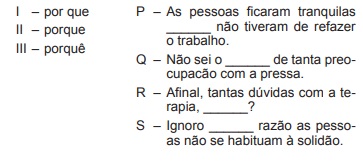
O preenchimento dos espaços com as expressões que tornam as sentenças corretas resulta nas seguintes associações:
O preenchimento dos espaços com as expressões que tornam as sentenças corretas resulta nas seguintes associações:
Ano: 2011
Banca:
CESGRANRIO
Órgão:
Transpetro
Provas:
CESGRANRIO - 2011 - Transpetro - Administrador Júnior
|
CESGRANRIO - 2011 - Transpetro - Analista de Sistemas Júnior |
CESGRANRIO - 2011 - Transpetro - Contador Júnior - Contábil |
CESGRANRIO - 2011 - Transpetro - Contador Júnior - Auditoria Interna |
CESGRANRIO - 2011 - Transpetro - Economista Júnior |
CESGRANRIO - 2011 - Transpetro - Engenheiro Júnior - Engenharia de Produção |
CESGRANRIO - 2011 - Transpetro - Médico do trabalho |
CESGRANRIO - 2011 - Transpetro - Engenheiro Júnior - Análise de Projetos de Inverstimentos |
CESGRANRIO - 2011 - Transpetro - Engenheiro Júnior - Geotécnica |
CESGRANRIO - 2011 - Transpetro - Engenheiro Júnior - Elétrica |
CESGRANRIO - 2011 - Transpetro - Engenheiro Júnior - Mecânica |
CESGRANRIO - 2011 - Transpetro - Profissional de Meio Ambiente Júnior |
CESGRANRIO - 2011 - Transpetro - Engenheiro Júnior - Processamento |
CESGRANRIO - 2011 - Transpetro - Engenheiro Júnior - Segurança |
CESGRANRIO - 2011 - Transpetro - Engenheiro Júnior - Naval |
CESGRANRIO - 2011 - Transpetro - Químico de Petróleo Júnior |
CESGRANRIO - 2011 - Transpetro - Engenheiro Júnior - Automação |
Q154621
Português
Texto associado
Um pouco de silêncio
Nesta trepidante cultura nossa, da agitação e do barulho, gostar de sossego é uma excentricidade.
Sob a pressão do ter de parecer, ter de participar, ter de adquirir, ter de qualquer coisa, assumimos uma infinidade de obrigações. Muitas desnecessárias, outras impossíveis, algumas que não combinam conosco nem nos interessam.
Não há perdão nem anistia para os que ficam de fora da ciranda: os que não se submetem mas questionam, os que pagam o preço de sua relativa autonomia, os que não se deixam escravizar, pelo menos sem alguma resistência.
O normal é ser atualizado, produtivo e bem-informado. É indispensável circular, estar enturmado. Quem não corre com a manada praticamente nem existe, se não se cuidar botam numa jaula: um animal estranho.
Acuados pelo relógio, pelos compromissos, pela opinião alheia, disparamos sem rumo – ou em trilhas determinadas – feito hamsters que se alimentam de sua própria agitação.
Ficar sossegado é perigoso: pode parecer doença. Recolher-se em casa, ou dentro de si mesmo, ameaça quem leva um susto cada vez que examina sua alma.
Estar sozinho é considerado humilhante, sinal de que não se arrumou ninguém – como se amizade ou amor se “arrumasse" em loja. [...]
Além do desgosto pela solidão, temos horror à quietude. Logo pensamos em depressão: quem sabe terapia e antidepressivo? Criança que não brinca ou salta nem participa de atividades frenéticas está com algum problema.
O silêncio nos assusta por retumbar no vazio dentro de nós. Quando nada se move nem faz barulho, notamos as frestas pelas quais nos espiam coisas incômodas e mal resolvidas, ou se enxerga outro ângulo de nós mesmos. Nos damos conta de que não somos apenas figurinhas atarantadas correndo entre casa, trabalho e bar, praia ou campo.
Existe em nós, geralmente nem percebido e nada valorizado, algo além desse que paga contas, transa, ganha dinheiro, e come, envelhece, e um dia (mas isso é só para os outros!) vai morrer. Quem é esse que afinal sou eu? Quais seus desejos e medos, seus projetos e sonhos?
No susto que essa ideia provoca, queremos ruí- do, ruídos. Chegamos em casa e ligamos a televisão antes de largar a bolsa ou pasta. Não é para assistir a um programa: é pela distração.
Silêncio faz pensar, remexe águas paradas, trazendo à tona sabe Deus que desconcerto nosso. Com medo de ver quem – ou o que – somos, adia-se o defrontamento com nossa alma sem máscaras.
Mas, se a gente aprende a gostar um pouco de sossego, descobre – em si e no outro – regiões nem imaginadas, questões fascinantes e não necessariamente ruins.
Nunca esqueci a experiência de quando alguém botou a mão no meu ombro de criança e disse: — Fica quietinha, um momento só, escuta a chuva chegando.
E ela chegou: intensa e lenta, tornando tudo singularmente novo. A quietude pode ser como essa chuva: nela a gente se refaz para voltar mais inteiro ao convívio, às tantas fases, às tarefas, aos amores.
Então, por favor, me deem isso: um pouco de silêncio bom para que eu escute o vento nas folhas, a chuva nas lajes, e tudo o que fala muito além das palavras de todos os textos e da música de todos os sentimentos. LUFT, Lya. Pensar é transgredir. Rio de Janeiro: Record, 2004. p. 41. Adaptado.
Nesta trepidante cultura nossa, da agitação e do barulho, gostar de sossego é uma excentricidade.
Sob a pressão do ter de parecer, ter de participar, ter de adquirir, ter de qualquer coisa, assumimos uma infinidade de obrigações. Muitas desnecessárias, outras impossíveis, algumas que não combinam conosco nem nos interessam.
Não há perdão nem anistia para os que ficam de fora da ciranda: os que não se submetem mas questionam, os que pagam o preço de sua relativa autonomia, os que não se deixam escravizar, pelo menos sem alguma resistência.
O normal é ser atualizado, produtivo e bem-informado. É indispensável circular, estar enturmado. Quem não corre com a manada praticamente nem existe, se não se cuidar botam numa jaula: um animal estranho.
Acuados pelo relógio, pelos compromissos, pela opinião alheia, disparamos sem rumo – ou em trilhas determinadas – feito hamsters que se alimentam de sua própria agitação.
Ficar sossegado é perigoso: pode parecer doença. Recolher-se em casa, ou dentro de si mesmo, ameaça quem leva um susto cada vez que examina sua alma.
Estar sozinho é considerado humilhante, sinal de que não se arrumou ninguém – como se amizade ou amor se “arrumasse" em loja. [...]
Além do desgosto pela solidão, temos horror à quietude. Logo pensamos em depressão: quem sabe terapia e antidepressivo? Criança que não brinca ou salta nem participa de atividades frenéticas está com algum problema.
O silêncio nos assusta por retumbar no vazio dentro de nós. Quando nada se move nem faz barulho, notamos as frestas pelas quais nos espiam coisas incômodas e mal resolvidas, ou se enxerga outro ângulo de nós mesmos. Nos damos conta de que não somos apenas figurinhas atarantadas correndo entre casa, trabalho e bar, praia ou campo.
Existe em nós, geralmente nem percebido e nada valorizado, algo além desse que paga contas, transa, ganha dinheiro, e come, envelhece, e um dia (mas isso é só para os outros!) vai morrer. Quem é esse que afinal sou eu? Quais seus desejos e medos, seus projetos e sonhos?
No susto que essa ideia provoca, queremos ruí- do, ruídos. Chegamos em casa e ligamos a televisão antes de largar a bolsa ou pasta. Não é para assistir a um programa: é pela distração.
Silêncio faz pensar, remexe águas paradas, trazendo à tona sabe Deus que desconcerto nosso. Com medo de ver quem – ou o que – somos, adia-se o defrontamento com nossa alma sem máscaras.
Mas, se a gente aprende a gostar um pouco de sossego, descobre – em si e no outro – regiões nem imaginadas, questões fascinantes e não necessariamente ruins.
Nunca esqueci a experiência de quando alguém botou a mão no meu ombro de criança e disse: — Fica quietinha, um momento só, escuta a chuva chegando.
E ela chegou: intensa e lenta, tornando tudo singularmente novo. A quietude pode ser como essa chuva: nela a gente se refaz para voltar mais inteiro ao convívio, às tantas fases, às tarefas, aos amores.
Então, por favor, me deem isso: um pouco de silêncio bom para que eu escute o vento nas folhas, a chuva nas lajes, e tudo o que fala muito além das palavras de todos os textos e da música de todos os sentimentos. LUFT, Lya. Pensar é transgredir. Rio de Janeiro: Record, 2004. p. 41. Adaptado.
No diálogo abaixo, cada fala corresponde a um número.
I — Por que ele adquiriu somente um ingresso!
II — Comprou dois: um para você outro para mim.
III — Mas ele saiu daqui dizendo: “Só comprarei o meu!"
IV — Pelo visto você acredita em tudo, o que ele diz.
Em relação ao diálogo, a pontuação está correta APENAS em
I — Por que ele adquiriu somente um ingresso!
II — Comprou dois: um para você outro para mim.
III — Mas ele saiu daqui dizendo: “Só comprarei o meu!"
IV — Pelo visto você acredita em tudo, o que ele diz.
Em relação ao diálogo, a pontuação está correta APENAS em
Ano: 2011
Banca:
CESGRANRIO
Órgão:
Transpetro
Provas:
CESGRANRIO - 2011 - Transpetro - Administrador Júnior
|
CESGRANRIO - 2011 - Transpetro - Analista de Sistemas Júnior |
CESGRANRIO - 2011 - Transpetro - Contador Júnior - Auditoria Interna |
CESGRANRIO - 2011 - Transpetro - Economista Júnior |
CESGRANRIO - 2011 - Transpetro - Engenheiro Júnior - Engenharia de Produção |
Q154620
Português
Texto associado
Um pouco de silêncio
Nesta trepidante cultura nossa, da agitação e do barulho, gostar de sossego é uma excentricidade.
Sob a pressão do ter de parecer, ter de participar, ter de adquirir, ter de qualquer coisa, assumimos uma infinidade de obrigações. Muitas desnecessárias, outras impossíveis, algumas que não combinam conosco nem nos interessam.
Não há perdão nem anistia para os que ficam de fora da ciranda: os que não se submetem mas questionam, os que pagam o preço de sua relativa autonomia, os que não se deixam escravizar, pelo menos sem alguma resistência.
O normal é ser atualizado, produtivo e bem-informado. É indispensável circular, estar enturmado. Quem não corre com a manada praticamente nem existe, se não se cuidar botam numa jaula: um animal estranho.
Acuados pelo relógio, pelos compromissos, pela opinião alheia, disparamos sem rumo – ou em trilhas determinadas – feito hamsters que se alimentam de sua própria agitação.
Ficar sossegado é perigoso: pode parecer doença. Recolher-se em casa, ou dentro de si mesmo, ameaça quem leva um susto cada vez que examina sua alma.
Estar sozinho é considerado humilhante, sinal de que não se arrumou ninguém – como se amizade ou amor se “arrumasse" em loja. [...]
Além do desgosto pela solidão, temos horror à quietude. Logo pensamos em depressão: quem sabe terapia e antidepressivo? Criança que não brinca ou salta nem participa de atividades frenéticas está com algum problema.
O silêncio nos assusta por retumbar no vazio dentro de nós. Quando nada se move nem faz barulho, notamos as frestas pelas quais nos espiam coisas incômodas e mal resolvidas, ou se enxerga outro ângulo de nós mesmos. Nos damos conta de que não somos apenas figurinhas atarantadas correndo entre casa, trabalho e bar, praia ou campo.
Existe em nós, geralmente nem percebido e nada valorizado, algo além desse que paga contas, transa, ganha dinheiro, e come, envelhece, e um dia (mas isso é só para os outros!) vai morrer. Quem é esse que afinal sou eu? Quais seus desejos e medos, seus projetos e sonhos?
No susto que essa ideia provoca, queremos ruí- do, ruídos. Chegamos em casa e ligamos a televisão antes de largar a bolsa ou pasta. Não é para assistir a um programa: é pela distração.
Silêncio faz pensar, remexe águas paradas, trazendo à tona sabe Deus que desconcerto nosso. Com medo de ver quem – ou o que – somos, adia-se o defrontamento com nossa alma sem máscaras.
Mas, se a gente aprende a gostar um pouco de sossego, descobre – em si e no outro – regiões nem imaginadas, questões fascinantes e não necessariamente ruins.
Nunca esqueci a experiência de quando alguém botou a mão no meu ombro de criança e disse: — Fica quietinha, um momento só, escuta a chuva chegando.
E ela chegou: intensa e lenta, tornando tudo singularmente novo. A quietude pode ser como essa chuva: nela a gente se refaz para voltar mais inteiro ao convívio, às tantas fases, às tarefas, aos amores.
Então, por favor, me deem isso: um pouco de silêncio bom para que eu escute o vento nas folhas, a chuva nas lajes, e tudo o que fala muito além das palavras de todos os textos e da música de todos os sentimentos. LUFT, Lya. Pensar é transgredir. Rio de Janeiro: Record, 2004. p. 41. Adaptado.
Nesta trepidante cultura nossa, da agitação e do barulho, gostar de sossego é uma excentricidade.
Sob a pressão do ter de parecer, ter de participar, ter de adquirir, ter de qualquer coisa, assumimos uma infinidade de obrigações. Muitas desnecessárias, outras impossíveis, algumas que não combinam conosco nem nos interessam.
Não há perdão nem anistia para os que ficam de fora da ciranda: os que não se submetem mas questionam, os que pagam o preço de sua relativa autonomia, os que não se deixam escravizar, pelo menos sem alguma resistência.
O normal é ser atualizado, produtivo e bem-informado. É indispensável circular, estar enturmado. Quem não corre com a manada praticamente nem existe, se não se cuidar botam numa jaula: um animal estranho.
Acuados pelo relógio, pelos compromissos, pela opinião alheia, disparamos sem rumo – ou em trilhas determinadas – feito hamsters que se alimentam de sua própria agitação.
Ficar sossegado é perigoso: pode parecer doença. Recolher-se em casa, ou dentro de si mesmo, ameaça quem leva um susto cada vez que examina sua alma.
Estar sozinho é considerado humilhante, sinal de que não se arrumou ninguém – como se amizade ou amor se “arrumasse" em loja. [...]
Além do desgosto pela solidão, temos horror à quietude. Logo pensamos em depressão: quem sabe terapia e antidepressivo? Criança que não brinca ou salta nem participa de atividades frenéticas está com algum problema.
O silêncio nos assusta por retumbar no vazio dentro de nós. Quando nada se move nem faz barulho, notamos as frestas pelas quais nos espiam coisas incômodas e mal resolvidas, ou se enxerga outro ângulo de nós mesmos. Nos damos conta de que não somos apenas figurinhas atarantadas correndo entre casa, trabalho e bar, praia ou campo.
Existe em nós, geralmente nem percebido e nada valorizado, algo além desse que paga contas, transa, ganha dinheiro, e come, envelhece, e um dia (mas isso é só para os outros!) vai morrer. Quem é esse que afinal sou eu? Quais seus desejos e medos, seus projetos e sonhos?
No susto que essa ideia provoca, queremos ruí- do, ruídos. Chegamos em casa e ligamos a televisão antes de largar a bolsa ou pasta. Não é para assistir a um programa: é pela distração.
Silêncio faz pensar, remexe águas paradas, trazendo à tona sabe Deus que desconcerto nosso. Com medo de ver quem – ou o que – somos, adia-se o defrontamento com nossa alma sem máscaras.
Mas, se a gente aprende a gostar um pouco de sossego, descobre – em si e no outro – regiões nem imaginadas, questões fascinantes e não necessariamente ruins.
Nunca esqueci a experiência de quando alguém botou a mão no meu ombro de criança e disse: — Fica quietinha, um momento só, escuta a chuva chegando.
E ela chegou: intensa e lenta, tornando tudo singularmente novo. A quietude pode ser como essa chuva: nela a gente se refaz para voltar mais inteiro ao convívio, às tantas fases, às tarefas, aos amores.
Então, por favor, me deem isso: um pouco de silêncio bom para que eu escute o vento nas folhas, a chuva nas lajes, e tudo o que fala muito além das palavras de todos os textos e da música de todos os sentimentos. LUFT, Lya. Pensar é transgredir. Rio de Janeiro: Record, 2004. p. 41. Adaptado.
A mudança na pontuação mantém o sentido da frase original, preservando a norma-padrão da língua, em:

 Conheça nossos planos