Selecionar segmento
Estude com questões de diferentes segmentos
Atenção: Isso limpará todos os campos já preenchidos no filtro!
Foram encontradas 7.017 questões
Resolva questões gratuitamente!
Junte-se a mais de 4 milhões de concurseiros!


Ano: 2008
Banca:
CESPE / CEBRASPE
Órgão:
STJ
Prova:
CESPE - 2008 - STJ - Analista Judiciário - Tecnologia da Informação |
Q52947
Inglês
Texto associado
In Brazil, federal and state court systems have used
technology in the last years, but the experience and coverage is
mixed. In the early 1990s, one of the major initiatives of the federal
judiciary has been the computerization of electoral courts. This
experience and other reforms have motivated some states judiciaries
to advance court automation in different jurisdictions, in aspects
such as public information, case management, and document
archiving. Studies indicate that the needs for information technology
and communications use are rising as many state court systems lag1
behind in investments.
The modernization of the documentary archives of the
federal judiciary is a fairly recent initiative that has been motivated
by a growing concern for the preservation of the country's historical
archive, and by the need to manage the exponential growth of current
archives. Paper archives constitute an enormous investment in terms
of time and space, documents deteriorate or are lost, and information
retrieval can be laborious. The modernization of archives involves
not only the rationalization of existing resources and collections, but
also the introduction of new technologies for the electronic storage
and retrieval of current documents.
In May 1998, the Supreme Federal Tribunal initiated a
project of reform, and in early 2000 carried out a survey to identify
the problem areas relating to infrastructure, access, archiving policy,
training and management strategies. The survey results constitute an
important first step in the development of a long-term technical and
administrative policy for the management of judicial archives.
Follow on work has so far collected information from all the archiveholding
judicial institutions in the area of the capital, Brasília.
There are on average 4 archivists per institution, which
means one archivist for every 751 meters of documents. The
technical equipment is for the most part antiquated, with only 37%
of archives equipped with computer terminals. Most of the judicial
archives do not, therefore, have either the technical or personnel
resources necessary for the efficient management, storage and
retrieval of documents.
 - a delay between two things happening.

Based on the passage above, it is correct to say that
technology in the last years, but the experience and coverage is
mixed. In the early 1990s, one of the major initiatives of the federal
judiciary has been the computerization of electoral courts. This
experience and other reforms have motivated some states judiciaries
to advance court automation in different jurisdictions, in aspects
such as public information, case management, and document
archiving. Studies indicate that the needs for information technology
and communications use are rising as many state court systems lag1
behind in investments.
The modernization of the documentary archives of the
federal judiciary is a fairly recent initiative that has been motivated
by a growing concern for the preservation of the country's historical
archive, and by the need to manage the exponential growth of current
archives. Paper archives constitute an enormous investment in terms
of time and space, documents deteriorate or are lost, and information
retrieval can be laborious. The modernization of archives involves
not only the rationalization of existing resources and collections, but
also the introduction of new technologies for the electronic storage
and retrieval of current documents.
In May 1998, the Supreme Federal Tribunal initiated a
project of reform, and in early 2000 carried out a survey to identify
the problem areas relating to infrastructure, access, archiving policy,
training and management strategies. The survey results constitute an
important first step in the development of a long-term technical and
administrative policy for the management of judicial archives.
Follow on work has so far collected information from all the archiveholding
judicial institutions in the area of the capital, Brasília.
There are on average 4 archivists per institution, which
means one archivist for every 751 meters of documents. The
technical equipment is for the most part antiquated, with only 37%
of archives equipped with computer terminals. Most of the judicial
archives do not, therefore, have either the technical or personnel
resources necessary for the efficient management, storage and
retrieval of documents.
- a delay between two things happening.Based on the passage above, it is correct to say that
to prevent paper archives from deteriorating, all that is required is to go through a process of storing information in a huge computer.
Ano: 2008
Banca:
CESPE / CEBRASPE
Órgão:
STJ
Prova:
CESPE - 2008 - STJ - Analista Judiciário - Tecnologia da Informação |
Q52944
Inglês
Texto associado
In Brazil, federal and state court systems have used
technology in the last years, but the experience and coverage is
mixed. In the early 1990s, one of the major initiatives of the federal
judiciary has been the computerization of electoral courts. This
experience and other reforms have motivated some states judiciaries
to advance court automation in different jurisdictions, in aspects
such as public information, case management, and document
archiving. Studies indicate that the needs for information technology
and communications use are rising as many state court systems lag1
behind in investments.
The modernization of the documentary archives of the
federal judiciary is a fairly recent initiative that has been motivated
by a growing concern for the preservation of the country's historical
archive, and by the need to manage the exponential growth of current
archives. Paper archives constitute an enormous investment in terms
of time and space, documents deteriorate or are lost, and information
retrieval can be laborious. The modernization of archives involves
not only the rationalization of existing resources and collections, but
also the introduction of new technologies for the electronic storage
and retrieval of current documents.
In May 1998, the Supreme Federal Tribunal initiated a
project of reform, and in early 2000 carried out a survey to identify
the problem areas relating to infrastructure, access, archiving policy,
training and management strategies. The survey results constitute an
important first step in the development of a long-term technical and
administrative policy for the management of judicial archives.
Follow on work has so far collected information from all the archiveholding
judicial institutions in the area of the capital, Brasília.
There are on average 4 archivists per institution, which
means one archivist for every 751 meters of documents. The
technical equipment is for the most part antiquated, with only 37%
of archives equipped with computer terminals. Most of the judicial
archives do not, therefore, have either the technical or personnel
resources necessary for the efficient management, storage and
retrieval of documents.
- a delay between two things happening.
Based on the passage above, it is correct to say that
technology in the last years, but the experience and coverage is
mixed. In the early 1990s, one of the major initiatives of the federal
judiciary has been the computerization of electoral courts. This
experience and other reforms have motivated some states judiciaries
to advance court automation in different jurisdictions, in aspects
such as public information, case management, and document
archiving. Studies indicate that the needs for information technology
and communications use are rising as many state court systems lag1
behind in investments.
The modernization of the documentary archives of the
federal judiciary is a fairly recent initiative that has been motivated
by a growing concern for the preservation of the country's historical
archive, and by the need to manage the exponential growth of current
archives. Paper archives constitute an enormous investment in terms
of time and space, documents deteriorate or are lost, and information
retrieval can be laborious. The modernization of archives involves
not only the rationalization of existing resources and collections, but
also the introduction of new technologies for the electronic storage
and retrieval of current documents.
In May 1998, the Supreme Federal Tribunal initiated a
project of reform, and in early 2000 carried out a survey to identify
the problem areas relating to infrastructure, access, archiving policy,
training and management strategies. The survey results constitute an
important first step in the development of a long-term technical and
administrative policy for the management of judicial archives.
Follow on work has so far collected information from all the archiveholding
judicial institutions in the area of the capital, Brasília.
There are on average 4 archivists per institution, which
means one archivist for every 751 meters of documents. The
technical equipment is for the most part antiquated, with only 37%
of archives equipped with computer terminals. Most of the judicial
archives do not, therefore, have either the technical or personnel
resources necessary for the efficient management, storage and
retrieval of documents.
- a delay between two things happening.Based on the passage above, it is correct to say that
the computerization of electoral courts dates back to the last century.
Ano: 2008
Banca:
CESPE / CEBRASPE
Órgão:
STJ
Prova:
CESPE - 2008 - STJ - Analista Judiciário - Tecnologia da Informação |
Q52943
Inglês
Texto associado
In Brazil, federal and state court systems have used
technology in the last years, but the experience and coverage is
mixed. In the early 1990s, one of the major initiatives of the federal
judiciary has been the computerization of electoral courts. This
experience and other reforms have motivated some states judiciaries
to advance court automation in different jurisdictions, in aspects
such as public information, case management, and document
archiving. Studies indicate that the needs for information technology
and communications use are rising as many state court systems lag1
behind in investments.
The modernization of the documentary archives of the
federal judiciary is a fairly recent initiative that has been motivated
by a growing concern for the preservation of the country's historical
archive, and by the need to manage the exponential growth of current
archives. Paper archives constitute an enormous investment in terms
of time and space, documents deteriorate or are lost, and information
retrieval can be laborious. The modernization of archives involves
not only the rationalization of existing resources and collections, but
also the introduction of new technologies for the electronic storage
and retrieval of current documents.
In May 1998, the Supreme Federal Tribunal initiated a
project of reform, and in early 2000 carried out a survey to identify
the problem areas relating to infrastructure, access, archiving policy,
training and management strategies. The survey results constitute an
important first step in the development of a long-term technical and
administrative policy for the management of judicial archives.
Follow on work has so far collected information from all the archiveholding
judicial institutions in the area of the capital, Brasília.
There are on average 4 archivists per institution, which
means one archivist for every 751 meters of documents. The
technical equipment is for the most part antiquated, with only 37%
of archives equipped with computer terminals. Most of the judicial
archives do not, therefore, have either the technical or personnel
resources necessary for the efficient management, storage and
retrieval of documents.
- a delay between two things happening.
Based on the passage above, it is correct to say that
technology in the last years, but the experience and coverage is
mixed. In the early 1990s, one of the major initiatives of the federal
judiciary has been the computerization of electoral courts. This
experience and other reforms have motivated some states judiciaries
to advance court automation in different jurisdictions, in aspects
such as public information, case management, and document
archiving. Studies indicate that the needs for information technology
and communications use are rising as many state court systems lag1
behind in investments.
The modernization of the documentary archives of the
federal judiciary is a fairly recent initiative that has been motivated
by a growing concern for the preservation of the country's historical
archive, and by the need to manage the exponential growth of current
archives. Paper archives constitute an enormous investment in terms
of time and space, documents deteriorate or are lost, and information
retrieval can be laborious. The modernization of archives involves
not only the rationalization of existing resources and collections, but
also the introduction of new technologies for the electronic storage
and retrieval of current documents.
In May 1998, the Supreme Federal Tribunal initiated a
project of reform, and in early 2000 carried out a survey to identify
the problem areas relating to infrastructure, access, archiving policy,
training and management strategies. The survey results constitute an
important first step in the development of a long-term technical and
administrative policy for the management of judicial archives.
Follow on work has so far collected information from all the archiveholding
judicial institutions in the area of the capital, Brasília.
There are on average 4 archivists per institution, which
means one archivist for every 751 meters of documents. The
technical equipment is for the most part antiquated, with only 37%
of archives equipped with computer terminals. Most of the judicial
archives do not, therefore, have either the technical or personnel
resources necessary for the efficient management, storage and
retrieval of documents.
- a delay between two things happening.Based on the passage above, it is correct to say that
only most recently has the use of technology by both federal and state court systems been used.
Ano: 2008
Banca:
CESGRANRIO
Órgão:
TJ-RO
Prova:
CESGRANRIO - 2008 - TJ-RO - Agente Judiciário - Analista de Sistemas (Microinformática) |
Q52650
Programação
Usando o Dreamweaver CS3 em sua configuração padrão, uma nova página HTML foi criada em branco. O código gerado pelo Dreamweaver CS3 para a página é mostrado abaixo.
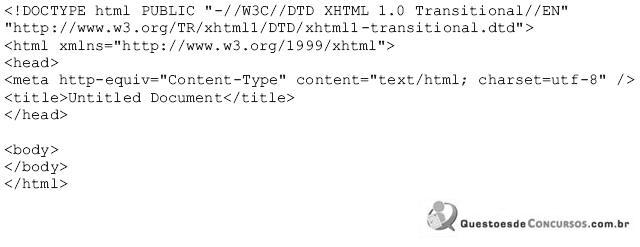
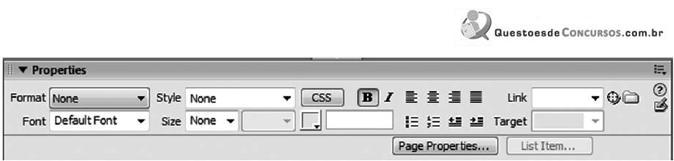
Após a criação da página, em modo de design, o texto "Acessibilidade é importante." foi digitado na área de edição, e, em seguida, a palavra "importante" foi selecionada e o botão B do painel Properties foi clicado, fazendo com que a mesma aparecesse em negrito.
O painel Properties é mostrado a seguir, na situação em que se encontrava ao final das ações descritas.
Qual o código HTML resultante como conteúdo do tag da página?
Após a criação da página, em modo de design, o texto "Acessibilidade é importante." foi digitado na área de edição, e, em seguida, a palavra "importante" foi selecionada e o botão B do painel Properties foi clicado, fazendo com que a mesma aparecesse em negrito.
O painel Properties é mostrado a seguir, na situação em que se encontrava ao final das ações descritas.
Qual o código HTML resultante como conteúdo do tag da página?
Ano: 2008
Banca:
CESGRANRIO
Órgão:
TJ-RO
Prova:
CESGRANRIO - 2008 - TJ-RO - Agente Judiciário - Analista de Sistemas (Microinformática) |
Q52649
Arquitetura de Software
A arquitetura de informação prevê dois grandes mecanismos através dos quais os usuários de um portal, site ou aplicação encontram as informações ou serviços em que estão interessados: a navegação, por meio de classificação do conteúdo em estruturas hierárquicas ou poli-hierárquicas e elos hipermídia e a busca, através da indexação do conteúdo. Além disso, a organização do conteúdo de um portal pode ser feita com esquemas exatos, em que cada item é enquadrado em apenas uma classificação (por exemplo, ordem cronológica ou classificação alfabética), ou com esquemas ambíguos, em que cada item pode receber mais de uma classificação (por exemplo, por tópico, por tarefa ou por audiência). As diversas hierarquias construídas para a classificação de conteúdo de um portal são chamadas de taxonomias. Sobre a estruturação da navegação e da busca em um portal e a organização de seu conteúdo, é INCORRETO afirmar que
Ano: 2008
Banca:
CESGRANRIO
Órgão:
TJ-RO
Prova:
CESGRANRIO - 2008 - TJ-RO - Agente Judiciário - Analista de Sistemas (Microinformática) |
Q52648
Arquitetura de Software
Diversos frameworks e APIs, incluindo a Java API for XML Web Services (JAX-WS), provêem suporte para uma abordagem arquitetural chamada REST (Representational State Transfer) para a criação de web services simples, que utilizam apenas o protocolo HTTP, dispensando uma camada de mensagens como o SOAP. Para tanto, cada serviço é disponibilizado na forma de um recurso associado a uma URL e os métodos do protocolo HTTP são utilizados para "comandar" ações de inclusão, atualização, exclusão e consulta de dados. Vista sob este prisma, a World Wide Web em si é um exemplo da abordagem arquitetural REST.
NÃO corresponde a um método previsto no protocolo HTTP/1.1:
NÃO corresponde a um método previsto no protocolo HTTP/1.1:
Ano: 2008
Banca:
CESGRANRIO
Órgão:
TJ-RO
Prova:
CESGRANRIO - 2008 - TJ-RO - Agente Judiciário - Analista de Sistemas (Microinformática) |
Q52647
Noções de Informática
Muitos sites atualmente oferecem newsfeeds RSS, que permitem que os interessados recebam atualizações de conteúdo de notícias, novidades e outras informações do site, através de recursos de leitura de newsfeeds dos navegadores ou de softwares específicos. Sobre a tecnologia RSS, é correto afirmar que
Ano: 2008
Banca:
CESGRANRIO
Órgão:
TJ-RO
Prova:
CESGRANRIO - 2008 - TJ-RO - Agente Judiciário - Analista de Sistemas (Microinformática) |
Q52645
Noções de Informática
Usando-se o modo de desenho merge no Flash CS3, foram desenhados um círculo e um retângulo, nesta ordem, afastados um do outro. Arrastou-se o retângulo de forma que parte dele cobrisse uma parte do círculo, clicando-se em seguida fora do retângulo para desselecioná-lo. Por fim, clicando-se sobre uma área do retângulo que não estava sobreposta ao círculo, o retângulo foi arrastado de volta para a posição original. Pode-se deduzir que
Ano: 2008
Banca:
CESGRANRIO
Órgão:
TJ-RO
Prova:
CESGRANRIO - 2008 - TJ-RO - Agente Judiciário - Analista de Sistemas (Microinformática) |
Q52644
Noções de Informática
Considere as quatro afirmativas a respeito do Adobe Flash CS3 e da tecnologia Flash, apresentadas a seguir.
I - O Adobe Flash CS3 gera arquivos FLA, que são uma versão compilada dos arquivos SWF.
II - Uma animação Flash pode ser programada para exibir determinados comportamentos e reagir a eventos de interface do usuário utilizando a linguagem Flashscript.
III - Um conceito importante na criação de animações em Flash são os keyframes, que demarcam os momentos em que há mudanças em propriedades dos objetos e podem ser utilizados para gerar os frames intermediários da animação.
IV - Os objetos de uma animação Flash podem ser organizados em layers (camadas) e em layers folders (pastas de camadas).
Estão corretas APENAS as afirmativas
I - O Adobe Flash CS3 gera arquivos FLA, que são uma versão compilada dos arquivos SWF.
II - Uma animação Flash pode ser programada para exibir determinados comportamentos e reagir a eventos de interface do usuário utilizando a linguagem Flashscript.
III - Um conceito importante na criação de animações em Flash são os keyframes, que demarcam os momentos em que há mudanças em propriedades dos objetos e podem ser utilizados para gerar os frames intermediários da animação.
IV - Os objetos de uma animação Flash podem ser organizados em layers (camadas) e em layers folders (pastas de camadas).
Estão corretas APENAS as afirmativas
Ano: 2008
Banca:
CESGRANRIO
Órgão:
TJ-RO
Prova:
CESGRANRIO - 2008 - TJ-RO - Agente Judiciário - Analista de Sistemas (Microinformática) |
Q52643
Noções de Informática
Outro tipo de ferramenta largamente utilizado na nova "web 2.0" é o blog. De forma geral, em um blog,
Ano: 2008
Banca:
CESGRANRIO
Órgão:
TJ-RO
Prova:
CESGRANRIO - 2008 - TJ-RO - Agente Judiciário - Analista de Sistemas (Microinformática) |
Q52642
Noções de Informática
Um dos tipos de ferramentas mais utilizadas atualmente na Internet, e até em intranets, é o wiki. Sobre wikis, em geral, é correto afirmar que
Ano: 2008
Banca:
CESGRANRIO
Órgão:
TJ-RO
Prova:
CESGRANRIO - 2008 - TJ-RO - Agente Judiciário - Analista de Sistemas (Microinformática) |
Q52641
Arquitetura de Software
Uma das recomendações de acessibilidade presentes na Cartilha Técnica do e-MAG diz respeito à indicação explícita da ordem de navegação/tabulação por elementos de um formulário, a qual pode ser especificada através do atributo HTML
Ano: 2008
Banca:
CESGRANRIO
Órgão:
TJ-RO
Prova:
CESGRANRIO - 2008 - TJ-RO - Agente Judiciário - Analista de Sistemas (Microinformática) |
Q52640
Programação
Texto associado
Para responder às questões de nºs 34 e 35, considere as informações a seguir.
O Eclipse SDK é uma das plataformas mais utilizadas na indústria de tecnologia atual como base para a criação de ambientes
de modelagem e desenvolvimento de aplicações. Sua arquitetura altamente modular e extensível, em combinação com as
condições de licenciamento e distribuição de seu código fonte, atraíram a maioria dos fabricantes de soluções de desenvolvimento
e contribuíram para que se tornasse um "padrão de fato" na indústria de tecnologia.
O Eclipse SDK é uma das plataformas mais utilizadas na indústria de tecnologia atual como base para a criação de ambientes
de modelagem e desenvolvimento de aplicações. Sua arquitetura altamente modular e extensível, em combinação com as
condições de licenciamento e distribuição de seu código fonte, atraíram a maioria dos fabricantes de soluções de desenvolvimento
e contribuíram para que se tornasse um "padrão de fato" na indústria de tecnologia.
Os recursos de atualização e instalação de novos plugins do Eclipse se encontram no menu
Ano: 2008
Banca:
CESGRANRIO
Órgão:
TJ-RO
Prova:
CESGRANRIO - 2008 - TJ-RO - Agente Judiciário - Analista de Sistemas (Microinformática) |
Q52639
Programação
Texto associado
Para responder às questões de nºs 34 e 35, considere as informações a seguir.
O Eclipse SDK é uma das plataformas mais utilizadas na indústria de tecnologia atual como base para a criação de ambientes
de modelagem e desenvolvimento de aplicações. Sua arquitetura altamente modular e extensível, em combinação com as
condições de licenciamento e distribuição de seu código fonte, atraíram a maioria dos fabricantes de soluções de desenvolvimento
e contribuíram para que se tornasse um "padrão de fato" na indústria de tecnologia.
O Eclipse SDK é uma das plataformas mais utilizadas na indústria de tecnologia atual como base para a criação de ambientes
de modelagem e desenvolvimento de aplicações. Sua arquitetura altamente modular e extensível, em combinação com as
condições de licenciamento e distribuição de seu código fonte, atraíram a maioria dos fabricantes de soluções de desenvolvimento
e contribuíram para que se tornasse um "padrão de fato" na indústria de tecnologia.
A base para o trabalho no ambiente Eclipse é o Workbench, com o qual o usuário interage diretamente, e que corresponde ao conceito comumente conhecido como "IDE" - Integrated Development Environment (ambiente integrado de desenvolvimento). A figura a seguir mostra uma janela do Workbench.
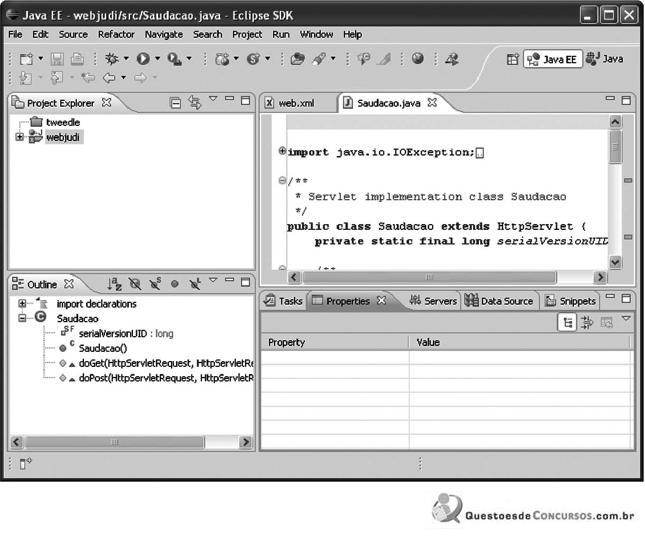
Com base na figura, assinale a afirmação correta.
Com base na figura, assinale a afirmação correta.
Ano: 2008
Banca:
CESGRANRIO
Órgão:
TJ-RO
Prova:
CESGRANRIO - 2008 - TJ-RO - Agente Judiciário - Analista de Sistemas (Microinformática) |
Q52638
Programação
Os componentes de interface de uma aplicação que utiliza JavaServer Faces (JSF) se apóiam em beans no lado do servidor, que são os managed beans, também chamados de backing beans. Sobre estes beans, é correto afirmar que
Ano: 2008
Banca:
CESGRANRIO
Órgão:
TJ-RO
Prova:
CESGRANRIO - 2008 - TJ-RO - Agente Judiciário - Analista de Sistemas (Microinformática) |
Q52636
Programação
Texto associado
Para responder às questões de nºs 30 e 31, considere o
Oracle Application Server em sua versão 10.1.3.1, com
os patches 10.1.3.3 aplicados, e com as configurações
padrões, incluindo o Oracle HTTP Server e o Oracle
Containers for J2EE (OC4J).
Oracle Application Server em sua versão 10.1.3.1, com
os patches 10.1.3.3 aplicados, e com as configurações
padrões, incluindo o Oracle HTTP Server e o Oracle
Containers for J2EE (OC4J).
A replicação de estado (sessões http) entre instâncias do OC4J no Oracle Application Server acontece, por padrão,
Ano: 2008
Banca:
CESGRANRIO
Órgão:
TJ-RO
Prova:
CESGRANRIO - 2008 - TJ-RO - Agente Judiciário - Analista de Sistemas (Microinformática) |
Q52635
Programação
Texto associado
Para responder às questões de nºs 30 e 31, considere o
Oracle Application Server em sua versão 10.1.3.1, com
os patches 10.1.3.3 aplicados, e com as configurações
padrões, incluindo o Oracle HTTP Server e o Oracle
Containers for J2EE (OC4J).
Oracle Application Server em sua versão 10.1.3.1, com
os patches 10.1.3.3 aplicados, e com as configurações
padrões, incluindo o Oracle HTTP Server e o Oracle
Containers for J2EE (OC4J).
O Oracle HTTP Server é capaz de fazer o balanceamento de carga entre instâncias do OC4J, em diferentes configurações e algoritmos de balanceamento. Tal capacidade é fornecida por um módulo específico, que pode ser utilizado também com uma versão padrão do Apache httpd web server para proporcionar o balanceamento de carga entre instâncias do OC4J. O módulo em questão chama-se
Ano: 2008
Banca:
CESGRANRIO
Órgão:
TJ-RO
Prova:
CESGRANRIO - 2008 - TJ-RO - Agente Judiciário - Analista de Sistemas (Microinformática) |
Q52634
Programação
Sobre o framework de mapeamento objeto/relacional Hibernate, é correto afirmar que
Ano: 2008
Banca:
CESGRANRIO
Órgão:
TJ-RO
Prova:
CESGRANRIO - 2008 - TJ-RO - Agente Judiciário - Analista de Sistemas (Microinformática) |
Q52633
Engenharia de Software
Texto associado
Considere as informações apresentadas a seguir para
responder às questões de nºs 26 e 27.

O modelo mostrado no diagrama de classes acima foi mapeado
para um esquema relacional em um banco de dados, e será
utilizado em uma aplicação Java com Hibernate em sua configuração
padrão. Todas as classes do modelo são concretas.
responder às questões de nºs 26 e 27.
O modelo mostrado no diagrama de classes acima foi mapeado
para um esquema relacional em um banco de dados, e será
utilizado em uma aplicação Java com Hibernate em sua configuração
padrão. Todas as classes do modelo são concretas.
À luz da UML, a relação entre Fabricante e Produto é uma
Ano: 2008
Banca:
CESGRANRIO
Órgão:
TJ-RO
Prova:
CESGRANRIO - 2008 - TJ-RO - Agente Judiciário - Analista de Sistemas (Microinformática) |
Q52632
Banco de Dados
Texto associado
Considere as informações apresentadas a seguir para
responder às questões de nºs 26 e 27.
O modelo mostrado no diagrama de classes acima foi mapeado
para um esquema relacional em um banco de dados, e será
utilizado em uma aplicação Java com Hibernate em sua configuração
padrão. Todas as classes do modelo são concretas.
responder às questões de nºs 26 e 27.
O modelo mostrado no diagrama de classes acima foi mapeado
para um esquema relacional em um banco de dados, e será
utilizado em uma aplicação Java com Hibernate em sua configuração
padrão. Todas as classes do modelo são concretas.
List x = session.createQuery(
"from Produto as produto " +
"where produto.fabricante.codigo = ?")
.setString(0, codigo).list ;
;
Assumindo que existem registros no banco de dados que satisfazem à cláusula where da query HQL mostrada acima, a variável x será populada com
"from Produto as produto " +
"where produto.fabricante.codigo = ?")
.setString(0, codigo).list
;Assumindo que existem registros no banco de dados que satisfazem à cláusula where da query HQL mostrada acima, a variável x será populada com

 Conheça nossos planos