Questões de Concurso
Para auditor fiscal do trabalho
Foram encontradas 907 questões
Resolva questões gratuitamente!
Junte-se a mais de 4 milhões de concurseiros!


order to answer questions 25 to 27.
The global union
Source: Newsweek Special Edition
Dec 2005 – Feb 2006 (Adapted)
What would a global union look like? Think more
corporate partnership than class struggle. Today, capital is
global and employers are global. Companies, not countries,
make the rules. To survive, unions need to find their niche.
Global companies are going to need an organization that,
in a sense, will manage their labor and protect workers’
rights. A global union would set standard practices and
codes of conduct – perhaps even minimum wages and
work hours.
My critics in the labor movement cringe when I use
words like “partnership” and “value added”. The reality is
that unions need to add value or corporations will ignore
us. If we want an equitable stake in the company, we need
to define what our goals are. We can’t just demand a raise
in pay without offering an incentive to the company. We’re
already far behind multinational corporations in the global
game. We made the mistake of transferring the industrial
model of unionism of the last country to the 21st. We lost
market share: in 1960, one in four workers was in a union;
now it’s one in 12.
order to answer questions 25 to 27.
The global union
Source: Newsweek Special Edition
Dec 2005 – Feb 2006 (Adapted)
What would a global union look like? Think more
corporate partnership than class struggle. Today, capital is
global and employers are global. Companies, not countries,
make the rules. To survive, unions need to find their niche.
Global companies are going to need an organization that,
in a sense, will manage their labor and protect workers’
rights. A global union would set standard practices and
codes of conduct – perhaps even minimum wages and
work hours.
My critics in the labor movement cringe when I use
words like “partnership” and “value added”. The reality is
that unions need to add value or corporations will ignore
us. If we want an equitable stake in the company, we need
to define what our goals are. We can’t just demand a raise
in pay without offering an incentive to the company. We’re
already far behind multinational corporations in the global
game. We made the mistake of transferring the industrial
model of unionism of the last country to the 21st. We lost
market share: in 1960, one in four workers was in a union;
now it’s one in 12.
order to answer questions 25 to 27.
The global union
Source: Newsweek Special Edition
Dec 2005 – Feb 2006 (Adapted)
What would a global union look like? Think more
corporate partnership than class struggle. Today, capital is
global and employers are global. Companies, not countries,
make the rules. To survive, unions need to find their niche.
Global companies are going to need an organization that,
in a sense, will manage their labor and protect workers’
rights. A global union would set standard practices and
codes of conduct – perhaps even minimum wages and
work hours.
My critics in the labor movement cringe when I use
words like “partnership” and “value added”. The reality is
that unions need to add value or corporations will ignore
us. If we want an equitable stake in the company, we need
to define what our goals are. We can’t just demand a raise
in pay without offering an incentive to the company. We’re
already far behind multinational corporations in the global
game. We made the mistake of transferring the industrial
model of unionism of the last country to the 21st. We lost
market share: in 1960, one in four workers was in a union;
now it’s one in 12.
Read the text below which is entitled "The future of work" in
order to answer questions 21 to 24.
The future of work
Source: Newsweek
Jan 30th, 2006 (Adapted)
Many of the rich world’s notions about old age are dying.
While the streamlining effects of international competition
are focusing attention on the need to create and keep good
jobs, those fears will eventually give way to worries about
the growing shortage of young workers. One unavoidable
solution: putting older people back to work, whether they
like it or not. Indeed, cutting-edge European economies
like those of Finland and Denmark have already raised
their retirement ages, reversing the postwar trend toward
ever-earlier retirement. Others are under severe pressure
to follow suit, as both the European Commission and the
Organization for Economic Cooperation and Development
(OECD) have recently warned their members that their
future prosperity depends on a growing contribution from
the elderly.
This erosion of one of the cornerstones of the good
life – relaxed golden years – has not gone unremarked. In
the last year, Belgium, Italy and France have all been hit
with massive protests against pension reforms that would,
among other things, have raised the retirement age.
Read the text below which is entitled "The future of work" in
order to answer questions 21 to 24.
The future of work
Source: Newsweek
Jan 30th, 2006 (Adapted)
Many of the rich world’s notions about old age are dying.
While the streamlining effects of international competition
are focusing attention on the need to create and keep good
jobs, those fears will eventually give way to worries about
the growing shortage of young workers. One unavoidable
solution: putting older people back to work, whether they
like it or not. Indeed, cutting-edge European economies
like those of Finland and Denmark have already raised
their retirement ages, reversing the postwar trend toward
ever-earlier retirement. Others are under severe pressure
to follow suit, as both the European Commission and the
Organization for Economic Cooperation and Development
(OECD) have recently warned their members that their
future prosperity depends on a growing contribution from
the elderly.
This erosion of one of the cornerstones of the good
life – relaxed golden years – has not gone unremarked. In
the last year, Belgium, Italy and France have all been hit
with massive protests against pension reforms that would,
among other things, have raised the retirement age.
Read the text below which is entitled "The future of work" in
order to answer questions 21 to 24.
The future of work
Source: Newsweek
Jan 30th, 2006 (Adapted)
Many of the rich world’s notions about old age are dying.
While the streamlining effects of international competition
are focusing attention on the need to create and keep good
jobs, those fears will eventually give way to worries about
the growing shortage of young workers. One unavoidable
solution: putting older people back to work, whether they
like it or not. Indeed, cutting-edge European economies
like those of Finland and Denmark have already raised
their retirement ages, reversing the postwar trend toward
ever-earlier retirement. Others are under severe pressure
to follow suit, as both the European Commission and the
Organization for Economic Cooperation and Development
(OECD) have recently warned their members that their
future prosperity depends on a growing contribution from
the elderly.
This erosion of one of the cornerstones of the good
life – relaxed golden years – has not gone unremarked. In
the last year, Belgium, Italy and France have all been hit
with massive protests against pension reforms that would,
among other things, have raised the retirement age.
Read the text below which is entitled "The future of work" in
order to answer questions 21 to 24.
The future of work
Source: Newsweek
Jan 30th, 2006 (Adapted)
Many of the rich world’s notions about old age are dying.
While the streamlining effects of international competition
are focusing attention on the need to create and keep good
jobs, those fears will eventually give way to worries about
the growing shortage of young workers. One unavoidable
solution: putting older people back to work, whether they
like it or not. Indeed, cutting-edge European economies
like those of Finland and Denmark have already raised
their retirement ages, reversing the postwar trend toward
ever-earlier retirement. Others are under severe pressure
to follow suit, as both the European Commission and the
Organization for Economic Cooperation and Development
(OECD) have recently warned their members that their
future prosperity depends on a growing contribution from
the elderly.
This erosion of one of the cornerstones of the good
life – relaxed golden years – has not gone unremarked. In
the last year, Belgium, Italy and France have all been hit
with massive protests against pension reforms that would,
among other things, have raised the retirement age.
Os trechos a seguir constituem um texto, mas estão desordenados. Ordene-os nos parênteses e assinale a resposta correta.
( ) Essa meta, alcançada 53 anos depois, começou a ganhar contornos de realidade nos anos 80, quando a empresa atingiu a produção de 500 mil barris/dia.
( ) Criada pelo decreto assinado pelo presidente Getúlio Vargas, em 3 de outubro de 1953, a Petrobras já nasceu com a missão de alcançar a auto-suficiência na produção brasileira de petróleo.
( ) Entretanto, foi no início da década de 70 que começou a ser delineada a estratégia que resultaria nas primeiras conquistas da empresa. Na época, o país crescia a taxas de 10% ao ano, o que contribuiu para que, naquela década, o consumo de derivados duplicasse.
( ) Porém, foi depois do alinhamento de preços dos combustíveis às cotações internacionais que a empresa conseguiu maior acesso ao mercado de capitais internacional. Com isso, obteve os recursos para financiar os investimentos necessários que resultaram na auto-suficiência.
( ) Assim, ao longo das últimas cinco décadas, diante do nacionalismo que cerca o petróleo no Brasil, os interesses da Petrobras confundiram-se com os do país.
(Jornal do Brasil, 23/04/2006)
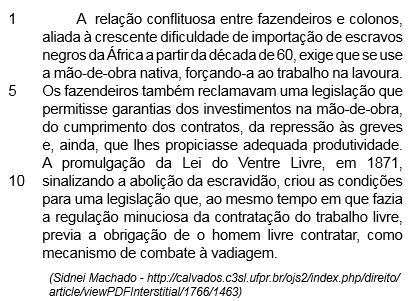
Os primeiros imigrantes trazidos por empresas importadoras eram, em geral, obrigados __1__assinar contratos de parceria com o importador para trabalharem nas lavouras do café do estado de São Paulo. O contratante adiantava __2__ despesas de transporte da Europa __3__ colônias e o necessário __4__subsistência inicial. Nas colônias, o imigrante recebia determinado número de pés de café para cultivar. Tinha direito __5__ meação no resultado da venda.
(Sidnei Machado, http://calvados.c3sl.ufpr.br/ojs2/index.php/direito/article/ viewPDFInterstitial/1766/1463)
assinale a opção que preenche orretamente as lacunas do texto
(Sidnei Machado - http://calvados.c3sl.ufpr.br/ojs2/index.php/direito/article/ viewPDFInterstitial/1766/1463)
assinale a opção que preenche orretamente as lacunas do texto
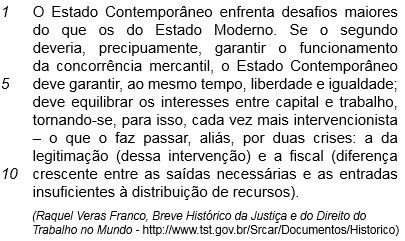
A Revolução Industrial também causou a formação de enormes aglomerados de desempregados nas cidades, ___1___ , em geral, cresciam sem nenhum planejamento urbano. Esse fenômeno, __2___ não passou despercebido a escritores como Émile Zola ou Alexis de Toqueville, propiciou o surgimento de fenômenos __3__desconhecidos, __4___ o alcoolismo e a demência em massa.
(Raquel Veras Franco, Breve Histórico da Justiça e do Direito do Trabalho no Mundo - http://www.tst.gov.br/Srcar/Documentos/Historico)
assinale a opção que preenche orretamente as lacunas do texto:
Assinale a opção de proposta de alteração para o texto que resulta em erro gramatical e/ou incoerência textual.
No atual estágio da sociedade brasileira, se se
deseja um regime democrático, não basta abolir a
necessidade de bens básicos. É necessário que o
processo produtivo seja capaz de continuar, com
eficiência, a produção e a oferta de bens considerados
supérfluos.
Em se tratando de um compromisso democrático,
uma hierarquia de prioridades deve colocar o
básico sobre o supérfluo. O que deve servir como
incentivo para a proposta de casar democracia, fim
da apartação e eficiência econômica em geral é o
fato de que o potencial econômico do país permite
otimismo quanto à possibilidade de atender todas
essas necessidades, dentro de uma estratégia em
que o tempo não será muito longo.
(Adaptado de Cristovam Buarque, Da modernidade técnica à modernidade ética, p.29)
Avalie as afirmações abaixo, a respeito do emprego das estruturas lingüísticas no texto, para assinalar a opção correta.
Quando se ouve a palavra "preço", as primeiras
imagens que invadem nossa mente são as de cartazes
de liquidação, máquinas registradoras, cheques e
cartões de crédito. Mesmo nas sociedades orientais,
menos capitalistas que a nossa, a idéia de preço é
sempre ligada à noção de objeto de valor.
Porém, diferentemente do que a mídia informa, nem
tudo pode ser comprado e parcelado em três vezes no
cartão. As coisas realmente importantes da vida têm
seu preço, isso é certo, mas a forma de pagamento é
bem diversa das praticadas nos shopping centers.
Na infinita negociação que é viver, se sairá melhor
aquele que possuir uma sólida conta corrente de
reservas emocionais e de bom senso do que aquele
que confia apenas em sua coleção de cartões de
plástico. Lucrará mais aquele que souber responder
com sabedoria a pergunta: vale a pena pagar o
preço?
(Adaptado da Revista Planeta, maio de 2006)
I. Para a coerência textual, o vocábulo "as"(l.2) tanto pode ser interpretado como um pronome, substituindo o substantivo "imagens"(l.2), quanto como um artigo definido que deixa implícita a concordância com "imagens".
II. O acento indicativo de crase em "à noção"(l.6) decorre da presença da preposição a, exigida por "ligada"(l.6) e do artigo determinante de "noção".
III. Por ser expressa a comparação em estrutura oracional, o termo "do que"(l.7) pode ser escrito apenas como "que", sem prejuízo da correção gramatical do texto.
IV. A retirada do pronome em "isso é certo"(l.10) resulta em erro gramatical, porque a oração fica sem sujeito; o que prejudica a coesão textual.
V. Devido ao emprego da vírgula, mantém-se a coerência textual e a correção gramatical ao empregar o pronome átono depois do verbo em "se sairá"(l.12): sairá-se.
VI. As regras gramaticais possibilitam também o emprego do acento indicador de crase em "a pergunta"(l.17): à pergunta.
Estão corretos apenas os itens
Assinale a opção que apresenta justificativa correta para o emprego da vírgula correspondente.
O setor de petróleo brasileiro merece legitimamente a comemoração pelo sucesso presente, (1) e as perspectivas do futuro contemplam êxito no trabalho de todas as empresas que atuam nessa área no Brasil, em especial, a Petrobras. Este futuro terá, com certeza, a marca do realismo e da humildade, (2) que são duas virtudes que, invariavelmente, andam juntas. Realismo no reconhecimento das possibilidades e limitações de todas as coisas. Humildade na renúncia a qualquer espécie de soberba, (3) de cega arrogância, (4) entendendo que a construção de uma nação e a consolidação de empresas fortes não são façanhas apenas de um punhado de homens, mas, sim, do esforço de uma sociedade inteira, (5) unida pelos laços multiplicadores da solidariedade nacional.
(Joel Mendes Rennó, Jornal do Brasil, 19/04/2006)
Assinale a opção que corresponde a erro gramatical.
A história do petróleo no Brasil, dos primeiros passos até este(1) novo degrau, que é a conquista da autosuficiência, não tem nome ou fisionomia particular. Pertence, na verdade, a todos os (2) brasileiros e administradores que acreditaram na possibilidade de o nosso país desenvolver o seu setor de petróleo com competência e talento. Ela foi escrita, capítulo a(3) capítulo, por valorosos trabalhadores de várias categorias, do técnico de ponta ao mais modesto operário, e não somente(4) por esses, que labutam na linha de frente, nos trabalhos de pesquisas e análises, como também, com igual dedicação e entusiasmo, pelos que lhe(5) dão suporte, na retaguarda, inclusive no plano administrativo, essencial quando eficiente.
(Joel Mendes Rennó, Jornal do Brasil, 19/04/2006)

 Conheça nossos planos