Questões de Concurso
Para professor - história
Foram encontradas 29.252 questões
Resolva questões gratuitamente!
Junte-se a mais de 4 milhões de concurseiros!


Ano: 2020
Banca:
NUCEPE
Órgão:
Prefeitura de Timon - MA
Prova:
NUCEPE - 2020 - Prefeitura de Timon - MA - Professor Educação Básica - Inglês |
Q1735528
Inglês
Texto associado
When you’re in a long line waiting for your turn with a bunch of other cranky people, a good wallet is essential. For everyone’s benefit, you want to be able to find the right card or bills, make your transaction, and get out of there as quickly as possible. Mobile payments, vendor apps, and the decline of cash have lessened the amount of space you need for library cards and twenties, and they’ve lessened the need for bulky, old-school leather cash carriers. There’s never been a better time to trim down your wallet and your carbon footprint in turn by choosing a wallet made from recycled or eco-friendly materials.
Answers the question according to the text below.
TEXT II
When you’re in a long line waiting for your turn with a bunch of other cranky people, a good wallet is essential. For everyone’s benefit, you want to be able to find the right card or bills, make your transaction, and get out of there as quickly as possible. Mobile payments, vendor apps, and the decline of cash have lessened the amount of space you need for library cards and twenties, and they’ve lessened the need for bulky, old-school leather cash carriers. There’s never been a better time to trim down your wallet and your carbon footprint in turn by choosing a wallet made from recycled or eco-friendly materials.
https://www.popsci.com/story/shop/eco-friendly-wallets/
The highlighted words: YOUR (line 01), EVERYONE (line 02), YOU(line 05), and YOUR (line 07) in the text
are, respectively:
Ano: 2020
Banca:
NUCEPE
Órgão:
Prefeitura de Timon - MA
Prova:
NUCEPE - 2020 - Prefeitura de Timon - MA - Professor Educação Básica - Inglês |
Q1735527
Inglês
Texto associado
When you’re in a long line waiting for your turn with a bunch of other cranky people, a good wallet is essential. For everyone’s benefit, you want to be able to find the right card or bills, make your transaction, and get out of there as quickly as possible. Mobile payments, vendor apps, and the decline of cash have lessened the amount of space you need for library cards and twenties, and they’ve lessened the need for bulky, old-school leather cash carriers. There’s never been a better time to trim down your wallet and your carbon footprint in turn by choosing a wallet made from recycled or eco-friendly materials.
Answers the question according to the text below.
TEXT II
When you’re in a long line waiting for your turn with a bunch of other cranky people, a good wallet is essential. For everyone’s benefit, you want to be able to find the right card or bills, make your transaction, and get out of there as quickly as possible. Mobile payments, vendor apps, and the decline of cash have lessened the amount of space you need for library cards and twenties, and they’ve lessened the need for bulky, old-school leather cash carriers. There’s never been a better time to trim down your wallet and your carbon footprint in turn by choosing a wallet made from recycled or eco-friendly materials.
https://www.popsci.com/story/shop/eco-friendly-wallets/
The sentence “…for your turn with a bunch of other cranky people.” (lines 01-02), MEANS THAT:
Ano: 2020
Banca:
NUCEPE
Órgão:
Prefeitura de Timon - MA
Prova:
NUCEPE - 2020 - Prefeitura de Timon - MA - Professor Educação Básica - Inglês |
Q1735526
Inglês
Texto associado
When you’re in a long line waiting for your turn with a bunch of other cranky people, a good wallet is essential. For everyone’s benefit, you want to be able to find the right card or bills, make your transaction, and get out of there as quickly as possible. Mobile payments, vendor apps, and the decline of cash have lessened the amount of space you need for library cards and twenties, and they’ve lessened the need for bulky, old-school leather cash carriers. There’s never been a better time to trim down your wallet and your carbon footprint in turn by choosing a wallet made from recycled or eco-friendly materials.
Answers the question according to the text below.
TEXT II
When you’re in a long line waiting for your turn with a bunch of other cranky people, a good wallet is essential. For everyone’s benefit, you want to be able to find the right card or bills, make your transaction, and get out of there as quickly as possible. Mobile payments, vendor apps, and the decline of cash have lessened the amount of space you need for library cards and twenties, and they’ve lessened the need for bulky, old-school leather cash carriers. There’s never been a better time to trim down your wallet and your carbon footprint in turn by choosing a wallet made from recycled or eco-friendly materials.
https://www.popsci.com/story/shop/eco-friendly-wallets/
Analyze the statements according to the text and choose the option where all alternatives are CORRECT.
I. It is time to reduce our carbon production by using environmentally friendly or recyclable materials. II. Internet payment culture, vendor application usage, and non-use of currency money have reduced the card space required in our wallet. III. Despite the encouragement that we should use recyclable and environmentally friendly materials, a good leather wallet is still indispensable. IV. The text encourages us to use green or recyclable materials which inevitably diminish our carbon footprint. V. A quality billfold is essential for us to organize our accounts, cards, carry out other transactions and reduce our carbon production.
I. It is time to reduce our carbon production by using environmentally friendly or recyclable materials. II. Internet payment culture, vendor application usage, and non-use of currency money have reduced the card space required in our wallet. III. Despite the encouragement that we should use recyclable and environmentally friendly materials, a good leather wallet is still indispensable. IV. The text encourages us to use green or recyclable materials which inevitably diminish our carbon footprint. V. A quality billfold is essential for us to organize our accounts, cards, carry out other transactions and reduce our carbon production.
Ano: 2020
Banca:
NUCEPE
Órgão:
Prefeitura de Timon - MA
Prova:
NUCEPE - 2020 - Prefeitura de Timon - MA - Professor Educação Básica - Inglês |
Q1735525
Inglês
Texto associado
Answers the question according to the text below.
TEXT I
The time to embrace change in education is right now! In fact, it’s long overdue.
Did you know that the model for modern-day public education was created by the
need for on-time mechanical workers during the industrial revolution? That was
certainly a technological disruption, but it happened 250 years ago. It’s what we
call the front-lead method, and it’s not the best model for addressing the learning
needs of many students: divergent thinkers, neurodiverse minds, creatives,
scientists, and the list goes on. Which brings us to our next point: it’s time for the
next wave of disruption. Luckily for us, it’s here. And it’s been here since 1989,
when Tim Berners-Lee — a British scientist from CERT — invented the World
Wide Web. We know, you use the internet every day, and it’s great, but maybe
you’re skeptical that it can revolutionize education. Well, if you didn’t know, it
already is. A large body of evidence-based, peer reviewed work points to the web
as one of the central hubs for positive educational change today. It’s our
connection to others, our access to a world of educational resources, it’s a format
that works for many learners, it’s at the heart of countless services (that don’t work
in an unconnected world), and it’s driving access to education.
https://www.early-childhood-education-degrees.com/features/editors-choice-best-books-on-technology-in-education/
“A large body of evidence-based, peer reviewed work points to the web as ONE of the central hubs for
positive educational change today.” The word ONE (line 13) is a:
Ano: 2020
Banca:
NUCEPE
Órgão:
Prefeitura de Timon - MA
Prova:
NUCEPE - 2020 - Prefeitura de Timon - MA - Professor Educação Básica - Inglês |
Q1735524
Inglês
Texto associado
Answers the question according to the text below.
TEXT I
The time to embrace change in education is right now! In fact, it’s long overdue.
Did you know that the model for modern-day public education was created by the
need for on-time mechanical workers during the industrial revolution? That was
certainly a technological disruption, but it happened 250 years ago. It’s what we
call the front-lead method, and it’s not the best model for addressing the learning
needs of many students: divergent thinkers, neurodiverse minds, creatives,
scientists, and the list goes on. Which brings us to our next point: it’s time for the
next wave of disruption. Luckily for us, it’s here. And it’s been here since 1989,
when Tim Berners-Lee — a British scientist from CERT — invented the World
Wide Web. We know, you use the internet every day, and it’s great, but maybe
you’re skeptical that it can revolutionize education. Well, if you didn’t know, it
already is. A large body of evidence-based, peer reviewed work points to the web
as one of the central hubs for positive educational change today. It’s our
connection to others, our access to a world of educational resources, it’s a format
that works for many learners, it’s at the heart of countless services (that don’t work
in an unconnected world), and it’s driving access to education.
https://www.early-childhood-education-degrees.com/features/editors-choice-best-books-on-technology-in-education/
Choose the alternative where all words are formed by the AFFIXATION PROCESS.
Ano: 2020
Banca:
NUCEPE
Órgão:
Prefeitura de Timon - MA
Prova:
NUCEPE - 2020 - Prefeitura de Timon - MA - Professor Educação Básica - Inglês |
Q1735523
Inglês
Texto associado
Answers the question according to the text below.
TEXT I
The time to embrace change in education is right now! In fact, it’s long overdue.
Did you know that the model for modern-day public education was created by the
need for on-time mechanical workers during the industrial revolution? That was
certainly a technological disruption, but it happened 250 years ago. It’s what we
call the front-lead method, and it’s not the best model for addressing the learning
needs of many students: divergent thinkers, neurodiverse minds, creatives,
scientists, and the list goes on. Which brings us to our next point: it’s time for the
next wave of disruption. Luckily for us, it’s here. And it’s been here since 1989,
when Tim Berners-Lee — a British scientist from CERT — invented the World
Wide Web. We know, you use the internet every day, and it’s great, but maybe
you’re skeptical that it can revolutionize education. Well, if you didn’t know, it
already is. A large body of evidence-based, peer reviewed work points to the web
as one of the central hubs for positive educational change today. It’s our
connection to others, our access to a world of educational resources, it’s a format
that works for many learners, it’s at the heart of countless services (that don’t work
in an unconnected world), and it’s driving access to education.
https://www.early-childhood-education-degrees.com/features/editors-choice-best-books-on-technology-in-education/
The word HUBS in the phrase "the central hubs" (line 13), means:
Ano: 2020
Banca:
NUCEPE
Órgão:
Prefeitura de Timon - MA
Prova:
NUCEPE - 2020 - Prefeitura de Timon - MA - Professor Educação Básica - Inglês |
Q1735522
Inglês
Texto associado
Answers the question according to the text below.
TEXT I
The time to embrace change in education is right now! In fact, it’s long overdue.
Did you know that the model for modern-day public education was created by the
need for on-time mechanical workers during the industrial revolution? That was
certainly a technological disruption, but it happened 250 years ago. It’s what we
call the front-lead method, and it’s not the best model for addressing the learning
needs of many students: divergent thinkers, neurodiverse minds, creatives,
scientists, and the list goes on. Which brings us to our next point: it’s time for the
next wave of disruption. Luckily for us, it’s here. And it’s been here since 1989,
when Tim Berners-Lee — a British scientist from CERT — invented the World
Wide Web. We know, you use the internet every day, and it’s great, but maybe
you’re skeptical that it can revolutionize education. Well, if you didn’t know, it
already is. A large body of evidence-based, peer reviewed work points to the web
as one of the central hubs for positive educational change today. It’s our
connection to others, our access to a world of educational resources, it’s a format
that works for many learners, it’s at the heart of countless services (that don’t work
in an unconnected world), and it’s driving access to education.
https://www.early-childhood-education-degrees.com/features/editors-choice-best-books-on-technology-in-education/
The pronoun IT (line 11), refers to:
Ano: 2020
Banca:
NUCEPE
Órgão:
Prefeitura de Timon - MA
Prova:
NUCEPE - 2020 - Prefeitura de Timon - MA - Professor Educação Básica - Inglês |
Q1735521
Inglês
Texto associado
Answers the question according to the text below.
TEXT I
The time to embrace change in education is right now! In fact, it’s long overdue.
Did you know that the model for modern-day public education was created by the
need for on-time mechanical workers during the industrial revolution? That was
certainly a technological disruption, but it happened 250 years ago. It’s what we
call the front-lead method, and it’s not the best model for addressing the learning
needs of many students: divergent thinkers, neurodiverse minds, creatives,
scientists, and the list goes on. Which brings us to our next point: it’s time for the
next wave of disruption. Luckily for us, it’s here. And it’s been here since 1989,
when Tim Berners-Lee — a British scientist from CERT — invented the World
Wide Web. We know, you use the internet every day, and it’s great, but maybe
you’re skeptical that it can revolutionize education. Well, if you didn’t know, it
already is. A large body of evidence-based, peer reviewed work points to the web
as one of the central hubs for positive educational change today. It’s our
connection to others, our access to a world of educational resources, it’s a format
that works for many learners, it’s at the heart of countless services (that don’t work
in an unconnected world), and it’s driving access to education.
https://www.early-childhood-education-degrees.com/features/editors-choice-best-books-on-technology-in-education/
According to the text it is correct to state:
Ano: 2020
Banca:
NUCEPE
Órgão:
Prefeitura de Timon - MA
Prova:
NUCEPE - 2020 - Prefeitura de Timon - MA - Professor Educação Básica - História |
Q1735450
História
TESE VIII
A tradição dos oprimidos ensina-nos que o “estado de exceção” em que vivemos é a regra. Temos de chegar a um conceito de história que corresponda a essa ideia. Só então se perfilará diante dos nossos olhos, como nossa tarefa, a necessidade de provocar o verdadeiro estado de exceção; e assim a nossa posição na luta contra o fascismo melhorará. A hipótese de ele se afirmar reside em grande parte no fato de seus opositores o verem com uma norma histórica, em nome do progresso. O espanto por as coisas a que assistimos “ainda” poderem ser assim no século vinte não é espanto filosófico. Ele não está no início de um processo de conhecimento, a não ser o de que a ideia de história de onde provém não é sustentável. (BENJAMIN, Walter. O anjo da história. Belo Horizonte: Autentica Editora, 2016, p.13.)
Segundo Michael Lowy (2005), estamos acostumados a classificar as diferentes teorias da história conforme seu caráter progressista e conservador, revolucionário ou nostálgico em relação ao passado. Esse tipo de etiqueta não se aplicaria ao pensamento de Walter Benjamim, para o qual
A tradição dos oprimidos ensina-nos que o “estado de exceção” em que vivemos é a regra. Temos de chegar a um conceito de história que corresponda a essa ideia. Só então se perfilará diante dos nossos olhos, como nossa tarefa, a necessidade de provocar o verdadeiro estado de exceção; e assim a nossa posição na luta contra o fascismo melhorará. A hipótese de ele se afirmar reside em grande parte no fato de seus opositores o verem com uma norma histórica, em nome do progresso. O espanto por as coisas a que assistimos “ainda” poderem ser assim no século vinte não é espanto filosófico. Ele não está no início de um processo de conhecimento, a não ser o de que a ideia de história de onde provém não é sustentável. (BENJAMIN, Walter. O anjo da história. Belo Horizonte: Autentica Editora, 2016, p.13.)
Segundo Michael Lowy (2005), estamos acostumados a classificar as diferentes teorias da história conforme seu caráter progressista e conservador, revolucionário ou nostálgico em relação ao passado. Esse tipo de etiqueta não se aplicaria ao pensamento de Walter Benjamim, para o qual
Ano: 2020
Banca:
NUCEPE
Órgão:
Prefeitura de Timon - MA
Prova:
NUCEPE - 2020 - Prefeitura de Timon - MA - Professor Educação Básica - História |
Q1735449
História e Geografia de Estados e Municípios
Povoamento – [...]. Quando da transferência da capital piauiense para Teresina, 1852, se tinha conhecimento
da existência de um porto, onde as pessoas pernoitavam, o qual veio denominar-se Porto das Cajazeiras, as
margens do Parnaíba, em frente à capital do Piauí, onde se formava pequena povoação que, posteriormente,
provando mais uma vez o costume de nossa gente, chamava-se São José de Parnaíba para alguns,
identificando a povoação com a maior expressão geográfica existente na região que é o Velho Monge; para
outros, a maioria, São José das Cajazeiras, isto porque predominavam, orlando o rio, inúmeras mangueiras e
cajazeiras com predomínio destas que já haviam batizado o porto e que agora batizavam também a
povoação. [...].
(SOUSA, Raimunda de Carvalho. Timon sua história, sua gente. Teresina: Editora Halley, 2005. p.20).
O texto compreende aspectos históricos sobre o povoamento e formação do atual município de Timon (MA).
Sobre a constituição desse município é procedente afirmar que
Ano: 2020
Banca:
NUCEPE
Órgão:
Prefeitura de Timon - MA
Prova:
NUCEPE - 2020 - Prefeitura de Timon - MA - Professor Educação Básica - História |
Q1735448
Conhecimentos Gerais
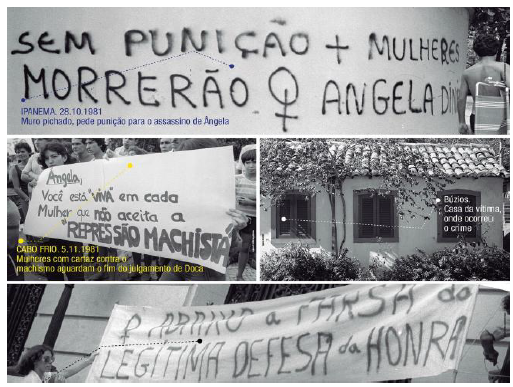
FONTE:https://www.google.com/search. Acesso em 10/12/2019
A violência contra a mulher é reconhecida em muitos países como um problema social e tem sido alvo de políticas públicas, legislações e ações de organizações não governamentais, com o objetivo de coibi-la e proteger suas vítimas. Tratados e convenções internacionais, formulados a partir de meados de 1970, têm procurado sensibilizar um número cada vez maior de governos e sociedades, visando ampliar adesão a essa causa. (LAGE, Lana e NADER, Maria Beatriz. Violência contra a mulher: da legitimação à condenação social. In:PINSKY, Carla Bassanezi e PEDRO, Joana Maria (Orgs.) Nova História das mulheres no Brasil, 2012. p.286).
As imagens acima se referem ao famoso caso do assassinato da socialite brasileira Ângela Diniz, por seu amante, o empresário Raul Fernando Amaral Street, o “Doca Street”, como era conhecido. O fato muito divulgado pela imprensa nacional do período é uma evidência de que, na história do Brasil, a violência em relação à mulher esteve sempre presente, independente do grupo social que ela integre, tendo sido
Ano: 2020
Banca:
NUCEPE
Órgão:
Prefeitura de Timon - MA
Prova:
NUCEPE - 2020 - Prefeitura de Timon - MA - Professor Educação Básica - História |
Q1735447
Conhecimentos Gerais
O cenário político brasileiro é perpassado por expressões como “lulismo”, “carlismo”, “malufismo”,
“sarneyismo”, “brizolismo”, “getulismo”, “janismo” etc.Esses “ismos” possuem uma função muito mais
avaliativa do que denotativa (COLLOVALD, 1991), isto é, julgamentos pejorativos e leituras consagradoras
mesclam-se em um universo de personificação do capital político como forma de capital simbólico.
(BOURDIEU, 1989). Tais termos fixam igualmente uma idéia (sic) de unidade e de continuidade, a partir da associação reivindicada ou
denunciada entre agentes atuantes no espaço político. (GRILL, 2012, p.193).
Dois indivíduos tiveram seus “nomes” e suas “lideranças” como bases da constituição de “etiquetas políticas” que dominaram a cena eleitoral maranhense ao longo do período 1945- 2010, sucedendo-se nas posições de poder político no estado: Victorino Freire e José Sarney. Em torno de ambos constituíram-se redes de seguidores e, em oposição aos mesmos e às facções que dirigiram, consolidaram-se facções rivais (“frentes oposicionistas” articuladas em nome do objetivo comum de derrotar o “grupo” dominante). (GRILL, 2012, p.197).
O autor dos textos acima destaca que os “ismos”, quando se referem ao universo da política, relacionam-se diretamente às condições de elegibilidade, apresentando-se como “instrumentos de localização de agentes em “linhagens” e agentes de associação com patrimônios coletivos”. Fez (fizeram) parte das dinâmicas de estruturação do “vitorinismo” e do “sarneysmo”.
Dois indivíduos tiveram seus “nomes” e suas “lideranças” como bases da constituição de “etiquetas políticas” que dominaram a cena eleitoral maranhense ao longo do período 1945- 2010, sucedendo-se nas posições de poder político no estado: Victorino Freire e José Sarney. Em torno de ambos constituíram-se redes de seguidores e, em oposição aos mesmos e às facções que dirigiram, consolidaram-se facções rivais (“frentes oposicionistas” articuladas em nome do objetivo comum de derrotar o “grupo” dominante). (GRILL, 2012, p.197).
O autor dos textos acima destaca que os “ismos”, quando se referem ao universo da política, relacionam-se diretamente às condições de elegibilidade, apresentando-se como “instrumentos de localização de agentes em “linhagens” e agentes de associação com patrimônios coletivos”. Fez (fizeram) parte das dinâmicas de estruturação do “vitorinismo” e do “sarneysmo”.
Ano: 2020
Banca:
NUCEPE
Órgão:
Prefeitura de Timon - MA
Prova:
NUCEPE - 2020 - Prefeitura de Timon - MA - Professor Educação Básica - História |
Q1735446
Geografia
O pensamento moderno ocidental é um pensamento abissal. Consiste num sistema de distinções visíveis e
invisíveis, sendo que as invisíveis fundamentam as visíveis. As distinções invisíveis são estabelecidas através
de linhas radicais que dividem a realidade social em dois universos distintos: o universo ‘deste lado da linha’ e
o universo ‘do outro lado da linha’. A divisão é tal, que o ‘outro lado da linha’ desaparece enquanto realidade;
torna-se inexistente, e é mesmo produzido como inexistente. Inexistência significa não existir sob qualquer
forma de ser relevante ou compreensível. Tudo aquilo que é produzido como inexistente é excluído de forma
radical porque permanece exterior ao universo que a própria concepção aceita de inclusão considera como
sendo o Outro. (DOS SANTOS, Boaventura e MENESES, Maria Paula. Epistemologia do Sul. São Paulo: Cortez, 2010, p.31-32).
Para Boaventura dos Santos e Maria Paula Meneses, a existência das linhas abissais por todo o período moderno não significa que elas tenham permanecido fixas. Nos dias atuais, as linhas globais que dividem os dois lados podem ser observadas
Para Boaventura dos Santos e Maria Paula Meneses, a existência das linhas abissais por todo o período moderno não significa que elas tenham permanecido fixas. Nos dias atuais, as linhas globais que dividem os dois lados podem ser observadas
Ano: 2020
Banca:
NUCEPE
Órgão:
Prefeitura de Timon - MA
Prova:
NUCEPE - 2020 - Prefeitura de Timon - MA - Professor Educação Básica - História |
Q1735445
História
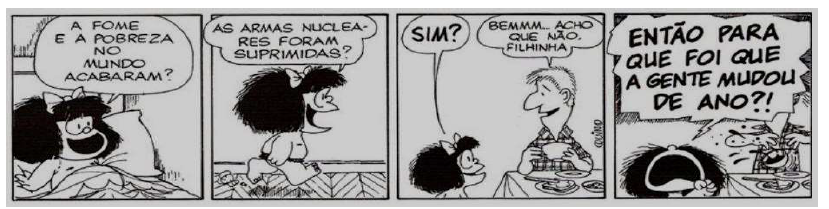
Fonte: https://raquelcardeiravarela.files.wordpress.com/2014/09/mafalda-charge-1.jpg. Acesso em 10/12/19.
A tirinha da Mafalda alude a um contexto histórico conturbado da política internacional, o qual expressa
Ano: 2020
Banca:
NUCEPE
Órgão:
Prefeitura de Timon - MA
Prova:
NUCEPE - 2020 - Prefeitura de Timon - MA - Professor Educação Básica - História |
Q1735444
História
Década de sessenta. Auge da Guerra Fria. Tempo de viva disputa entre as grandes potências, Estados
Unidos e União Soviética. O planeta dividido em dois blocos geopolíticos, espelhados pelos três mundos da
Guerra Fria. O Primeiro mundo do capitalismo ocidental, o Segundo Mundo dos países socialistas e o
Terceiro Mundo da América Latina, Ásia e África. Capitalismo versus socialismo. O mundo todo é palco da
competição. Amplo cenário, ameaçado por temerária corrida armamentista. A situação só vai mudar após a
queda do Muro de Berlim, em 1989, marco simbólico do fim do socialismo real.
(COUTO, Ronaldo Costa. História indiscreta da ditadura e da abertura: Brasil – 1964-1985. Rio de Janeiro; Record, 2003, p.23).
Tony Judt, ao comentar o legado da Segunda Guerra em sua obra “Pós-guerra: uma história da Europa desde 1945” (2008), pondera que, na sequência desse evento, a perspectiva da Europa era de miséria e de desolamento total. Tudo e todos parecem exauridos. Fizeram parte desse cenário político e social caótico
Tony Judt, ao comentar o legado da Segunda Guerra em sua obra “Pós-guerra: uma história da Europa desde 1945” (2008), pondera que, na sequência desse evento, a perspectiva da Europa era de miséria e de desolamento total. Tudo e todos parecem exauridos. Fizeram parte desse cenário político e social caótico
Ano: 2020
Banca:
NUCEPE
Órgão:
Prefeitura de Timon - MA
Prova:
NUCEPE - 2020 - Prefeitura de Timon - MA - Professor Educação Básica - História |
Q1735443
História
Um traço peculiar do regime imposto em 1964 gerou efeitos também peculiares para a vida privada de seus
opositores. A “Revolução de Março” foi essencialmente uma ordem autoritária pouco institucionalizada. Suas
regras eram cambiantes, e móveis as divisas entre o proibido e o permitido. Manteve, distorcidas, instituições
e liturgias próprias do sistema democrático: eleições (semicompetitivas), partidos políticos (cerceados),
espaço (estreito) para o Congresso, Assembléias Legislativas e Câmaras Municipais. Por isso, ao tratar do
Brasil, o cientista político espanhol Juan Linz preferiu escrever situação autoritária, em vez de regime
autoritário.
(ALMEIDA, Maria Hermínia Tavares de e WEIS, Luis. Carro Zero e Pau-de-Arara: o cotidiano da oposição de classe média ao regime
militar. IN: Scharcz, Lilia Moritz. História da vida privada no Brasil: contrastes da intimidade contemporânea. São Paulo: Companhia das
Letras, 1998,p.327).
A situação acima descrita, sobre a natureza do regime militar instaurado no Brasil entre 1964-1985, permite concluir que
A situação acima descrita, sobre a natureza do regime militar instaurado no Brasil entre 1964-1985, permite concluir que
Ano: 2020
Banca:
NUCEPE
Órgão:
Prefeitura de Timon - MA
Prova:
NUCEPE - 2020 - Prefeitura de Timon - MA - Professor Educação Básica - História |
Q1735442
História
Em vez de enfrentar os japoneses, o Mao aumentou suas forças no norte da China. No fim da guerra, em
1945, Stalin, sempre rígido e pragmático, assinou um tratado de aliança com o Kuomintang, diminuindo as
perspectivas de apoio ao comunismo na eventualidade de uma guerra civil. Logo após a rendição do Japão,
reiniciou-se a guerra total entre comunistas e nacionalistas, Stalin ficou de lado novamente, chegando até a
avisar Mao para tomar cuidado com os Estados Unidos, que apoiaram Chiang Kai-Shek, agora reconhecido
como líder mundial na vitória dos aliados contra o Japão. Mao ignorou o aviso. Os comunistas finalmente
conseguiam vantagem. Quando chegaram à capital, Nanquim, a União Soviética foi um dos poucos países a
permitir que seu embaixador fugisse junto com o Kuomintang.
(DIKÖTTER, Frank. A grande fome de Mao: a história da catástrofe mais devastadora da China (1958-1962). Rio de Janeiro: Record,
2017, p.30).
As relações entre a China pós-revolucionária e a União Soviética foram marcadas por
As relações entre a China pós-revolucionária e a União Soviética foram marcadas por
Ano: 2020
Banca:
NUCEPE
Órgão:
Prefeitura de Timon - MA
Prova:
NUCEPE - 2020 - Prefeitura de Timon - MA - Professor Educação Básica - História |
Q1735441
História
A tentação de negar é constante. Não quero saber que minha mulher (ou meu marido) me trai, que meu filho
se droga, que estou com câncer, que a tortura é cotidiana. Quanto ao holocausto, os franceses sabiam?
Toda a maquinaria de morte se fundava sobre este único princípio: que as pessoas não sabem para onde vão
nem o que as espera” (Richard Glazer, citado em Shoah). Quando a França foi derrotada, moravam no país
300 mil judeus, metade deles estrangeiros. Em 3 de outubro de 1940, é publicado o “Estatuto dos judeus de
nacionalidade francesa”.
(VINCENT, Gérard. Guerras ditas, guerras silenciadas e o enigma identitário. IN: ARIÉS, Phillipe e DUBY, Georges. História da vida
privada: da Primeira Guerra aos nossos dias. São Paulo: Companhia das Letras, 1992, p. 215).
A publicação do documento mencionado no texto teve como desdobramento
A publicação do documento mencionado no texto teve como desdobramento
Ano: 2020
Banca:
NUCEPE
Órgão:
Prefeitura de Timon - MA
Prova:
NUCEPE - 2020 - Prefeitura de Timon - MA - Professor Educação Básica - História |
Q1735440
História
Provavelmente, a figura mais eminente no estudo do totalitarismo foi Hannah Arendt, que o definiu em seu
livro Origens do Totalitarismo, de 1949, como uma “nova forma de governo” propiciada pelo advento da
modernidade. Segundo ela, a destruição das sociedades e dos modos de vida tradicionais criou as condições
para o desenvolvimento da “personalidade autoritária”, homens e mulheres cujas identidades são
inteiramente dependentes do Estado.
(APPLEBAUM, Anne. Cortina de ferro: o esfacelamento do leste europeu (1944-1956). São Paulo: Três Estrelas, 2016, p.18).
Entre os anos 40 e os anos 80 do século XX, o “totalitarismo” foi mais que um conceito teórico. Ele adquiriu associações políticas concretas, produzindo diferentes debates e práticas sobre sua natureza e capacidade, estando alguns fundamentados na ideia
Entre os anos 40 e os anos 80 do século XX, o “totalitarismo” foi mais que um conceito teórico. Ele adquiriu associações políticas concretas, produzindo diferentes debates e práticas sobre sua natureza e capacidade, estando alguns fundamentados na ideia
Ano: 2020
Banca:
NUCEPE
Órgão:
Prefeitura de Timon - MA
Prova:
NUCEPE - 2020 - Prefeitura de Timon - MA - Professor Educação Básica - História |
Q1735439
História
Em novembro de 1937 instaura-se no país um regime político que afirma inaugurar uma experiência única na
história do Brasil. Assim, o Estado Novo, ou o novo Estado Nacional, procura articular uma política ideológica
que assinale toda a grandeza de sua inovação e que legitime seu formato político-institucional perante todos
os atores relevantes do sistema. Com este objetivo, mobiliza uma série de recursos específicos que
asseguram a produção e a divulgação de um certo conjunto de ideias que conforma o seu projeto político.
[...].
(GOMES, Angela Maria de Castro. O redescobrimento do Brasil. p.109-150. In.: OLIVEIRA, Lucia Lippi; VELLOSO, Mônica Pimenta;
GOMES, Ângela Maria de Castro. Estado Novo – Ideologia e Poder. Rio de Janeiro: Zahar Ed. 1982. p.109).
O texto de Ângela Maria de Castro Gomes trata da organização do Estado Novo, durante a Era Vargas. São aspectos dessa estrutura
O texto de Ângela Maria de Castro Gomes trata da organização do Estado Novo, durante a Era Vargas. São aspectos dessa estrutura

 Conheça nossos planos