Questões de Concurso
Para ppsa
Foram encontradas 1.364 questões
Resolva questões gratuitamente!
Junte-se a mais de 4 milhões de concurseiros!


I.Este campo, com reservatórios, da Formação Carapebus, de idade Oligocênica, é formada por arenitos com excelentes características de produtividade e portador de óleo entre 17 e 24° API. Já foi o campo de maior produção de óleo do Brasil.
II.O reservatório deste campo, da Formação Barra Velha, de idade Aptiana, é composta por carbonatos incomuns, lamitos nas porções proximais e folhelhos nas porções distais. Faz parte da super sequência onde no topo ocorre espessa camada de evaporitos da Formação Ariri. Um de seus campos é o de maior produção de óleo do Brasil atualmente.
III.Esta área é de fronteira exploratória, em setores de águas rasas e águas profundas. Tem como objetivo principal turbiditos neocretácicos e com expectativa de óleo leve. São estimados volumes elevados de petróleo. Para a perfuração de poços exploratórios na área é necessário aguardar a licença ambiental que não foi ainda concedida.
IV.O Bloco Aram foi arrematado na 6° rodada de licitações de partilha da produção. O reservatório, da Formação Macabu é possivelmente constituído por rochas carbonáticas microbiais do Aptiano e depositadas em um ambiente lacustrino alcalino.
Com relação ao estágio de desenvolvimento ou exploração do texto acima, qual a resposta correta:
O texto seguinte servirá de base para responder à questão.
Texto 2
Driven by pre-salt, oil becomes Brazil's top export
Revenues
The discovery of the pre-salt was so significant for Brazil's oil production potential that it led the government to change the regime that authorized companies to explore the submerged resources.
As a result, the pre-salt areas are governed by the sharing regime. Under this model, surplus oil production—the balance after covering costs—is divided between the company and the Brazilian government. During the auction that authorizes exploration, the company offering the highest share of profits to the federal government is granted the right to explore.
This is distinct from the concession model, which applies to the post-salt period. In this system, the risk of investment and exploration lies with the concessionaire, who becomes the owner of all the oil and gas that may be discovered. In return, the company pays royalties and special participation fees, particularly for large production fields, in addition to a signature bonus upon winning the auction.
New frontiers
With the pre-salt expected to reach its peak in the 2030s, Brazil's oil industry, led by Petrobras, is shifting its focus to new oil frontiers that are believed to hold significant production potential.
One such frontier is the so-called equatorial margin, located off Brazil's northern coast, where exploration is pending a favorable decision from the Brazilian Institute for the Environment and Renewable Natural Resources (Ibama), an agency under the Ministry of the Environment and Climate Change.
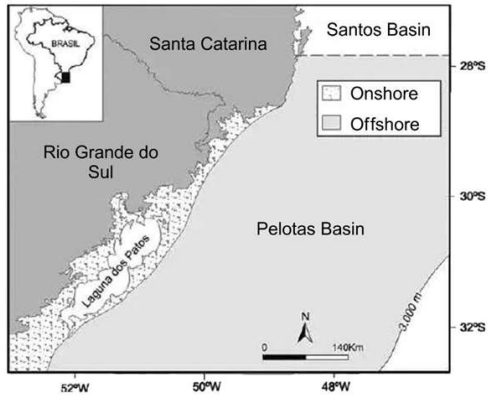
Another promising region is the Pelotas Basin, located off Brazil's southern coast. The growing interest in this area is fueled by the discovery of oil wells in Uruguay and off the coasts of Namibia and South Africa. Experts suggest that the geological conditions in these regions are similar, as the continents were once joined tens of millions of years ago.
According to Petrobras, the company plans to invest $79 billion in exploring new oil and gas frontiers by 2029. Of this amount, 40 percent will be allocated to the South and Southeast regions, 38 percent to the equatorial margin, with the remainder directed towards other countries.
From MOURA, Bruno de Freitas. Driven by pre-salt, oil becomes Brazil's top export. Rio de Janeiro, Agência Brasil, Jan 18th,2025. Accessed on February 21st, 2025
Read the statements below:
I.The implemented sharing system consists in the company offering the government the largest percentage of oil has the right to extract.
II.Pre-salt areas are divided between companies, as well as the revenues.
III.The Brazilian government owns those companies.
IV.The risk of investment lies on the company in the concession model.
Select the correct alternative:

 Conheça nossos planos