Questões de Concurso
Para sme - sp
Foram encontradas 895 questões
Resolva questões gratuitamente!
Junte-se a mais de 4 milhões de concurseiros!


Read Text 2 and answer the question.
Text 2
Here are four passages from an article on awareness of English as a lingua franca (ELF):
1) “Few will deny that research in the area of English as a lingua franca (ELF) has significantly contributed to our understanding of many different facets of communication involving non-native speakers of English. Such studies have added valuable insights to the growing research in the domain of critical applied linguistics and critical pedagogy and have prompted many scholars to problematize all aspects of English language teaching, learning, testing, curriculum designing, etc.”
2) “It is important at this stage to distinguish between the critical and the transformative perspective in ESOL teacher education. While they both share the element of reflection, they are different in a crucial way, although the former has often been seen as an umbrella term that subsumes the latter.”
3) “Critical pedagogy is invaluable in our attempt to understand the complex processes of the global spread of English and the intricate ways in which it continues to be localized and relocalized (Pennycook, 2010). It has the tools to help teachers appreciate the complications of context and the various underlying and often hidden discourses, from learner identity construction in the ESOL classroom (Norton and Toohey, 2011) to language testing (Shohamy, 2004) to the politics of pedagogy in the ‘classroom as a microcosm of the larger social and cultural world’” (Pennycook, 2001: 138).
4) “The value of an ELF-aware transformative perspective to ESOL teacher education lies in its power to help teachers define ELF for themselves and for their teaching contexts. In this way, teachers are involved in the co-construction of ELF and, in particular, in the development of one or more pedagogical frameworks for ELF. To achieve this, teachers have to have an informed awareness of the ELF construct, a critical awareness of their own deeper convictions about essential aspects of language, communication, and language teaching/learning, and the capability to bring about sustainable change in their teaching.”
From Sifakis, N. C. (2014). "ELF awareness as an opportunity for change: a
transformative perspective for ESOL teacher education". Journal of English as a
Lingua Franca, 3/2: 317-335
Read Text 2 and answer the question.
Text 2
Here are four passages from an article on awareness of English as a lingua franca (ELF):
1) “Few will deny that research in the area of English as a lingua franca (ELF) has significantly contributed to our understanding of many different facets of communication involving non-native speakers of English. Such studies have added valuable insights to the growing research in the domain of critical applied linguistics and critical pedagogy and have prompted many scholars to problematize all aspects of English language teaching, learning, testing, curriculum designing, etc.”
2) “It is important at this stage to distinguish between the critical and the transformative perspective in ESOL teacher education. While they both share the element of reflection, they are different in a crucial way, although the former has often been seen as an umbrella term that subsumes the latter.”
3) “Critical pedagogy is invaluable in our attempt to understand the complex processes of the global spread of English and the intricate ways in which it continues to be localized and relocalized (Pennycook, 2010). It has the tools to help teachers appreciate the complications of context and the various underlying and often hidden discourses, from learner identity construction in the ESOL classroom (Norton and Toohey, 2011) to language testing (Shohamy, 2004) to the politics of pedagogy in the ‘classroom as a microcosm of the larger social and cultural world’” (Pennycook, 2001: 138).
4) “The value of an ELF-aware transformative perspective to ESOL teacher education lies in its power to help teachers define ELF for themselves and for their teaching contexts. In this way, teachers are involved in the co-construction of ELF and, in particular, in the development of one or more pedagogical frameworks for ELF. To achieve this, teachers have to have an informed awareness of the ELF construct, a critical awareness of their own deeper convictions about essential aspects of language, communication, and language teaching/learning, and the capability to bring about sustainable change in their teaching.”
From Sifakis, N. C. (2014). "ELF awareness as an opportunity for change: a
transformative perspective for ESOL teacher education". Journal of English as a
Lingua Franca, 3/2: 317-335
Read Text 2 and answer the question.
Text 2
Here are four passages from an article on awareness of English as a lingua franca (ELF):
1) “Few will deny that research in the area of English as a lingua franca (ELF) has significantly contributed to our understanding of many different facets of communication involving non-native speakers of English. Such studies have added valuable insights to the growing research in the domain of critical applied linguistics and critical pedagogy and have prompted many scholars to problematize all aspects of English language teaching, learning, testing, curriculum designing, etc.”
2) “It is important at this stage to distinguish between the critical and the transformative perspective in ESOL teacher education. While they both share the element of reflection, they are different in a crucial way, although the former has often been seen as an umbrella term that subsumes the latter.”
3) “Critical pedagogy is invaluable in our attempt to understand the complex processes of the global spread of English and the intricate ways in which it continues to be localized and relocalized (Pennycook, 2010). It has the tools to help teachers appreciate the complications of context and the various underlying and often hidden discourses, from learner identity construction in the ESOL classroom (Norton and Toohey, 2011) to language testing (Shohamy, 2004) to the politics of pedagogy in the ‘classroom as a microcosm of the larger social and cultural world’” (Pennycook, 2001: 138).
4) “The value of an ELF-aware transformative perspective to ESOL teacher education lies in its power to help teachers define ELF for themselves and for their teaching contexts. In this way, teachers are involved in the co-construction of ELF and, in particular, in the development of one or more pedagogical frameworks for ELF. To achieve this, teachers have to have an informed awareness of the ELF construct, a critical awareness of their own deeper convictions about essential aspects of language, communication, and language teaching/learning, and the capability to bring about sustainable change in their teaching.”
From Sifakis, N. C. (2014). "ELF awareness as an opportunity for change: a
transformative perspective for ESOL teacher education". Journal of English as a
Lingua Franca, 3/2: 317-335

This exercise illustrates
Read Text 2 and answer the question.
Text 2
Here are four passages from an article on awareness of English as a lingua franca (ELF):
1) “Few will deny that research in the area of English as a lingua franca (ELF) has significantly contributed to our understanding of many different facets of communication involving non-native speakers of English. Such studies have added valuable insights to the growing research in the domain of critical applied linguistics and critical pedagogy and have prompted many scholars to problematize all aspects of English language teaching, learning, testing, curriculum designing, etc.”
2) “It is important at this stage to distinguish between the critical and the transformative perspective in ESOL teacher education. While they both share the element of reflection, they are different in a crucial way, although the former has often been seen as an umbrella term that subsumes the latter.”
3) “Critical pedagogy is invaluable in our attempt to understand the complex processes of the global spread of English and the intricate ways in which it continues to be localized and relocalized (Pennycook, 2010). It has the tools to help teachers appreciate the complications of context and the various underlying and often hidden discourses, from learner identity construction in the ESOL classroom (Norton and Toohey, 2011) to language testing (Shohamy, 2004) to the politics of pedagogy in the ‘classroom as a microcosm of the larger social and cultural world’” (Pennycook, 2001: 138).
4) “The value of an ELF-aware transformative perspective to ESOL teacher education lies in its power to help teachers define ELF for themselves and for their teaching contexts. In this way, teachers are involved in the co-construction of ELF and, in particular, in the development of one or more pedagogical frameworks for ELF. To achieve this, teachers have to have an informed awareness of the ELF construct, a critical awareness of their own deeper convictions about essential aspects of language, communication, and language teaching/learning, and the capability to bring about sustainable change in their teaching.”
From Sifakis, N. C. (2014). "ELF awareness as an opportunity for change: a
transformative perspective for ESOL teacher education". Journal of English as a
Lingua Franca, 3/2: 317-335
Read Text 2 and answer the question.
Text 2
Here are four passages from an article on awareness of English as a lingua franca (ELF):
1) “Few will deny that research in the area of English as a lingua franca (ELF) has significantly contributed to our understanding of many different facets of communication involving non-native speakers of English. Such studies have added valuable insights to the growing research in the domain of critical applied linguistics and critical pedagogy and have prompted many scholars to problematize all aspects of English language teaching, learning, testing, curriculum designing, etc.”
2) “It is important at this stage to distinguish between the critical and the transformative perspective in ESOL teacher education. While they both share the element of reflection, they are different in a crucial way, although the former has often been seen as an umbrella term that subsumes the latter.”
3) “Critical pedagogy is invaluable in our attempt to understand the complex processes of the global spread of English and the intricate ways in which it continues to be localized and relocalized (Pennycook, 2010). It has the tools to help teachers appreciate the complications of context and the various underlying and often hidden discourses, from learner identity construction in the ESOL classroom (Norton and Toohey, 2011) to language testing (Shohamy, 2004) to the politics of pedagogy in the ‘classroom as a microcosm of the larger social and cultural world’” (Pennycook, 2001: 138).
4) “The value of an ELF-aware transformative perspective to ESOL teacher education lies in its power to help teachers define ELF for themselves and for their teaching contexts. In this way, teachers are involved in the co-construction of ELF and, in particular, in the development of one or more pedagogical frameworks for ELF. To achieve this, teachers have to have an informed awareness of the ELF construct, a critical awareness of their own deeper convictions about essential aspects of language, communication, and language teaching/learning, and the capability to bring about sustainable change in their teaching.”
From Sifakis, N. C. (2014). "ELF awareness as an opportunity for change: a
transformative perspective for ESOL teacher education". Journal of English as a
Lingua Franca, 3/2: 317-335
Read the statements below and mark them as TRUE (T) or FALSE (F).
( ) Teachers’ lack of qualification may contribute to this perception.
( ) This is because local cultures and discursive practices are disregarded.
( ) To solve this problem, basic rules of grammar and vocabulary should be taught.
The statements are, respectively:
Read Text 2 and answer the question.
Text 2
Here are four passages from an article on awareness of English as a lingua franca (ELF):
1) “Few will deny that research in the area of English as a lingua franca (ELF) has significantly contributed to our understanding of many different facets of communication involving non-native speakers of English. Such studies have added valuable insights to the growing research in the domain of critical applied linguistics and critical pedagogy and have prompted many scholars to problematize all aspects of English language teaching, learning, testing, curriculum designing, etc.”
2) “It is important at this stage to distinguish between the critical and the transformative perspective in ESOL teacher education. While they both share the element of reflection, they are different in a crucial way, although the former has often been seen as an umbrella term that subsumes the latter.”
3) “Critical pedagogy is invaluable in our attempt to understand the complex processes of the global spread of English and the intricate ways in which it continues to be localized and relocalized (Pennycook, 2010). It has the tools to help teachers appreciate the complications of context and the various underlying and often hidden discourses, from learner identity construction in the ESOL classroom (Norton and Toohey, 2011) to language testing (Shohamy, 2004) to the politics of pedagogy in the ‘classroom as a microcosm of the larger social and cultural world’” (Pennycook, 2001: 138).
4) “The value of an ELF-aware transformative perspective to ESOL teacher education lies in its power to help teachers define ELF for themselves and for their teaching contexts. In this way, teachers are involved in the co-construction of ELF and, in particular, in the development of one or more pedagogical frameworks for ELF. To achieve this, teachers have to have an informed awareness of the ELF construct, a critical awareness of their own deeper convictions about essential aspects of language, communication, and language teaching/learning, and the capability to bring about sustainable change in their teaching.”
From Sifakis, N. C. (2014). "ELF awareness as an opportunity for change: a
transformative perspective for ESOL teacher education". Journal of English as a
Lingua Franca, 3/2: 317-335
Here, the writer is attributing this view to
Read Text 2 and answer the question.
Text 2
Here are four passages from an article on awareness of English as a lingua franca (ELF):
1) “Few will deny that research in the area of English as a lingua franca (ELF) has significantly contributed to our understanding of many different facets of communication involving non-native speakers of English. Such studies have added valuable insights to the growing research in the domain of critical applied linguistics and critical pedagogy and have prompted many scholars to problematize all aspects of English language teaching, learning, testing, curriculum designing, etc.”
2) “It is important at this stage to distinguish between the critical and the transformative perspective in ESOL teacher education. While they both share the element of reflection, they are different in a crucial way, although the former has often been seen as an umbrella term that subsumes the latter.”
3) “Critical pedagogy is invaluable in our attempt to understand the complex processes of the global spread of English and the intricate ways in which it continues to be localized and relocalized (Pennycook, 2010). It has the tools to help teachers appreciate the complications of context and the various underlying and often hidden discourses, from learner identity construction in the ESOL classroom (Norton and Toohey, 2011) to language testing (Shohamy, 2004) to the politics of pedagogy in the ‘classroom as a microcosm of the larger social and cultural world’” (Pennycook, 2001: 138).
4) “The value of an ELF-aware transformative perspective to ESOL teacher education lies in its power to help teachers define ELF for themselves and for their teaching contexts. In this way, teachers are involved in the co-construction of ELF and, in particular, in the development of one or more pedagogical frameworks for ELF. To achieve this, teachers have to have an informed awareness of the ELF construct, a critical awareness of their own deeper convictions about essential aspects of language, communication, and language teaching/learning, and the capability to bring about sustainable change in their teaching.”
From Sifakis, N. C. (2014). "ELF awareness as an opportunity for change: a
transformative perspective for ESOL teacher education". Journal of English as a
Lingua Franca, 3/2: 317-335
Read Text 2 and answer the question.
Text 2
Here are four passages from an article on awareness of English as a lingua franca (ELF):
1) “Few will deny that research in the area of English as a lingua franca (ELF) has significantly contributed to our understanding of many different facets of communication involving non-native speakers of English. Such studies have added valuable insights to the growing research in the domain of critical applied linguistics and critical pedagogy and have prompted many scholars to problematize all aspects of English language teaching, learning, testing, curriculum designing, etc.”
2) “It is important at this stage to distinguish between the critical and the transformative perspective in ESOL teacher education. While they both share the element of reflection, they are different in a crucial way, although the former has often been seen as an umbrella term that subsumes the latter.”
3) “Critical pedagogy is invaluable in our attempt to understand the complex processes of the global spread of English and the intricate ways in which it continues to be localized and relocalized (Pennycook, 2010). It has the tools to help teachers appreciate the complications of context and the various underlying and often hidden discourses, from learner identity construction in the ESOL classroom (Norton and Toohey, 2011) to language testing (Shohamy, 2004) to the politics of pedagogy in the ‘classroom as a microcosm of the larger social and cultural world’” (Pennycook, 2001: 138).
4) “The value of an ELF-aware transformative perspective to ESOL teacher education lies in its power to help teachers define ELF for themselves and for their teaching contexts. In this way, teachers are involved in the co-construction of ELF and, in particular, in the development of one or more pedagogical frameworks for ELF. To achieve this, teachers have to have an informed awareness of the ELF construct, a critical awareness of their own deeper convictions about essential aspects of language, communication, and language teaching/learning, and the capability to bring about sustainable change in their teaching.”
From Sifakis, N. C. (2014). "ELF awareness as an opportunity for change: a
transformative perspective for ESOL teacher education". Journal of English as a
Lingua Franca, 3/2: 317-335
Read Text 2 and answer the question.
Text 2
Here are four passages from an article on awareness of English as a lingua franca (ELF):
1) “Few will deny that research in the area of English as a lingua franca (ELF) has significantly contributed to our understanding of many different facets of communication involving non-native speakers of English. Such studies have added valuable insights to the growing research in the domain of critical applied linguistics and critical pedagogy and have prompted many scholars to problematize all aspects of English language teaching, learning, testing, curriculum designing, etc.”
2) “It is important at this stage to distinguish between the critical and the transformative perspective in ESOL teacher education. While they both share the element of reflection, they are different in a crucial way, although the former has often been seen as an umbrella term that subsumes the latter.”
3) “Critical pedagogy is invaluable in our attempt to understand the complex processes of the global spread of English and the intricate ways in which it continues to be localized and relocalized (Pennycook, 2010). It has the tools to help teachers appreciate the complications of context and the various underlying and often hidden discourses, from learner identity construction in the ESOL classroom (Norton and Toohey, 2011) to language testing (Shohamy, 2004) to the politics of pedagogy in the ‘classroom as a microcosm of the larger social and cultural world’” (Pennycook, 2001: 138).
4) “The value of an ELF-aware transformative perspective to ESOL teacher education lies in its power to help teachers define ELF for themselves and for their teaching contexts. In this way, teachers are involved in the co-construction of ELF and, in particular, in the development of one or more pedagogical frameworks for ELF. To achieve this, teachers have to have an informed awareness of the ELF construct, a critical awareness of their own deeper convictions about essential aspects of language, communication, and language teaching/learning, and the capability to bring about sustainable change in their teaching.”
From Sifakis, N. C. (2014). "ELF awareness as an opportunity for change: a
transformative perspective for ESOL teacher education". Journal of English as a
Lingua Franca, 3/2: 317-335
Read Text 2 and answer the question.
Text 2
Here are four passages from an article on awareness of English as a lingua franca (ELF):
1) “Few will deny that research in the area of English as a lingua franca (ELF) has significantly contributed to our understanding of many different facets of communication involving non-native speakers of English. Such studies have added valuable insights to the growing research in the domain of critical applied linguistics and critical pedagogy and have prompted many scholars to problematize all aspects of English language teaching, learning, testing, curriculum designing, etc.”
2) “It is important at this stage to distinguish between the critical and the transformative perspective in ESOL teacher education. While they both share the element of reflection, they are different in a crucial way, although the former has often been seen as an umbrella term that subsumes the latter.”
3) “Critical pedagogy is invaluable in our attempt to understand the complex processes of the global spread of English and the intricate ways in which it continues to be localized and relocalized (Pennycook, 2010). It has the tools to help teachers appreciate the complications of context and the various underlying and often hidden discourses, from learner identity construction in the ESOL classroom (Norton and Toohey, 2011) to language testing (Shohamy, 2004) to the politics of pedagogy in the ‘classroom as a microcosm of the larger social and cultural world’” (Pennycook, 2001: 138).
4) “The value of an ELF-aware transformative perspective to ESOL teacher education lies in its power to help teachers define ELF for themselves and for their teaching contexts. In this way, teachers are involved in the co-construction of ELF and, in particular, in the development of one or more pedagogical frameworks for ELF. To achieve this, teachers have to have an informed awareness of the ELF construct, a critical awareness of their own deeper convictions about essential aspects of language, communication, and language teaching/learning, and the capability to bring about sustainable change in their teaching.”
From Sifakis, N. C. (2014). "ELF awareness as an opportunity for change: a
transformative perspective for ESOL teacher education". Journal of English as a
Lingua Franca, 3/2: 317-335
( ) Both perspectives attribute value to reflection. ( ) The classroom should be seen as part of a wider context. ( ) ELF teachers are stimulated to reflect on their own teaching. ( ) ELF studies have had great impact on English language teaching.
Read Text 1 and answer the question.
Text 1
Multiliteracies

Read Text 1 and answer the question.
Text 1
Multiliteracies
1. Multiliteracies posture 2. The Audio Lingual method 3. The Grammar-Translation method 4. Communicative Language teaching
( ) Presenting target-language reading passages and answering questions that follow. ( ) Discussing cultural diversity through different means such as written texts and blogs. ( ) Repeating patterns until students are able to form new habits in the target language. ( ) Offering students authentic materials that may function as triggers for classroom interactions.
Mark the option which indicates the correct matching, from top to bottom.
Observe a imagem a seguir.
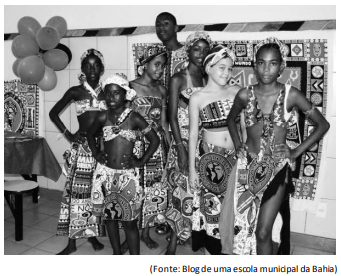
A partir da imagem, registro de uma atividade realizada no Ensino
Fundamental, é correto afirmar
Após o estudo do tema “gênero”, o professor de sociologia propõe uma atividade sobre o problema da violência doméstica no Brasil hoje a partir da apreciação e da análise da música “Maria da Vila Matilde”, da leitura e compreensão da legislação brasileira recente que trata da violência doméstica e da construção coletiva de uma campanha contra a violência doméstica a ser realizada na escola, em colaboração com outros alunos e professores. As opções a seguir descrevem corretamente os objetivos e os métodos dessa atividade, em sintonia com os textos dos PCNsEnsino Médio, à exceção de uma. Assinale-a.
Relacione os três campos com as competências e habilidades específicas listadas a seguir.
1. Representação e comunicação. 2. Investigação e compreensão. 3. Contextualização sociocultural.
( ) Ler e analisar as situações socioculturais mediante categorias próprias dos paradigmas teóricos das Ciências Sociais; ( ) desenvolver uma visão crítica da sociedade contemporânea e compreender as diversidades culturais e sociais; ( ) participar da construção da própria identidade social e política, atuando para que haja maior conscientização quanto à reciprocidade de direitos e deveres.
Assinale a opção que indica a relação correta, de cima para baixo.
A figura a seguir apresenta um fenômeno estudado pela Sociologia.

A imagem critica
Em relação às características do paradigma da tecnologia da informação, analise as afirmativas a seguir.
I. Graças às novas tecnologias, predomina a lógica das redes, uma vez que pode ser implementada em qualquer tipo de processo. II. A tecnologia digital favorece a flexibilidade, já que permite modificar os processos em função de sua alta capacidade de reconfiguração. III. A convergência das tecnologias mostra a interligação entre diversas áreas de saber, graças, por exemplo, à microeletrônica, à robótica e à inteligência artificial.
Assinale:
I. Formas de poder exercidas pelos sujeitos dominantes sem a ação física direta, mas pela imposição de uma visão de mundo, dos papéis sociais, das categorias cognitivas, das estruturas mentais por meio das quais o mundo é percebido e pensado. II. Mecanismo de poder no qual técnicas disciplinares de controle concorrem para o estabelecimento de um padrão de normalidade que é, ao mesmo tempo, um dispositivo de poder e uma forma de saber.
Os trechos citados descrevem, respectivamente, dois conceitos sociológicos definidos como
As opções a seguir caracterizam corretamente aspectos da contra cultura, à exceção de uma. Assinale-a.

 Conheça nossos planos