Selecionar segmento
Estude com questões de diferentes segmentos
Atenção: Isso limpará todos os campos já preenchidos no filtro!
Foram encontradas 4.441 questões
Resolva questões gratuitamente!
Junte-se a mais de 4 milhões de concurseiros!


Q4284949
Química
A preocupação com o clima e a poluição tem sido destaque em várias notícias de jornais e tema de pesquisas
científicas no mundo. A seguir, encontra-se o recorte de uma notícia de um jornal do estado de Rondônia, publicada em março de 2026.
MPRO debate poluição do ar e queimadas em workshop sobre clima.
Evento realizado em Porto Velho reuniu pesquisadores e instituições para discutir impactos das mudanças climáticas e da poluição atmosférica na saúde da população amazônica. No debate, a promotora ressaltou que as queimadas estão entre as principais causas da poluição atmosférica na Amazônia, provocando uma série de problemas de saúde. Entre os impactos citados estão doenças respiratórias, alergias, problemas cardiovasculares, além de prejuízos às atividades escolares e ao trabalho durante períodos de fumaça intensa.
News Rondônia. Disponível em: https://newsrondonia.com.br/meio-ambiente/2026/03/11/mpro-debate-poluicao-do-ar-e-queimadas- -em-workshop-sobre-clima/?utm_source=chatgpt.com. Acesso em: 15 maio 2026.
A fumaça, citada na reportagem, é um tipo de dispersão, ou seja, misturas formadas por disperso e dispersante. Dos tipos de dispersões, destacam-se os coloides, misturas heterogêneas que representam um estado intermediário entre uma solução e uma suspensão e que são classificados de acordo com o meio dispersante e a fase dispersa. Sobre os tipos de coloides, analise as afirmativas a seguir:
I. A fumaça é um tipo de coloide (aerossol), gás (fase dispersa) e líquido (meio dispersante).
II. O marshmallow é um coloide do tipo espuma, sólido (meio dispersante) e gás (fase dispersa).
III. A maionese e a manteiga são coloides do tipo emulsões, líquido/líquido.
IV. A geleia e a gelatina são coloides (gel), em que o meio dispersante é sólido e a fase dispersa é líquida.
V. O creme de barbear é um coloide (espuma), em que a fase dispersa é líquida e o meio dispersante é gás.
Pode-se afirmar que:
MPRO debate poluição do ar e queimadas em workshop sobre clima.
Evento realizado em Porto Velho reuniu pesquisadores e instituições para discutir impactos das mudanças climáticas e da poluição atmosférica na saúde da população amazônica. No debate, a promotora ressaltou que as queimadas estão entre as principais causas da poluição atmosférica na Amazônia, provocando uma série de problemas de saúde. Entre os impactos citados estão doenças respiratórias, alergias, problemas cardiovasculares, além de prejuízos às atividades escolares e ao trabalho durante períodos de fumaça intensa.
News Rondônia. Disponível em: https://newsrondonia.com.br/meio-ambiente/2026/03/11/mpro-debate-poluicao-do-ar-e-queimadas- -em-workshop-sobre-clima/?utm_source=chatgpt.com. Acesso em: 15 maio 2026.
A fumaça, citada na reportagem, é um tipo de dispersão, ou seja, misturas formadas por disperso e dispersante. Dos tipos de dispersões, destacam-se os coloides, misturas heterogêneas que representam um estado intermediário entre uma solução e uma suspensão e que são classificados de acordo com o meio dispersante e a fase dispersa. Sobre os tipos de coloides, analise as afirmativas a seguir:
I. A fumaça é um tipo de coloide (aerossol), gás (fase dispersa) e líquido (meio dispersante).
II. O marshmallow é um coloide do tipo espuma, sólido (meio dispersante) e gás (fase dispersa).
III. A maionese e a manteiga são coloides do tipo emulsões, líquido/líquido.
IV. A geleia e a gelatina são coloides (gel), em que o meio dispersante é sólido e a fase dispersa é líquida.
V. O creme de barbear é um coloide (espuma), em que a fase dispersa é líquida e o meio dispersante é gás.
Pode-se afirmar que:
Q4284948
Física
Dentre os conteúdos abordados sobre estrutura atômica e tabela periódica, destaca-se a radiação eletromagnética. A luz, em todas as suas formas (raio X, luz visível, entre outras), é chamada de radiação eletromagnética.
Algumas das características da luz podem ser compreendidas como propriedades de ondas, e estas, definidas por
meio de algumas variáveis, como: comprimento de onda (λ), frequência (ν) e velocidade da luz (c).
Considerando que a luz amarela apresenta frequência de 5,3 x 10⁸ MHz, marque a alternativa correta quanto ao comprimento de onda observado:
(Dados: 1 Hz = 1 s−1; c = 3,0 x 10⁸ m.s−1).
Considerando que a luz amarela apresenta frequência de 5,3 x 10⁸ MHz, marque a alternativa correta quanto ao comprimento de onda observado:
(Dados: 1 Hz = 1 s−1; c = 3,0 x 10⁸ m.s−1).
Q4284947
Química
O ácido perclórico é extremamente forte e pode ser utilizado na indústria química na produção de algumas classes de agrotóxicos e explosivos. Para a utilização em um desses processos, um químico preparou uma solução
deste ácido na concentração de 0,0034 mol.L−1. Dentre algumas medições realizadas pelo químico, assinale a
alternativa que corresponde ao pOH e ao pH da solução, respectivamente.
(Dados: log 3,4 = 0,53).
(Dados: log 3,4 = 0,53).
Q4284946
Química
Muitas reações químicas estão presentes no nosso cotidiano e são importantes também nos processos industriais. Entre os tipos de reações, existem as de oxirredução, que ocorrem entre muitas substâncias inorgânicas
e orgânicas, sendo importantes nos sistemas bioquímicos. Um exemplo deste tipo de reação ocorre quando o
ácido iodídrico é adicionado com dicromato de potássio, produzindo iodeto de cromo III, iodeto de potássio, água
e gás iodo. Com base em seus conhecimentos, marque a alternativa que corresponde à equação balanceada e
ao agente redutor:
Q4284945
Química
O nitrato de magnésio tem se destacado por sua utilização na agricultura como fertilizante e adubo foliar, principalmente por ser fonte de magnésio solúvel e com rápida absorção pelas plantas. Uma das formas de obtenção
deste fertilizante ocorre por meio da reação do carbonato de magnésio com ácido nítrico, como pode ser verificado pela equação química não balanceada a seguir:
MgCO₃ + HNO₃ → Mg(NO₃)₂ + CO₂ + H2O
Para a obtenção do fertilizante descrito acima, foi utilizada uma amostra de 30,0 g de carbonato de magnésio (70% de pureza) e 50 g de ácido nítrico, e a reação apresenta um rendimento de 80% (do produto formado). A partir disso, marque a alternativa que apresenta a massa de nitrato de magnésio obtida e a massa do reagente em excesso ao final da reação, respectivamente.
(Dados: Mg = 24; C = 12; O = 16; H = 1; N = 14)
MgCO₃ + HNO₃ → Mg(NO₃)₂ + CO₂ + H2O
Para a obtenção do fertilizante descrito acima, foi utilizada uma amostra de 30,0 g de carbonato de magnésio (70% de pureza) e 50 g de ácido nítrico, e a reação apresenta um rendimento de 80% (do produto formado). A partir disso, marque a alternativa que apresenta a massa de nitrato de magnésio obtida e a massa do reagente em excesso ao final da reação, respectivamente.
(Dados: Mg = 24; C = 12; O = 16; H = 1; N = 14)
Q4284944
Química
A solubilidade (S), ou também chamada de Coeficiente de Solubilidade (CS), é a quantidade máxima de soluto que
pode ser dissolvido a uma quantidade definida de solvente, sob determinada temperatura. Em função disso, uma
solução pode ser saturada ou insaturada, entre outras classificações possíveis, e, nesses casos, a temperatura é
um fator importante, que afeta a solubilidade de sólidos em líquidos. A seguir, é apresentado um gráfico hipotético da solubilidade de cinco sólidos em água, sob determinadas condições de temperatura.
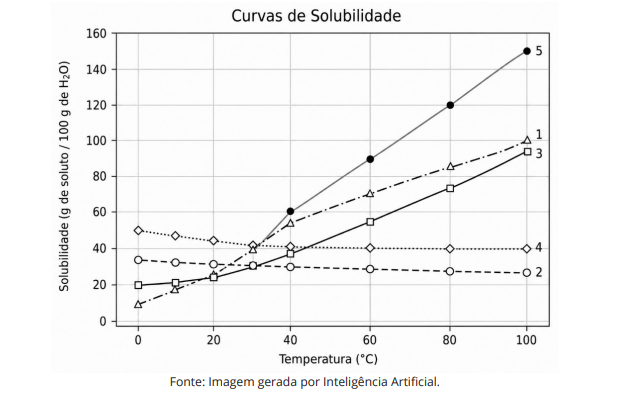
A partir da análise do gráfico, pode-se afirmar que:
A partir da análise do gráfico, pode-se afirmar que:
Q4284943
Química
Uma solução formada por água e etanol (C₂H₆O) pode apresentar diversas finalidades, dependendo do teor de
etanol presente. Considerando uma solução formada por 90 g de etanol e 108 g de água, marque a alternativa
que apresenta a molalidade da solução, a fração em quantidade de matéria do soluto e a porcentagem em massa
do soluto.
(Dados: C = 12; H = 1, O = 16; para os cálculos da quantidade de matéria, considere duas casas decimais).
(Dados: C = 12; H = 1, O = 16; para os cálculos da quantidade de matéria, considere duas casas decimais).
Q4284942
Química
Os números quânticos estão diretamente relacionados com a estrutura atômica, pois podem ser utilizados para
“definir os estados de energia e os orbitais disponíveis para o elétron”. Dos quatro existentes, apresentamos três
aqui: número quântico principal (n), número quântico de momento angular (ℓ) e número quântico magnético
(mℓ
). Com base nas informações fornecidas para o elemento Tecnécio (Z = 43), muito utilizado na medicina nuclear em técnicas de diagnóstico, marque a alternativa que corresponde à sua classificação e aos números quânticos
mencionados anteriormente, para o último elétron adicionado, seguindo a distribuição de Linus Pauling. Considere o preenchimento convencional dos orbitais de −2 a +2 para mℓ
.
Q4284941
Química
O gráfico abaixo representa curvas de pressão de vapor (P) em função da temperatura (T) para dois sistemas
líquidos. Com base nas informações apresentadas, analise as afirmações a seguir.
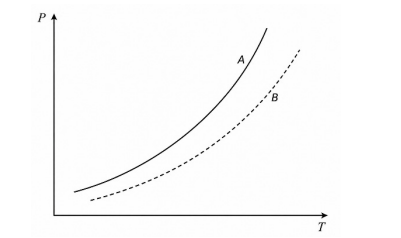
I. A curva A representa um líquido com maior pressão de vapor em todas as temperaturas, indicando maior volatilidade quando comparado ao sistema B.
II. A curva B pode representar um sistema cuja adição de um soluto não volátil provoca diminuição da pressão de vapor em relação ao solvente puro.
III. Para uma mesma pressão externa, o sistema representado pela curva B entra em ebulição a uma temperatura maior que o sistema A.
IV. As curvas A e B representam líquidos com a mesma composição química, diferindo-se apenas na quantidade de matéria presente.
Pode-se afirmar que:
I. A curva A representa um líquido com maior pressão de vapor em todas as temperaturas, indicando maior volatilidade quando comparado ao sistema B.
II. A curva B pode representar um sistema cuja adição de um soluto não volátil provoca diminuição da pressão de vapor em relação ao solvente puro.
III. Para uma mesma pressão externa, o sistema representado pela curva B entra em ebulição a uma temperatura maior que o sistema A.
IV. As curvas A e B representam líquidos com a mesma composição química, diferindo-se apenas na quantidade de matéria presente.
Pode-se afirmar que:
Q4284940
Química
As ligações intermoleculares (dipolo/dipolo, dipolo/dipolo induzido, dipolo induzido/dipolo induzido) são um dos
conteúdos da Química de suma importância, pois, a partir delas, é possível entender algumas propriedades específicas de substâncias de aplicações na indústria e no cotidiano. De acordo com Kotz, Treichel e Weaver (2009),
elas são diretamente relacionadas a propriedades como temperatura de fusão e ebulição, solubilidades de gases,
líquidos e sólidos em vários solventes, entre outras. Sobre este tipo de ligações e substâncias com massas molares semelhantes, analise as afirmações a seguir, se verdadeiras (V) ou falsas (F):
I. O tipo de ligação intermolecular presente na molécula de água (polar) é a ligação de hidrogênio, um caso especial da interação dipolo/dipolo induzido.
II. No tetracloreto de carbono (apolar), a principal ligação intermolecular existente é do tipo dipolo induzido/ dipolo induzido.
III. As ligações do tipo dipolo/dipolo induzido são também chamadas de Forças de London.
IV. Em geral, para substâncias de tamanhos semelhantes (massas molares), a intensidade das ligações intermoleculares é: dipolo induzido/dipolo induzido < dipolo/dipolo induzido < dipolo/dipolo.
V. As ligações dipolo induzido/dipolo induzido são as únicas que ocorrem em moléculas polares.
Marque a alternativa com a sequência correta:
I. O tipo de ligação intermolecular presente na molécula de água (polar) é a ligação de hidrogênio, um caso especial da interação dipolo/dipolo induzido.
II. No tetracloreto de carbono (apolar), a principal ligação intermolecular existente é do tipo dipolo induzido/ dipolo induzido.
III. As ligações do tipo dipolo/dipolo induzido são também chamadas de Forças de London.
IV. Em geral, para substâncias de tamanhos semelhantes (massas molares), a intensidade das ligações intermoleculares é: dipolo induzido/dipolo induzido < dipolo/dipolo induzido < dipolo/dipolo.
V. As ligações dipolo induzido/dipolo induzido são as únicas que ocorrem em moléculas polares.
Marque a alternativa com a sequência correta:
Q4284939
Ciências
Considere a Competência Específica 3 da área de Ciências da Natureza e suas Tecnologias, conforme apresentada
na BNCC:
“Investigar situações-problema e avaliar aplicações do conhecimento científico e tecnológico e suas implicações no mundo, utilizando procedimentos e linguagens próprios das Ciências da Natureza, para propor soluções que considerem demandas locais, regionais e/ou globais, e comunicar suas descobertas e conclusões a públicos variados, em diversos contextos e por meio de diferentes mídias e tecnologias digitais de informação e comunicação (TDIC).”
Agora, observe as seguintes habilidades:
I. “Analisar as propriedades dos materiais para avaliar a adequação de seu uso em diferentes aplicações (industriais, cotidianas, arquitetônicas ou tecnológicas) e/ou propor soluções seguras e sustentáveis considerando seu contexto local e cotidiano.”
II. “Investigar e analisar o funcionamento de equipamentos elétricos e/ou eletrônicos e sistemas de automação para compreender as tecnologias contemporâneas e avaliar seus impactos sociais, culturais e ambientais.”
III. “Aplicar os princípios da evolução biológica para analisar a história humana, considerando sua origem, diversificação, dispersão pelo planeta e diferentes formas de interação com a natureza, valorizando e respeitando a diversidade étnica e cultural humana.”
Considerando a correspondência direta entre competências específicas e habilidades estabelecida no documento, assinale a alternativa que apresenta as habilidades corretamente associadas à Competência Específica 3.
“Investigar situações-problema e avaliar aplicações do conhecimento científico e tecnológico e suas implicações no mundo, utilizando procedimentos e linguagens próprios das Ciências da Natureza, para propor soluções que considerem demandas locais, regionais e/ou globais, e comunicar suas descobertas e conclusões a públicos variados, em diversos contextos e por meio de diferentes mídias e tecnologias digitais de informação e comunicação (TDIC).”
Agora, observe as seguintes habilidades:
I. “Analisar as propriedades dos materiais para avaliar a adequação de seu uso em diferentes aplicações (industriais, cotidianas, arquitetônicas ou tecnológicas) e/ou propor soluções seguras e sustentáveis considerando seu contexto local e cotidiano.”
II. “Investigar e analisar o funcionamento de equipamentos elétricos e/ou eletrônicos e sistemas de automação para compreender as tecnologias contemporâneas e avaliar seus impactos sociais, culturais e ambientais.”
III. “Aplicar os princípios da evolução biológica para analisar a história humana, considerando sua origem, diversificação, dispersão pelo planeta e diferentes formas de interação com a natureza, valorizando e respeitando a diversidade étnica e cultural humana.”
Considerando a correspondência direta entre competências específicas e habilidades estabelecida no documento, assinale a alternativa que apresenta as habilidades corretamente associadas à Competência Específica 3.
Q4284938
Química
Considere os dados apresentados no quadro a seguir:
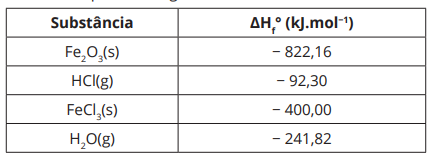
Utilizando os valores de entalpia padrão de formação (ΔHf ° ) apresentados, calcule a entalpia padrão da reação não balanceada a seguir:
Fe₂O₃(s) + HCl(g) → FeCl₃(s) + H₂O(g)
Q4284937
Química
A desidratação intramolecular do etanol, em meio ácido concentrado e aquecimento, pode ser classificada como:
Q4284936
Física
A série brasileira Emergência Radioativa, lançada pela Netflix, em março de 2026, é uma minissérie dramática inspirada no acidente com o Césio-137 em Goiânia, ocorrido em 1987. A produção alcançou rapidamente o topo das
listas de mais assistidas da plataforma e reacendeu o debate sobre a importância do tema. Um professor falou
sobre o acidente e explicou sobre tipos de decaimento radioativo. Em seguida, apresentou um núcleo radioativo
de césio que sofre decaimento beta negativo (β−), conforme representado abaixo:
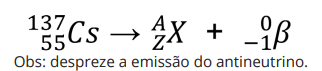
Após o decaimento, o núcleo formado X apresenta número de massa (A) e número atômico (Z), respectivamente:
Após o decaimento, o núcleo formado X apresenta número de massa (A) e número atômico (Z), respectivamente:
Q4284935
Química
Considerando isômeros com ligações duplas trissubstituídas ou tetrassubstituídas, utiliza-se o sistema de nomenclatura E/Z. Esse sistema consiste em um conjunto de regras de sequência utilizado para atribuir prioridades aos
grupos substituintes nos carbonos da ligação dupla. Assinale a alternativa em que a designação estereoquímica
(E/Z) foi corretamente atribuída, de acordo com as regras de prioridade de Cahn-Ingold-Prelog (CIP), para as estruturas I e II, respectivamente.
(Dados: Br = 35; C = 6; H = 1).
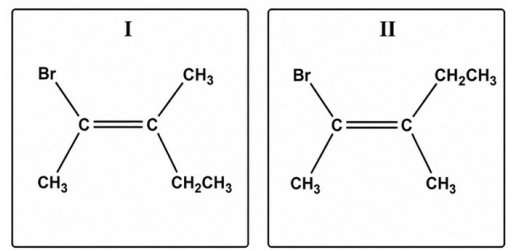
(Dados: Br = 35; C = 6; H = 1).
Q4284934
Química
Considere uma célula voltaica baseada nas semirreações a seguir:
In+(aq) → In³⁺(aq) + 2e−
Br₂(l) + 2e⁻ → 2Br⁻(aq)
Sabendo que a força eletromotriz (fem) padrão para essa célula é igual a 1,46 V e que o potencial-padrão de redução da reação Br2(l) + 2e− → 2Br−(aq) é +1,06 V, marque a alternativa que corresponde ao potencial-padrão de redução (E0red) do sistema In3+/In+:
Q4284933
Química
Os dados experimentais abaixo foram obtidos para a reação entre óxido nítrico e gás hidrogênio:

Com base nos dados experimentais apresentados acima, assinale a alternativa que apresenta corretamente a lei de velocidade (ν) e o valor da constante de velocidade k:
Com base nos dados experimentais apresentados acima, assinale a alternativa que apresenta corretamente a lei de velocidade (ν) e o valor da constante de velocidade k:
Q4284932
Química
Uma mistura de gases hidrogênio e nitrogênio, em um recipiente de reação, atinge o equilíbrio a 450 °C. Ao analisar a mistura, foi identificado que ela apresentou pressões parciais de 2,0 atm de H₂, 1,0 atm de N₂ e 0,40 atm de
NH₃. Com base nas informações anteriores, o valor da constante de equilíbrio, Kp, da equação não balanceada, a seguir, é:
N2(g) + H₂(g) ⇌ NH₃(g)
N2(g) + H₂(g) ⇌ NH₃(g)
Q4284931
Química
Considere a reação de calcinação do carbonato de cálcio e os dados apresentados no quadro a seguir, em condições-padrão:
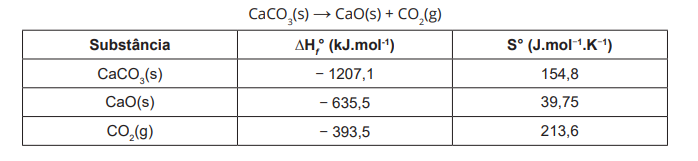
Podemos afirmar, com base nos dados apresentados, que o valor da variação da energia livre de Gibbs para a reação acima, em kJ·mol−1, é aproximadamente:
Podemos afirmar, com base nos dados apresentados, que o valor da variação da energia livre de Gibbs para a reação acima, em kJ·mol−1, é aproximadamente:
Q4284930
Química
Alguns medicamentos são utilizados em crianças com autismo para amenizar algumas situações, tais como: melhorar a concentração, diminuir os movimentos repetitivos, entre outros. Um destes medicamentos é a risperidona, um antipsicótico atípico, e sua fórmula estrutural está representada a seguir:
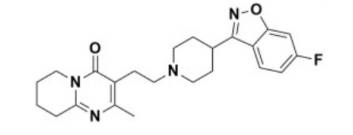
Acerca do composto, assinale a alternativa incorreta:
Acerca do composto, assinale a alternativa incorreta:

 Conheça nossos planos