Foram encontradas 1.642 questões
Resolva questões gratuitamente!
Junte-se a mais de 4 milhões de concurseiros!


Os autores de uma nota técnica do IPEA assim descreveram a organização textual de tal nota.
A seção 1 sistematiza, resumidamente, os argumentos do BCB em defesa de um novo ciclo de elevação da SELIC (no intuito de prevenção da inflação); a seção 2 apresenta evidências empíricas que contrariam tais argumentos; e a seção final reúne as conclusões derivadas desse conjunto de evidências, apontando para o fato de que, na atual conjuntura, a adoção de uma política monetária contracionista seria, no mínimo, precipitada.
Considerando a "seção 1" como o discurso institucional do BCB; a "seção 2" como a contra-argumentação dos autores; e a "seção final" como a conclusão dos autores, julgue os itens a seguir quanto à associação de cada idéia transcrita com a respectiva seção da referida nota técnica.
O persistente descompasso entre o ritmo de expansão da demanda doméstica e da oferta vem representando risco relevante para o panorama inflacionário. (trecho condizente com a seção 2)
Considerando que os fragmentos apresentados nos itens seguintes são partes sucessivas da nota técnica, adaptada, de Vianna, Modenesi e Bruno (op. cit.), julgue-os quanto à correção gramatical.
Em meio às incertezas e às tensões decorrentes dos desdobramentos da crise financeira, abalando as principais economias desenvolvidas, o BCB reconheceu, em março, a importância de que a demanda interna vem tendo na criação de um ambiente favorável à expansão dos investimentos.
Considerando que os fragmentos apresentados nos itens seguintes são partes sucessivas da nota técnica, adaptada, de Vianna, Modenesi e Bruno (op. cit.), julgue-os quanto à correção gramatical.
Ainda que uma elevação da SELIC não interromperia os investimentos já em curso, ela certamente inibiria novos investimentos. E aí, sim, num cenário de retração dos investimentos, a expansão da demanda poderia comprometer a estabilidade dos preços.
Considerando que os fragmentos apresentados nos itens seguintes são partes sucessivas da nota técnica, adaptada, de Vianna, Modenesi e Bruno (op. cit.), julgue-os quanto à correção gramatical.
Na verdade, como se pretende demonstrar, uma contração monetária representaria um forte impacto negativo nas expectativas empresariais, capaz de reduzir a sustentabilidade do atual ciclo de crescimento.
Considerando que os fragmentos apresentados nos itens seguintes são partes sucessivas da nota técnica, adaptada, de Vianna, Modenesi e Bruno (op. cit.), julgue-os quanto à correção gramatical.
Esta nota técnica tem por objetivo contribuir para esse debate, apresentando evidências que contrariam tanto o suposto excesso de demanda, quanto à alegada incapacidade de a oferta responder ao crescimento da procura.
Considerando que os fragmentos apresentados nos itens seguintes são partes sucessivas da nota técnica, adaptada, de Vianna, Modenesi e Bruno (op. cit.), julgue-os quanto à correção gramatical.
Agindo assim, a autoridade monetária estaria não apenas garantindo a sustentabilidade do crescimento econômico, mas, principalmente, minimizando o custo do combate à inflação. Em suma, um banco central previnido (isto é, pronto a se antecipar as pressões inflacionárias), reduz os custos da política anti-inflacionária.
Considerando que os fragmentos apresentados nos itens seguintes são partes sucessivas da nota técnica, adaptada, de Vianna, Modenesi e Bruno (op. cit.), julgue-os quanto à correção gramatical.
Ressaltando que a existência de defasagens na condução da política monetária exige um comportamento prospectivo, quanto à evolução da inflação, o BCB considera necessário a realização de um movimento preventivo de alta da taxa básica de juros, a SELIC.
Considerando que os fragmentos apresentados nos itens seguintes são partes sucessivas da nota técnica, adaptada, de Vianna, Modenesi e Bruno (op. cit.), julgue-os quanto à correção gramatical.
O Banco Central do Brasil identifica o surgimento de tensões inflacionárias, decorrentes dos seguintes motivos: possível descompasso entre o ritmo de expansão da demanda doméstica e da oferta; choques de custos derivados da inflação global; reestruturação no mercado de trabalho — devido à redução da população economicamente ativa (PEA) —, que, somada ao dinamismo da economia, poderia desencadear pressões por aumentos reais de salário acima dos ganhos de produtividade.
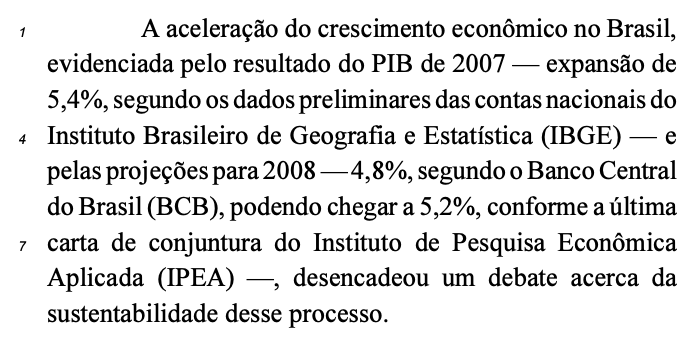
Parônimas de "acerca de" são as expressões a cerca de e há cerca de, que estão corretamente empregadas nos períodos a seguir: Chegou e logo indagou a cerca das divergências de resultados. Não sabia que o debate havia terminado há cerca de meia hora.
De acordo com o texto, são referentes do termo "desse processo" (l.9) as seguintes expressões: expansão do PIB de 2007 da ordem de 5,4% e projeções de crescimento para 2008 situadas entre 4,8% e 5,2%.
A palavra "conforme" (l.6) está empregada com sentido e regência iguais aos que assume no seguinte período: O resultado da segunda pesquisa está conforme com o da primeira.
Dado que é apresentada mais de uma projeção para 2008, o artigo definido deveria ser suprimido no segmento "pelas projeções para 2008" (l.5), de forma a se estabelecer paralelismo sintático na construção do período.
Nos trechos "segundo o Banco Central" (l.5) e "conforme a última carta de conjuntura" (l.6-7), os termos sublinhados introduzem referência às fontes de dados mencionadas pelo autor.
Pelos sentidos do texto, a substituição do termo "evidenciada" (l.2) pela forma no masculino (evidenciado) seria adequada, visto que a concordância estaria sendo feita com "crescimento econômico" (l.1), expressão que constitui o núcleo sintático e semântico da oração.
O duplo travessão empregado para isolar o trecho entre as linhas 2 e 4 pode ser substituído por parênteses, sem prejuízo da correta pontuação do parágrafo.
Constitui resumo fiel e sucinto da principal idéia do texto a seguinte frase: A aceleração do crescimento econômico brasileiro pode alcançar o patamar de 5,2% em 2008.
Nos itens de 16 a 30, a seguir, são avaliados conhecimentos em língua inglesa.
1 The Brazilian economy performance in 2008 should
not be affected by the international financial crisis, mainly
due to the domestic demand. This is the evaluation of
4 Brazil’s National Confederation of Industries (CNI).
According to the quarterly Conjectural Information,
disclosed on Friday, October 3, the CNI has increased to
7 5.3% its estimates for growth of the Brazilian Gross
Domestic Product (GDP) this year. The previous forecast, in
June, was that the Brazilian economy would grow 4.7%.
10 In the evaluation of CNI technicians, the
international crisis should only reflect in the economic results
next year. The GDP in 2009 should grow 3.5%. To the CNI,
13 the Brazilian capacity to face difficulties is greater than last
year.
The country has great reserves, a substantial primary
16 surplus, a developed banking regulation system and lower
foreign dependency. “However, these conditions do not bar
the unfolding of the global crisis from reaching Brazil”,
19 according to the Conjectural Information.
According to the study, the foreign crisis should
reduce the international offer of credit and demand for
22 Brazilian products. “The former should have more immediate
effects, whereas the latter should present itself in a more
progressive manner, as global trade loses dynamism”, write
25 the institution’s technicians.
To the CNI, the non-renovation of foreign financing
lines of credit, especially export credit, should create
28 operational difficulties for companies. This way, according
to the text, the Brazilian Central Bank should be aware of
liquidity problems and of the greater cost of credit, once
31 again evaluating the monetary policy, “which was not
developed taking into consideration a more adverse
environment as the one we are currently living”.
34 The industrial sector should grow 5.5% this year, a
little over the average growth of the economy as a whole.
This performance should be boosted by the estimated civil
37 construction growth of 8.7%. The transformation industry
should grow 5.1% this year.
Internet: <www.brazzilmag.com> (adapted).
Based on the text above, judge the items 16 through 30.
"boosted" (l.36) means increased.
Nos itens de 16 a 30, a seguir, são avaliados conhecimentos em língua inglesa.
1 The Brazilian economy performance in 2008 should
not be affected by the international financial crisis, mainly
due to the domestic demand. This is the evaluation of
4 Brazil’s National Confederation of Industries (CNI).
According to the quarterly Conjectural Information,
disclosed on Friday, October 3, the CNI has increased to
7 5.3% its estimates for growth of the Brazilian Gross
Domestic Product (GDP) this year. The previous forecast, in
June, was that the Brazilian economy would grow 4.7%.
10 In the evaluation of CNI technicians, the
international crisis should only reflect in the economic results
next year. The GDP in 2009 should grow 3.5%. To the CNI,
13 the Brazilian capacity to face difficulties is greater than last
year.
The country has great reserves, a substantial primary
16 surplus, a developed banking regulation system and lower
foreign dependency. “However, these conditions do not bar
the unfolding of the global crisis from reaching Brazil”,
19 according to the Conjectural Information.
According to the study, the foreign crisis should
reduce the international offer of credit and demand for
22 Brazilian products. “The former should have more immediate
effects, whereas the latter should present itself in a more
progressive manner, as global trade loses dynamism”, write
25 the institution’s technicians.
To the CNI, the non-renovation of foreign financing
lines of credit, especially export credit, should create
28 operational difficulties for companies. This way, according
to the text, the Brazilian Central Bank should be aware of
liquidity problems and of the greater cost of credit, once
31 again evaluating the monetary policy, “which was not
developed taking into consideration a more adverse
environment as the one we are currently living”.
34 The industrial sector should grow 5.5% this year, a
little over the average growth of the economy as a whole.
This performance should be boosted by the estimated civil
37 construction growth of 8.7%. The transformation industry
should grow 5.1% this year.
Internet: <www.brazzilmag.com> (adapted).
Based on the text above, judge the items 16 through 30.
'unfolding' (l.18) is the same as development.
Nos itens de 16 a 30, a seguir, são avaliados conhecimentos em língua inglesa.
1 The Brazilian economy performance in 2008 should
not be affected by the international financial crisis, mainly
due to the domestic demand. This is the evaluation of
4 Brazil’s National Confederation of Industries (CNI).
According to the quarterly Conjectural Information,
disclosed on Friday, October 3, the CNI has increased to
7 5.3% its estimates for growth of the Brazilian Gross
Domestic Product (GDP) this year. The previous forecast, in
June, was that the Brazilian economy would grow 4.7%.
10 In the evaluation of CNI technicians, the
international crisis should only reflect in the economic results
next year. The GDP in 2009 should grow 3.5%. To the CNI,
13 the Brazilian capacity to face difficulties is greater than last
year.
The country has great reserves, a substantial primary
16 surplus, a developed banking regulation system and lower
foreign dependency. “However, these conditions do not bar
the unfolding of the global crisis from reaching Brazil”,
19 according to the Conjectural Information.
According to the study, the foreign crisis should
reduce the international offer of credit and demand for
22 Brazilian products. “The former should have more immediate
effects, whereas the latter should present itself in a more
progressive manner, as global trade loses dynamism”, write
25 the institution’s technicians.
To the CNI, the non-renovation of foreign financing
lines of credit, especially export credit, should create
28 operational difficulties for companies. This way, according
to the text, the Brazilian Central Bank should be aware of
liquidity problems and of the greater cost of credit, once
31 again evaluating the monetary policy, “which was not
developed taking into consideration a more adverse
environment as the one we are currently living”.
34 The industrial sector should grow 5.5% this year, a
little over the average growth of the economy as a whole.
This performance should be boosted by the estimated civil
37 construction growth of 8.7%. The transformation industry
should grow 5.1% this year.
Internet: <www.brazzilmag.com> (adapted).
Based on the text above, judge the items 16 through 30.
In 2008, Brazilian GDP growth augmented 0.6%.
Nos itens de 16 a 30, a seguir, são avaliados conhecimentos em língua inglesa.
1 The Brazilian economy performance in 2008 should
not be affected by the international financial crisis, mainly
due to the domestic demand. This is the evaluation of
4 Brazil’s National Confederation of Industries (CNI).
According to the quarterly Conjectural Information,
disclosed on Friday, October 3, the CNI has increased to
7 5.3% its estimates for growth of the Brazilian Gross
Domestic Product (GDP) this year. The previous forecast, in
June, was that the Brazilian economy would grow 4.7%.
10 In the evaluation of CNI technicians, the
international crisis should only reflect in the economic results
next year. The GDP in 2009 should grow 3.5%. To the CNI,
13 the Brazilian capacity to face difficulties is greater than last
year.
The country has great reserves, a substantial primary
16 surplus, a developed banking regulation system and lower
foreign dependency. “However, these conditions do not bar
the unfolding of the global crisis from reaching Brazil”,
19 according to the Conjectural Information.
According to the study, the foreign crisis should
reduce the international offer of credit and demand for
22 Brazilian products. “The former should have more immediate
effects, whereas the latter should present itself in a more
progressive manner, as global trade loses dynamism”, write
25 the institution’s technicians.
To the CNI, the non-renovation of foreign financing
lines of credit, especially export credit, should create
28 operational difficulties for companies. This way, according
to the text, the Brazilian Central Bank should be aware of
liquidity problems and of the greater cost of credit, once
31 again evaluating the monetary policy, “which was not
developed taking into consideration a more adverse
environment as the one we are currently living”.
34 The industrial sector should grow 5.5% this year, a
little over the average growth of the economy as a whole.
This performance should be boosted by the estimated civil
37 construction growth of 8.7%. The transformation industry
should grow 5.1% this year.
Internet: <www.brazzilmag.com> (adapted).
Based on the text above, judge the items 16 through 30.
"Conjectural Information" is a periodical published every four years.
 Conheça nossos planos