Questões de Concurso
Para uftm
Foram encontradas 846 questões
Resolva questões gratuitamente!
Junte-se a mais de 4 milhões de concurseiros!


Please, read the following text in order to answer questions 21 to 25.
Are scientists leaving the net?
The scientists who helped create the Internet may be leaving it for less crowded cyberspaces. Having been on the Internet longer than the rest of us, scientists use it differently.
Premier researchers use the Internet to test projects like real-time, 3D models of colliding galaxies or rampaging tornadoes. For tasks like that, the Internet is no longer fast enough or reliable enough. And some scientists are frustrated. For them, the information superhighway is full of bumper-to-bumper traffic.
Visionary engineers at the National Science Foundation, fortunately, have long foreseen such congestion. As an alternative, they created the very high-speed Backbone Network Service (VBNS). It links a handful of government and university labs at speed of 155,000,000 bits per second, or 10,000 times faster than a standard modem. By the year 2000, a new generation of equipment and another round of research could give scientists data pipes 12 times faster than that. Among other tricks, these new high bandwidth networks will allow scientists to manipulate huge computer files so unwieldy they are now shipped by four-wheeled means. “Never underestimate the bandwidth of a pick-up truck full of data”, jokes Daniel Sandin of the University of Illinois.
Sandin and his team in Chicago will use the VBNS to immerse goggled humans at different locations into the same type of jaw-dropping virtual reality simulation generated by a supercomputer. “You could not do that on the Internet,” says Thomas Defanti, Sandin’s colleague. “The Internet is so congested that for any kind of highbandwidth use, it is essentially rendered useless.”
“Simply adding lanes is not going to work,” adds Beth Gaston of the National Science Foundation. “Our role is to spur the technology forward” – Mark Uheling.
(Popular Science, September 1996, p.60)
The areas in which scientists mostly use the Internet are:
Gráficos de energia potencial para a formação de moléculas ou íons moleculares são bastante úteis, pois podem ser utilizados para a obtenção de parâmetros importantes como distância de ligação (DL) e energia de ligação. Observe o gráfico a seguir.
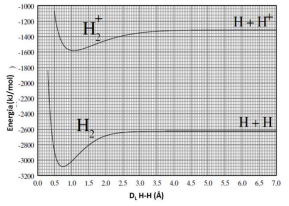
A partir das informações que podem ser extraídas do gráfico, é CORRETO afirmar que:
A estrutura de uma molécula ou íon é descrita em função dos seus ângulos de ligação e comprimentos de ligação. Considere o dióxido de nitrogênio e seus respectivos íons NO2+ e NO2- .
Dado: N (Z = 7); O (Z = 8)
A ordem CRESCENTE dos ângulos de ligação O-N-O nessas espécies é:
A seguir estão representados 3 alcalóides com suas respectivas ações farmacológicas. Esses alcaloides apresentam fórmulas estruturais semelhantes.
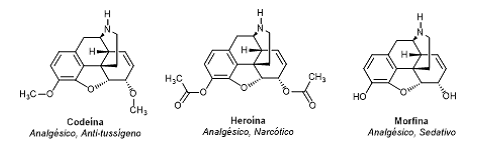
Os grupos funcionais presentes na codeína, heroína e morfina que diferenciam suas estruturas são
respectivamente:
O Estradiol, representado na figura a seguir, é um hormônio sexual feminino diretamente ligado à fertilidade da mulher. Como todo esteroide, é altamente solúvel em gorduras e apresenta uma estrutura básica de 17 átomos de carbono dispostos em quatro anéis ligados entre si, que formam diversos centros quirais.
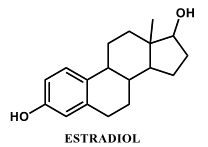
O número de centros quirais e o máximo de estereoisômeros presentes no estradiol são respectivamente:
A utilização de um determinado elemento químico requer o conhecimento de suas propriedades. Para materiais condutores, por exemplo, são utilizados elementos metálicos, os quais podem ser moldados na forma de fios. As propriedades dos elementos, entre elas a condutividade, estão ligadas à sua configuração eletrônica de valência, que, por sua vez, pode ser obtida a partir dos valores sucessivos de energia de ionização (E.I). A partir da configuração eletrônica de valência, pode-se determinar a qual grupo da tabela periódica um elemento representativo pertence. Uma grande variação relativa do valor da E.I indica que o elétron é retirado de uma camada mais interna e os anteriores, consequentemente, da camada de valência. Observe os Quadros 1 e 2.
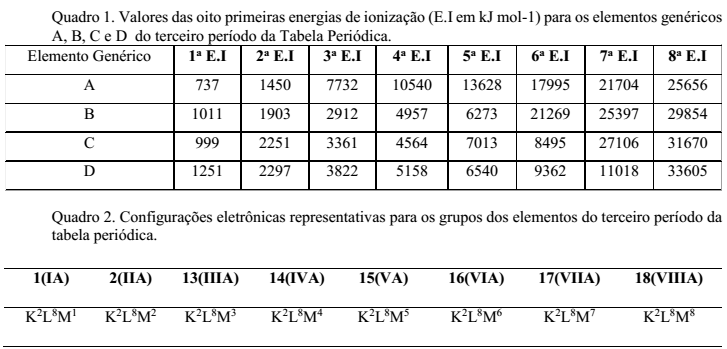
O elemento genérico adequado para obtenção de um fio condutor é:
Íons Ba2+(aq) são altamente tóxicos e suas soluções não podem ser descartadas na rede de esgoto. Esses íons devem, portanto, ser removidos de misturas que se pretende descartar, o que pode ser feito através de reações de precipitação. Para a remoção de íons Ba2+(aq) de 1,0 L de resíduo de concentração 0,01 mol L -1 foram propostos os seguintes procedimentos:
I. Adição de 0,1 L de solução de Na2CO3 0,1 mol L-1
II. Adição de 0,1 L de solução de Na2SO4 0,1 mol L-1
III. Adição de 0,1 L de solução de Na3PO4 0,01 mol L-1
IV. Adição de 0,1 L de solução de NaOH, 0,01 mol L-1
Dado: Constante do produto de solubilidade dos compostos de bário (Ks)
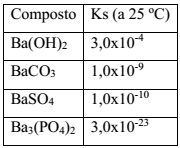
O procedimento que resulta na produção de um material mais adequado ao descarte é:
O oxalato de cálcio é encontrado nas folhas de espinafre, nas sementes do tomate e é um dos constituintes das pedras formadas nos rins (cálculo renal). Uma alíquota de 25 cm3 de uma solução aquosa de oxalato de cálcio contém 0,32 g desse sal.
Dado: CaC2O4 (128 g mol-1 )
A concentração comum e a concentração molar de oxalato de cálcio nessa solução são, respectivamente:
Um frasco de ácido clorídrico concentrado contém 37% de HCl em massa e apresenta uma densidade de 1,20 g mL-1 . Foi transferido 5,00 mL de HCl desse frasco para um balão volumétrico de um litro e avolumado com água deionizada.
Qual o volume necessário dessa solução de HCl diluída para neutralizar 500 mL de NaOH 0,02 mol L-1 ?
O ácido oxálico (H2C2O4 . 2H2O) é um ácido diprótico muito usado para fins analíticos, industriais e aplicações veterinárias. Uma amostra de 0,2520 g de um ácido oxálico foi pesada e titulada completamente com 25,00 mL de uma solução de NaOH de concentração 0,1200 mol L-1 .
Dado: H2C2O4 . 2H2O = 126 g mol-1
A porcentagem de pureza desse ácido é:
Uma das formas de produção da amônia é a partir da reação entre a cal viva (óxido de cálcio) e o cloreto de amônio, conforme reação a seguir:
CaO(s) + 2 NH4Cl(s) → 2 NH3(g) + H2O(g) + CaCl2(s)
10 g de uma amostra de cal viva foram colocados para reagir com excesso de cloreto de amônio e foram produzidos 5 g de amônia. Qual a porcentagem de óxido de cálcio dessa amostra de cal viva?
Dados: CaO (56 g mol-1 )
NH4Cl (53,5 g mol-1 )
NH3 (17 g mol-1 )
H2O (18 g mol-1 )
CaCl2 (111 g mol-1
)
Uma _______________________ constitui uma excelente solução para a neutralização de soluções ácidas para descarte, pois além de elevar o pH, promove a formação de bolhas atóxicas que, quando cessadas, possibilitam que o usuário perceba que o meio já se encontra em pH próximo ao neutro.
A alternativa que completa a frase de forma CORRETA é:
O cloreto de titânio(IV), TiCl4, é um importante produto químico industrial. Esse pode ser usado tanto na obtenção do TiO2 quanto de titânio metálico. O TiCl4 pode ser obtido a partir de um minério contendo titânio (TiO2 impuro), utilizado em excesso, com carbono e gás cloro, conforme a equação química a seguir.
TiO2(s) + 2 Cl2(g) + C(s) → TiCl4(l) + CO2(g)
Considere que a obtenção do TiCl4 seja feita a partir de 852 g de C e 852 g de Cl2.
Dados: Cl2 (71 g mol-1 ); C (12 g mol-1 ) e TiCl4 (190 g mol-1 )
O reagente limitante e a massa em gramas de TiCl4 obtida são, respectivamente:
Acerca das teorias ácido-base e tampão são feitas as seguintes afirmações:
I. Segundo a teoria de Arrhenius ácidos e bases são classificados segundo sua capacidade de doar e receber prótons.
II. Quanto maior o valor da constante de ionização de uma base, maior será o valor do pH da solução.
III. Para uma solução de amônia que apresenta concentração dos íons OH- igual a 10-3 mol L-1, o pH é igual a 3.
IV. Um sistema tampão pode ser formado por um ácido forte e sua base conjugada.
V. Dobrando a concentração de ácido e sua base conjugada, que formam a solução tampão, o pH permanece constante, porém o poder tamponante aumenta.
É CORRETO o que se afirma em:

 Conheça nossos planos