Foram encontradas 10.383 questões
Resolva questões gratuitamente!
Junte-se a mais de 4 milhões de concurseiros!


A respeito de correspondência oficial, julgue o item seguinte, à luz do Manual de Redação da Presidência da República.
Quanto à apresentação, nos documentos que seguem o padrão
ofício, devem-se priorizar a utilização de negrito, itálico e
letras maiúsculas.
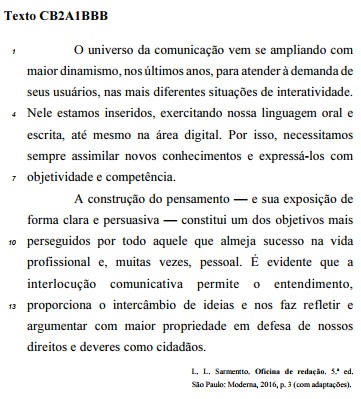
A respeito dos aspectos linguísticos do texto CB2A1BBB, julgue o item que se segue.
Na linha 13, o pronome “nos” exerce a função de complemento
da forma verbal “refletir”
A respeito dos aspectos linguísticos do texto CB2A1BBB, julgue o item que se segue.
A substituição de “Por isso” (l.5) por Por esse motivo
manteria a correção e o sentido original do texto.
A respeito dos aspectos linguísticos do texto CB2A1BBB, julgue o item que se segue.
A correção gramatical e o sentido do texto seriam preservados
caso o trecho “expressá-los com objetividade e competência”
(l. 6 e 7) fosse reescrito da seguinte maneira: expressá-los
objetiva e competentemente.
A respeito dos aspectos linguísticos do texto CB2A1BBB, julgue o item que se segue.
A substituição da expressão “todo aquele” (l.10) por todos
manteria o sentido original e a correção gramatical do texto.
A respeito dos aspectos linguísticos do texto CB2A1BBB, julgue o item que se segue.
O texto associa o êxito de uma pessoa na esfera social — como
nas relações de trabalho, por exemplo — ao modo como ela
expõe suas ideias.
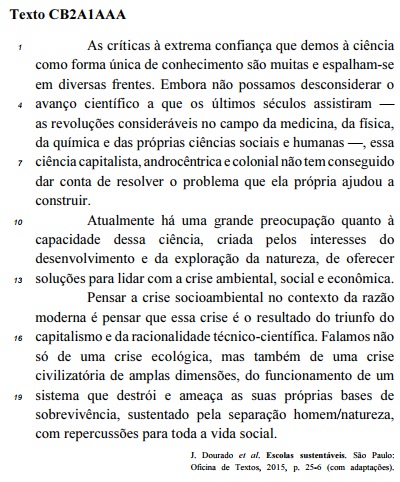
Considerando as ideias e estruturas linguísticas do texto CB2A1AAA, julgue o item a seguir.
O emprego do sinal indicativo de crase em “à capacidade dessa
ciência” (l. 10 e 11) é facultativo.
Considerando as ideias e estruturas linguísticas do texto CB2A1AAA, julgue o item a seguir.
O trecho “Embora não possamos (...) assistiram” (l. 3 e 4)
pode ser reescrito, sem prejuízo da coerência e da correção
gramatical do texto, da seguinte maneira: Ainda que não pode
desconsiderar que os últimos séculos assistiram o avanço
científico.
Considerando as ideias e estruturas linguísticas do texto CB2A1AAA, julgue o item a seguir.
O conectivo “Embora” (l.3) introduz no período em que ocorre
uma ideia de concessão.
Considerando as ideias e estruturas linguísticas do texto CB2A1AAA, julgue o item a seguir.
Mantém-se a correção gramatical do período caso os
travessões empregados no primeiro parágrafo sejam
substituídos por parênteses.
Considerando as ideias e estruturas linguísticas do texto CB2A1AAA, julgue o item a seguir.
A expressão “mas também” (l.17) introduz no período em que
ocorre uma ideia de oposição.
Com base na Lei Orgânica do DF (LODF), julgue o item a seguir.
Se um cargo for extinto, o servidor público estável do DF que
o ocupava ficará em disponibilidade, com remuneração
integral, independentemente do tempo de serviço, até seu
adequado aproveitamento em outro cargo.
Com base na Lei Orgânica do DF (LODF), julgue o item a seguir.
A motivação e o interesse público são princípios que devem ser obedecidos pela administração pública direta e indireta.Com base na Lei Orgânica do DF (LODF), julgue o item a seguir.
A proteção do meio ambiente é competência comum da União e do DF.Com base na Lei Orgânica do DF (LODF), julgue o item a seguir.
Um dos valores fundamentais expressamente previsto na LODF é a plena cidadania.Com base na Lei Orgânica do DF (LODF), julgue o item a seguir.
Os conselhos de representantes comunitários das regiões administrativas do DF têm funções consultivas, fiscalizadoras e normativas.Maurício, chefe imediato de João (ambos servidores públicos distritais), determinou que este participasse de reunião de trabalho em Fortaleza – CE nos dias nove e dez de janeiro. João recebeu o valor das diárias. No dia oito de janeiro, João sofreu um acidente de carro e, conforme atestado médico apresentado para Maurício, teve de ficar de repouso por três dias, razão pela qual não pôde viajar. Essa foi a primeira vez no bimestre que João teve de se afastar do serviço por motivo de saúde.
Acerca dessa situação hipotética e de aspectos legais e doutrinários
a ela relacionados, julgue o item a seguir.
Maurício, chefe imediato de João (ambos servidores públicos distritais), determinou que este participasse de reunião de trabalho em Fortaleza – CE nos dias nove e dez de janeiro. João recebeu o valor das diárias. No dia oito de janeiro, João sofreu um acidente de carro e, conforme atestado médico apresentado para Maurício, teve de ficar de repouso por três dias, razão pela qual não pôde viajar. Essa foi a primeira vez no bimestre que João teve de se afastar do serviço por motivo de saúde.
Acerca dessa situação hipotética e de aspectos legais e doutrinários
a ela relacionados, julgue o item a seguir.
Maurício, chefe imediato de João (ambos servidores públicos distritais), determinou que este participasse de reunião de trabalho em Fortaleza – CE nos dias nove e dez de janeiro. João recebeu o valor das diárias. No dia oito de janeiro, João sofreu um acidente de carro e, conforme atestado médico apresentado para Maurício, teve de ficar de repouso por três dias, razão pela qual não pôde viajar. Essa foi a primeira vez no bimestre que João teve de se afastar do serviço por motivo de saúde.
Acerca dessa situação hipotética e de aspectos legais e doutrinários
a ela relacionados, julgue o item a seguir.
Maurício, chefe imediato de João (ambos servidores públicos distritais), determinou que este participasse de reunião de trabalho em Fortaleza – CE nos dias nove e dez de janeiro. João recebeu o valor das diárias. No dia oito de janeiro, João sofreu um acidente de carro e, conforme atestado médico apresentado para Maurício, teve de ficar de repouso por três dias, razão pela qual não pôde viajar. Essa foi a primeira vez no bimestre que João teve de se afastar do serviço por motivo de saúde.
Acerca dessa situação hipotética e de aspectos legais e doutrinários
a ela relacionados, julgue o item a seguir.
 Conheça nossos planos