Foram encontradas 4.080 questões

Resolva questões gratuitamente!

Junte-se a mais de 4 milhões de concurseiros!

Q4381280 Não definido
Read the text to answer.


Using Podcasts in World Language Classes


(Elena Spathis; September 03/2021.)


    In a sense, language teachers act as tour guides as we lead our students through the unfamiliar territory that is a new language. Over the course of this cultural and linguistic journey, we hope to witness them as they grow into culturally competent communicators. Therefore, we must ensure that they have ample opportunities to practice listening, speaking, reading, and writing in the target language throughout the school year. Each year, my students consistently share that they find listening comprehension tasks to be the most difficult and nerve-racking. Without a doubt, listening to native speakers use the language at a fast pace can be daunting for language learners of all ages. To help build my students’ listening skills as well as their cultural awareness, I strive to expose them to a wide range of culturally rich songs, videos, and audio clips. Repeated practice improves their skills and builds their confidence.

    With the rise in popularity of audiobooks and podcasts over the past few years, I suddenly thought to myself, why not integrate podcasts into my classes? Rather than repeatedly playing quick audio clips for my students, I felt that a podcast could tell a compelling story. This was likely to immediately engage them and hopefully could make listening to the target language a bit less overwhelming. I found myself exploring the award-winning Radio Ambulante by NPR, despite the fact that it was not a traditional language-learning podcast. Upon browsing the multitude of culturally focused podcasts on the site, I noticed that they aligned well with my units. Many of the episodes focused on immigration experiences, while others discussed environmental challenges or global issues. When using any podcast, I focus on designing pre-listening, while- -listening, and post-listening activities for students to complete. Here are some key steps for incorporating podcasts. 

1. Preview the material. Prior to listening to the podcast, I present students with the title and theme of the episode and ask them to share what they know about the particular topic. I also have them make predictions in pairs as to what the podcast might address. This sets them up for success once they start listening.

2. Encourage active listening. While students listen to each podcast section, I provide them with cloze-style activities or a series of open-ended comprehension questions, students need to fill in the blanks with missing words; you can have them focus on verbs, nouns, adjectives, or a mix. I often have them participate in think-pair-share activities and ask them to share their responses with a partner. Sometimes I simply ask them to share what they’ve understood in the target language aloud.

3. Finish with reflection. Upon listening to the entirety of the podcast, I lead a whole-class discussion in which we collectively talk about the highlights and takeaways. While improving students’ listening skills is at the forefront, podcasts also allow for a wide range of speaking and writing tasks. If you are looking for podcast options take a look at an article in Afar magazine called “15 Best Podcasts toHelp You Master a New Language”, which is broken down by proficiency level and language. Instead of treating listening comprehension as a drill, we can take a more creative and engaging approach by exploring world-language podcasts.


(Available at: https://www.edutopia.org/article/using-podcasts-worldlanguage-classes.)
In the segment “I also have them make predictions in pairs as to what the podcast might address” AS TO means:
Alternativas
Q4381279 Não definido
Read the text to answer.


Using Podcasts in World Language Classes


(Elena Spathis; September 03/2021.)


    In a sense, language teachers act as tour guides as we lead our students through the unfamiliar territory that is a new language. Over the course of this cultural and linguistic journey, we hope to witness them as they grow into culturally competent communicators. Therefore, we must ensure that they have ample opportunities to practice listening, speaking, reading, and writing in the target language throughout the school year. Each year, my students consistently share that they find listening comprehension tasks to be the most difficult and nerve-racking. Without a doubt, listening to native speakers use the language at a fast pace can be daunting for language learners of all ages. To help build my students’ listening skills as well as their cultural awareness, I strive to expose them to a wide range of culturally rich songs, videos, and audio clips. Repeated practice improves their skills and builds their confidence.

    With the rise in popularity of audiobooks and podcasts over the past few years, I suddenly thought to myself, why not integrate podcasts into my classes? Rather than repeatedly playing quick audio clips for my students, I felt that a podcast could tell a compelling story. This was likely to immediately engage them and hopefully could make listening to the target language a bit less overwhelming. I found myself exploring the award-winning Radio Ambulante by NPR, despite the fact that it was not a traditional language-learning podcast. Upon browsing the multitude of culturally focused podcasts on the site, I noticed that they aligned well with my units. Many of the episodes focused on immigration experiences, while others discussed environmental challenges or global issues. When using any podcast, I focus on designing pre-listening, while- -listening, and post-listening activities for students to complete. Here are some key steps for incorporating podcasts. 

1. Preview the material. Prior to listening to the podcast, I present students with the title and theme of the episode and ask them to share what they know about the particular topic. I also have them make predictions in pairs as to what the podcast might address. This sets them up for success once they start listening.

2. Encourage active listening. While students listen to each podcast section, I provide them with cloze-style activities or a series of open-ended comprehension questions, students need to fill in the blanks with missing words; you can have them focus on verbs, nouns, adjectives, or a mix. I often have them participate in think-pair-share activities and ask them to share their responses with a partner. Sometimes I simply ask them to share what they’ve understood in the target language aloud.

3. Finish with reflection. Upon listening to the entirety of the podcast, I lead a whole-class discussion in which we collectively talk about the highlights and takeaways. While improving students’ listening skills is at the forefront, podcasts also allow for a wide range of speaking and writing tasks. If you are looking for podcast options take a look at an article in Afar magazine called “15 Best Podcasts toHelp You Master a New Language”, which is broken down by proficiency level and language. Instead of treating listening comprehension as a drill, we can take a more creative and engaging approach by exploring world-language podcasts.


(Available at: https://www.edutopia.org/article/using-podcasts-worldlanguage-classes.)
An experience report is a text about a given practice which might contribute in a relevant way to a specific field by sharing ideas and procedures. In the text “Using Podcasts in World Language Classes” the subject is approached in order to deploy the enunciator’s point of view by means of:
Alternativas
Q4381278 Não definido
Read the text to answer.


Using Podcasts in World Language Classes


(Elena Spathis; September 03/2021.)


    In a sense, language teachers act as tour guides as we lead our students through the unfamiliar territory that is a new language. Over the course of this cultural and linguistic journey, we hope to witness them as they grow into culturally competent communicators. Therefore, we must ensure that they have ample opportunities to practice listening, speaking, reading, and writing in the target language throughout the school year. Each year, my students consistently share that they find listening comprehension tasks to be the most difficult and nerve-racking. Without a doubt, listening to native speakers use the language at a fast pace can be daunting for language learners of all ages. To help build my students’ listening skills as well as their cultural awareness, I strive to expose them to a wide range of culturally rich songs, videos, and audio clips. Repeated practice improves their skills and builds their confidence.

    With the rise in popularity of audiobooks and podcasts over the past few years, I suddenly thought to myself, why not integrate podcasts into my classes? Rather than repeatedly playing quick audio clips for my students, I felt that a podcast could tell a compelling story. This was likely to immediately engage them and hopefully could make listening to the target language a bit less overwhelming. I found myself exploring the award-winning Radio Ambulante by NPR, despite the fact that it was not a traditional language-learning podcast. Upon browsing the multitude of culturally focused podcasts on the site, I noticed that they aligned well with my units. Many of the episodes focused on immigration experiences, while others discussed environmental challenges or global issues. When using any podcast, I focus on designing pre-listening, while- -listening, and post-listening activities for students to complete. Here are some key steps for incorporating podcasts. 

1. Preview the material. Prior to listening to the podcast, I present students with the title and theme of the episode and ask them to share what they know about the particular topic. I also have them make predictions in pairs as to what the podcast might address. This sets them up for success once they start listening.

2. Encourage active listening. While students listen to each podcast section, I provide them with cloze-style activities or a series of open-ended comprehension questions, students need to fill in the blanks with missing words; you can have them focus on verbs, nouns, adjectives, or a mix. I often have them participate in think-pair-share activities and ask them to share their responses with a partner. Sometimes I simply ask them to share what they’ve understood in the target language aloud.

3. Finish with reflection. Upon listening to the entirety of the podcast, I lead a whole-class discussion in which we collectively talk about the highlights and takeaways. While improving students’ listening skills is at the forefront, podcasts also allow for a wide range of speaking and writing tasks. If you are looking for podcast options take a look at an article in Afar magazine called “15 Best Podcasts toHelp You Master a New Language”, which is broken down by proficiency level and language. Instead of treating listening comprehension as a drill, we can take a more creative and engaging approach by exploring world-language podcasts.


(Available at: https://www.edutopia.org/article/using-podcasts-worldlanguage-classes.)
The “Afar” magazine article “15 Best Podcasts to Help You Master a New Language” exhibits materials:
Alternativas
Q4381277 Não definido
Read the text to answer.


Using Podcasts in World Language Classes


(Elena Spathis; September 03/2021.)


    In a sense, language teachers act as tour guides as we lead our students through the unfamiliar territory that is a new language. Over the course of this cultural and linguistic journey, we hope to witness them as they grow into culturally competent communicators. Therefore, we must ensure that they have ample opportunities to practice listening, speaking, reading, and writing in the target language throughout the school year. Each year, my students consistently share that they find listening comprehension tasks to be the most difficult and nerve-racking. Without a doubt, listening to native speakers use the language at a fast pace can be daunting for language learners of all ages. To help build my students’ listening skills as well as their cultural awareness, I strive to expose them to a wide range of culturally rich songs, videos, and audio clips. Repeated practice improves their skills and builds their confidence.

    With the rise in popularity of audiobooks and podcasts over the past few years, I suddenly thought to myself, why not integrate podcasts into my classes? Rather than repeatedly playing quick audio clips for my students, I felt that a podcast could tell a compelling story. This was likely to immediately engage them and hopefully could make listening to the target language a bit less overwhelming. I found myself exploring the award-winning Radio Ambulante by NPR, despite the fact that it was not a traditional language-learning podcast. Upon browsing the multitude of culturally focused podcasts on the site, I noticed that they aligned well with my units. Many of the episodes focused on immigration experiences, while others discussed environmental challenges or global issues. When using any podcast, I focus on designing pre-listening, while- -listening, and post-listening activities for students to complete. Here are some key steps for incorporating podcasts. 

1. Preview the material. Prior to listening to the podcast, I present students with the title and theme of the episode and ask them to share what they know about the particular topic. I also have them make predictions in pairs as to what the podcast might address. This sets them up for success once they start listening.

2. Encourage active listening. While students listen to each podcast section, I provide them with cloze-style activities or a series of open-ended comprehension questions, students need to fill in the blanks with missing words; you can have them focus on verbs, nouns, adjectives, or a mix. I often have them participate in think-pair-share activities and ask them to share their responses with a partner. Sometimes I simply ask them to share what they’ve understood in the target language aloud.

3. Finish with reflection. Upon listening to the entirety of the podcast, I lead a whole-class discussion in which we collectively talk about the highlights and takeaways. While improving students’ listening skills is at the forefront, podcasts also allow for a wide range of speaking and writing tasks. If you are looking for podcast options take a look at an article in Afar magazine called “15 Best Podcasts toHelp You Master a New Language”, which is broken down by proficiency level and language. Instead of treating listening comprehension as a drill, we can take a more creative and engaging approach by exploring world-language podcasts.


(Available at: https://www.edutopia.org/article/using-podcasts-worldlanguage-classes.)
As stated in the text, podcasts will be able to: 
Alternativas
Q4381231 Não definido
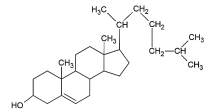
O colesterol, um lipídio encontrado nas membranas celulares das células animais, auxilia na fabricação da bílis e no metabolismo de vitaminas lipossolúveis (A, D, E e K). É também o principal precursor para a síntese de vitamina D e de vários hormônios esteroides. Observe a fórmula estrutural do colesterol:

Imagem associada para resolução da questão

Em relação ao colesterol, analise as afirmativas a seguir.

I. Pode se apresentar sob diferentes formas enantioméricas.
II. É capaz de formar ligações de hidrogênio com a água.
III. Descora uma solução de bromo em tetracloreto de carbono.
IV. Absorve apenas um mol de H2, quando submetido à reação de hidrogenação catalítica.

Está correto o que se afirma em
Alternativas
Q4381230 Não definido
O pentadeca-2,5-dieno é um hidrocarboneto insaturado que pode ser utilizado como material de partida para obtenção de produtos químicos mais complexos. Em relação à fórmula estrutural deste composto, assinale a afirmativa correta. 
Alternativas
Q4381229 Não definido
A equação química a seguir representa uma reação elementar:

A(g) + B(g) → AB (g)

Considere que ela ocorre em um sistema fechado sob temperatura controlada. Assim, é INCORRETO afirmar que:
Alternativas
Q4381228 Não definido
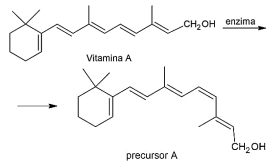
A vitamina A pode ser encontrada no tecido animal sob a forma de retinoides ou como pró-vitamina em tecidos vegetais, sob a forma de carotenoide. No fígado, a vitamina A sofre uma reação enzimática que a converte no precursor A, conforme representado na equação a seguir: 

Imagem associada para resolução da questão

Considerando as informações anteriores, marque V para as afirmativas verdadeiras e F para as falsas.

( ) A vitamina A e o precursor A são isômeros geométricos.
( ) A presença do grupo hidroxila na vitamina A possibilita que ela estabeleça ligação de hidrogênio com moléculas de água; e, por isso, é classificada como vitamina hidrossolúvel.
( ) O precursor A apresenta átomos de carbono com hibridização do tipo sp3 ou sp2 .

A sequência está correta em
Alternativas
Q4381227 Não definido
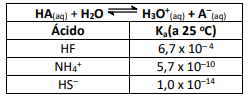
A Teoria de Brönsted-Lowry pode ser utilizada para explicar o comportamento dos ácidos e das bases. A equação genérica do processo de ionização de três ácidos fracos (HA) em solução aquosa e seus valores das constantes de ionização (Ka) está representada a seguir:

Imagem associada para resolução da questão

Diante do exposto, analise as afirmativas a seguir.

I. F - ; NH3; e, S2– são, respectivamente, as bases conjugadas de Brönsted-Lowry dos ácidos HF; NH4 + ; e, HS– .
II. O ácido fluorídrico tem uma maior tendência em reagir com o íon hidrogenossulfeto do que com o íon amônio.
III. A água é uma espécie anfiprótica e atua como uma base na equação de equilíbrio.
IV. Entre as bases conjugadas de Brönsted-Lowry, o íon sulfeto que apresenta a maior afinidade por próton.

Está correto o que se afirma em

Alternativas
Q4381226 Não definido
Duas amostras (5g) de ferro metálico (uma delas em raspa e a outra em pó) foram adicionadas, respectivamente, nos recipientes A e B. Em cada um dos recipientes foi adicionado 50 mL de solução de ácido clorídrico (5 mol L–1 ). Os recipientes foram fechados; o volume de gás hidrogênio liberado durante a reação entre o ferro e o ácido clorídrico foi monitorado em ambos. Assinale a alternativa, cujo gráfico representa o volume (v) de gás hidrogênio produzido em função do tempo (t) de reação.
Alternativas
Q4381225 Não definido

A representação ilustra uma aparelhagem que pode ser utilizada para testar a força dos ácidos, observe.
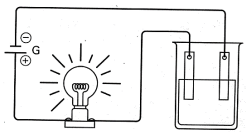


Imagem associada para resolução da questão


Considere que foram realizados quatro experimentos (a 25° C) para avaliar a força dos ácidos: fluorídrico; acético; fosfórico; e, cianídrico, que apresentam, respectivamente, 8; 1; 27; e, 0,008% de ionização. Sabe-se que em cada um dos experimentos a solução aquosa do ácido (0,1 mol L–1 ) foi adicionada no béquer (aparelhagem) e a intensidade da luz foi observada. Assinale a alternativa na qual a solução aquosa do ácido possibilitaria o maior brilho para a lâmpada.

Alternativas
Q4381224 Não definido

Levando em consideração a equação química, analise as afirmativas a seguir.
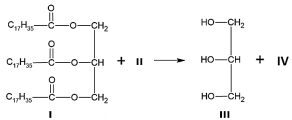


Imagem associada para resolução da questão


I. A reação do composto I com etanol em meio ácido é utilizada para se obter compostos sulfônicos.


II. Aquecendo-se o composto I com hidróxido de sódio, em condições apropriadas, o produto IV apresentará uma parte hidrofílica e outra hidrofóbica.


III. O composto I é um anidrido – constituinte químico presente em óleos essenciais.


IV. A reação pode ser utilizada para a obtenção de biodiesel, caso o composto II seja o álcool metílico.


Está correto o que se afirma apenas em
Alternativas
Q4381223 Não definido
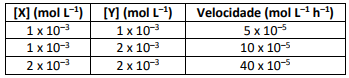
Considere que o estudo cinético da reação entre X(g) e Y(g) foi realizado em um sistema fechado, mantendo-se constante os valores de volume e temperatura. Os resultados obtidos no experimento estão representados na tabela a seguir:

Imagem associada para resolução da questão

A partir dos resultados obtidos, assinale, a seguir, a Lei da Velocidade (v) para a reação X(g) + Y(g) → XY(g). 
Alternativas
Q4381222 Não definido

Considere os grupos substituintes derivados de hidrocarbonetos:
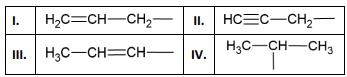


Imagem associada para resolução da questão


Assinale, a seguir, o número que representa o grupo univalente alil(a).

Alternativas
Q4381221 Não definido
Considere as substâncias químicas e suas respectivas ocorrências no cotidiano:

I. Ácido acético: principal componente do vinagre.
II. Salicilato de metila (éster metílico do ácido salicílico): ações analgésica e anti-inflamatória.
III. Glicerina: propriedades emolientes, lubrificantes e umectantes.
IV. Álcool etílico: prevenção do contágio com o Coronavírus, combustível em automóveis e limpeza doméstica.

Assinale a associação correta das substâncias químicas e as suas fórmulas estruturais.
Alternativas
Q4381220 Não definido
Um laboratorista misturou, em um béquer, óxido de cálcio e água. A mistura foi filtrada e recolhida em um Erlenmeyer. Com o auxílio de uma pipeta, ele soprou por algum tempo no interior do líquido (filtrado) e observou a formação de um sólido branco. Sobre tal experimento, analise as afirmativas a seguir.

I. O óxido de cálcio é um anidrido e apresenta caráter ácido.
II. A equação química balanceada que explica a formação do sólido branco é: 2CO2 + Ca(OH)2 → CaCO3 + H2O.
III. O sólido branco formado é o carbonato de cálcio.
IV. O sopro do laboratorista introduziu dióxido de carbono no sistema que se dissolve na água, segundo a equação química balanceada: CO2 + H2O → H2CO3.

Está correto o que se afirma apenas em 
Alternativas
Q4381219 Não definido
Em função da isomeria geométrica, os ácidos maleico e fumárico apresentam propriedades químicas distintas. Enquanto a molécula do ácido maleico sofre reação de desidratação e produz o anidrido maleico, a molécula do ácido fumárico não é capaz de realizar desidratação intramolecular nas mesmas condições. Sendo assim, o reconhecimento de isomeria geométrica em compostos orgânicos é de grande relevância na área de síntese orgânica para o desenvolvimento de novos produtos. Assinale, a seguir, o composto que NÃO apresenta isomeria geométrica:
Alternativas
Q4381218 Não definido
Em determinados sistemas, o aumento da temperatura promove o aumento na velocidade das reações químicas pela alteração de alguns fatores. São considerados fatores que podem ser alterados pelo aumento da temperatura, EXCETO:
Alternativas
Q4381217 Não definido
Observe as equações químicas a seguir:

I. CaO + H2O → Ca(OH)2
II. SO2 + H2O → H2SO3
III. Rb2O + 2HCl → 2RbCl + H2O
IV. CO2 + 2NaOH → Na2CO3 + H2O

Assinale a afirmativa INCORRETA.
Alternativas
Q4381216 Não definido

Considere a equação química a seguir:


a Pb(NO3)2(aq) + b KI(aq) → c PbI2(s) + d KNO3(aq)


É correto afirmar que: 

Alternativas
Respostas
3581: A
3582: C
3583: B
3584: C
3585: A
3586: B
3587: A
3588: B
3589: A
3590: B
3591: C
3592: C
3593: D
3594: A
3595: D
3596: C
3597: B
3598: A
3599: A
3600: D